
Market Report · July 22, 2026

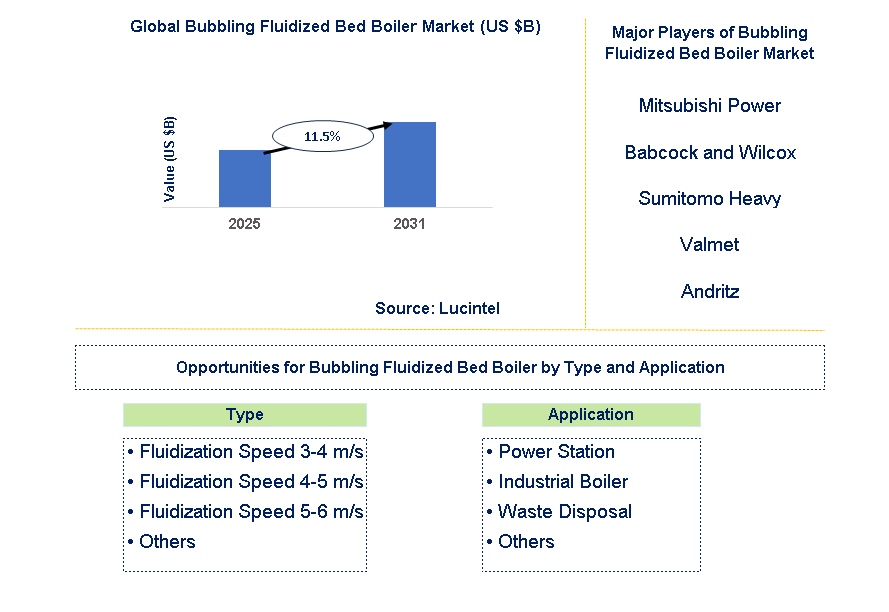
Key data points: The growth forecast = 11.5% annually for the next 7 years. Scroll below to get more insights. This market report covers Trends, opportunities and forecasts in bubbling fluidized bed boiler market to 2031 by type (fluidization speed 3-4 m/s, fluidization speed 4-5 m/s, fluidization speed 5-6 m/s, and others), application (power station, industrial boiler, waste disposal, and others), and region (North America, Europe, Asia Pacific, and the Rest of the World)
We'll send your sample report shortly.
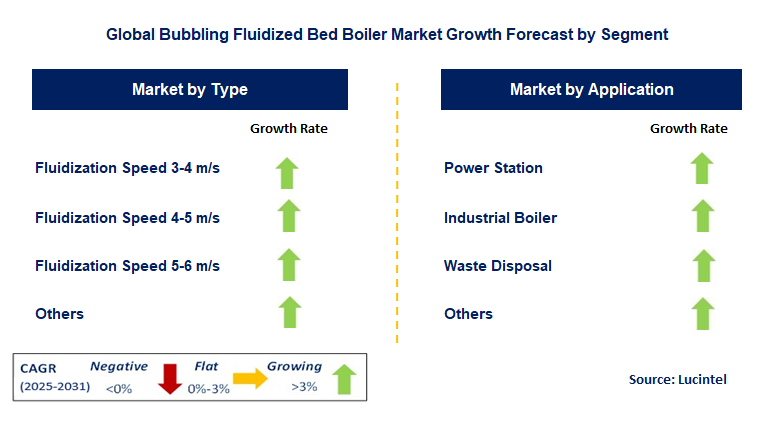
• Lucintel forecasts that, within the type category, fluidization speed 4-5 m/s is expected to witness the highest growth over the forecast period.
• Within the application category, power station is expected to witness the highest growth due to their ability to burn a variety of fuels.
• In terms of region, APAC is expected to witness the highest growth over the forecast period due to increasing the demand for electricity.
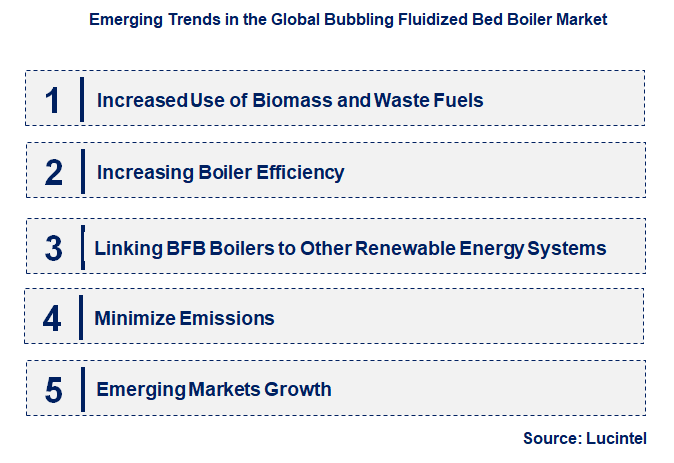
• Increased Use of Biomass and Waste Fuels: There is an increasing use of bubbling fluidized bed boilers in burning biomass and waste fuels. They are capable of combusting a wide variety of fuels, including fuels that are considered sub-standard, like biomass, municipal waste, and agricultural waste. This characteristic makes them very suitable for sustainable power plants. This is mainly driven by increased focus on waste-to-energy programs and renewable energy initiatives across different governments.
• Increasing Boiler Efficiency: With new technology bubbling fluidized bed boiler design and operation is undergoing continuous modification which improves efficiency and performance. The development of advanced economizers, control systems, automated combustion management, and increased heat transfer rates makes these boilers more reliable and affordable. It has become possible for industries to enhance fuel use efficiency, lower operational costs, and increase energy production with reduced emission levels due to these technological improvements.
• Linking BFB Boilers to Other Renewable Energy Systems: Currently, there is a huge integration trend of BFB Boilers with other renewable energy systems as part of the global move toward renewable energy. BFB Boilers are being incorporated into hybrid energy plants together with solar, wind, and hydro power systems to provide dependable energy supply. This enables industries to utilize multiple energy sources, enhance sustainability, and minimize carbon emissions.
• Minimize Emissions: Recently, emissions reduction has become a priority for governments and industries, and this is where BFB Boilers come in. BFB Boilers are ideal candidates for meeting these more stringent industrial standards because they can economically operate at low NOx emissions and also mitigate the discharge of particulates. As a result, there is a growing need for cost effective, cleaner, and more efficient BFB Boiler systems.
• Emerging Markets Growth: The growth of the bubbling fluidized bed boilers market is being buoyed by new markets in Asia and Africa. These regions have an increasing energy demand as new industries are developing and cities are expanding. These regions also need low-emission and energy-efficient technologies. The adoption of BFB Boilers, which can use a wide variety of fuels, along with the need for clean energy in these regions presents effective opportunities for market growth. The market for bubbling fluidized bed boilers is being supported by renewable fuels, emerging technologies, and emission reduction targets. These sustainability and efficiency focused strategies are expected to drive solution innovation and market growth. Clean and flexible alternative energy sources are now in higher demand, and will continue to expand.
• Development of High-Efficiency BFB Boilers: These recent innovations to the design of BFB Boiler have led to the development of higher efficiency systems. The efficiency of these boilers has been greatly increased due to improved control of combustion, better heat transfer surfaces and improved flexibility in fuel use. The implementation of sophisticated control systems has enabled better fuel tracking and boiler performance optimization which results in reduction of fuel consumption and costs of operations.
• Improved Environmental Performance: BFB Boilers are now becoming more increasingly eco-friendly due to these advancements in emission reduction technologies. Other newer models are now designed with better filtration systems that lower emissions particulates and better NOx reducing techniques so that industries can comply with tough environmental requirements. These enhancements are most useful in areas where air quality standards are very high, which increases the adoption of BFB Boilers.
• Increased Adoption of Biomass and Waste-to-Energy Technologies: The increased interest in biomass along with waste to energy technologies is one drivers that is fueling the demand to bubbling fluidized bed boilers. The BFB Boilers are preferred for these applications because these boilers are able to burn different types of biomass and waste efficiently. This is particularly important when governments and industries work towards meeting renewable energy solutions and lowering landfill waste.
• Integrated Energy Technology Solutions: There is a noticeable shift towards the incorporation of BFB Boilers into hybrid energy systems that include the use of solar or wind energy along with conventional power generation. This systems approach facilitates the maintenance of reliable power supply and assists in growing the efficiency of energy consumption and production. The use of BFB Boilers in conjunction with renewable energy systems represents an important milestone for the decarbonization of the electricity-generating industry.
• Strategic Marketing Partnerships: Some companies in the BFB sector are forming strategic alliances with energy companies, state agencies, and academic and research institutions to scale up their market coverage. Such alliances enhance technological innovation, create new markets, and facilitate the diffusion of the BFB Boiler technology in developing economies. Efforts have also been made in the cooperation to enhance the efficiency and effectiveness of BFB Boilers. These changes are propelling innovation and growth in the bubbling fluidized bed boilers market. Improvements in BFB Boilers’ efficiency, emissions, and fuel flexibility makes the technology more appealing to industries searching for economically and environmentally friendly energy solutions. Such changes, which are inevitable in the wake of the growth in clean energy consumption around the world, will guarantee the development of the market and new opportunities for growth.
• Power Generation: Among other segments, the generation of power has remained an important prospect for the adoption of BFB Boilers. The growing concern for clean and efficient power generation is making BFB Boilers the go-to boiler because they can accommodate a wide range of fuels and have lower emission rates. The use of renewable fuels, especially biomass, gives this sector a lot of potential growth opportunities.
• Waste-to-Energy Plants: As public focus shifts towards reducing landfill waste and recovering energy from municipal solid waste, waste-to energy plants are incorporating BFB Boilers at an increasing rate. The introduction of BFB Boilers helps with the efficient burning of waste products, further increasing the adoption of BFB Boilers in this segment. Marketers highly recommend these applications in regions with a focus on renewable energy and waste management.
• Industrial Heating: In industrial heating, BFB Boilers are finding crucial uses, especially as industries look for ways to heat and energize their diverse manufacturing activities. Industries globally are looking for dependable boiler system solutions like the BFB Boilers to help lower carbon emissions while optimizing energy usage. This area has a lot of promise for growth as industries shift to more sustainable models.
• Biomass Power Plants: bubbling fluidized bed boilers have other applications under development, one is biomass power plants. There is an increasing growth in the biomass energy sector due to the focus of governments and industries to increase the percentage of renewable energy. DFB Boilers are capable of combusting biomass and with their capacity to process a wide range of biomass fuels, they can serve this market effectively.
• District Heating Systems: The use of district heating systems is becoming more common, especially in big cities. These systems use BFB Boilers to heat several buildings or districts at the same time. With the expansion of cities and the rising need for sustainable heating solutions, there is significant room for BFB Boiler market development through district heating applications. Strategic growth opportunities in various applications are influencing the bubbling fluidized bed boilers market’s growth. The BFB Boilers efficiency and flexibility allow for the increasing demand of energy solutions to be met from different industrial locations. Sustainability and energy efficiency becoming more emphasized indicates continued growth for the BFB Boilers market.
• Mitsubishi Power
• Babcock and Wilcox
• Sumitomo Heavy Industries
• Valmet
• Andritz
• Steam And Control Systems
• Industrial Boilers America
• Thermodyne Engineering Systems
• Alstom
• Zhengzhou Boiler
• Fluidization Speed 3-4 m/s
• Fluidization Speed 4-5 m/s
• Fluidization Speed 5-6 m/s
• Others
• Power Station
• Industrial Boiler
• Waste Disposal
• Others
• North America
• Europe
• Asia Pacific
• The Rest of the World
• United States: The demand for efficient and clean energy solutions is driving the growth of bubbling fluidized bed boilers in the United States. Growing use of clean energy sources, coupled with the need for more powerful renewable energy, shifts within the energy industry, and the increased focus on green initiatives are forcing industries and utility companies to modernize technologies. In addition, the use of BFB Boilers in biomass power plants and waste to energy plants is becoming more common as these systems are flexible with the fuels they can accept. The reduction in BFB Boiler maintenance costs due to the improvement in automation and control system performance is also contributing to the growth of this market.
• China: China is progressing with the development of the bubbling fluidized bed boilers market as a part of its sustainable energy goals. With the government’s emphasis on reducing carbon emissions for better air quality, BFB Boilers are being accepted widely in the industrial and power generation sectors. The investment of the Chinese government on cleaner technologies and renewable energy is further boosting the adoption of BFB Boilers in large scale coal-fired power plants. Moreover, the increasing need of the country for district heating is resulting in the BFB Boiler systems needing to be more advanced at energy efficiency.
• Germany: Germany, as a front runner in energy transition, is trying to achieve a drastic reduction in carbon emissions through the use of cleaner solutions, and this is encouraging development of the bubbling fluidized bed boilers market. As the German government’s commitment to renewable, especially biomass, and their move towards sustainable energy usually increases the demand of BFB Boilers. These boilers serve numerous purposes such as industrial processes, district heating, and combined heat and power (CHP) systems. The German industries are likely to witness further technological improvements in the design and operation of BFB Boilers which will increase their efficiency.
• India: The market for bubbling fluidized bed boilers in India is witnessing growth owing to efficient power generation solutions. The expanding industrial base of the country, especially in cement, steel, and paper, is creating demand for dependable energy systems. BFB Boilers are in demand from industries that are striving to lower their carbon emissions due to the government’s focus on clean energy and lowering emission levels. In a resource-abundant country like India, BFB Boilers can use many kinds of fuels including low-grade fuels and waste products, which makes them very advantageous.
• Japan: With growing energy security concerns and the need to cut down on imported fossil fuels, Japan is utilizing bubbling fluidized bed boilers. The market continues to grow as Japan attempts to increase the proportion of renewable energy in the country, especially in the aftermath of the Fukushima disaster. The environmental goals of the country also support the increasing usage of BFB Boilers in waste-to-energy plants and biomass power generation. Furthermore, Japan is able to work towards clean energy objectives as developments in BFB Boiler technology, including higher efficiencies and lower emissions, are achieved.


• Mitsubishi Power
• Babcock and Wilcox
• Sumitomo Heavy Industries
• Valmet
• Andritz
• Steam And Control Systems
• Industrial Boilers America
• Thermodyne Engineering Systems
• Alstom
• Zhengzhou Boiler Q5. Which bubbling fluidized bed boiler market segment will be the largest in future? Answer: Lucintel forecasts that, within the type category, fluidization speed 4-5 m/s is expected to witness the highest growth over the forecast period. Q6. In bubbling fluidized bed boiler market, which region is expected to be the largest in next 5 years? Answer: In terms of region, APAC is expected to witness the highest growth over the forecast period due to increasing the demand for electricity. Q7. Do we receive customization in this report? Answer: Yes, Lucintel provides 10% customization without any additional cost.


Choose a license that fits your team. Instant PDF delivery.
Prices exclude taxes. Instant delivery. Custom licensing available on request.
Market Report · July 22, 2026
Market Report · July 22, 2026
Market Report · July 17, 2026
Trusted partner for strategic intelligence and business growth


Receive a complimentary market analysis tailored to your industry. Our analysts will identify key growth opportunities and competitive dynamics specific to your business.

Market size, growth rate, and key trend analysis for your specific sector.

Top competitor positioning and market share analysis.

Strategic recommendations backed by data-driven insights.
Get curated market intelligence and competitive moves straight to your inbox.
By subscribing, you agree to receive our monthly insights. Unsubscribe anytime.
Receive a complimentary market analysis tailored to your industry. Our analysts will identify key growth opportunities and competitive dynamics specific to your business.
Market size, growth rate, and key trend analysis for your specific sector.
Top competitor positioning and market share analysis.
Strategic recommendations backed by data-driven insights.
Get curated market intelligence, emerging trends, and competitive moves straight to your inbox each month.
By subscribing, you agree to receive our monthly insights. Unsubscribe anytime.
We'll send your sample report shortly.