
Market Report · July 29, 2026

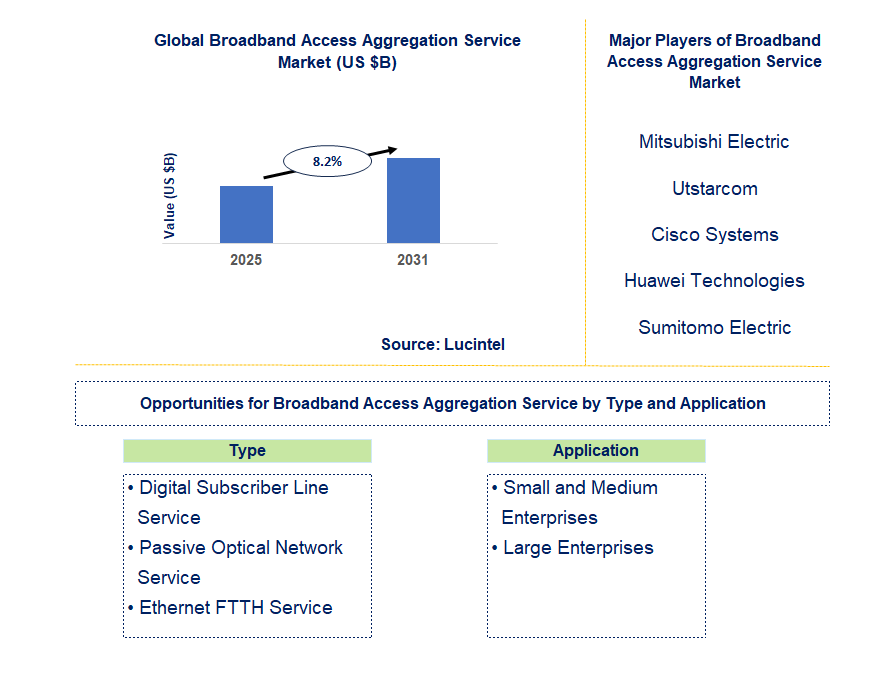
Key data points: The growth forecast = 8.2% annually for the next 7 years. Scroll below to get more insights. This market report covers Trends, opportunity and forecast in broadband access aggregation service market to 2031 by type (digital subscriber line service, passive optical network service, and ethernet ftth service), application (small and medium enterprises and large enterprises), and region (North America, Europe, Asia Pacific, and the Rest of the World)
We'll send your sample report shortly.
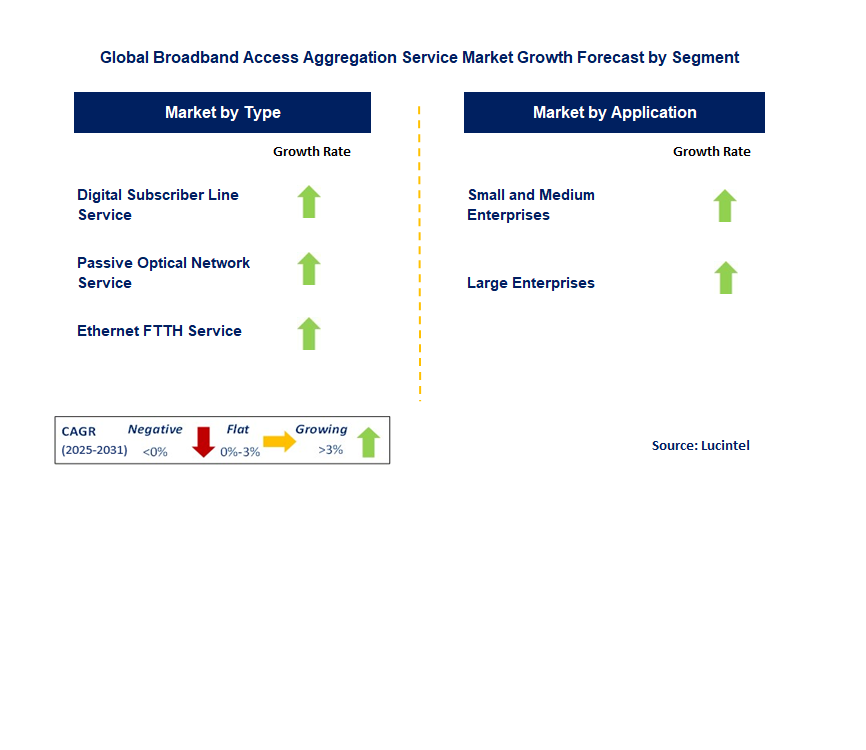
• Lucintel forecasts that, within the type category, , within the type category, ethernet ftth service is expected to witness the highest growth over the forecast period due to the increasing demand for high-speed internet & scalability.
• Within the application category, Within the application category, large enterprise is expected to witness the higher growth due to greater demand for scalable, high-capacity broadband services.
• In terms of region, In terms of region, APAC is expected to witness the highest growth over the forecast period. Gain valuable insights for your business decisions with our comprehensive 150+ page report. Sample figures with some insights are shown below.
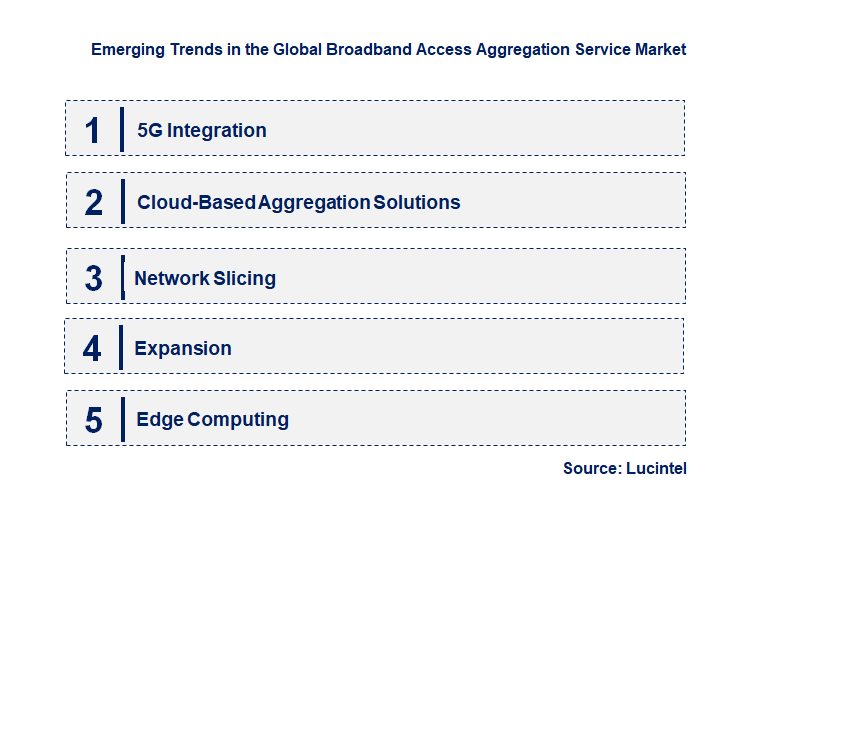
• 5G Integration: The coming of 5G technology was one of the major growth factors for the broadband access aggregation service market. Considering that 5G networks have higher speeds, lower latency, and higher capacity for supporting more connected devices, the need for broadband access aggregation is paramount in achieving network efficiency and high-quality service. This trend is revolutionizing the approach internet service providers take towards data traffic management and bandwidth optimization, resulting in improved reliability and speed of services.
• Cloud-Based Aggregation Solutions: Broadband access aggregation services are now being offered differently because of the shift to cloud-based infrastructure. Service providers are slowly adopting the use of cloud-based systems to aggregate traffic, data, and deliver services more efficiently. Scalability, flexibility, and cost-effectiveness are the primary benefits of cloud aggregation systems that drive broadband suppliers to stay competitive while implementing high-demand services such as video streaming, cloud computing, and more.
• Network Slicing: Network slicing, a technology introduced with 5G, is already being used in the broadband access aggregation service market. This technology enables telecom operators to divide one network into several virtual networks (slices) and provide services that are specific to particular use cases. The technology enhances the service optimization processes, and applications such as healthcare or autonomous vehicles, which require priority connectivity, can work concurrently with the public without any issues.
• Expansion: The establishment of fiber optic networks is no doubt one of the prime elements used for building up broadband access aggregation services. Thanks to the special characteristics such as greater bandwidth, dependability etc., fiber was the efficient measure in tackling such a massive quantity of traffic unlike copper wire approaches. Increased investments into fiber-to-the-home (FTTH) and fiber-to-the-premises (FTTP) technologies will get the broadband supply ready for high-performance as well as reliable connections both in the urban and rural geographies.
• Edge Computing: Bringing the processing and storage closer to the end users has been formalized into an all-encompassing service offering called Edge computing, which, however, is gradually finding its way into the broadband access aggregation market also. It reduces latency, increases the effectiveness of service provisioning, and enhances the quality of user experience by delivering computing resources to the network edge. With the help of edge computing, especially IoT, video streaming, and gaming can take advantage of low-latency delivery at the edge because they all demand real-time data processing and delivery. The more interconnected the devices, the greater the need for optimization of edge computing in broadband aggregation services. In addition, competition in the broadband access aggregation services market is increased by these trends. As the service providers are increasingly using features like 5G, cloud technology, and fiber optics, the market gets dynamic and competitive, with enhanced service delivery, effectiveness, and scalability.
• Architectural Changes in 5G Networks: It is clear that broadband access aggregation services have improved due to the ongoing deployment of 5G networks. 5G technologies have lower latencies, greater capacity, and faster traffic speeds, all of which are crucial for efficient broadband traffic aggregation. Effective adaptation of 5G in existing networks enables service providers to deal with more data traffic and provide better services to customers in urban centers with a higher demand for connectivity.
• Government Measures Regarding Broadband Installation: The underdeveloped areas are also supported by the governments across the world that increase connectivity penetration. The United States broadband investment plan and the Bharat Net in India promoted demand for aggregation services as well by supporting infrastructural provision as well as their improvement in areas with less deployment. This drives the penetration rate of broadband more accessible and fosters competition with providers who subsequently provide better service.
• Cloud Solutions Engagement: Service providers are using cloud technology to promote the use of cloud-based traffic aggregation, encouraging broadband providers to create more accessible alternatives. Aggregate metrics usage requires the development of an MMP that will offer cost-effective options, scalability, and flexibility, hence favoring providers in the long run. The improvement of emerging services is quite evident as the cost-effective infrastructure is used for the betterment of broadband networks.
• Edge Data Centers and Service Optimization: Edge computing has facilitated an improvement in broadband offerings by reducing latency thus lowering the end-users' cost, and it goes along with better performance and accessibility. It makes it easier to aggregate broadband traffic efficiently, especially in areas of high demand which include smart cities, IoT networks, as well as real-time applications. It's more successful in the redistribution market in which there is high transfer speed and improved customer satisfaction.
• Expansion of Fiber Optics: Investment in fiber optic networks is on the rise, with countries such as Germany, the United States, and China aiming to meet consumer needs and business opportunities for broadband expansion. Fiber optics, being the backbone of large-scale video streaming and gaming, deliver higher bandwidth necessary for fast broadband, enabling the above-mentioned countries and companies to bridge the gap between their services and 5G capabilities while reducing the strain faced by traditional networks. Advancements in 5G, edge computing, and fiber optics are forcing changes that will make broadband networks more competitive, efficient, and functional in the aggregation service market. As such, the future of network aggregation is promising with an increase in the provision of stable and fast internet services.
• Advancement of 5G Technology and Network Augmentation: Market need exists in this case, by broadband providers who look to exploit higher adaptation rates in 5G networks. This is due to the fact that high IoT connectivity can be enabled using optimized 5G networks and large-scale demand. Network users going forward will thus be subjected to several aggregation choices.
• Fiber-Optic Networks Deployment: The deployment of fiber-optic equipment across the globe, especially in remote areas, is an excellent opportunity for further proliferation of broadband services. The bandwidth and reliability of fiber-optic networks make them suitable for data traffic aggregation. Providers offering these services can expand their portfolio by using fiber-optic aggregation solutions in a rapidly expanding market for reliable and fast broadband connectivity.
• Cloud-Based Aggregation Solutions: With the steady increase in service providers using cloud technology, there is scope to provide broadband access aggregation tools that are location-independent. These solutions are more scalable, flexible, and economically efficient, making them an attractive option for network service providers who are keen on optimizing network performance. In addition to cloud technology, companies can create innovative, competitive services through the cloud-based deployment of aggregation solutions.
• Integration with Edge Computing: The IoT era, characterized by smart devices and data-driven applications, leads to greater demand for edge computing. Edge computing processes data near the edge of the network, minimizing round-trip delays and data transfer times. Broadband providers who augment their edge computing capabilities with aggregation services can offer improved user experiences and enhanced services.
• Smart Cities Initiative: There is a vast opportunity for broadband access aggregation providers in the transition to smart cities. These initiatives require high-speed internet integration. The broadband services will be necessary to aggregate data from various sensors, devices, and networks. The providers who integrate services that support such market strategies will be well placed to serve their customers in those cities. The such underserved opportunities in the market for broadband access aggregation services are great sources of new ideas and growth. Market share will go to broadband providers that can fulfill the global demand surge for high-speed internet, 5G providers, fiber-optic delivery companies, and edge computing service providers.
• Mitsubishi Electric
• Utstarcom
• Cisco Systems
• Huawei Technologies
• Sumitomo Electric Networks
• Ericsson
• Freescale Semiconductor
• Marlin Equity Partners
• Calix Network
• Bandwave Systems
• Digital Subscriber Line Service
• Passive Optical Network Service
• Ethernet Ftth Service
• Small and Medium Enterprises
• Large Enterprises
• North America
• Europe
• Asia Pacific
• The Rest of the World
• United States: The United States is in the frontline in this industry since it has taken a leading role in the BAAS industry 5G infrastructure construction and in the cloud technologies with the immense investment made by major players like AT&T and Verizon, hence having fast access to highly reliable solutions. Many infrastructural programs are also promoted by the US government, including the Broadband Infrastructure Investment Plan, that encourages private investments and provides much more than boosting the ones already in place. This alone solves the high-speed broadband gap. The integration of edge computing and network slicing has enabled service providers to bundle broadband traffic effectively for optimum performance for consumers and businesses.
• China: The sector is boosted in the country by the acceleration in the deployment of 5G networks. The leading contributions, however, are also coming from state-owned firms such as China Telecom and China Mobile, also constructing wireless 5G infrastructure in the country. The lack of market regulations has had a negative influence, but it has been compensated by the high level of government support for information and communication technologies, as well as the development and enforcement of several broadband policy measures. The active policies of the Chinese government in encouraging the digital transformation of various industries have also increased the need for high-density aggregation services that can be used in content delivery, IoT solutions, and cloud computing.
• Germany: The creation and development of telecommunication aggregation services in Germany have been stimulated by government measures to increase the availability of broadband internet in underdeveloped areas. Along with other regional operators, Deutsche Telekom is also contributing to the development of the infrastructure through the modernization of existing networks and FTTH deployment. Among the most important applications in Germany's category potential is the use of software or SDN in 5G networks. It's also bringing change in German's market conditions with the approach for energy-saving, ecofriendly broadband solutions through offering broadband plans in a very cheap manner such that providers keep minimizing the needs for power requirements used in maintaining and running of networks and then boost its reliance.
• India: In India internet is increasingly adapting among the Indian public, it also brings rapid advancement in India 4G and 5G networks. The demand for broadband is rising exponentially, mainly due to the growing number of people working remotely, attending online classes, and availing digital services. Reliance Jio and Bharti Airtel are looking to upgrade their broadband aggregation infrastructure to offer higher speed connectivity in the future with a larger number of connected devices. In addition, government initiatives such as Bharat Net are targeting rural areas for the development of broadband aggregation services at a low cost.
• Japan: The broadband access aggregation market in Japan is characterized by the focus on fiber optic high-speed internet and 5G connectivity. Market leaders NTT and Soft Bank are focusing on the establishment of 5G network infrastructure to provide faster and better internet services. The trend towards innovation in Japan, especially in IoT, smart cities, and self-driving cars, increases the demand for effective aggregation services. In addition, the policies that encourage investment in building infrastructure for digital networks and next-generation networks are expected to further enhance the growth of the market.


• Mitsubishi Electric
• Utstarcom
• Cisco Systems
• Huawei Technologies
• Sumitomo Electric Networks
• Ericsson
• Freescale Semiconductor
• Marlin Equity Partners
• Calix Network
• Bandwave Systems Q5. Which broadband access aggregation service market segment will be the largest in future? Answer: Lucintel forecasts that, within the type category, ethernet ftth service is expected to witness the highest growth over the forecast period due to the increasing demand for high-speed internet & scalability. Q6. In broadband access aggregation service market, which region is expected to be the largest in next 5 years? Answer: In terms of region, APAC is expected to witness the highest growth over the forecast period. Q7. Do we receive customization in this report? Answer: Yes, Lucintel provides 10% customization without any additional cost.


Choose a license that fits your team. Instant PDF delivery.
Prices exclude taxes. Instant delivery. Custom licensing available on request.
Market Report · July 29, 2026
Market Report · July 20, 2026
Market Report · July 20, 2026
Trusted partner for strategic intelligence and business growth


Receive a complimentary market analysis tailored to your industry. Our analysts will identify key growth opportunities and competitive dynamics specific to your business.

Market size, growth rate, and key trend analysis for your specific sector.

Top competitor positioning and market share analysis.

Strategic recommendations backed by data-driven insights.
Get curated market intelligence and competitive moves straight to your inbox.
By subscribing, you agree to receive our monthly insights. Unsubscribe anytime.
Receive a complimentary market analysis tailored to your industry. Our analysts will identify key growth opportunities and competitive dynamics specific to your business.
Market size, growth rate, and key trend analysis for your specific sector.
Top competitor positioning and market share analysis.
Strategic recommendations backed by data-driven insights.
Get curated market intelligence, emerging trends, and competitive moves straight to your inbox each month.
By subscribing, you agree to receive our monthly insights. Unsubscribe anytime.
We'll send your sample report shortly.