
Market Report · July 29, 2026

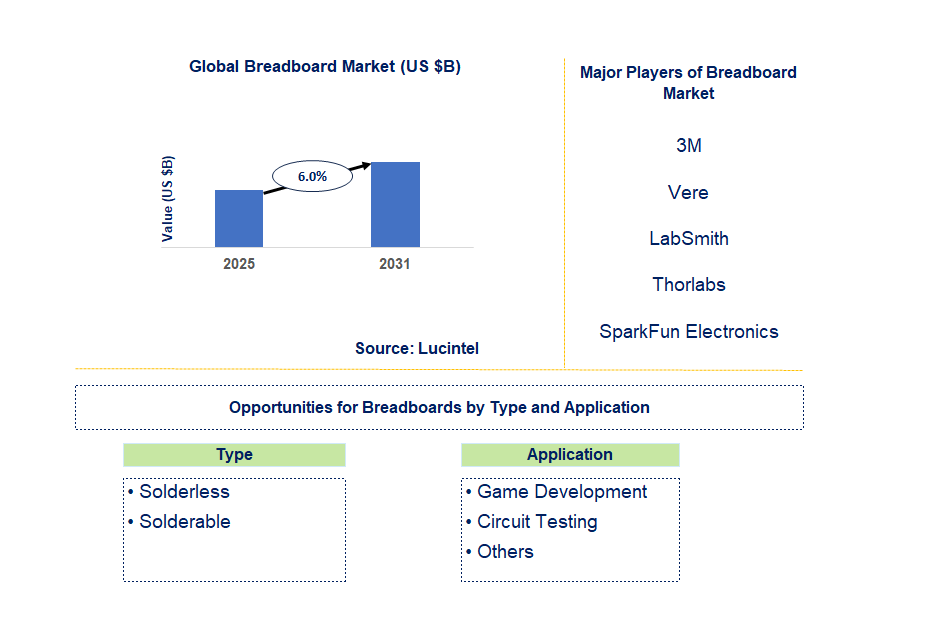
Key data points: The growth forecast = 6.0% annually for the next 7 years. Scroll below to get more insights. This market report covers trends, opportunities and forecasts in breadboard market to 2031 by type (solderless and solderable), application (game development, circuit testing, and others), and region (North America, Europe, Asia Pacific, and the Rest of the World)
We'll send your sample report shortly.
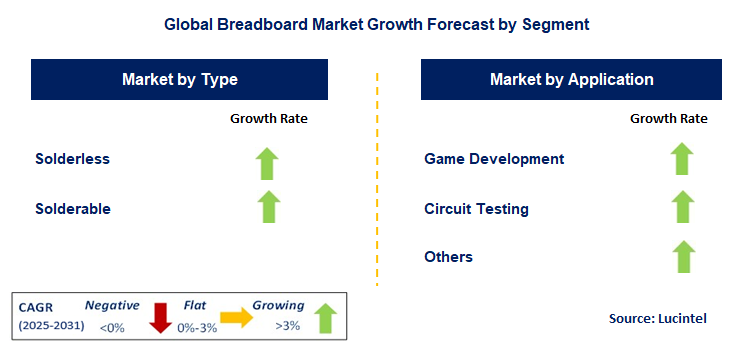
• Lucintel forecasts that, within the type category, solderable is expected to witness higher growth over the forecast period.
• Within the application category, circuit testing is expected to witness higher growth.
• In terms of region, APAC is expected to witness the highest growth over the forecast period. Gain valuable insights for your business decisions with our comprehensive 150+ page report. Sample figures with some insights are shown below.
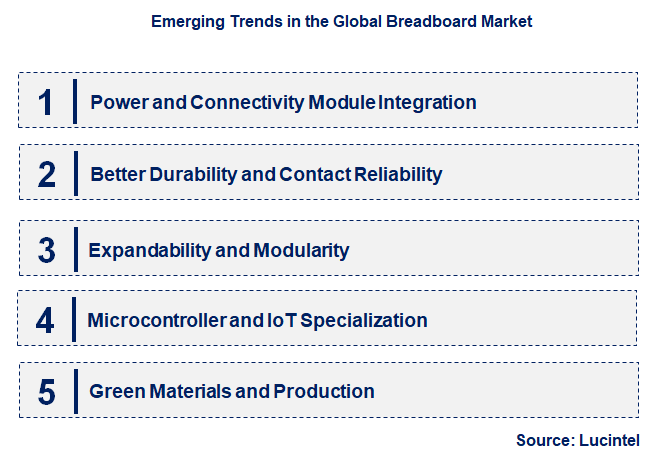
• Power and Connectivity Module Integration: More recent breadboards increasingly come with integrated power supply modules, having user-selectable voltage outputs, and in some cases even USB ports for direct powering or data transfer. This does away with the hassle of using separate power supplies and allows for easier circuit setup. The effect is a cleaner, more convenient prototyping experience, cutting down on mess and making breadboards more accessible to newcomers and those developing portable projects, while enhancing overall power supply.
• Better Durability and Contact Reliability: Companies are concentrating on the enhanced quality of internal metal contacts to provide more reliable and consistent connections, minimizing intermittent circuit faults. It involves employing superior-grade materials for the contact springs and the use of more durable plastic bodies to withstand multiple insertions and removals of components. The effect is a longer lifespan of the breadboards and higher assurance of circuit stability when tested, resulting in more productive and less aggravating prototyping sessions.
• Expandability and Modularity: There is a trend in the market towards modular breadboard design, where small breadboard units can be easily linked to form larger prototyping spaces when necessary. Some provide alternate modules for specialty applications such as integrated circuit, or IC, holders or power distribution. This gives higher flexibility and scalability to users so they can tailor their prototyping area to the intricacy of their circuits. The effect is a more flexible and versatile prototyping platform that expands with the user’s project requirements.
• Microcontroller and IoT Specialization: Breadboards are being manufactured specifically to integrate easily with such well-known microcontrollers as Arduino, Raspberry Pi, and ESP32, with many having dedicated pinout marking or mounting holes for these boards. This is in response to the exploding Internet of Things (or IoT) and embedded systems market. The effect is a more customized and effective prototyping environment for digital electronics, speeding up the creation of smart devices and networked applications.
• Green Materials and Production: As people become increasingly environmentally aware, there is a developing trend towards having more sustainable, recyclable, and environmentally friendly materials used in breadboard manufacture. Companies are also seeking greener production methods to minimize waste and energy use. The effect is a move towards more sustainable production and consumption in the hobby and learning of electronics. The trend is appealing to green consumers and supports international sustainability objectives. These new trends are dramatically transforming the breadboard industry by upgrading its fundamental features and making it compatible with contemporary electronics development. The addition of power and connectivity, added durability, and modularity increases the versatility and dependability of breadboards. Moreover, microcontroller specialization and environmental concern-based practices ensure their sustainability and relevance to a wider base of users. These developments are not only enhancing the user experience but are also solidifying the place of the breadboard as a necessity in electronics.
• Multiple Voltage Output Integrated Power Rails: One important innovation is the addition of integrated power rails on breadboards that provide multiple, usually selectable, voltage outputs, such as 3.3V and 5V. This does away with the use of external power modules or bulky wiring for simple power distribution. The result is a cleaner, more streamlined, and more efficient prototyping environment, especially useful in microcontrollers and mixed-voltage circuits, making the breadboard a more enclosed prototyping solution.
• Better Quality Contact Points and Enhanced Spring Retention: Companies are spending money on higher-quality materials and processes for internal metal clips or springs inside breadboard holes. This produces more uniform electrical contact and a greater hold on component lead and jumper wire insertions over and over again. The effect is that more reliable circuits constructed on breadboards, eliminating annoying intermittent connections and prolonging the life of the breadboard itself, making users’ lives better.
• Interconnectable and Larger Sizes: Increasing availability of larger breadboards and interconnectable designs that are easy to connect together to increase the prototyping space. This makes it possible to build more intricate circuits or combine several sub-circuits onto one, albeit longer, platform. The advantage is more flexibility for ambitious designs, allowing engineers and hobbyists to handle higher counts of components and more complex wiring schemes without the need to go to multiple separate, smaller boards.
• Packaging with Starter Kits and Development Boards: Most breadboards are nowadays packaged as part of complete starter kits, which may contain jumper wires, fundamental components, and well-known development boards such as Arduino or Raspberry Pi. The packaging makes it easier for beginners to enter the market and provides instant hands-on learning. The effect is greater accessibility and faster learning for new users, cementing the use of the breadboard as a learning tool and promoting a new generation of electronics designers.
• Transparent and Colored Breadboards: In addition to functionality, there has been progress in providing breadboards in transparent and other colored plastics. Although seemingly cosmetic, transparent breadboards facilitate clearer inspection of internal connections and the spotting of problems, particularly for use in educational environments. Colored breadboards can assist with grouping complex circuits by color-coding individual sections. The effect is clearer visibility, organization, and an enhanced learning experience, especially for visual learners. These new developments are collectively shaping the breadboard market by solidifying its role as a must-have tool for prototyping and learning electronics. By enhancing power management, connection reliability, scalability, and ease of use, these developments cater to essential user needs. The packaging with starter kits and the addition of visually distinctive options further democratize learning electronics to ensure that the breadboard continues to be a pertinent, useful, and highly effective platform for innovation and discovery in the discipline.
• STEM Education and Vocational Training: The emerging worldwide focus on STEM, or Science, Technology, Engineering, and Mathematics, education presents a vast growth potential for breadboards. They are perfect for classroom instruction of basic electronics concepts in schools, colleges, and vocational schools because of their hands-on, solderless design. Opportunities involve creating customized education kits that combine breadboards with curriculum-specific parts and online material, promoting hands-on learning experiences.
• IoT and Embedded Systems Prototyping: The accelerated growth of the Internet of Things and embedded systems design presents a solid growth opportunity. Breadboards are a priceless asset for rapidly prototyping sensor interfaces, microcontroller pins, and low-pin-count peripheral circuits prior to the commitment to custom PCB design. Growth opportunities are in creating breadboards designed specifically for widespread IoT platforms with pinouts tailored to their specifications, better signal integrity for high-speed communication, and built-in power solutions.
• Rapid Prototyping for Startups and SMEs: Technology startups and small and medium-sized enterprises, or SMEs, tend to have low budgets and short development times, and breadboards represent a cost-effective solution for preliminary proof-of-concept and iterative design. Breadboards enable the rapid modification of circuits without the cost and lead time of PCB manufacturing. Opportunities for expansion include providing bulk packages, bespoke prototyping kits, and customized breadboard configurations suited to startup requirements.
• Hobbyist and DIY Electronics Projects: The expanding hobbyist electronics community and DIY makers continue to be a fundamental growth driver. They continually look for easy and adaptable tools for their personal endeavors, from home control to audio circuits. Opportunities lie in serving this group with an assortment of breadboard sizes, hues, and accessory packs, coupled with extensive online tutorials and support forums, inspiring creativity and ongoing interaction.
• Legacy System Repair and Troubleshooting: In situations handling older electronic systems or where field repairs need to be performed in a hurry, breadboards are useful as a temporary troubleshooting platform to test individual components or sub-circuits without making permanent changes. This directly applies to industrial repair or restoration work in vintage electronics. Opportunities for expansion include promoting the use of breadboards in diagnostic settings, highlighting that breadboards can be reused and allow non-destructive testing. These strategic opportunities for growth are having a profound effect on the breadboard market by funneling innovation and marketing efforts into high-growth applications. With its position in STEM education, IoT prototyping, and DIY reinforced, and seeing its value in niche applications such as repair, the market is showing resilience and versatility. These opportunities guarantee that breadboards continue to be a fundamental, versatile, and affordable tool, sustaining ongoing demand and cultivating a new generation of electronics innovators in every industry.
• 3M
• Vere
• LabSmith
• Thorlabs
• SparkFun Electronics
• SAE Manufacturing Specialties
• Newport
• CHUO PRECISION INDUSTRIAL
• Qioptiq Photonics
• CopperSound Pedals
• Solderless
• Solderable
• Game Development
• Circuit Testing
• Others
• North America
• Europe
• Asia Pacific
• The Rest of the World
• United States: In the United States, the market for breadboards is fueled by a mature maker culture, widespread STEM education efforts, and strong demand from technology startups for quick prototyping. Recent developments comprise more reliable contact points, power rail integration with regulated voltage outputs, and extended format breadboards for more complex projects. Dedicated electronics suppliers and online retailers are also crucial, providing an assortment of breadboards in a range of kits suitable for newcomers, promoting accessibility and ongoing development.
• China: China dominates the production of breadboards, being typified by high-volume output and competitive pricing. Recent innovations involve higher automation in the manufacturing processes to provide uniform quality and quantity. Chinese manufacturers are also becoming innovative in design, providing a wide variety of sizes, colors, and specialty features, such as integrated power supply modules. The thrust is for catering to both domestic educational and industrial requirements, as well as the international market, with affordable solutions.
• Germany: The breadboard market in Germany focuses on accuracy, long-term durability, and the capability to withstand demanding school and industrial research applications. Improvements focus on enhancing the breadboard’s mechanical and electrical stability, usually with the use of better materials for extended lifetime and improved signal integrity. German suppliers stress rugged build for professional repeated use and exacting quality compliance. The market mainly targets engineering universities, vocational training schools, and industrial R&D sections that require reliability.
• India: The Indian breadboard industry is witnessing tremendous growth, driven by government programs encouraging STEM education, a fast-growing electronics sector, and a thriving do-it-yourself, or DIY, culture. Recent trends have seen the rise of indigenous makers supplying cost-effective yet high-quality breadboards. There is increasing demand for breadboards as part of schooling and college kits that are used to provide hands-on education. The industry is also witnessing an increase in online channels, enhancing accessibility throughout the nation.
• Japan: The Japanese breadboard market, while perhaps smaller in sheer volume compared to some other regions, focuses on quality, innovation, and compact designs. Recent developments often involve miniaturization for portable projects and integration with specialized development boards like Arduino and Raspberry Pi. Japanese manufacturers emphasize precision-engineered contact points for reliable connections and often offer breadboards as part of comprehensive electronics learning kits, catering to meticulous hobbyists and advanced electronics engineers.


• 3M
• Vere
• LabSmith
• Thorlabs
• SparkFun Electronics
• SAE Manufacturing Specialties
• Newport
• CHUO PRECISION INDUSTRIAL
• Qioptiq Photonics
• CopperSound Pedals Q5. Which breadboard market segment will be the largest in future? Answer: Lucintel forecasts that, within the type category, solderable is expected to witness higher growth over the forecast period. Q6. In breadboard market, which region is expected to be the largest in next 5 years? Answer: In terms of region, APAC is expected to witness the highest growth over the forecast period. Q7. Do we receive customization in this report? Answer: Yes, Lucintel provides 10% customization without any additional cost.


Choose a license that fits your team. Instant PDF delivery.
Prices exclude taxes. Instant delivery. Custom licensing available on request.
Market Report · July 29, 2026
Market Report · July 20, 2026
Market Report · July 20, 2026
Trusted partner for strategic intelligence and business growth


Receive a complimentary market analysis tailored to your industry. Our analysts will identify key growth opportunities and competitive dynamics specific to your business.

Market size, growth rate, and key trend analysis for your specific sector.

Top competitor positioning and market share analysis.

Strategic recommendations backed by data-driven insights.
Get curated market intelligence and competitive moves straight to your inbox.
By subscribing, you agree to receive our monthly insights. Unsubscribe anytime.
Receive a complimentary market analysis tailored to your industry. Our analysts will identify key growth opportunities and competitive dynamics specific to your business.
Market size, growth rate, and key trend analysis for your specific sector.
Top competitor positioning and market share analysis.
Strategic recommendations backed by data-driven insights.
Get curated market intelligence, emerging trends, and competitive moves straight to your inbox each month.
By subscribing, you agree to receive our monthly insights. Unsubscribe anytime.
We'll send your sample report shortly.