
Market Report · July 29, 2026

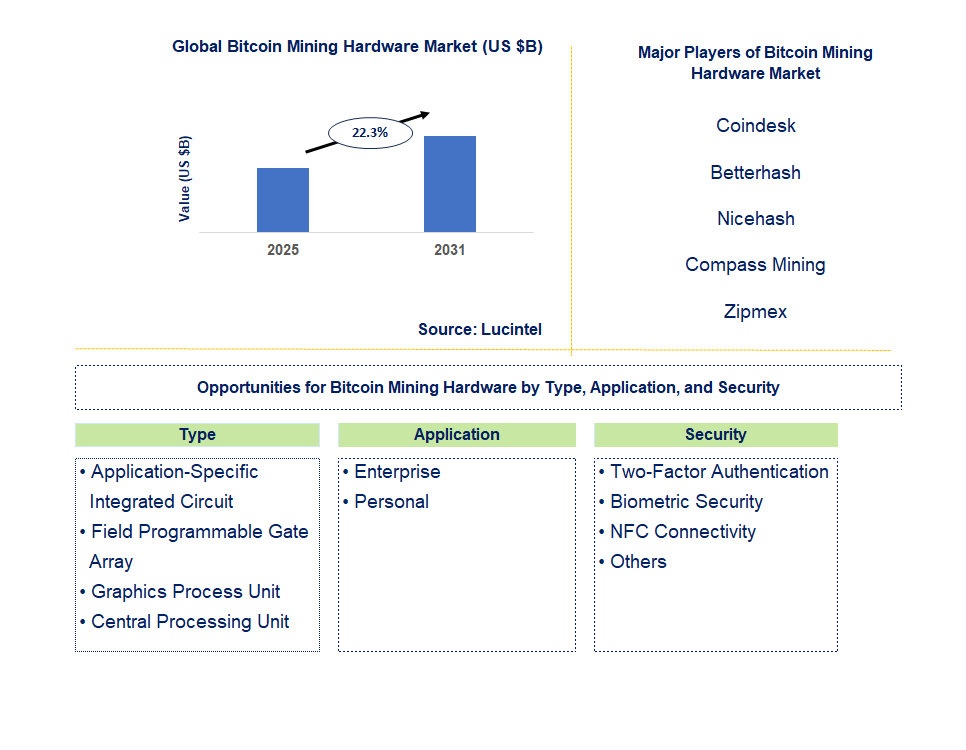
Key data points: The growth forecast = 22.3% annually for the next 7 years. Scroll below to get more insights. This market report covers Trends, opportunity and forecast in bitcoin mining hardware market to 2031 by type (application-specific integrated circuit, field programmable gate array, graphics process unit, and central processing unit), application (enterprise and personal), security (two-factor authentication, biometric security, NFC connectivity, and others), and region (North America, Europe, Asia Pacific, and the Rest of the World)
We'll send your sample report shortly.
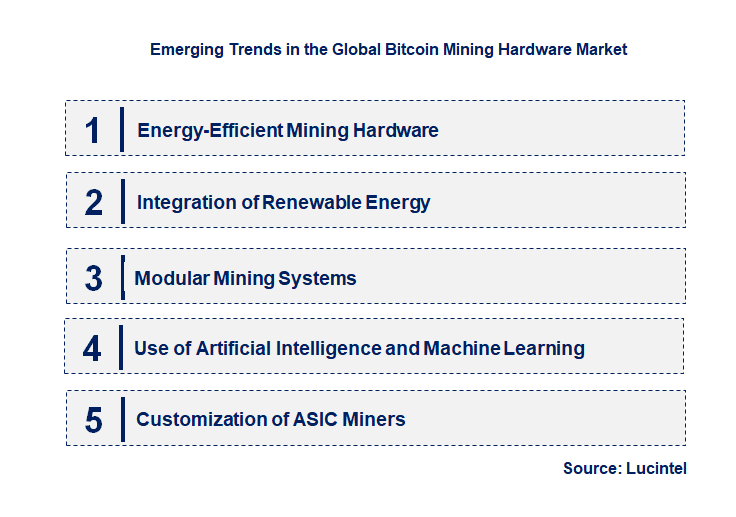
• Energy-Efficient Mining Hardware: Energy efficiency is a central focus in the bitcoin mining hardware market. As energy consumption remains a major concern for miners, newer models of ASIC miners are designed to maximize hashing power while minimizing energy use. This trend is largely driven by the need to reduce operational costs and adhere to global environmental standards. Innovations, including custom-built chips, cooling solutions, and improvements in power management, contribute to more sustainable mining practices. There is a rapidly increasing demand for energy-efficient mining rigs as miners aim to reduce costs and enhance profitability.
• Integration of Renewable Energy: The inclusion of renewable sources such as solar, wind, and hydropower in bitcoin mining operations is another important trend that has emerged recently. Miners are seeking ways to reduce the environmental impact of their operations by using renewable energy to power their rigs. This trend is not only due to regulatory pressure but also because of the need to lower electricity costs, especially in regions where energy costs are high. The future of the industry will likely be influenced by the transition to green mining practices in regions such as the U.S., China, and Germany.
• Modular Mining Systems: Modular mining systems are gaining popularity due to their scalability and flexibility in bitcoin mining. Modular mining systems allow miners to scale up or scale down their operations as market conditions and hardware requirements change. Furthermore, modular rigs facilitate easier portability and shorter setup times. This trend is particularly attractive for large-scale mining farms and data centers, where efficiency and ease of scale expansion are important. Modular systems enable miners to optimize hardware resources and adapt to changes in the environment and economy.
• Use of Artificial Intelligence and Machine Learning: Artificial intelligence and machine learning are becoming essential for optimizing bitcoin mining hardware by predicting hardware failure, improving miners’ performance, and optimizing power consumption in real-time. By using AI/ML-driven solutions, miners can make better and more informed choices about hardware placement, heat management, and maintenance schedules. As mining becomes increasingly competitive, AI and ML are helping miners stay ahead by providing data-driven strategies to maximize profitability.
• Customization of ASIC Miners: The customization of ASIC (Application-Specific Integrated Circuit) miners is growing as hardware developers offer customized solutions that cater to specific mining needs. Chips built specifically for the miner can ensure better efficiency, performance, and energy consumption compared to off-the-shelf solutions. This trend is pushing hardware to its limits as companies create specialized miners for different bitcoin block difficulties and operational conditions. Competition in the mining space is intensifying, and customization will be key for miners to maximize the potential of their hardware. These emerging trends are reshaping the bitcoin mining hardware market by focusing on efficiency, scalability, and sustainability. As energy consumption becomes a more critical issue, miners are increasingly adopting greener, more efficient technologies. Moreover, innovations in AI, modular systems, and customization are enabling miners to operate more effectively in an ever-competitive market. These trends are not only enhancing hardware performance but also contributing to the broader goal of making bitcoin mining more sustainable and profitable in the long term.
• ASIC Miner Improvements: ASIC miners have made tremendous improvements as companies develop new models with higher hash rates and lower power consumption. These newer models incorporate better technologies in chips, such as smaller process nodes, to improve performance and minimize energy consumption. ASIC miners are now more efficient than ever, and their increased computing power enables miners to compete effectively in the market. This development has significantly improved mining efficiency, allowing miners to mine more bitcoin at a lower and more sustainable cost. Energy-Efficient Hardware: Energy-efficient bitcoin mining hardware is a growing trend, as newer machines are optimized for maximum hash rates and very low power consumption, addressing one of the major pain points for miners to date: innovating on systems for power supply, custom chips, and enhanced cooling techniques. In addition to decreasing operational costs, energy-efficient hardware helps lower mining’s ecological footprint. Energy-efficient solutions provide miners with a competitive edge as they optimize consumption and other elements.
• Liquid Cooling Solutions: Mining rig heat outputs increase with computing power and density, creating the need for liquid cooling for miners. Liquid cooling dissipates heat much more efficiently than air cooling methods. This allows miners to operate their hardware at greater efficiency without overheating. It reduces the energy consumption for cooling and prevents overheating, which can shorten mining hardware lifespan. This technology is especially valuable in large-scale mining farms, as keeping temperatures within an optimal range is crucial for long-term profitability.
• Sustainability Focus: The emphasis on sustainability is driving mining hardware development. Companies are incorporating renewable energy sources into mining rigs, making it easier for miners to utilize solar, wind, or hydroelectric power. Companies are also designing machines to last longer with recyclable materials, reducing electronic waste. Sustainability has become a competitive differentiator for miners, as they strive to meet environmental goals while improving the bottom line and remaining compliant with regulations.
• Customization and Specialized Hardware: As the need to develop highly specialized ASIC miners for optimal functionality in specific mining tasks grows, the demand for customized and specialized hardware is increasing. Miners are seeking tailored solutions to better meet their needs, such as specific algorithms or unique environmental conditions. Customization allows miners to extract more value from their hardware investments, improving profitability in a competitive landscape. Specialized hardware is becoming a niche market segment with growing demand. The latest developments in bitcoin mining hardware are helping improve the efficiency, profitability, and sustainability of mining operations. As miners face pressure to reduce costs while meeting environmental regulations, the most important areas for advancement include ASIC miners, energy efficiency, cooling technologies, and sustainability initiatives. The growing trend of custom hardware enables miners to optimize operations, ensuring the market remains competitive and technologically advanced.
• Renewable Energy Integration: The integration of renewable energy sources into bitcoin mining represents the most relevant growth area. As the use of carbon footprints decreases, fluctuations in traditional energy prices have led miners to consider solar, wind, and hydroelectric power as sustainable ways to power their rigs. This opportunity is not only environmentally friendly but also economically rewarding in the long term, as renewable energy provides steady, low-cost power for mining operations. Miners adopting green energy solutions can optimize profits while meeting international environmental requirements.
• AI-Powered Optimization for Mining Bitcoin: AI and machine learning are increasingly being used to optimize bitcoin mining operations. AI applications include monitoring hardware performance, making maintenance predictions, and optimizing power consumption for efficiency, which helps reduce downtime. AI solutions also enable miners to scale operations for better profitability. The future of bitcoin mining hardware will rely heavily on the development and adoption of AI tools that help miners make data-driven decisions.
• Modular Mining Infrastructure: The shift toward modular mining systems presents a significant growth opportunity. Modular hardware systems allow miners to scale their operations efficiently, adapting to market conditions and hardware advancements without the need for complete overhauls. This flexibility makes it easier for both small and large-scale miners to optimize their hardware resources. The demand for modular systems is expected to rise as miners seek greater agility and cost efficiency in a fluctuating market.
• Improved Cooling Solutions: Advanced cooling solutions, such as liquid cooling and immersion cooling technologies, represent an important growth opportunity within the bitcoin mining hardware market. These systems provide more efficient heat management as mining rigs become more powerful and the need to manage heat increases. The development and adoption of efficient cooling systems will allow miners to run more powerful rigs with fewer cooling costs and a lower chance of overheating.
• Geothermal Mining: Geothermal mining offers bitcoin miners a remarkable opportunity to grow due to its abundance in many geothermal-rich areas. Geothermal energy is always available, allowing miners to operate their rigs with minimal environmental impact and reduced operational costs. With improved technology to harness geothermal energy, this could become a main growth area in the bitcoin mining hardware industry. These strategic growth opportunities are reshaping the bitcoin mining hardware market by focusing on sustainability, optimization, and scalability. As miners look for ways to stay competitive, leveraging renewable energy, AI, modular infrastructure, and advanced cooling technologies will provide critical advantages. By tapping into these opportunities, companies can enhance profitability, reduce environmental impact, and position themselves for long-term success in a rapidly evolving market.
• Coindesk
• Betterhash
• Nicehash
• Compass Mining
• Zipmex
• Stormgain
• Biostar Group
• Bitcoin Merch
• Bitmain Technologies Holding Company
• Application-Specific Integrated Circuit
• Field Programmable Gate Array
• Graphics Process Unit
• Central Processing Unit
• Enterprise
• Personal
• North America
• Europe
• Asia Pacific
• The Rest of the World
• United States: In the United States, the growing demand for more efficient mining operations has led to a new wave of innovation in bitcoin mining hardware. Companies like Bitmain, Micro BT, and Canaan have produced more powerful ASIC miners that feature better hash rates and energy efficiency. The U.S. is also seeing a rise in investments in data centers and energy-efficient mining farms. Focusing on sustainability, U.S. miners are increasingly considering renewable sources such as solar and wind power to reduce operational costs and comply with local environmental regulations. This will further solidify the United States as the global bitcoin mining leader.
• China: In the wake of China’s clampdown on cryptocurrency mining in 2021, most miners moved to other countries. However, the market in China is slowly picking up. Some Chinese manufacturers are producing more advanced hardware, including newer models of ASIC miners that offer higher hash rates and consume less power. Domestic companies such as Bitmain continue to produce next-generation hardware, although most of it is now marketed abroad. The increasing focus on energy-efficient machines aligns with China’s long-term environmental goals, despite the difficult regulatory framework.
• Germany: Germany has positioned itself as the hub for crypto mining in Europe, thanks to its stable energy grid and favorable regulatory environment. Recently, German miners have been focusing on integrating renewable energy sources like hydro and wind power into their operations to minimize carbon footprints. The country has seen increased partnerships between technology companies and mining companies, with a rise in research and development for hardware to achieve higher efficiency and profitability. Improved cooling technology and the development of recovery systems for waste heat are further enhancing mining operations in Germany.
• India: India’s bitcoin mining hardware market is still developing but has picked up recently. Given that power costs are high and the regulatory environment is somewhat ambiguous, most local miners are investing in high-performance ASIC miners to increase output. Hardware suppliers from India are importing these mining rigs and setting up their data centers to facilitate these operations. Additionally, miners are looking into off-grid mining solutions like solar-powered mining farms to circumvent energy-related challenges. It is a growing market with significant potential for the future.
• Japan: In Japan, progress in bitcoin mining hardware is a blend of high-tech innovation and sustainability. Miners in Japan are embracing state-of-the-art ASIC hardware that offers enhanced processing power and lower energy consumption. Japanese firms are also pushing forward through significant investments in research and development aimed at creating more efficient and eco-friendly mining rigs. As global interest in renewable energy intensifies, more people are shifting toward integrating solar and geothermal power within mining operations. The country is also showing clearer regulatory aspects regarding infrastructure development and acceptance of hardware equipment.


• Coindesk
• Betterhash
• Nicehash
• Compass Mining
• Zipmex
• Stormgain
• Biostar Group
• Bitcoin Merch
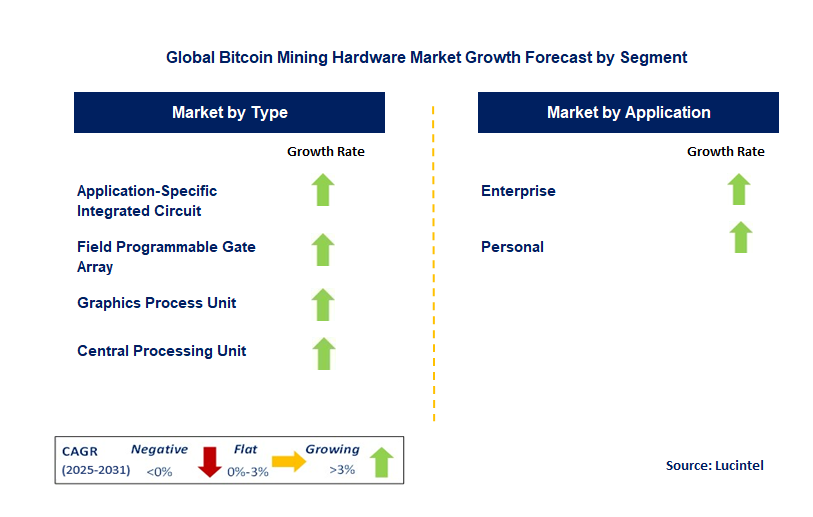
• Bitmain Technologies Holding Company Q5. Which bitcoin mining hardware market segment will be the largest in future? Answer: Lucintel forecasts that application-specific integrated circuit is expected to witness the highest growth over the forecast period due to their specialized design for bitcoin mining makes them the go-to choice for miners seeking profitability. Q6. In bitcoin mining hardware market, which region is expected to be the largest in next 5 years? Answer: APAC is expected to witness the highest growth over the forecast period due to the rising adoption of blockchain technology and digital currencies. Q7. Do we receive customization in this report? Answer: Yes, Lucintel provides 10% customization without any additional cost.


Choose a license that fits your team. Instant PDF delivery.
Prices exclude taxes. Instant delivery. Custom licensing available on request.
Market Report · July 29, 2026
Market Report · July 20, 2026
Market Report · July 20, 2026
Trusted partner for strategic intelligence and business growth


Receive a complimentary market analysis tailored to your industry. Our analysts will identify key growth opportunities and competitive dynamics specific to your business.

Market size, growth rate, and key trend analysis for your specific sector.

Top competitor positioning and market share analysis.

Strategic recommendations backed by data-driven insights.
Get curated market intelligence and competitive moves straight to your inbox.
By subscribing, you agree to receive our monthly insights. Unsubscribe anytime.
Receive a complimentary market analysis tailored to your industry. Our analysts will identify key growth opportunities and competitive dynamics specific to your business.
Market size, growth rate, and key trend analysis for your specific sector.
Top competitor positioning and market share analysis.
Strategic recommendations backed by data-driven insights.
Get curated market intelligence, emerging trends, and competitive moves straight to your inbox each month.
By subscribing, you agree to receive our monthly insights. Unsubscribe anytime.
We'll send your sample report shortly.