
Market Report · July 15, 2026

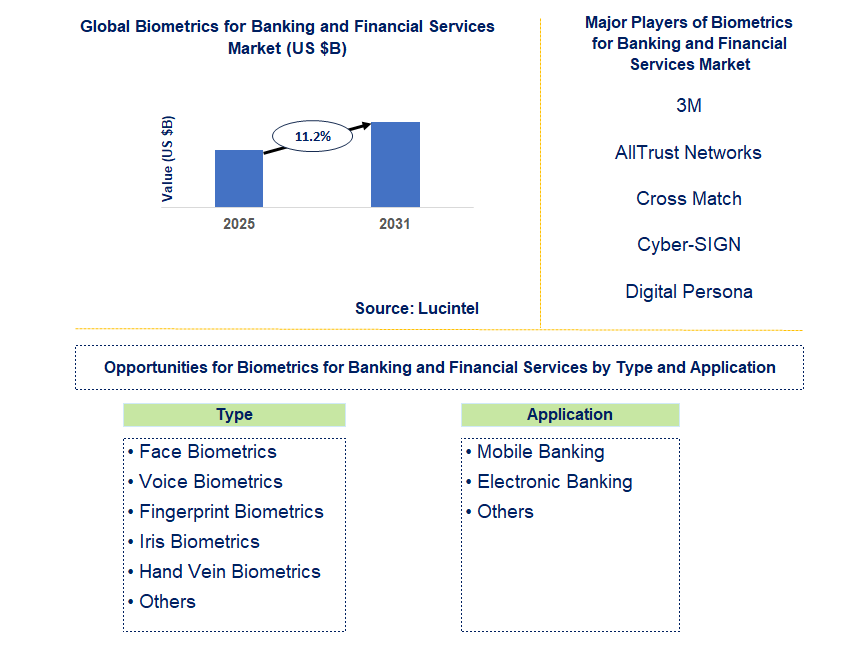
Key data points: The growth forecast = 11.2% annually for the next 7 years. Scroll below to get more insights. This market report covers Trends, opportunity and forecast in biometrics for banking and financial services market to 2031 by type (face biometrics, voice biometrics, fingerprint biometrics, iris biometrics, hand vein biometrics, and others), application (mobile banking, electronic banking, and others), and region (North America, Europe, Asia Pacific, and the Rest of the World)
We'll send your sample report shortly.
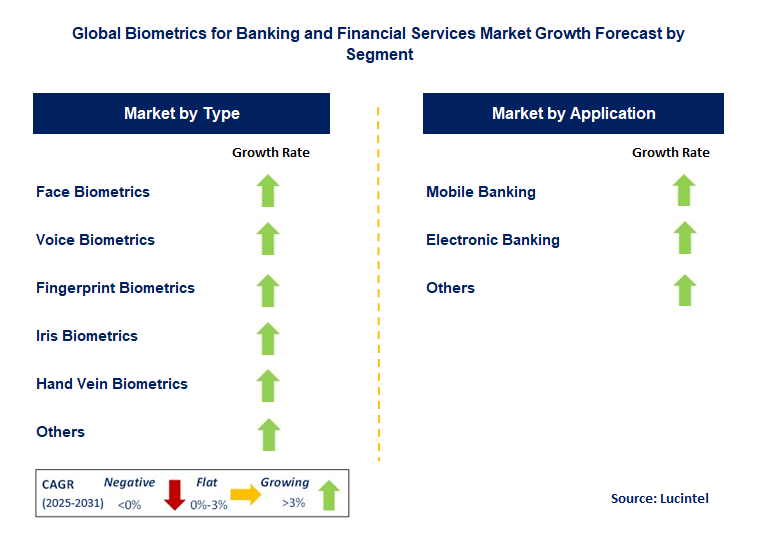
• Lucintel forecasts that, within the type category, face biometric is expected to witness the highest growth over the forecast period.
• Within the application category, mobile banking is expected to witness higher growth.
• In terms of region, APAC is expected to witness the highest growth over the forecast period. Gain valuable insights for your business decisions with our comprehensive 150+ page report. Sample figures with some insights are shown below.
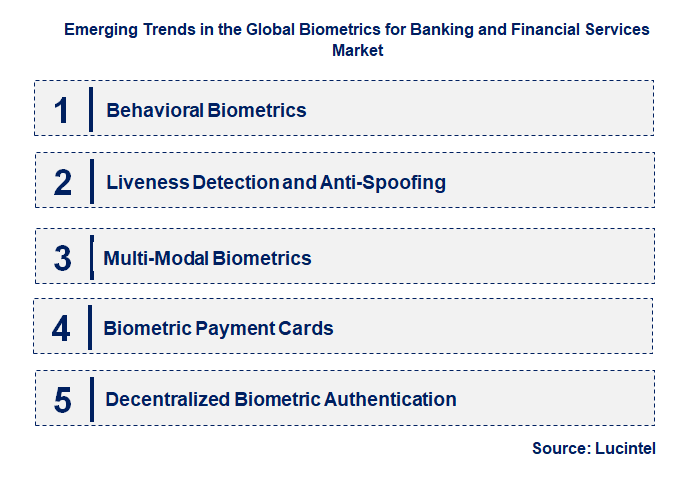
• Behavioral Biometrics: This trend involves analyzing user behavior, such as typing patterns, mouse movements, and gait, for continuous authentication. This adds an extra layer of security without requiring explicit user interaction, improving the user experience and detecting anomalies indicative of fraud. This impacts security by providing passive, ongoing authentication.
• Liveness Detection and Anti-Spoofing: Advancements in liveness detection are crucial to prevent spoofing attacks using photos, videos, or synthetic data. This includes techniques like 3D facial recognition, multi-modal biometrics, and advanced image analysis. This enhances the security of biometric authentication and builds user trust in these technologies.
• Multi-Modal Biometrics: Combining multiple biometric modalities, such as facial and voice recognition, enhances accuracy and security. This makes it more difficult for fraudsters to bypass authentication systems and provides a more robust and reliable form of identity verification. This impacts security by creating a more difficult target for attackers.
• Biometric Payment Cards: Integrating fingerprint sensors directly into payment cards allows for secure and convenient contactless payments without PIN entry. This enhances security by preventing unauthorized use of lost or stolen cards and improves the user experience by streamlining the payment process. This impacts the payment ecosystem by offering a more secure alternative to traditional cards.
• Decentralized Biometric Authentication: Using blockchain or other decentralized technologies to store and manage biometric data can enhance privacy and security. This gives users greater control over their data and reduces the risk of large-scale data breaches. This impacts data privacy by giving users more control over their biometric information. These trends are significantly reshaping the biometrics market in banking and financial services by driving the development of more secure, convenient, and user-centric authentication solutions. The focus is shifting towards continuous authentication, enhanced liveness detection, and privacy-preserving technologies. This evolution is transforming how financial institutions verify identity, prevent fraud, and provide seamless customer experiences in the digital age.
• Advancements in Liveness Detection: Liveness detection techniques are becoming increasingly sophisticated, moving beyond simple 2D facial recognition to incorporate 3D depth mapping, infrared imaging, and even heart rate detection. This significantly reduces the risk of spoofing attacks using photos, videos, or masks, bolstering the security of biometric authentication and increasing user trust.
• Integration of Behavioral Biometrics: Behavioral biometrics, analyzing user interactions like typing speed, mouse movements, and scrolling patterns, adds a layer of continuous, passive authentication. This provides enhanced security without requiring explicit user action, improving the user experience and detecting anomalous behavior indicative of fraud.
• Expansion of Biometric Payment Authentication: Biometric authentication is expanding beyond mobile banking apps to encompass payment cards and other transaction channels. Fingerprint sensors embedded in payment cards allow for secure contactless payments without PINs, while voice recognition is being used for phone-based banking and customer service.
• Focus on Privacy-Preserving Biometrics: Concerns about data privacy are driving the development of privacy-preserving biometric techniques. This includes on-device processing of biometric data, federated learning approaches, and the use of homomorphic encryption, minimizing the risk of data breaches and ensuring compliance with privacy regulations.
• Increased Use of Biometrics for KYC and Onboarding: Biometrics are becoming increasingly prevalent in Know Your Customer (KYC) and customer onboarding processes. Facial recognition and document verification technologies are being used to automate identity verification, streamlining the onboarding process and reducing fraud. These developments are significantly impacting the biometrics market in banking and financial services by driving the adoption of more secure, convenient, and privacy-conscious authentication methods. The focus is shifting towards multi-layered security approaches, continuous authentication, and user-centric design. This evolution is reshaping how financial institutions interact with their customers, enhancing security, and improving the overall customer experience.
• Mobile Banking Authentication: Biometrics offers a secure and convenient alternative to passwords and PINs for mobile banking access and transaction authorization. Fingerprint and facial recognition are widely adopted, while voice and behavioral biometrics are gaining traction. This enhances security, improves user experience, and reduces fraud related to compromised credentials.
• Contactless Payments and Biometric Cards: Integrating biometrics into payment cards and mobile wallets enables secure and frictionless contactless payments. Fingerprint sensors on cards and facial/voice recognition in mobile wallets authenticate transactions without requiring PIN entry. This enhances security and convenience, promoting the adoption of contactless payment methods.
• KYC and Digital Onboarding: Biometrics streamline Know Your Customer (KYC) and customer onboarding processes. Facial recognition and document verification technologies automate identity verification, reducing manual processes and improving efficiency. This reduces onboarding time, lowers operational costs, and mitigates fraud associated with identity theft.
• Fraud Prevention and Detection: Biometrics play a crucial role in preventing and detecting fraud. Behavioral biometrics can detect anomalous user behavior indicative of account takeover or fraudulent transactions. Multi-factor biometric authentication adds an extra layer of security, making it more difficult for fraudsters to bypass authentication systems.
• Branchless Banking and Remote Customer Service: Biometrics enable secure and convenient access to financial services without the need for physical branches. Voice and facial recognition can be used for remote customer authentication and service requests. This expands access to financial services for underserved populations and reduces operational costs for financial institutions. These strategic growth opportunities are significantly impacting the biometrics market in banking and financial services by driving specialization and innovation. Vendors are focusing on developing tailored solutions for specific application needs, leading to a more diverse and competitive market. The emphasis is on enhanced security, improved user experience, and seamless integration with existing financial platforms. This application-driven approach is shaping the future of financial services, enabling more secure, convenient, and accessible banking experiences.
• 3M
• AllTrust Networks
• Cross Match Technologies
• Cyber-SIGN
• Digital Persona
• Fujitsu Frontech North America
• Ingenico
• Lumidigm
• Morpho
• Nuance Communications
• Face Biometrics
• Voice Biometrics
• Fingerprint Biometrics
• Iris Biometrics
• Hand Vein Biometrics
• Others
• Mobile Banking
• Electronic Banking
• Others
• North America
• Europe
• Asia Pacific
• The Rest of the World
• United States: The US market is characterized by a strong focus on mobile banking and digital payments, driving the adoption of fingerprint and facial recognition for account access and transaction authorization. Key developments include advancements in liveness detection to prevent spoofing attacks, integration of behavioral biometrics for continuous authentication, and increasing use of voice recognition for customer service and remote banking. Regulatory frameworks like FIDO are also gaining traction.
• China: The Chinese market is experiencing widespread adoption of facial recognition for various financial services, including mobile payments, account opening, and ATM access. Key developments include advancements in facial recognition technology for challenging lighting conditions and crowded environments, integration with social credit systems, and increasing use of voice recognition for customer authentication in call centers. Mobile payment platforms are leading the charge in biometric adoption.
• Germany: The German market is characterized by a strong emphasis on data privacy and security, influenced by strict European regulations like GDPR. Key developments include the cautious adoption of biometrics, with a focus on fingerprint and iris scanning for high-security applications, and a preference for on-device processing of biometric data to minimize privacy risks. There's also a focus on user consent and data minimization.
• India: The Indian market is experiencing rapid growth in biometric adoption, driven by government initiatives like Aadhaar, a national biometric identification system. Key developments include the widespread use of fingerprint and iris scanning for KYC (Know Your Customer) processes, integration with mobile wallets and digital payment platforms, and increasing use of voice recognition for customer service in multiple languages.
• Japan: The Japanese market is characterized by a focus on the high accuracy and reliability of biometric technologies, with a preference for fingerprint and vein pattern recognition. Key developments include the use of biometrics for branchless banking and ATM access, increasing adoption of facial recognition for identity verification in financial institutions, and exploration of new biometric modalities like palm vein and behavioral biometrics.


• 3M
• AllTrust Networks
• Cross Match Technologies
• Cyber-SIGN
• Digital Persona
• Fujitsu Frontech North America
• Ingenico
• Lumidigm
• Morpho
• Nuance Communications Q5. Which biometrics for banking and financial services market segment will be the largest in future? Answer: Lucintel forecasts that face biometric is expected to witness the highest growth over the forecast period. Q6. In biometrics for banking and financial services market, which region is expected to be the largest in next 5 years? Answer: APAC is expected to witness the highest growth over the forecast period. Q7. Do we receive customization in this report? Answer: Yes, Lucintel provides 10% customization without any additional cost.


Choose a license that fits your team. Instant PDF delivery.
Prices exclude taxes. Instant delivery. Custom licensing available on request.
Market Report · July 15, 2026
Market Report · June 26, 2026
Market Report · June 24, 2026
Trusted partner for strategic intelligence and business growth


Receive a complimentary market analysis tailored to your industry. Our analysts will identify key growth opportunities and competitive dynamics specific to your business.

Market size, growth rate, and key trend analysis for your specific sector.

Top competitor positioning and market share analysis.

Strategic recommendations backed by data-driven insights.
Get curated market intelligence and competitive moves straight to your inbox.
By subscribing, you agree to receive our monthly insights. Unsubscribe anytime.
Receive a complimentary market analysis tailored to your industry. Our analysts will identify key growth opportunities and competitive dynamics specific to your business.
Market size, growth rate, and key trend analysis for your specific sector.
Top competitor positioning and market share analysis.
Strategic recommendations backed by data-driven insights.
Get curated market intelligence, emerging trends, and competitive moves straight to your inbox each month.
By subscribing, you agree to receive our monthly insights. Unsubscribe anytime.
We'll send your sample report shortly.