
Market Report · July 20, 2026

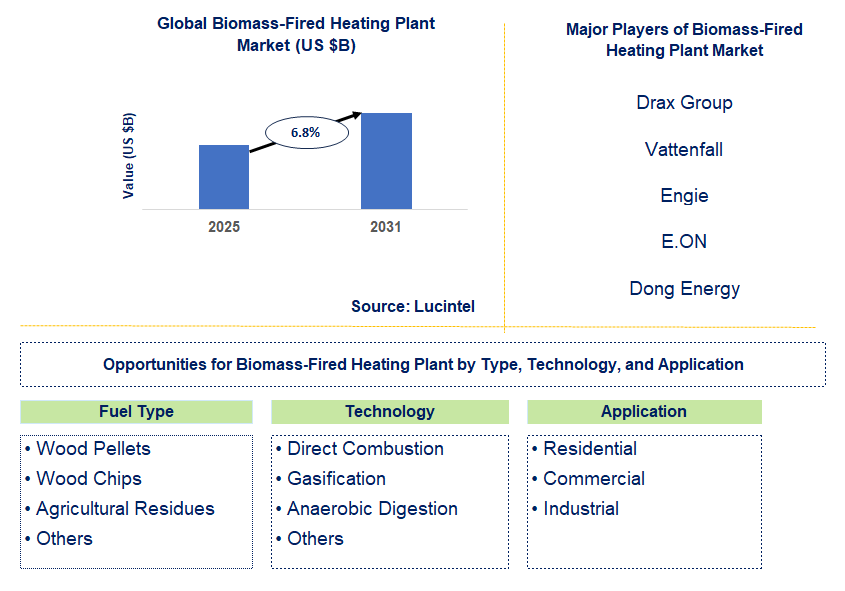
Key data points: The growth forecast = 6.8% annually for the next 7 years. Scroll below to get more insights. This market report covers Trends, opportunities and forecasts in biomass-fired heating plant market to 2031 by fuel type (wood pellets, wood chips, agricultural residues, and others), technology (direct combustion, gasification, anaerobic digestion, and others), application (residential, commercial, and industrial), and region (North America, Europe, Asia Pacific, and the Rest of the World)
We'll send your sample report shortly.
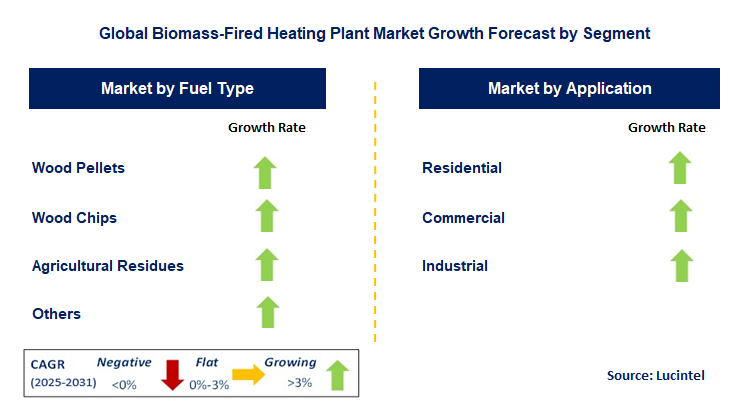
• Lucintel forecasts that, within the fuel type category, wood pellet is expected to witness the highest growth over the forecast period.
• Within the application category, industrial is expected to witness the highest growth.
• In terms of region, APAC is expected to witness the highest growth over the forecast period.
• Advanced Combustion Technologies for Emission Reduction: A strong trend towards the adoption and development of advanced combustion technologies, including staged combustion and flue gas recirculation, is observed to greatly minimize particulate matter, NOx, and other toxic emissions from biomass heating plants. This responds to environmental issues and new regulations.
• Integration with Smart Control and Automation Systems: Biomass heating systems are increasingly being integrated into smart control and automation systems for optimized fuel usage, efficient heat distribution, remote monitoring, and predictive maintenance. This increases operational efficiency as well as lowers overall running costs.
• Combined Heat and Power Applications: Increasing use is being found for biomass heat plants in combined heat and power (CHP) arrangements in which they generate electricity and hot water or other thermal energy concurrently, greatly increasing overall energy efficiency and economic justification, particularly in industrial and district heating applications.
• Use of Diverse and Renewable Biomass Feedstocks: The industry is experiencing a transition towards the use of a broader array of sustainable biomass feedstocks, such as agricultural residues, energy crops, and waste streams, to help decrease dependence on conventional wood pellets and respond to forest-related sustainability issues.
• Development of Smaller, Modular Biomass Heating Systems: There is a growing tendency for smaller, modular biomass heating systems that are appropriate for small commercial and residential use, with ease of installation, scalability, and compatibility with existing heating infrastructure.
These upcoming trends are vastly changing the market for biomass-fired heating plants. The interest in cleaner burning, intelligent integration, CHP opportunities, varied feedstocks, and modular systems is compelling innovation and widening the prospects for biomass heat as a cost-effective and environment friendly heating system for various markets.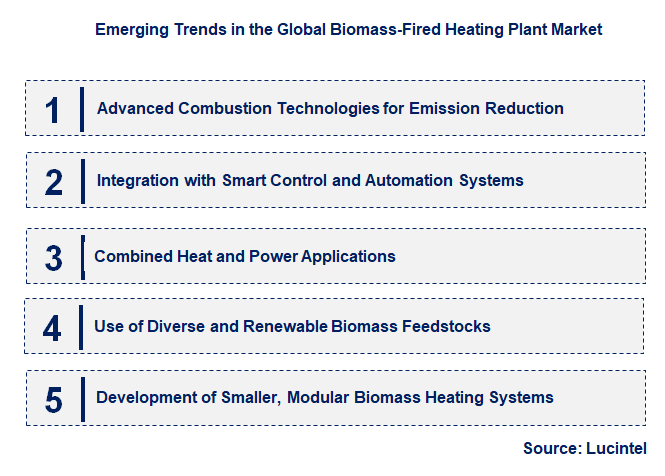
• Development in Gasification Technologies: Extensive developments in biomass gasification technologies make it possible to convert solid biomass to a gaseous fuel (syngas) and utilize it in high-efficiency boilers or CHP, with clean combustion and higher energy recovery.
• Development of Automated Fuel Handling and Storage Systems: Advances in automated fuel handling, storage, and feeding systems are enhancing the efficiency of operation and minimizing the labor needs for large biomass heating plants, making them more competitive.
• Implementation of Tighter Emission Regulations and Control Technologies: Tighter emission regulations of air pollutants from biomass combustion are causing more stringent emission standards to be developed and implemented, including more advanced flue gas cleaning technologies like electrostatic precipitators and baghouse filters.
• Integration of Biomass Heating into District Heating Networks: District heating networks driven by large-scale biomass boilers are one of the emerging trends in a number of areas, with a centralized and effective heating option for cities and the added benefit of lowering personal fossil fuel usage.
• Policy Support and Incentives for Biomass Heating: Policies such as subsidies, tax credits, and renewable heat incentives implemented by the government are significantly influencing the uptake of biomass heating systems by different sectors, impacting sales and market growth.
These major developments are having a considerable influence on the biomass-fired heating plant sales market by influencing technological innovation, enhancing operational effectiveness, mitigating environmental issues, and taking advantage of favorable policies. The emphasis on gasification, automation, emission control, district heating integration, and policy incentives is causing more sustainable and competitive biomass heating solutions.• Residential Space Heating: The replacement of conventional fossil fuel boilers with state-of-the-art biomass boilers and pellet stoves in homes provides a great growth potential, especially in those areas rich in wood resources and government incentive support.
• Commercial and Institutional Facilities: Schools, hospitals, and office buildings are an enormous market for large-scale biomass heating systems that can supply efficient and economical heat while limiting carbon emissions.
• Industrial Process Heat Generation: Large amounts of process heat are needed by many industries, and biomass-fired heating plants can present a renewable energy solution to fossil fuel systems, an opportunity for customized industrial heating solutions to grow.
• District Heating Networks: Installing and extending district heating networks based on large-scale, high-efficiency biomass boilers represents a considerable opportunity to supply sustainable heating to whole communities and cities.
• Agricultural and Rural Uses: Biomass heat systems may utilize agricultural wastes and energy crops for supplying heat for greenhouses, livestock barns, and rural villages, giving a renewable, locally available, and energy-sufficient heating supply.
These strategic growth prospects in major applications are heavily influencing the sales market for biomass-fired heating plants. The demand for renewable heating options in residential, commercial, industrial, district heating, and agriculture applications is fueling innovation and the creation of customized biomass heating technologies, promoting enormous market growth.• Drax Group
• Vattenfall
• Engie
• E.ON
• Dong Energy
• RWE
• Veolia Environnement
• Babcock & Wilcox Enterprises
• General Electric Company
• Siemens
• Wood Pellets
• Wood Chips
• Agricultural Residues
• Others
• Direct Combustion
• Gasification
• Anaerobic Digestion
• Others
• North America
• Europe
• Asia Pacific
• The Rest of the World
• United States: The US biomass-fired heating plant market is largely fueled by the presence of forestry and agricultural residues, especially in the Northeast and Northwest. New developments involve improved automated feeding systems and emission control technologies for commercial and industrial-scale applications. Policy support is state-dependent, driving market growth.
• China: China is giving active support to biomass heating as one of its renewable energy initiatives, particularly in rural regions where there is a great deal of agricultural waste. Recent growth has seen the use of big biomass district heating systems and improved efficiency and cleaner combustion equipment for both domestic and industrial applications. There is a big role played by government subsidies.
• Germany: Germany has a mature biomass heating market for domestic and small commercial use, stimulated by supportive feed-in tariffs and environmental policy. Recent activity centers on minimizing combustion losses, lowering particulate emissions, and combining biomass boilers with thermal storage for grid balancing.
• India: India's market for biomass-fired heating plants is primarily focused on industrial uses using agricultural residues and dedicated energy crops. Recent growth has involved government efforts to encourage biomass cogeneration for industry and the creation of smaller, more efficient biomass cookstoves for rural communities in order to reduce dependence on conventional fuels.
• Japan: Japan's biomass-fired heating industry is expanding due to its renewable energy ambitions and access to wood pellets and farm residues. The latest trends involve the installation of biomass power plants with combined heat and power (CHP) capacities and the improvement of combustion technologies to satisfy tight emission limits.


• Drax Group
• Vattenfall
• Engie
• E.ON
• Dong Energy
• RWE
• Veolia Environnement
• Babcock & Wilcox Enterprises
• General Electric Company
• Siemens
Q5. Which biomass-fired heating plant market segment will be the largest in future?

Choose a license that fits your team. Instant PDF delivery.
Prices exclude taxes. Instant delivery. Custom licensing available on request.
Market Report · July 20, 2026
Market Report · July 20, 2026
Market Report · July 20, 2026
Trusted partner for strategic intelligence and business growth


Receive a complimentary market analysis tailored to your industry. Our analysts will identify key growth opportunities and competitive dynamics specific to your business.

Market size, growth rate, and key trend analysis for your specific sector.

Top competitor positioning and market share analysis.

Strategic recommendations backed by data-driven insights.
Get curated market intelligence and competitive moves straight to your inbox.
By subscribing, you agree to receive our monthly insights. Unsubscribe anytime.
Receive a complimentary market analysis tailored to your industry. Our analysts will identify key growth opportunities and competitive dynamics specific to your business.
Market size, growth rate, and key trend analysis for your specific sector.
Top competitor positioning and market share analysis.
Strategic recommendations backed by data-driven insights.
Get curated market intelligence, emerging trends, and competitive moves straight to your inbox each month.
By subscribing, you agree to receive our monthly insights. Unsubscribe anytime.
We'll send your sample report shortly.