
Market Report · May 18, 2026

This market report covers trends, opportunities, and forecasts in the global biological digital microscope market to 2031 by technology (cmos (complementary metal oxide semiconductor) and ccd (charge-coupled device)), end use (hospitals, research laboratories, pharmaceutical and biotechnology industries, and clinics), and region (North America, Europe, Asia Pacific, and the Rest of the World)
We'll send your sample report shortly.
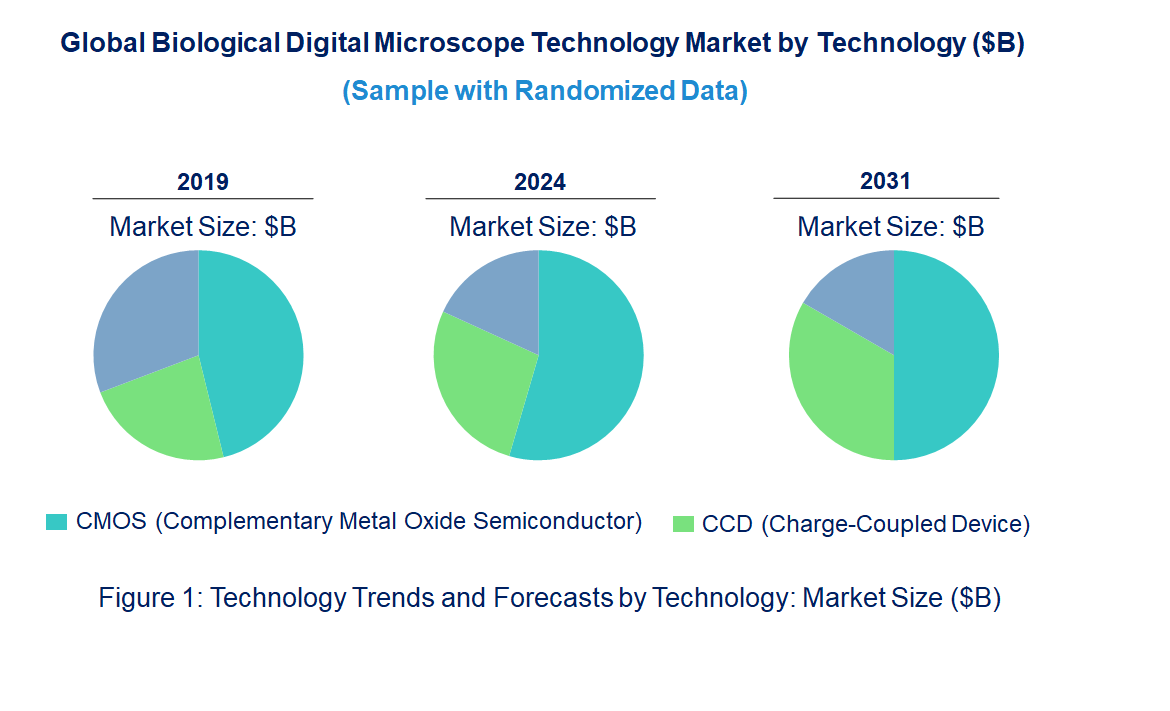
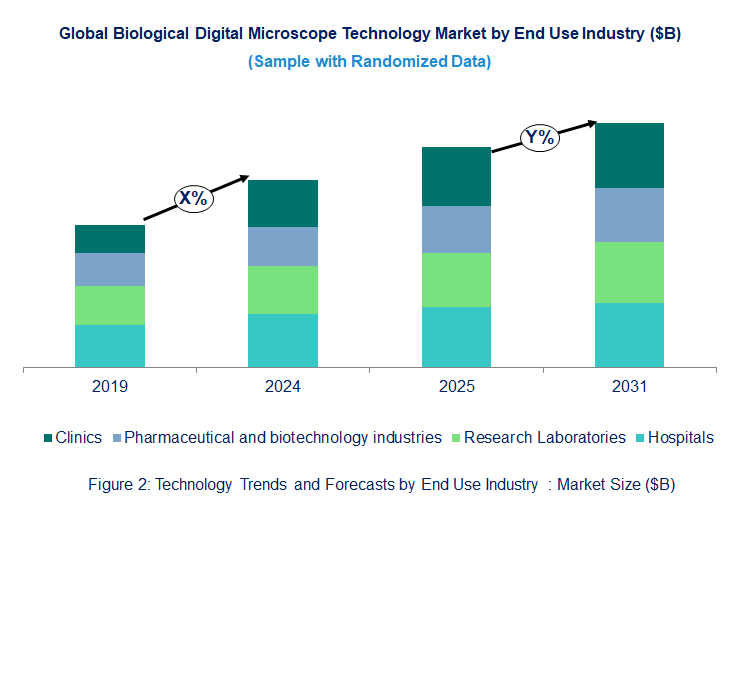
• From CCD to CMOS Sensor: CMOS sensors have replaced CCD sensors because they are cheaper to use, consume less power, and are faster. These improvements help with higher resolution and live imaging, which are ideal for applications such as clinical diagnostics and research.
• Integration with Artificial Intelligence and Machine Learning: With the integration of AI and machine learning algorithms, biological digital microscopes can now perform real-time image analysis and pattern recognition. These intelligent systems will improve diagnostics, automate time-consuming tasks, and optimize workflows in clinical or research environments.
• Miniaturization and Portability: There is an increasing trend toward miniaturizing biological digital microscopes, making them more portable and easier to use in various environments. This trend is particularly relevant for mobile diagnostic applications in clinics, remote areas, and field research, where traditional bulky equipment is less practical.
• Increased Resolution and Speed of Imaging: The development of microscopes with enhanced optics and sensors allows for increased resolution and faster imaging speeds. Higher resolution helps capture finer details of biological samples, which is critical for advanced research in areas such as genomics, cancer research, and drug discovery.
• Integration with Cloud-Based Platforms: Cloud-based solutions are being integrated into biological digital microscopes for the storage, sharing, and collaboration of high-resolution images across multiple platforms. This is particularly important in research laboratories and medical diagnostics, where data sharing and remote access are essential for collaboration and analysis. These technology trends are taking the biological digital microscope market to a higher level of efficiency, accuracy, and accessibility. Replacing CCD sensors with CMOS, integrating AI, improving portability, and enhancing resolution are bringing a new look to their usage in hospitals, research labs, and clinics.
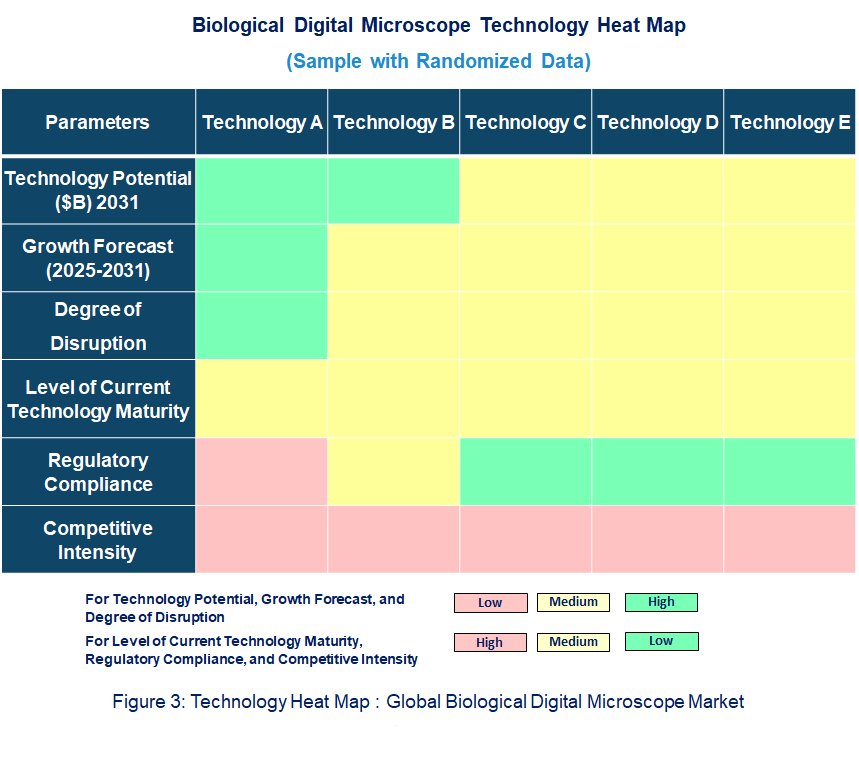
• Technological Potential: Biological digital microscopes hold vast potential. AI and machine learning can be integrated to enable automated image analysis, disease detection, and pattern recognition, speeding up research and analysis processes. Advanced sensors and high-resolution cameras enhance imaging capabilities. Cloud connectivity and data-sharing capabilities facilitate collaborative research and remote diagnostics, providing greater accessibility and efficiency.
• Level of Disruption: Cell biology and biological research still rely heavily on traditional microscopes, but next-generation digital and AI-driven systems offer improvements in precision, speed, and data handling. These technologies can optimize workflows and increase access to biological analysis, but complete market disruption will occur only when adoption increases and prices decrease.
• Level of Current Technological Maturity: The technology is mature, with digital microscopes already being applied in laboratories, healthcare, and educational institutions. AI-based image analysis and cloud integration are still developing but are being refined for wider applications.
• Regulatory Compliance: The most important regulatory consideration is compliance, especially for healthcare and research applications. Biological digital microscopes need to comply with medical device regulations, such as FDA approval in the U.S. and CE marking in Europe, particularly for safety and efficacy in diagnostics and research applications.
• Danaher Corporation: Danaher has enriched its portfolio in the biological digital microscope market by focusing on areas such as the integration of advanced imaging technologies, like CMOS sensors and AI-driven image analysis. These products provide high-resolution imaging solutions for clinical and research applications that aid in diagnostics and research productivity.
• Nikon Corporation: Nikon has introduced advanced microscopy solutions with enhanced digital imaging systems, including high-performance CMOS sensors to increase resolution and image acquisition speeds. These innovations enable researchers and doctors to make accurate evaluations.
• Roper Technologies, Inc.: Roper Technologies has evolved its microscope imaging systems to incorporate high-sensitivity CMOS sensors with software solutions that enable advanced image capture and analysis. These systems give researchers better tools to study biological samples and allow real-time data processing, which accelerates decision-making.
• Carl Zeiss AG: Carl Zeiss is continuously pushing for innovation in biological digital microscopy by integrating ultra-high-resolution CMOS sensors and AI-powered image analysis. These products find significant application in laboratories for scientific and medical uses, improving imaging and automation capabilities.
• Olympus Corporation: Olympus is focusing on developing portable microscopes with high resolution. Their products, equipped with advanced CMOS technology, provide clearer images and analyses. These microscopes are increasingly used in clinical diagnostics and pharmaceutical research for more precise and efficient results.
• Hamamatsu Photonics K.K.: Hamamatsu has invested in digital microscope systems that use CMOS sensors to produce high-quality images that can be processed faster. These products are aimed at higher-throughput applications in the health sciences, improving speed and accuracy in diagnostics.
• Basler AG: Basler has introduced biological digital microscopes with CMOS camera systems featuring high-quality imaging and ultra-sensitivity to low light. These microscopes are used in research laboratories and medical facilities for in-depth observation and quick examination.
• Guangzhou Micro-shot Technology Co., Ltd.: Guangzhou Micro-shot is dedicated to developing digital microscopes with high-performance CMOS sensors and compact, user-friendly designs. These microscopes are gaining popularity in educational and research institutions for both basic and advanced biological studies.
• BMS Microscopes B.V.: BMS Microscopes innovates traditional microscopy by adding digital components. The company offers models with CMOS sensors and integrated image processing, improving imaging results and research outcomes.
• Euromex Microscopen B.V.: Euromex has enhanced its biological digital microscopes with advanced CMOS imaging technology, ensuring better resolution and overall image quality. Their systems are used for various biological applications, from research to medical diagnostics, enabling users to obtain clearer and more accurate data. The advancements from leading manufacturers reflect a continued need for more sophisticated digital imaging technology, including CMOS sensors and AI integration, to serve as catalysts for innovation and better performance in biological digital microscopes.
• Technological Advancements: Advances in CMOS sensor technology, along with the integration of AI and machine learning, are improving the performance and capabilities of biological digital microscopes. These improvements in resolution, speed, and image quality are driving the adoption of these systems across healthcare and research sectors.
• Increased Need for High Accuracy in Diagnostics: Healthcare requires higher accuracy and faster real-time diagnostics from biological digital microscopes. Enhanced imaging capabilities help clinicians make better-informed decisions in medical diagnostics.
• Increasing Research Applications: The demand for advanced digital microscopy in research labs, especially in genomics, biotechnology, and pharmaceuticals, is driving market growth. Better imaging technologies allow for more detailed studies of biological samples at the molecular level, enabling breakthroughs in drug development and disease understanding.
• Miniaturization and Portability: More compact and portable digital microscopes are helping expand their applications in diverse settings, including field research, education, and clinical diagnostics, where portability is essential. Challenges in the biological digital microscope market include:
• High Initial Costs: Advanced biological digital microscopes, especially those with sophisticated CMOS sensors and AI integration, may be costly, limiting market entry for smaller research institutions and clinics. This can slow the adoption process in those market segments.
• Integration and Training Complexity: Advanced technologies, including AI-based analytics and cloud-based data sharing, require specific skills and training. This may pose a challenge to institutions implementing these systems, as there is often a learning curve in terms of operation and integration.
• Regulatory and Compliance Issues: Biological digital microscopes, particularly those applied in clinical and medical settings, must meet stringent regulatory requirements. Ensuring compliance with these regulations can be challenging, especially when new technologies are introduced that require certification and approval. driven by technological developments, precision diagnostics, and the expansion of research applications, the biological digital microscope market faces challenges, including high costs, integration complexity, and regulatory hurdles. These factors affect the continued growth and widespread adoption of these systems.
• Danaher Corporation
• Nikon Corporation
• Roper Technologies Inc.
• Carl Zeiss AG
• Olympus Corporation
• Hamamatsu Photonics K.K.
• Technology Readiness by Technology Type for Biological Digital Microscope Market: CMOS technology is well-prepared for widespread implementation in biological digital microscopes, offering cost-effectiveness and high performance along with rapid advancements in resolution and processing speed. CMOS sensors compete well because modern digital system integrations provide quality images with good sensitivity. CCD technology, though proven and historically reliable, has become limited to high-end applications due to its high cost and power consumption. Both technologies are closely monitored for regulatory compliance, especially in medical and research applications, to ensure image accuracy and safe use. CMOS leads in mobile and affordable systems, while CCD mainly serves specialized, high-performance markets.
• Competitive Intensity and Regulatory Compliance of Different Technologies for Biological Digital Microscope Market: The competitive intensity in the biological digital microscope market is high because CMOS sensors are increasingly used due to their lower cost, high-speed performance, and versatility. CMOS’s dominance is growing, but CCD still holds a strong position in high-end and research-oriented applications. Both technologies must meet regulatory standards for safe and accurate imaging, especially in medical and research environments. CMOS systems must comply with safety and performance standards, while CCD sensors are regulated for use in clinical and laboratory settings. Both technologies must adhere to environmental and energy efficiency regulations, which impact design and manufacturing.
• Disruption Potential of Different Technologies for the Biological Digital Microscope Market: The disruption potential of CMOS technology in this market is driven by considerations such as price benefits, speed of image processing, and compatibility with modern digital systems. CMOS allows for high-resolution imaging with low power consumption, making it ideal for mobile or portable microscopes. Although CCD offers superior image quality and sensitivity, it is more expensive and power-hungry. However, CCD is still preferred for high-end microscopy applications requiring exceptional image quality and low noise. The trend towards compact, cost-effective, and high-performance microscopes gives CMOS a greater disruption potential, while CCD remains relevant in niche markets requiring superior optical performance.
• CMOS (Complementary Metal Oxide Semiconductor)
• CCD (Charge-Coupled Device)
• Hospitals
• Research Laboratories
• Pharmaceutical and Biotechnology Industries
• Clinics
• North America
• Europe
• Asia Pacific
• The Rest of the World
• Latest Developments and Innovations in the Biological Digital Microscope Technologies
• Companies / Ecosystems
• Strategic Opportunities by Technology Type


Choose a license that fits your team. Instant PDF delivery.
Prices exclude taxes. Instant delivery. Custom licensing available on request.
Market Report · May 18, 2026
Market Report · May 18, 2026
Market Report · May 18, 2026
Trusted partner for strategic intelligence and business growth


Receive a complimentary market analysis tailored to your industry. Our analysts will identify key growth opportunities and competitive dynamics specific to your business.

Market size, growth rate, and key trend analysis for your specific sector.

Top competitor positioning and market share analysis.

Strategic recommendations backed by data-driven insights.
Get curated market intelligence and competitive moves straight to your inbox.
By subscribing, you agree to receive our monthly insights. Unsubscribe anytime.
Receive a complimentary market analysis tailored to your industry. Our analysts will identify key growth opportunities and competitive dynamics specific to your business.
Market size, growth rate, and key trend analysis for your specific sector.
Top competitor positioning and market share analysis.
Strategic recommendations backed by data-driven insights.
Get curated market intelligence, emerging trends, and competitive moves straight to your inbox each month.
By subscribing, you agree to receive our monthly insights. Unsubscribe anytime.
We'll send your sample report shortly.