
Market Report · July 16, 2026

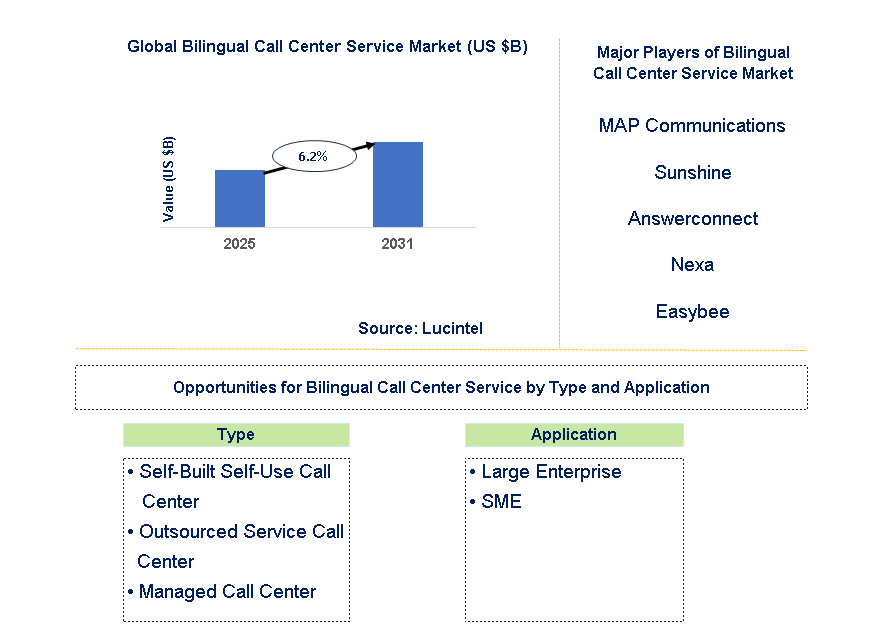
Key data points: The growth forecast = 6.2% annually for the next 7 years. Scroll below to get more insights. This market report covers Trends, opportunity and forecast in bilingual call center service market to 2031 by type (self-built self-use call center, outsourced service call center, and managed call center), application (large enterprise and SME), and region (North America, Europe, Asia Pacific, and the Rest of the World)
We'll send your sample report shortly.
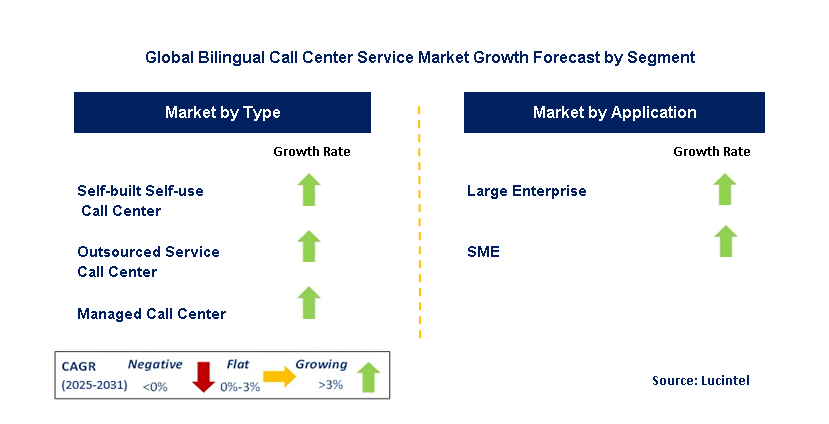
• Lucintel forecasts that, within the type category, outsourced service call centers will remain the largest segment over the forecast period.
• Within the application category, SME is expected to witness the higher growth.
• In terms of region, North America is expected to witness the highest growth over the forecast period. Gain valuable insights for your business decisions with our comprehensive 150+ page report. Sample figures with some insights are shown below.
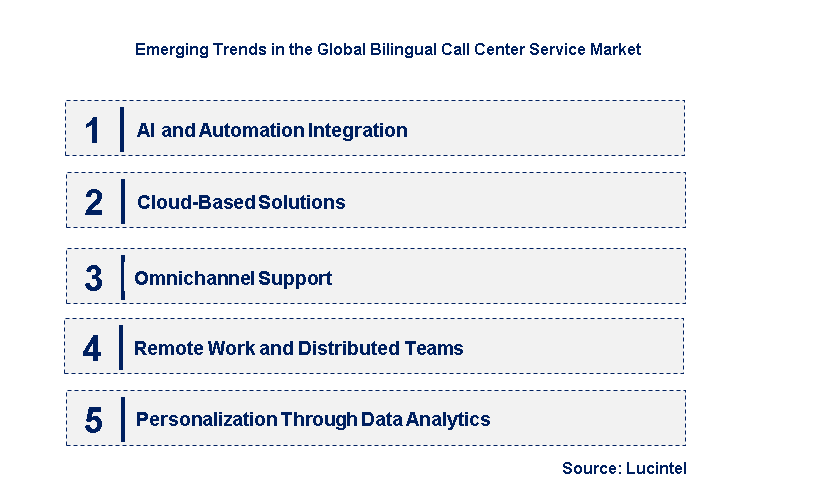
• AI and Automation Integration: AI and automation are fast revolutionizing the bilingual call center landscape. Businesses have significantly harnessed AI-based chatbots and automated voice assistants to put up with routine inquiries in multiple languages. This is reducing the response times and has improved customer satisfaction with faster service. AI solutions have also refined language translation accuracy and allowed for more efficient routing of customer requests to appropriate bilingual agents. With advancing automation technology, companies are able to offer 24/7 bilingual support at scale.
• Cloud-Based Solutions: The cloud-based call center solutions are now becoming the standard for bilingual services, offering flexibility, scalability, and cost-efficiency. This allows businesses to manage multilingual customer interactions across various channels, including phone, email, and live chat, from any location. By placing call center operations in the cloud, companies are in a position to rapidly scale bilingual services, deploy agents remotely, and provide consistent quality of service despite location.
• Omnichannel Support: With omnichannel support, another trend in bilingual call centers is the ability for businesses to allow customers to be served seamlessly on multiple communication channels. The customers can start interactions in one channel, for instance, phone or chat, and then switch to another, like email or social media, without losing continuity in their service. This trend is highly significant for bilingual services, as it ensures that the language preferences of the customers are maintained throughout their journey, improving satisfaction and loyalty towards the brand. Omnichannel support enables businesses to collect data from various sources for more accurate insights into customer needs.
• Remote Work and Distributed Teams: Remote work and distributed teams are reshaping the bilingual call center model. The COVID-19 pandemic accelerated the adoption of remote work, and many bilingual call centers have continued to operate in this model. This shift allows businesses to tap into a global pool of multilingual talent, providing greater flexibility in staffing and ensuring better service for international customers. Another cost-saving factor of remote work is that companies need not maintain big physical call center spaces. In the coming days, this will be the way of doing things as more flexible work arrangements gain acceptance by the businesses.
• Personalization Through Data Analytics: Data analytics is playing a crucial role in personalizing bilingual customer service. Businesses can understand individual preferences, purchase histories, and language needs through analyzing customer data, which can allow them to tailor interactions and offer more personalized service. Data-driven insights help call centers anticipate customer issues, optimize staffing, and provide more proactive support. This trend is especially important in bilingual services because it enables businesses to offer culturally relevant and linguistically appropriate solutions for a diverse customer base. These trends—AI integration, cloud solutions, omnichannel support, remote work, and data-driven personalization—are transforming the global bilingual call center service market. These trends are improving efficiency, accessibility, and customer experience and are enabling businesses to serve their multilingual customers better while gaining a competitive advantage in the marketplace.
• AI-powered Language Translation: The bilingual call centers have been revolutionized by AI-powered language translation that enables real-time accurate translations between the agents and the customers. This has reduced the barriers of language and improved communication among the call centers. They are able to deliver seamless bilingual services across multiple languages. The sophistication of AI-based translation tools has improved to offer better context understanding and conversational flow. As AI improves, bilingual call centers are scaling operations while keeping the quality high.
• Voice Recognition Technology: Voice recognition technology is now incorporated into bilingual call centers to further enhance the customer experience. The system can transcribe and translate conversations accurately, and agents can more efficiently manage their multilingual calls. Voice recognition also assists with call routing because it identifies the language preference of the caller so that they get connected to the right agent speaking their preferred language. This helps in reducing the response time and errors, which further aids in faster and accurate bilingual support delivery.
• Remote Customer Service Operations: Bilingual call centers have become increasingly popular with remote customer service operations, especially after the COVID-19 pandemic. The shift toward virtual call center models has been noticed by businesses to enable agents to work from home, providing flexibility and reducing overhead costs. The global talent pool is tapped by remote call centers, ensuring that businesses can offer multilingual services regardless of location. This development is bringing bilingual call center services closer to more and scalable markets.
• Cloud Contact Centers: Bilingual services are increasingly popular within cloud-based contact centers. Through these solutions, businesses can interact with their clients in several languages from any part of the globe. Cloud-based contact centers are easily scalable to fit changes in volume calls. Hence, it works well for call centers with different customers speaking several languages. These services are also integrated with other customer service tools, such as CRM and analytics systems, which ensures a seamless experience for both customers and agents.
• Interactive Voice Response (IVR) Systems: IVR systems are being upgraded to include new features involving multilingual functionality, so that they can interact with automated systems in the chosen language. Modern IVR systems can walk the customer through frequently asked questions and service requests in multiple languages, thus reducing the workload of the bilingual agents. This development ensures that customers receive support in their native language without having to wait for an agent. These developments—AI translation, voice recognition, remote operations, cloud contact centers, and multilingual IVR systems—are driving the growth of the bilingual call center service market. These innovations are improving operational efficiency, enhancing customer experiences, and enabling businesses to offer high-quality, multilingual support at scale.
• Growth in Multilingual Service in Emerging Markets: Emerging markets in Asia, Africa, and Latin America offer high growth opportunities for bilingual call center services. As companies grow their operations into these markets, the demand for multilingual services increases. By offering bilingual services in local languages and global business languages such as English and Spanish, companies will be better positioned to respond to the diversified customer base in these regions.
• Bilingual call center services: The rapid growth of e-commerce, especially cross-border transactions, is forcing the need for bilingual call center services. E-commerce platforms require customer support across various languages to cater to a global audience. E-commerce businesses can enhance the customer experience and improve conversion rates in international markets by providing multilingual support across different channels such as chat, email, and phone.
• Bilingual Healthcare Customer Service: The healthcare sector is slowly relying on bilingual call center services to cater to patients belonging to various linguistic backgrounds. This creates expansion scope in countries with high immigration rates, as healthcare organizations have to converse with patients in foreign languages. Bilingual healthcare services increase patient satisfaction and provide for smoother communication, eliminating chance miscommunication in medical treatment.
• Demand for the Telecommunications Industry: This is where there is an opportunity for telecommunications firms to extend their customer service into the bilingual category. This opportunity applies more in the North American and European regions since companies are mandated to support the multilingual environment of their diversified customers. Therefore, companies with the capability of offering bilingual services, both in regional languages and international business languages, will be competitive in such markets.
• Government and Public Sector Services: The government and public sectors also invest in bilingual call center services to ensure access to equal service for citizens with different languages. This involves giving multilingual customer service to all the different services provided by the government, including immigration, health, and social services. Bilingual call centers may be a valuable resource for the government in the promotion of increased public participation as well as quality service delivery for non-native speakers. These growth opportunities-emergence in developing countries, increasing e-commerce support needs, multilingual healthcare services, telecom industry requirements, and government services are going to change the future face of the bilingual call center service market. It will allow companies to leverage untapped revenue opportunities while also giving customers more meaningful experiences.
• MAP Communications
• Sunshine Communications
• Answerconnect
• Nexa
• Easybee
• Self-Built Self-use Call Center
• Outsourced Service Call Center
• Managed Call Center
• Large Enterprise
• SME
• North America
• Europe
• Asia Pacific
• The Rest of the World
• United States: Bilingual call centers have been more concentrated on improving the experience of customers across Spanish, Mandarin, and other languages in the United States, as the country‘s population has become increasingly multicultural. Companies are investing in AI-driven customer service tools that can accurately and efficiently address customer inquiries in multiple languages. In addition, the advent of remote work and cloud-based systems has allowed call centers to scale their operations without any geographical constraints, making it easier to hire bilingual agents from diverse locations. This shift has optimized operations and allowed businesses to better serve their multilingual customer base.
• China: In China, bilingual call centers have been rapidly adopted, especially in e-commerce and tech industries, as companies expand their global reach. There has been a tremendous increase in demand for services in English, Japanese, and other regional languages. As a result, companies have made investments in the latest customer support technologies, including voice recognition and AI-based systems. This reduces language barriers, which further enhances customer satisfaction both from within and outside the country. Additionally, the Chinese government‘s encouragement for digital transformation has increased the pace of bilingual expansion in customer service centers.
• Germany: Bilingual call centers have increased over the years in Germany. Most of them are found in automotive, IT, and finance sectors. Given that Germany is a country that heavily relies on exports, there is a growth in businesses that provide support in several languages to clients abroad, in English, French, and Italian. Moreover, Germany has taken advanced AI and machine learning techniques to enhance routing in calls, fasten responses, and perfect the translation. German is also experiencing an increasing trend for hybrid call centers which consist of in-house agents and outsourcing bilingual services by reducing the expenses but maintaining high quality.
• India: India forms a significant centre for bilingual contact centers, since companies support most of the language, such as Hindi, Bengali, and various regional dialects, besides the English language. The Indian bilingual call center market has been growing on a rapid scale as multiple global companies, in pursuit of outsourced customer support services, are turning toward India. Besides the vast pool of multilingual talent, the effective labor cost was another factor driving companies to select India for companies in the telecommunications, banking, and healthcare segments. The integration of AI-driven solutions, for instance, automated chatbots and predictive analytics, is also adding quality and speed to bilingual customer service in India.
• Japan: The demand for bilingual call center services is increasing in Japan due to the country‘s aging population and multilingual customer support in tourism, e-commerce, and telecommunication. Companies are increasingly focusing on providing services in languages such as English, Chinese, and Korean to cater to international visitors and expatriates. Moreover, Japan is investing heavily in voice recognition technology and AI to improve language translation and make customer service interactions more efficient. As Japan embraces more digital solutions, bilingual call centers are becoming a vital component of its customer service strategy.


• MAP Communications
• Sunshine Communications
• Answerconnect
• Nexa
• Easybee Q5. Which bilingual call center service market segment will be the largest in future? Answer: Lucintel forecasts that outsourced service call centers will remain the largest segment over the forecast period. Q6. In bilingual call center service market, which region is expected to be the largest in next 5 years? Answer: North America is expected to witness the highest growth over the forecast period. Q7. Do we receive customization in this report? Answer: Yes, Lucintel provides 10% customization without any additional cost.


Choose a license that fits your team. Instant PDF delivery.
Prices exclude taxes. Instant delivery. Custom licensing available on request.
Market Report · July 16, 2026
Market Report · May 18, 2026
Market Report · May 18, 2026
Trusted partner for strategic intelligence and business growth


Receive a complimentary market analysis tailored to your industry. Our analysts will identify key growth opportunities and competitive dynamics specific to your business.

Market size, growth rate, and key trend analysis for your specific sector.

Top competitor positioning and market share analysis.

Strategic recommendations backed by data-driven insights.
Get curated market intelligence and competitive moves straight to your inbox.
By subscribing, you agree to receive our monthly insights. Unsubscribe anytime.
Receive a complimentary market analysis tailored to your industry. Our analysts will identify key growth opportunities and competitive dynamics specific to your business.
Market size, growth rate, and key trend analysis for your specific sector.
Top competitor positioning and market share analysis.
Strategic recommendations backed by data-driven insights.
Get curated market intelligence, emerging trends, and competitive moves straight to your inbox each month.
By subscribing, you agree to receive our monthly insights. Unsubscribe anytime.
We'll send your sample report shortly.