
Market Report · July 15, 2026

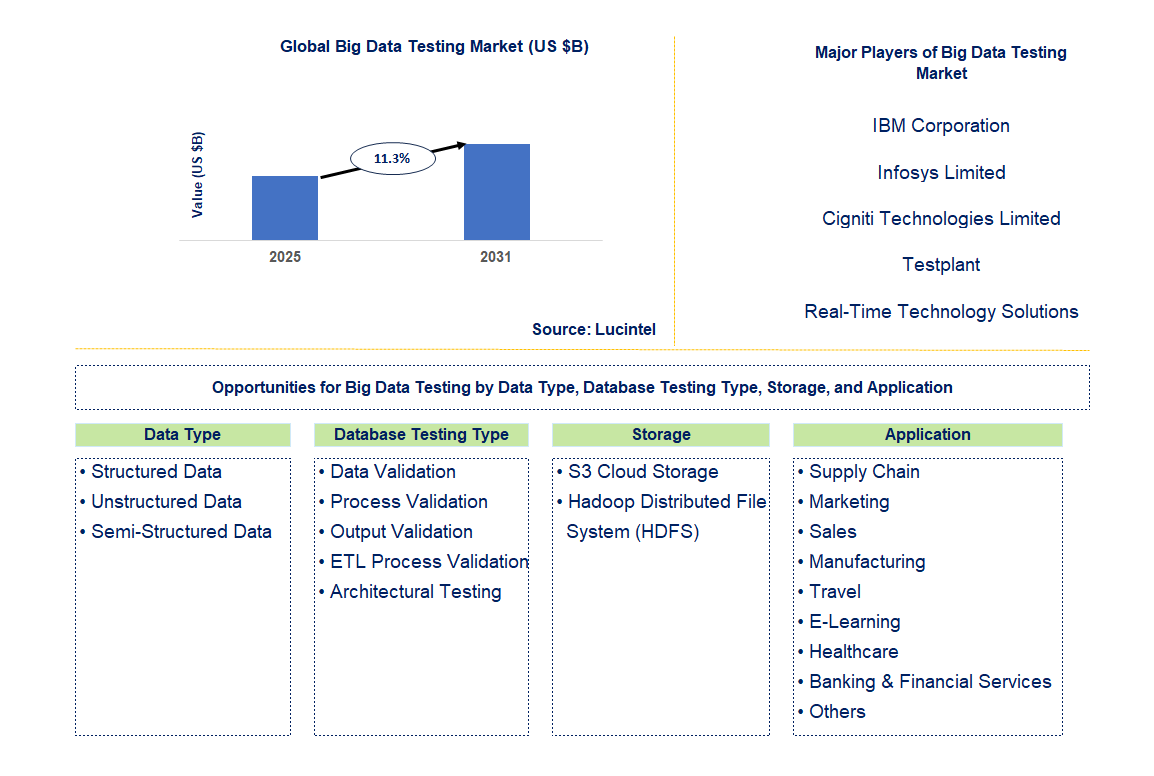
Key data points: The growth forecast = 11.3% annually for the next 7 years. Scroll below to get more insights. This market report covers Trends, opportunity and forecast in big data testing market to 2031 by data type (structured data, unstructured data, and semi-structured data), database testing type (data validation, process validation, output validation, ETL process validation, and architectural testing), storage (S3 cloud storage and hadoop distributed file system (HDFS)), application (supply chain, marketing, sales, manufacturing, travel, e-learning, healthcare, banking & financial services, and others), and region (North America, Europe, Asia Pacific, and the Rest of the World)
We'll send your sample report shortly.
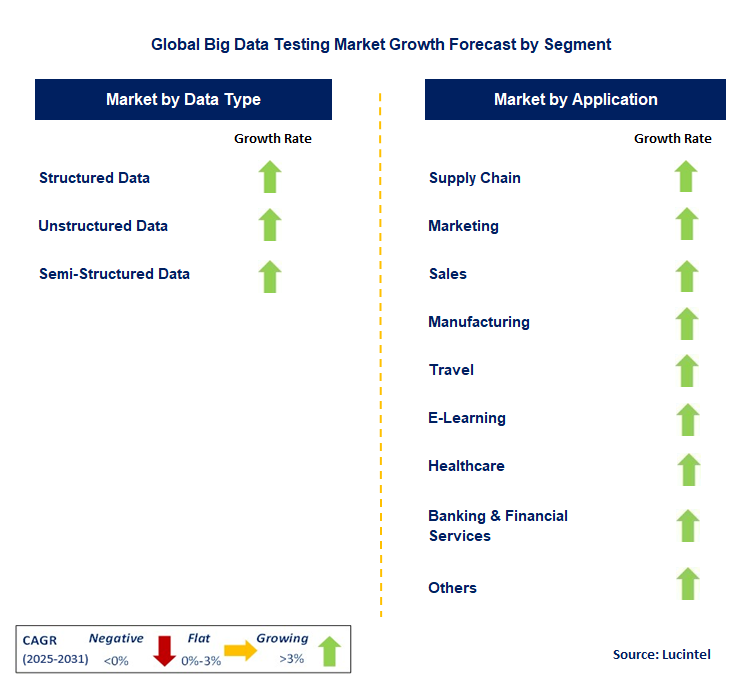
• Lucintel forecasts that, within the data type category, structured data is expected to witness the highest growth over the forecast period.
• Within the application category, healthcare is expected to witness the highest growth.
• In terms of region, North America will remain the largest region over the forecast period due to growing need for insights based on data and the rising adoption of advanced technologies in the region. Gain valuable insights for your business decisions with our comprehensive 150+ page report. Sample figures with some insights are shown below.
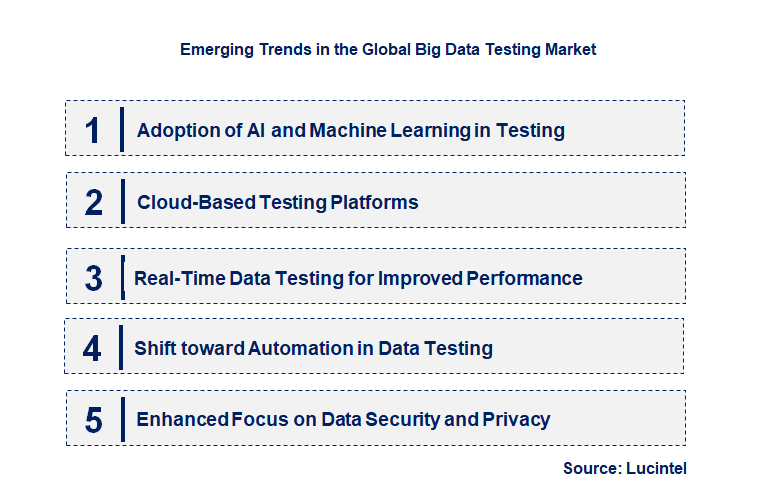
• Adoption of AI and Machine Learning in Testing: AI and machine learning are revolutionizing Big Data Testing by automating data validation and anomaly detection. These technologies enable predictive analytics, where potential issues are identified before they impact system performance. Machine learning models can continuously improve test cases based on historical data, reducing the time spent on manual interventions. The use of AI also enhances the scalability of testing frameworks, making it easier to handle large and complex datasets. As data volumes increase, AI-driven testing is becoming essential for optimizing both the speed and accuracy of Big Data Testing processes.
• Cloud-Based Testing Platforms: Cloud-based testing solutions are rapidly gaining traction in the big data testing market. These platforms offer scalability, flexibility, and cost-efficiency, allowing organizations to test large datasets without investing in on-premise infrastructure. Cloud environments enable real-time collaboration among distributed teams and simplify the testing of cloud-based applications. Additionally, the integration of Big Data Testing tools with cloud services provides businesses with automated testing capabilities and faster results. As cloud adoption continues to rise, this trend is expected to dominate the market, providing businesses with efficient, reliable, and cost-effective solutions for data testing.
• Real-Time Data Testing for Improved Performance: As businesses increasingly rely on real-time data for decision-making, there is a growing need for real-time data testing to ensure the accuracy and reliability of streaming data. Real-time testing is essential for applications in sectors like finance, healthcare, and IoT, where timely data processing is critical. This trend focuses on validating data as it is generated, ensuring it is correctly processed and transmitted in real time. Tools and techniques for real-time data testing are evolving to keep pace with the rise of streaming analytics and real-time data processing platforms, improving overall system performance and reliability.
• Shift toward Automation in Data Testing: Automation is increasingly being integrated into Big Data Testing to streamline repetitive tasks, such as data validation and performance testing. By automating these processes, businesses can reduce human error, speed up testing cycles, and improve overall efficiency. Automated testing frameworks can also scale to handle large datasets, making it easier to validate complex big data applications. The rise of DevOps and CI/CD methodologies has further fueled this trend, as automation aligns with the need for continuous integration and deployment of data-driven applications. This shift toward automation is revolutionizing how testing is performed, driving higher quality and faster releases.
• Enhanced Focus on Data Security and Privacy: With growing concerns around data breaches and privacy regulations like GDPR and CCPA, there is an increasing focus on integrating data security and privacy testing into Big Data Testing frameworks. Businesses are now prioritizing secure data handling practices and ensuring compliance with local and international regulations. Security testing tools are being developed to assess vulnerabilities and protect sensitive data in the storage, transit, and processing stages. This trend is critical for industries such as healthcare, finance, and e-commerce, where data security is paramount. Ensuring data privacy is an essential aspect of maintaining trust and mitigating risks associated with Big Data applications. The big data testing market is evolving rapidly, driven by emerging trends such as AI-powered testing, cloud-based platforms, real-time data testing, automation, and a heightened focus on data security. These trends are reshaping the industry by improving the efficiency, scalability, and accuracy of data validation processes. As businesses continue to embrace data-driven decision-making, the need for robust testing solutions will intensify. By leveraging these trends, organizations can ensure data integrity, optimize performance, and maintain security in their big data applications, paving the way for better outcomes in sectors ranging from finance to healthcare and beyond.
• Integration of AI and Machine Learning in Testing Tools: Artificial Intelligence (AI) and Machine Learning (ML) have become key components of modern Big Data Testing solutions. AI-driven testing tools now automate data validation and error detection processes by identifying patterns and anomalies in large datasets. These tools learn from historical test data and adapt over time to improve test accuracy and efficiency. As a result, AI and ML integration enables faster, more accurate testing cycles while reducing manual intervention. This development is particularly beneficial for industries that rely on high-volume data, such as e-commerce, healthcare, and finance.
• Emergence of Cloud-Based Testing Solutions: Cloud-based testing platforms have become increasingly popular in the big data testing market due to their scalability, cost-efficiency, and flexibility. These platforms provide businesses with the ability to test large datasets without needing to invest in costly on-premise infrastructure. Cloud environments also enable real-time collaboration across distributed teams and simplify the testing of cloud-based applications. Moreover, the integration of Big Data Testing tools with cloud services offers businesses automated testing capabilities and faster results. This development is fostering greater adoption of cloud technologies, especially for industries transitioning to cloud environments.
• Real-Time Data Testing Capabilities: With the growing importance of real-time data in decision-making, there has been a surge in the demand for real-time Big Data Testing solutions. Real-time data testing ensures that data streams are continuously validated and processed without delays. This development is particularly relevant for sectors such as financial services, healthcare, and IoT, where the timely processing of data is crucial. By implementing real-time testing frameworks, businesses can maintain the accuracy and performance of live data systems, enabling them to make informed decisions instantly and mitigate potential issues before they affect operations.
• Automation of Testing Processes: Automation has emerged as a critical development in Big Data Testing, helping organizations reduce manual efforts and speed up testing cycles. Automated testing frameworks can efficiently validate data, conduct regression tests, and perform performance checks on vast datasets. These tools not only improve accuracy but also enhance testing efficiency, allowing businesses to scale their operations and meet faster release schedules. With the rise of DevOps and continuous integration/continuous deployment (CI/CD) pipelines, automated testing has become integral to agile methodologies. This development allows organizations to maintain high-quality standards without slowing down production.
• Enhanced Focus on Data Security and Privacy Testing: As concerns around data security and privacy grow, there has been a marked shift towards incorporating security and privacy testing into Big Data Testing frameworks. With strict data protection regulations such as GDPR and CCPA, businesses are focusing on ensuring compliance and safeguarding sensitive information. New testing tools are being developed to evaluate data vulnerabilities and ensure that data is securely handled at every stage of its lifecycle. This development is especially critical for industries like healthcare, finance, and e-commerce, where data breaches can lead to severe financial and reputational damage. Recent developments in the big data testing market are transforming how businesses approach data validation, performance, and security. The integration of AI and ML, the rise of cloud-based platforms, the shift toward real-time data testing, the automation of testing processes, and the focus on data security are all playing pivotal roles in reshaping the landscape. These innovations enable companies to handle vast datasets more efficiently, maintain high-quality standards, and comply with regulations, all while optimizing their testing cycles. As the market continues to evolve, these developments will likely remain central to the successful implementation of big data solutions.
• E-Commerce Data Validation and Testing: E-commerce businesses are increasingly relying on Big Data for personalized recommendations, customer analytics, and inventory management. A key growth opportunity in Big Data Testing is ensuring the integrity and accuracy of e-commerce data, especially given the vast amount of user behavior and transactional data involved. Automated testing solutions can be employed to verify data accuracy in real-time, ensuring that personalized content and recommendations are based on the most recent and correct data. This improves the user experience and boosts conversion rates while also ensuring compliance with regulatory standards such as GDPR.
• Real-Time Testing in IoT Systems: The Internet of Things (IoT) is generating an enormous amount of real-time data, making real-time testing a crucial growth opportunity in Big Data Testing. As IoT devices increase in number and complexity, businesses need to ensure the data they generate is validated continuously to maintain system performance. This opportunity focuses on automating the testing of real-time data streams, ensuring accurate data capture, low latency, and operational efficiency. By implementing robust real-time testing, companies can improve the reliability of IoT systems, which are critical for applications in smart homes, healthcare, and industrial automation.
• Data Security and Privacy Testing in Healthcare: Healthcare is another key industry with significant Big Data usage, and with sensitive patient data, security and privacy testing are vital. Given the rise of digital health technologies and the increased regulatory pressure from frameworks like HIPAA and GDPR, ensuring data privacy and security in healthcare applications presents a growth opportunity. Big Data Testing solutions focused on detecting vulnerabilities, preventing data breaches, and ensuring regulatory compliance can protect patient information and maintain system trustworthiness. By investing in these solutions, healthcare organizations can safeguard patient data, comply with regulations, and prevent costly security breaches.
• Fraud Detection and Risk Management in Financial Services: In the financial sector, Big Data is extensively used for predictive analytics, fraud detection, and risk management. A significant growth opportunity exists in developing advanced testing tools that can analyze vast amounts of transactional data for potential fraud and anomalies. By leveraging machine learning and AI, financial institutions can enhance the effectiveness of their fraud detection systems. Big Data Testing tools that simulate various scenarios and stress-test systems against fraudulent activity allow for more accurate risk assessments. This contributes to greater security, regulatory compliance, and improved trust from clients and stakeholders.
• Cloud-Based Testing for Scalability in Retail: Retail businesses are increasingly adopting cloud-based platforms for data storage, inventory management, and customer analytics. This transition presents a key opportunity for Big Data Testing in retail, particularly in testing the scalability of cloud-based data management systems. By leveraging cloud-based testing platforms, retailers can ensure their systems can handle fluctuating data loads, such as during sales events or peak shopping seasons. Automated testing tools that assess scalability, data flow, and system performance ensure that retailers can maintain seamless operations and avoid system downtime, which is crucial for customer satisfaction and operational efficiency. Strategic growth opportunities in Big Data Testing are unfolding across diverse applications, each addressing specific challenges in data accuracy, real-time validation, security, and scalability. In e-commerce, IoT, healthcare, finance, and retail, businesses are investing in advanced testing solutions that automate processes, ensure data integrity, and optimize system performance. By capitalizing on these growth opportunities, companies can meet the increasing demands of Big Data while ensuring compliance with regulations, enhancing customer satisfaction, and improving operational efficiency. These opportunities are shaping the future of the big data testing market, driving innovation and competitive advantage in key industries.
• IBM Corporation
• Infosys Limited
• Cigniti Technologies Limited
• Testplant
• Real-Time Technology Solutions
• Tricentis
• Codoid
• Structured Data
• Unstructured Data
• Semi-Structured Data
• Data Validation
• Process Validation
• Output Validation
• ETL Process Validation
• Architectural Testing
• North America
• Europe
• Asia Pacific
• The Rest of the World
• United States: In the United States, the big data testing market is evolving rapidly with advancements in automation tools and AI-powered testing frameworks. Companies are increasingly adopting cloud-based testing platforms to handle the massive volumes of data generated by IoT, social media, and e-commerce. Key players in the tech industry are investing in machine learning algorithms that enhance the efficiency of data validation and quality assurance. The integration of DevOps with big data testing is streamlining the testing process, ensuring faster releases and better scalability. These innovations are transforming sectors like finance, healthcare, and retail, where data accuracy is critical.
• China: China has seen a surge in Big Data Testing adoption driven by its fast-growing technology sector and government investments in data-driven industries. The country is advancing its big data capabilities in e-commerce, smart cities, and telecommunications. With the rapid data growth from consumer behavior and government initiatives, Chinese companies are focusing on developing high-performance testing tools for data quality and security. Local companies are leveraging cloud computing and AI to enhance their testing frameworks, aiming to ensure seamless data processing and analytics for industries like finance, manufacturing, and healthcare.
• Germany: Germany is strengthening its position in the big data testing market through a combination of innovation and regulatory compliance. The country's industries, particularly automotive, engineering, and finance, are leveraging big data to optimize their operations, which has fueled the demand for comprehensive testing solutions. Recent advancements include the integration of blockchain technology for data integrity testing and the use of artificial intelligence to predict data anomalies. Additionally, the EU's GDPR regulations have driven the adoption of secure data testing practices, with German companies prioritizing compliance while optimizing their big data systems for scalability and performance.
• India: The Indian big data testing market is expanding rapidly, particularly in IT services, telecom, and e-commerce. As Indian companies increasingly adopt data-driven strategies, they are investing in Big Data Testing tools to handle large-scale data volumes efficiently. Indian startups and established IT giants are developing customized testing solutions to meet the specific needs of the finance, healthcare, and retail sectors. Moreover, India's growing focus on digital transformation and cloud migration is accelerating the demand for advanced testing techniques to ensure data integrity, security, and performance across cloud environments. The trend of using open-source testing tools is also growing in India.
• Japan: Japan is embracing Big Data Testing to support its technological advancements in robotics, healthcare, and automotive industries. The country is focused on optimizing testing solutions to ensure the high quality of data used in automated systems and IoT devices. Japanese companies are incorporating machine learning models to predict data anomalies and automate testing processes. With the rise of big data applications in manufacturing and healthcare, testing tools are being developed to handle large datasets and ensure real-time performance. Japan's commitment to advanced technologies and high-quality standards is driving innovation in the big data testing market, particularly in automation and scalability.


• IBM Corporation
• Infosys Limited
• Cigniti Technologies Limited
• Testplant
• Real-Time Technology Solutions
• Tricentis
• Codoid Q5. Which big data testing market segment will be the largest in future? Answer: Lucintel forecasts that structured data is expected to witness the highest growth over the forecast period. Q6. In big data testing market, which region is expected to be the largest in next 5 years? Answer: North America will remain the largest region over the forecast period due to growing need for insights based on data and the rising adoption of advanced technologies in the region. Q7. Do we receive customization in this report? Answer: Yes, Lucintel provides 10% customization without any additional cost.


Choose a license that fits your team. Instant PDF delivery.
Prices exclude taxes. Instant delivery. Custom licensing available on request.
Market Report · July 15, 2026
Market Report · June 26, 2026
Market Report · June 24, 2026
Trusted partner for strategic intelligence and business growth


Receive a complimentary market analysis tailored to your industry. Our analysts will identify key growth opportunities and competitive dynamics specific to your business.

Market size, growth rate, and key trend analysis for your specific sector.

Top competitor positioning and market share analysis.

Strategic recommendations backed by data-driven insights.
Get curated market intelligence and competitive moves straight to your inbox.
By subscribing, you agree to receive our monthly insights. Unsubscribe anytime.
Receive a complimentary market analysis tailored to your industry. Our analysts will identify key growth opportunities and competitive dynamics specific to your business.
Market size, growth rate, and key trend analysis for your specific sector.
Top competitor positioning and market share analysis.
Strategic recommendations backed by data-driven insights.
Get curated market intelligence, emerging trends, and competitive moves straight to your inbox each month.
By subscribing, you agree to receive our monthly insights. Unsubscribe anytime.
We'll send your sample report shortly.