
Market Report · July 13, 2026

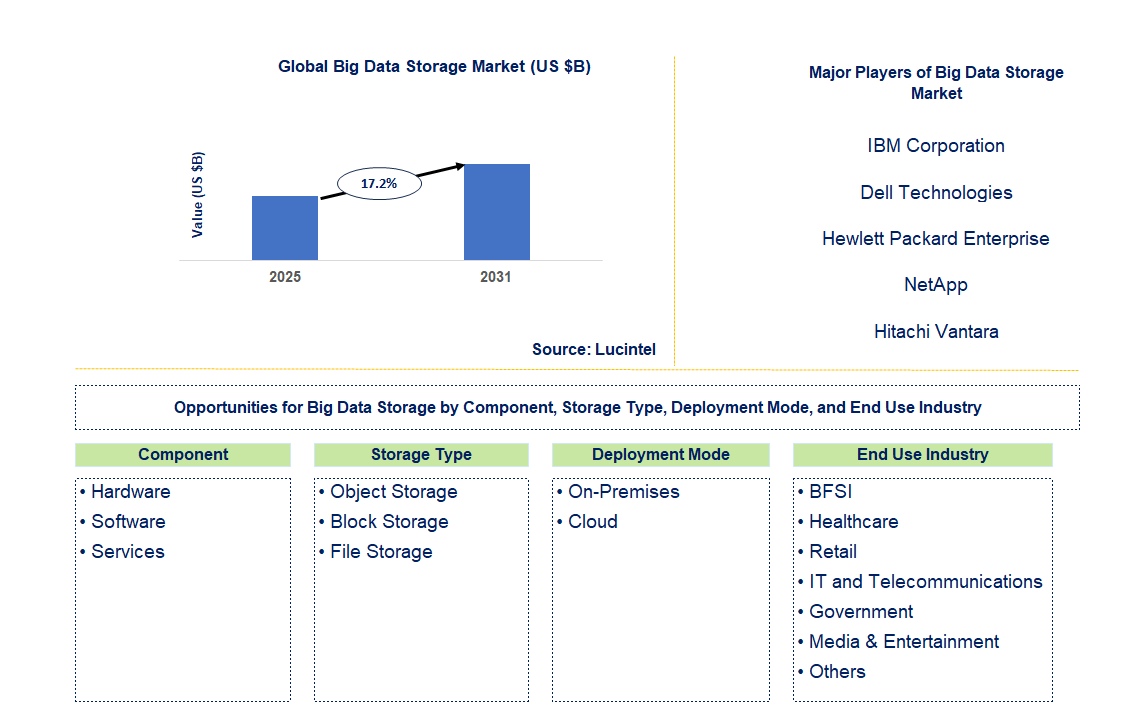
Key data points: The growth forecast = 17.2% annually for the next 7 years. Scroll below to get more insights. This market report covers Trends, opportunity and forecast in big data storage market to 2031 by component (hardware, software, and services), storage type (object storage, block storage, and file storage), deployment mode (on-premises and cloud), end use industry (BFSI, healthcare, retail, IT and telecommunications, government, media & entertainment, and others), and region (North America, Europe, Asia Pacific, and the Rest of the World)
We'll send your sample report shortly.
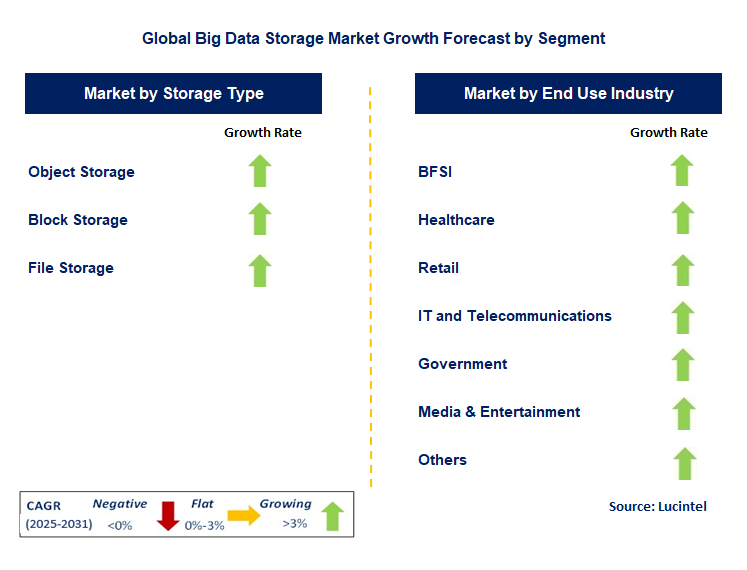
• Lucintel forecasts that, within the storage type category, object storage is expected to witness the highest growth over the forecast period.
• Within the end use industry category, BFSI is expected to witness the highest growth.
• In terms of region, North America is expected to witness the highest growth over the forecast period due to the presence of significant technology firms and the rapid uptake of cutting-edge storage solutions. Gain valuable insights for your business decisions with our comprehensive 150+ page report. Sample figures with some insights are shown below.
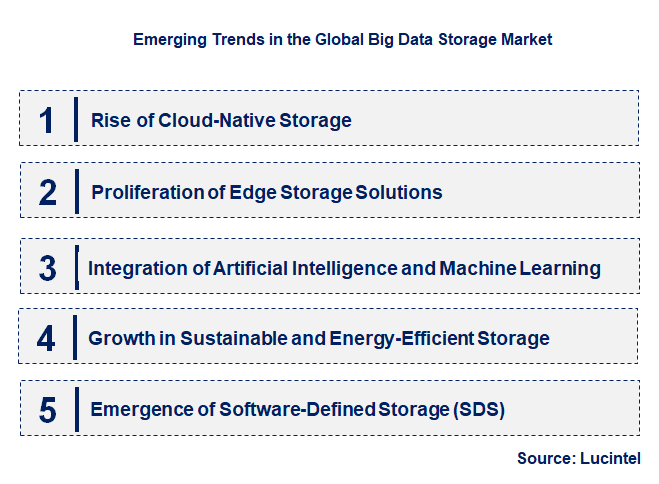
• Rise of Cloud-Native Storage: Cloud-native storage solutions are designed to integrate seamlessly with cloud computing platforms, offering scalability and flexibility for modern applications. Organizations are moving away from traditional storage systems to adopt solutions that support containerized workloads and microservices architectures. This trend is driven by the need to support hybrid and multi-cloud environments, enabling businesses to store and access data across diverse locations with minimal latency. Major providers like AWS, Google Cloud, and Microsoft Azure are leading the charge with robust cloud-native storage offerings. This shift reduces infrastructure costs and increases agility, allowing businesses to respond rapidly to changing market needs.
• Proliferation of Edge Storage Solutions: Edge storage is gaining traction as industries like healthcare, retail, and manufacturing seek real-time data processing capabilities closer to the data source. By decentralizing data storage and processing, edge solutions reduce latency and enhance performance for applications like IoT and autonomous systems. Companies are investing in compact, energy-efficient storage devices tailored for edge use cases. This trend is particularly impactful in remote and bandwidth-constrained environments. As 5G networks expand, the adoption of edge storage is expected to accelerate, enabling faster data processing and empowering industries with actionable insights at the edge of their operations.
• Integration of Artificial Intelligence and Machine Learning: AI and ML are revolutionizing data storage by enabling intelligent data management and predictive analytics. These technologies optimize storage utilization, automate routine tasks, and enhance security through anomaly detection. AI-powered storage systems can dynamically allocate resources based on workload requirements, improving efficiency and reducing costs. For example, predictive analytics can identify storage failures before they occur, minimizing downtime. As the volume and complexity of data grow, AI and ML are becoming indispensable tools for organizations looking to harness the full potential of their storage infrastructure while maintaining operational excellence.
• Growth in Sustainable and Energy-Efficient Storage: Sustainability is a growing priority in the big data storage market, driven by environmental concerns and regulatory pressures. Companies are focusing on developing energy-efficient storage systems and adopting green data center practices. Innovations such as liquid cooling, heat recycling, and low-power SSDs are reducing the environmental footprint of storage infrastructure. Cloud providers are also committing to carbon neutrality, influencing the design of next-generation storage solutions. This trend not only addresses sustainability goals but also lowers operating costs, making energy-efficient storage a win-win for businesses. Sustainable practices are becoming a key differentiator in an increasingly competitive market.
• Emergence of Software-Defined Storage (SDS): Software-Defined Storage (SDS) is transforming how data is stored and managed by decoupling storage hardware from the software layer. SDS enables greater flexibility, scalability, and cost-efficiency by allowing organizations to use commodity hardware with sophisticated storage software. This approach supports diverse data types and dynamic workloads, making it ideal for hybrid and multi-cloud deployments. The ability to scale horizontally and integrate with automation tools further enhances its appeal. With SDS, businesses can adapt quickly to evolving data needs, improving operational efficiency while reducing dependence on proprietary storage systems. These emerging trends—cloud-native storage, edge solutions, AI integration, sustainability, and SDS—are redefining the big data storage market. Together, they address critical challenges such as scalability, efficiency, and environmental impact while unlocking new opportunities for innovation. As organizations embrace these developments, the market is poised for continued growth and transformation, enabling a more intelligent and sustainable future for data storage.
• Expansion of Multi-Cloud Storage Solutions: The adoption of multi-cloud strategies has surged, enabling businesses to leverage the best features of various cloud providers. Multi-cloud storage allows organizations to distribute data across multiple platforms, enhancing redundancy, performance, and flexibility. Providers like AWS, Google Cloud, and Azure offer advanced interoperability features to simplify data migration and management. This approach minimizes vendor lock-in and improves disaster recovery capabilities. Businesses benefit from greater control over their data environments, reduced downtime, and optimized costs. Multi-cloud storage is becoming a cornerstone for enterprises seeking agility and resilience in their data operations.
• Advancements in NVMe Storage Technology: Non-Volatile Memory Express (NVMe) is revolutionizing storage performance, offering ultra-low latency and high-speed data transfer capabilities. This technology is increasingly adopted in data centers and enterprise environments to handle workloads like AI, analytics, and real-time processing. NVMe over Fabrics (NVMe-of) extends these benefits across networked storage systems, further boosting scalability. Major players are launching NVMe-based solutions to meet the growing demand for faster and more efficient storage. NVMe's impact is evident in reduced application response times, improved user experiences, and enhanced operational efficiency, making it a critical component of modern Big Data Storage infrastructures.
• Emergence of Object Storage for Unstructured Data: Object storage has gained prominence as an efficient solution for managing unstructured data such as images, videos, and documents. Its scalability and cost-effectiveness make it ideal for use cases like media streaming, archiving, and AI training datasets. Cloud providers and storage vendors are enhancing their object storage platforms with features like AI-driven data tagging, improved searchability, and high durability. Businesses benefit from simplified data access and reduced storage costs while maintaining data integrity. Object storage is becoming a preferred choice for industries dealing with large volumes of unstructured data, contributing to improved data-driven decision-making.
• Growth in Storage Security and Encryption Technologies: With data breaches and cyber threats on the rise, storage security has become a top priority. Innovations in encryption technologies, such as homomorphic encryption and quantum-safe encryption, are bolstering data protection. Storage providers are also integrating AI-driven anomaly detection and zero-trust architectures to enhance security measures. Compliance with data privacy regulations like GDPR and CCPA is driving investments in secure storage solutions. These advancements mitigate risks, ensuring data confidentiality and integrity while boosting customer trust. The emphasis on storage security is reshaping the market by prioritizing robust safeguards in the design and deployment of storage systems.
• Adoption of AI-Powered Data Management: AI-powered data management is transforming storage systems, enabling automation and intelligent decision-making. AI optimizes resource allocation, predicts failures, and enhances data retrieval speeds. Machine learning algorithms are used to categorize and prioritize data, improving overall storage efficiency. Cloud providers are embedding AI features into their storage offerings, facilitating real-time analytics and workload optimization. The adoption of AI-driven solutions reduces manual intervention, lowers operational costs, and enhances system reliability. This development is crucial for organizations aiming to handle growing data complexities while maintaining high levels of performance and scalability. The big data storage market is undergoing significant evolution through developments like multi-cloud strategies, NVMe adoption, object storage, advanced security, and AI integration. These advancements address critical challenges while unlocking new opportunities for businesses to enhance their data infrastructure. Together, they are shaping a future where data storage is faster, more secure, and more adaptable, empowering organizations to thrive in a data-driven era.
• Healthcare - Enhancing Patient Care Through Data Integration: Healthcare applications, including electronic health records (EHRs), medical imaging, and genomics, require vast storage capacities and real-time access. Big Data Storage solutions enable healthcare providers to integrate patient data from multiple sources, improving diagnostics and personalized treatments. Cloud-based and hybrid storage systems ensure data security and compliance with regulations like HIPAA. Advanced analytics powered by AI further enhance decision-making and patient outcomes. The adoption of robust storage infrastructure in healthcare is driving advancements in predictive medicine and operational efficiency, creating significant growth opportunities for providers catering to this sector.
• Finance - Strengthening Risk Management and Fraud Detection: The financial industry generates enormous amounts of transactional and behavioral data, necessitating efficient storage solutions to support analytics and compliance. Big Data Storage systems enhance risk assessment, fraud detection, and real-time transaction monitoring. Innovations like high-performance storage for trading platforms and secure archiving solutions for regulatory data offer strategic growth opportunities. Cloud-based storage also supports scalability and disaster recovery. As financial institutions adopt AI-driven models for predictive analytics, demand for scalable and secure storage systems is set to rise, making it a key area of growth in the big data storage market.
• Retail - Driving Personalized Customer Experiences: In retail, Big Data Storage supports the collection and analysis of customer behavior, inventory management, and supply chain optimization. Retailers leverage real-time data from e-commerce platforms, IoT devices, and loyalty programs to create personalized shopping experiences. Cloud-native storage solutions allow retailers to scale quickly during peak shopping periods while managing operational costs. AI-powered insights derived from stored data drive targeted marketing campaigns and inventory forecasting. By enabling retailers to harness data for decision-making, Big Data Storage solutions open avenues for enhanced customer engagement and operational excellence, making it a strategic growth area in the retail sector.
• Media and Entertainment - Empowering Content Delivery and Analytics: The media and entertainment industry is driven by the need to store, manage, and deliver large volumes of high-resolution content. Big Data Storage solutions support workflows like video editing, rendering, and real-time streaming. Object storage, combined with AI, enables efficient content search and categorization. Content Delivery Networks (CDNs) leverage edge storage to ensure seamless user experiences. As streaming platforms expand globally, scalable and energy-efficient storage systems are crucial. The industry's reliance on advanced storage technologies for enhanced content creation and delivery positions media and entertainment as a significant growth driver for the market.
• Manufacturing - Enabling Smart Factories and IoT Integration: In manufacturing, Big Data Storage underpins applications like predictive maintenance, supply chain optimization, and quality control. The rise of IoT devices in smart factories generates vast amounts of data requiring efficient storage and real-time processing. Edge storage solutions enable manufacturers to process data locally, reducing latency and improving decision-making. Advanced analytics stored on scalable systems enhance operational efficiency and product innovation. As Industry 4.0 adoption grows, storage providers offering tailored solutions for manufacturing processes are positioned to capitalize on this trend, creating growth opportunities within the sector. Strategic growth opportunities in the big data storage market are emerging across healthcare, finance, retail, media, and manufacturing applications. These sectors demand innovative storage solutions to enhance efficiency, scalability, and analytics capabilities. By addressing the specific needs of each application, storage providers can unlock significant value for industries navigating the complexities of a data-driven world. Collectively, these opportunities are driving the evolution of the big data storage market, ensuring its critical role in powering innovation and operational success across key verticals.
• IBM Corporation
• Dell Technologies
• Hewlett Packard Enterprise (HPE)
• NetApp
• Hitachi Vantara
• Amazon Web Services (AWS)
• Microsoft Corporation
• Google Cloud Platform
• Oracle Corporation
• Pure Storage
• Hardware
• Software
• Services
• Object Storage
• Block Storage
• File Storage
• North America
• Europe
• Asia Pacific
• The Rest of the World
• United States: The United States remains a leader in Big Data Storage, with significant growth driven by advancements in hybrid cloud solutions and storage-as-a-service platforms. Major players like Amazon Web Services, Microsoft Azure, and Google Cloud continue to innovate with AI-driven data management tools and high-speed storage tiers. Additionally, increased adoption of NVMe (Non-Volatile Memory Express) technologies has enhanced performance in data centers. Regulatory requirements around data privacy, such as CCPA, have also spurred investment in secure storage architectures. Collaboration between tech firms and federal initiatives further accelerates the development of cutting-edge storage solutions.
• China: The Chinese big data storage market is booming, fueled by government-backed digital transformation initiatives and the rise of domestic tech giants like Alibaba Cloud and Tencent Cloud. The country has seen rapid adoption of localized cloud storage solutions, catering to stringent data localization laws. Investment in AI-powered storage optimization and high-performance computing solutions is growing and is driven by sectors like e-commerce and smart cities. Additionally, China's leadership in hardware manufacturing has positioned it as a hub for innovative storage hardware, including SSDs and next-generation memory technologies. Partnerships with global firms are also expanding China's influence in the market.
• Germany: The German big data storage market is shaped by its robust industrial base and focus on Industry 4.0 initiatives. Enterprises are investing heavily in edge storage solutions to support real-time analytics in the manufacturing and automotive sectors. The adoption of hybrid and multi-cloud architectures is rising, facilitated by partnerships between local firms and international providers. Compliance with GDPR drives demand for secure and transparent data storage solutions. The country's commitment to green technologies has also spurred interest in energy-efficient storage systems, with innovations in heat-resistant and sustainable data center designs.
• India: The Indian big data storage market is expanding rapidly due to the proliferation of digital services and the government's push for data localization. Cloud adoption across industries like IT, BFSI, and retail is driving demand for scalable storage solutions. Domestic players such as Tata Communications and HCL Technologies are gaining prominence alongside global cloud providers. AI and ML integration in storage systems for analytics is a growing trend. Additionally, the rise of hyperscale data centers in cities like Hyderabad and Bengaluru reflects India's increasing importance as a global data hub. Affordable solutions cater to small and medium enterprises.
• Japan: The Japanese big data storage market is characterized by innovation in storage technologies and a focus on advanced automation. Companies like Fujitsu and Hitachi have led the development of cutting-edge storage systems, including all-flash arrays and software-defined storage solutions. The demand for 5G and IoT storage capabilities has surged, aligning with Japan's goals for smart infrastructure and connected devices. The country's emphasis on disaster recovery and business continuity has driven the adoption of high-reliability storage systems. Additionally, collaboration with academic institutions fosters R&D in quantum and DNA storage technologies, setting the stage for future breakthroughs in Big Data Storage.


• IBM Corporation
• Dell Technologies
• Hewlett Packard Enterprise (HPE)
• NetApp
• Hitachi Vantara
• Amazon Web Services (AWS)
• Microsoft Corporation
• Google Cloud Platform
• Oracle Corporation
• Pure Storage Q5. Which big data storage market segment will be the largest in future? Answer: Lucintel forecasts that object storage is expected to witness the highest growth over the forecast period. Q6. In big data storage market, which region is expected to be the largest in next 5 years? Answer: North America is expected to witness the highest growth over the forecast period due to the presence of significant technology firms and the rapid uptake of cutting-edge storage solutions. Q7. Do we receive customization in this report? Answer: Yes, Lucintel provides 10% customization without any additional cost.


Choose a license that fits your team. Instant PDF delivery.
Prices exclude taxes. Instant delivery. Custom licensing available on request.
Market Report · July 13, 2026
Market Report · July 13, 2026
Market Report · July 2, 2026
Trusted partner for strategic intelligence and business growth


Receive a complimentary market analysis tailored to your industry. Our analysts will identify key growth opportunities and competitive dynamics specific to your business.

Market size, growth rate, and key trend analysis for your specific sector.

Top competitor positioning and market share analysis.

Strategic recommendations backed by data-driven insights.
Get curated market intelligence and competitive moves straight to your inbox.
By subscribing, you agree to receive our monthly insights. Unsubscribe anytime.
Receive a complimentary market analysis tailored to your industry. Our analysts will identify key growth opportunities and competitive dynamics specific to your business.
Market size, growth rate, and key trend analysis for your specific sector.
Top competitor positioning and market share analysis.
Strategic recommendations backed by data-driven insights.
Get curated market intelligence, emerging trends, and competitive moves straight to your inbox each month.
By subscribing, you agree to receive our monthly insights. Unsubscribe anytime.
We'll send your sample report shortly.