
Market Report · July 15, 2026

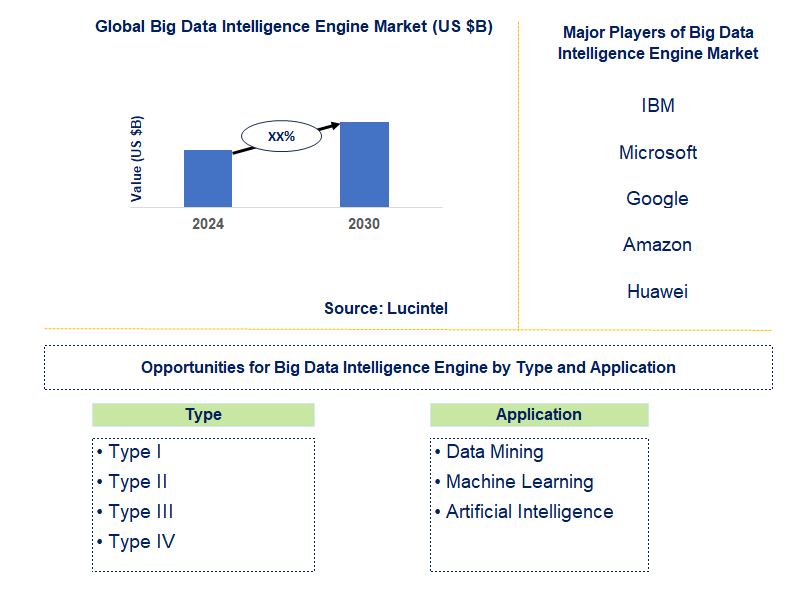
Key data points: The growth forecast = 15.4% annually for the next 7 years. Scroll below to get more insights. This market report covers Trends, opportunity and forecast in big data intelligence engine market to 2031 by type (type I, type II, type III, and type IV), application (data mining, machine learning, and artificial intelligence), and region (North America, Europe, Asia Pacific, and the Rest of the World)
We'll send your sample report shortly.
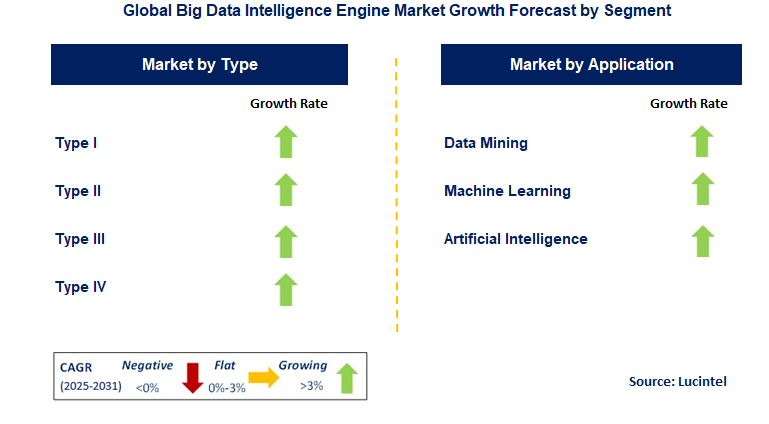
• Lucintel forecasts that, within the type category, type III is expected to witness the highest growth over the forecast period.
• Within the application category, machine learning is expected to witness the highest growth.
• In terms of region, APAC is expected to witness the highest growth over the forecast period. Gain valuable insights for your business decisions with our comprehensive 150+ page report. Sample figures with some insights are shown below.
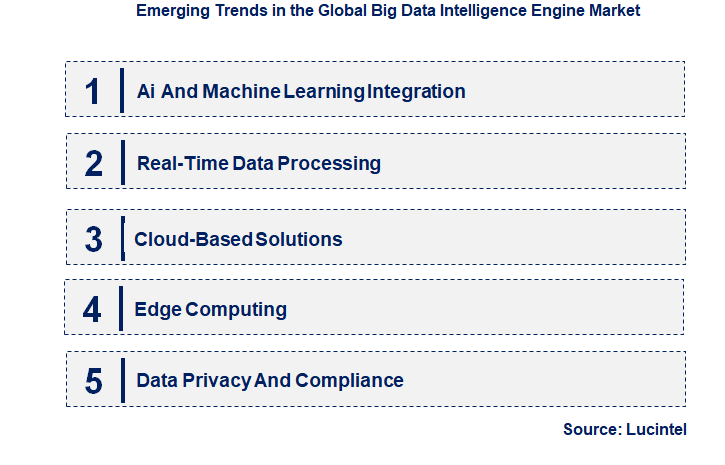
• AI and Machine Learning Integration: The incorporation of AI and machine learning into big data intelligence engines continues to improve the accuracy and speed of insights. New technologies enable more sophisticated data processing and predictive analytics for better decision-making. As machine learning models advance, businesses can automate and optimize various operations based on data, leading to improved business outcomes.
• Real-Time Data Processing: Many industries, including finance, healthcare, and e-commerce, now require real-time data analytics. As a result, big data intelligence engines are increasingly designed to process large datasets in real time, allowing businesses to quickly analyze data and respond to changing situations. This development is especially important for industries where quick decision-making is crucial to reduce risks or improve performance.
• Cloud-Based Solutions: Cloud technology has transformed the way businesses utilize big data. With cloud solutions in place, organizations can continue to grow while containing costs. Cloud platforms offer scalability, flexibility, and efficiency, meaning businesses no longer need to invest heavily in infrastructure. In sectors like healthcare, retail, and finance, businesses are increasingly adopting cloud-based approaches to big data analytics, as they avoid extensive initial investments.
• Edge Computing: The rise of IoT devices has made edge computing increasingly important in the big data intelligence engine market. By bringing algorithms closer to data sources, edge computing reduces latency and decreases bandwidth use. This trend is beneficial for industries like manufacturing, self-driving cars, and smart cities, as it lowers costs and makes data processing more efficient.
• Data Privacy and Compliance: Data privacy is becoming a critical issue amid growing concerns over the management of sensitive data. As stricter regulations come into play, businesses are taking steps like encryption and data masking to stay compliant with laws like GDPR and CCPA. Privacy concerns can no longer be overlooked, and organizations must integrate secure solutions into their data analytics processes while maintaining customer trust. These trends are reshaping the big data intelligence engine market, making it more efficient, responsive, and compliant with regulatory changes.
• AI-Powered Analytics Solutions: AI-powered analytics platforms are gaining significant traction as a primary solution in the big data intelligence engine market. These platforms are being used by organizations in sectors like finance, healthcare, and retail to improve operational efficiency and customer satisfaction. Actionable insights are obtained by analyzing large datasets using machine learning algorithms.
• Adoption of Multi-Cloud Environments: Many companies are moving toward multi-cloud environments for greater flexibility and scalability. Multi-cloud approaches allow organizations to choose cloud services based on their business needs, helping to manage costs and performance. By integrating big data intelligence engines into multi-cloud ecosystems, companies can access and analyze data from multiple sources while minimizing risks.
• Automation of Data Processing: Automation is transforming the big data intelligence engine market by streamlining data collection, cleaning, and analytics. Automated data pipelines reduce the need for human intervention, improving accuracy and speeding up decision-making. As data volumes continue to rise, many companies are adopting automation technologies to better manage data and improve the overall productivity of their data analytics systems.
• Improvements in Natural Language Processing (NLP): NLP is becoming increasingly important for big data intelligence engines, particularly in healthcare and customer-oriented businesses. NLP enables machines to understand human language, helping businesses extract insights from unstructured data like customer reviews, social media posts, and medical documents.
• Integration of Big Data with Blockchain: The integration of blockchain with big data intelligence engines is improving data management by enhancing security and transparency. Blockchain’s decentralized ledger ensures the integrity of data, preventing tampering with sensitive information, especially in sectors like finance and healthcare. This integration helps businesses manage and share large datasets securely. These advancements are facilitating innovation in the big data intelligence engine market as companies increasingly adopt AI, automation, and secure data management practices for improved operational efficiency and decision-making.
• E-Commerce and Retail: The demand for improved customer experiences is driving the adoption of big data intelligence engines in the e-commerce and retail sectors. These engines help analyze customers’ buying behavior, providing automated recommendations. This improves the bottom line by optimizing stock levels, which leads to better operational efficiency and customer satisfaction.
• Healthcare: Many healthcare organizations are using big data intelligence engines to analyze patient data, enhance operational processes, and support decision-making. AI and machine learning help healthcare providers improve diagnostics, predict outcomes, and manage resources effectively, resulting in better care and reduced operational costs.
• Finance: Companies in the finance sector are using big data intelligence engines to detect fraud, manage risks, and analyze customer behavior. Real-time transaction analysis helps identify potentially fraudulent activities, while predictive analytics improves investment decisions and regulatory compliance.
• Manufacturing: Big data intelligence engines are transforming the manufacturing industry by enabling predictive maintenance, supply chain optimization, and production process improvements. IoT devices and sensors help manufacturers analyze large datasets to identify inefficiencies, reduce downtime, and improve product quality, all of which reduce costs and enhance operational effectiveness.
• Smart Cities: The development of smart cities is opening new growth opportunities for big data intelligence engines. IoT devices, sensors, and AI analytics can optimize traffic, reduce energy consumption, and improve public safety in cities. Big data analytics are central to making cities cleaner, smarter, and more enjoyable for residents. The ecosystem of applications that fosters smart cities is creating new opportunities for the industrial use of big data intelligence engines, improving the efficiency and accuracy of decision-making processes within cities.
• IBM
• Microsoft
• Amazon
• Huawei
• Alibaba Cloud
• Tencent Cloud
• Type I
• Type II
• Type III
• Type IV
• Data Mining
• Machine Learning
• Artificial Intelligence
• North America
• Europe
• Asia Pacific
• The Rest of the World
• United States: The US has been a major player in the big data intelligence engine market globally due to its strong technological base. Healthcare, financial services, and retail are among the many industries where enterprises have embraced the use of cloud platforms and artificial intelligence. Other major players like IBM, Microsoft, and Amazon are also advancing innovation through advanced data analytics solutions. The analytics in the US have also advanced further due to government initiatives supporting data adoption in decision-making processes.
• China: China has established itself as a strong actor in the big data intelligence engine market due to the growing e-commerce and fintech sectors, as well as government initiatives for digital transformation projects. The nation has witnessed a significant surge in AI and machine learning, with companies like Alibaba and Tencent making large investments in big data analytics. China's policies on innovation are facilitating the use of data in various sectors like healthcare and manufacturing, which in turn fosters market growth.
• Germany: The development of the big data intelligence engine market in Germany is driven by Industry 4.0, which involves the integration of IoT with AI and machine learning in manufacturing processes. Market development is evident in sectors such as automotive, logistics, and finance. Germany also emphasizes regulation, as evidenced by the GDPR, which impacts data processing and storage. There is a new focus in the country on increasing investment in data-driven technologies, particularly leveraging AI in business intelligence tools for the corporate sector.
• India: The market for big data intelligence engines in India is growing due to the rapid embrace of digitalization and the proliferation of AI and machine learning across various sectors. Indian businesses are using big data analytics driven by the growth of mobile payments, e-commerce, and other digital services to gain deeper insights into customer behavior and improve operational efficiency. Additionally, initiatives like Digital India continue to encourage the application and use of data-driven technologies in both public and private institutions.
• Japan: Japan is investing heavily in the development of new AI, IoT, and big data analytics technologies aimed at improving productivity in manufacturing, automotive, and healthcare industries. Japanese enterprises are adopting big data intelligence engines to enhance operations, customer relations, and product quality. The government of Japan is also promoting the deployment of new technologies to support business digitalization, particularly in the automotive industry, with a focus on data-centric smart manufacturing.


• IBM
• Microsoft
• Amazon
• Huawei
• Alibaba Cloud
• Tencent Cloud Q5. Which big data intelligence engine market segment will be the largest in future? Answer: Lucintel forecasts that type III is expected to witness the highest growth over the forecast period. Q6. In big data intelligence engine market, which region is expected to be the largest in next 5 years? Answer: APAC is expected to witness the highest growth over the forecast period. Q7. Do we receive customization in this report? Answer: Yes, Lucintel provides 10% customization without any additional cost.


Choose a license that fits your team. Instant PDF delivery.
Prices exclude taxes. Instant delivery. Custom licensing available on request.
Market Report · July 15, 2026
Market Report · June 26, 2026
Market Report · June 24, 2026
Trusted partner for strategic intelligence and business growth


Receive a complimentary market analysis tailored to your industry. Our analysts will identify key growth opportunities and competitive dynamics specific to your business.

Market size, growth rate, and key trend analysis for your specific sector.

Top competitor positioning and market share analysis.

Strategic recommendations backed by data-driven insights.
Get curated market intelligence and competitive moves straight to your inbox.
By subscribing, you agree to receive our monthly insights. Unsubscribe anytime.
Receive a complimentary market analysis tailored to your industry. Our analysts will identify key growth opportunities and competitive dynamics specific to your business.
Market size, growth rate, and key trend analysis for your specific sector.
Top competitor positioning and market share analysis.
Strategic recommendations backed by data-driven insights.
Get curated market intelligence, emerging trends, and competitive moves straight to your inbox each month.
By subscribing, you agree to receive our monthly insights. Unsubscribe anytime.
We'll send your sample report shortly.