
Market Report · July 15, 2026

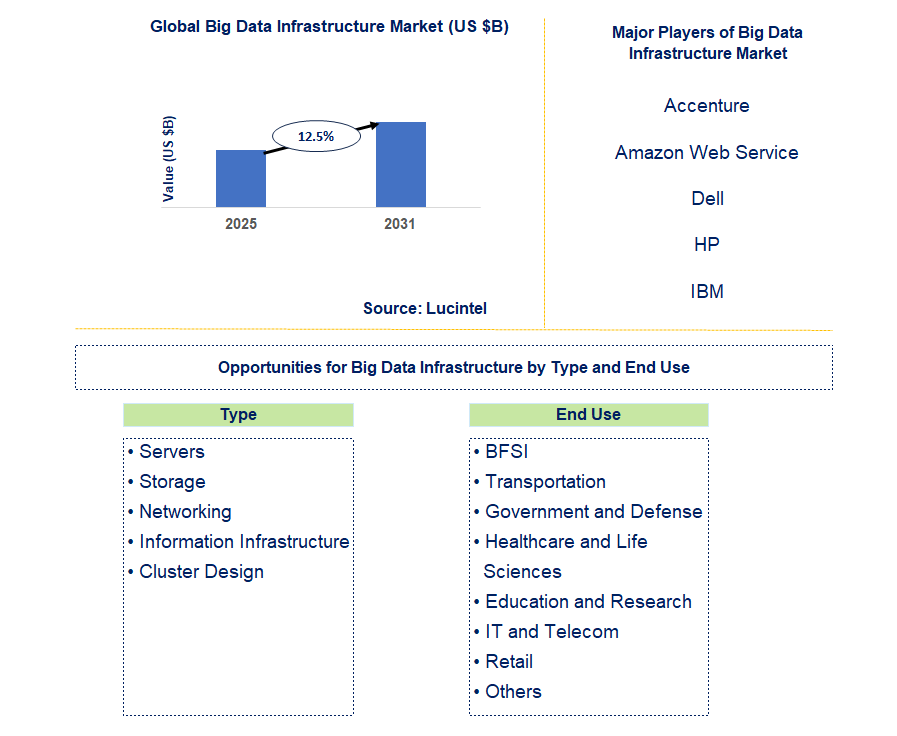
Key data points: The growth forecast = 12.5% annually for the next 7 years. Scroll below to get more insights. This market report covers Trends, opportunity and forecast in big data infrastructure market to 2031 by type (servers, storage, networking, information infrastructure, and cluster design), end use (BFSI, transportation, government and defense, healthcare and life sciences, education and research, IT and telecom, retail, and others), and region (North America, Europe, Asia Pacific, and the Rest of the World)
We'll send your sample report shortly.
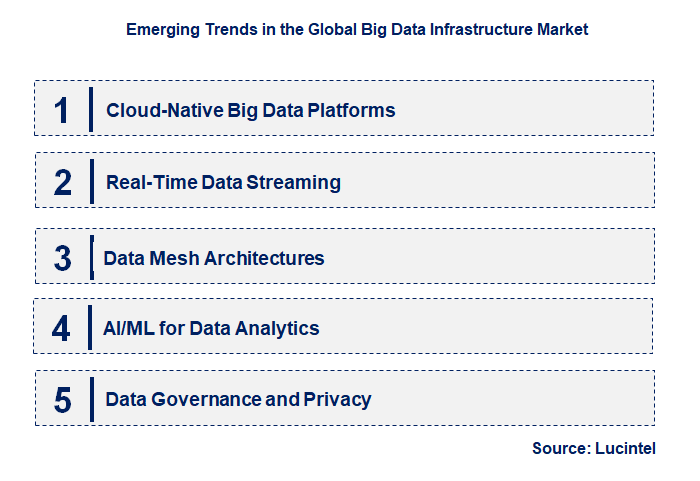
• Cloud-Native Big Data Platforms: Organizations are increasingly migrating their big data infrastructure to cloud-native platforms. Cloud providers offer scalable and cost-effective services for data storage, processing, and analytics. This trend enables organizations to focus on data analysis rather than infrastructure management. The impact is improved agility, reduced costs, and faster time-to-insights.
• Real-Time Data Streaming: The need to process data in real-time is growing rapidly. Technologies like Apache Kafka and Apache Flink enable organizations to ingest, process, and analyze data as it is generated. This trend is crucial for applications like fraud detection, personalized recommendations, and real-time monitoring. The impact is faster decision-making, improved responsiveness, and the ability to react to events in real-time.
• Data Mesh Architectures: Data mesh architectures are emerging as a new approach to data management, decentralizing ownership and empowering domain teams to manage their data as a product. This trend improves data discoverability, accessibility, and quality. The impact is increased agility, improved data governance, and better alignment of data with business needs.
• AI/ML for Data Analytics: Artificial intelligence and machine learning are being increasingly used for data analytics. These technologies enable organizations to automate data analysis, identify patterns and anomalies, and build predictive models. The impact is faster and more accurate insights, improved decision-making, and the ability to automate complex analytical tasks.
• Data Governance and Privacy: With increasing regulations like GDPR and CCPA, data governance and privacy are becoming critical. Organizations are investing in tools and processes to ensure data quality, security, and compliance. This trend is essential for maintaining trust and avoiding penalties. The impact is reduced risk, improved data quality, and enhanced compliance with regulations. These trends are collectively reshaping the big data infrastructure market, driving it towards a more agile, scalable, and intelligent ecosystem. Organizations are embracing new technologies to unlock the full potential of their data, improve decision-making, and gain a competitive advantage. The future of big data lies in the ability to effectively manage and analyze data in a secure, compliant, and efficient manner.
• Cloud-Native Big Data Platforms: Cloud providers offer comprehensive big data platforms, including storage, processing, and analytics services. Organizations are migrating to these platforms for scalability, cost-effectiveness, and ease of use. The impact is reduced infrastructure management burden, improved agility, and faster time-to-insights.
• Real-Time Data Streaming: The need for real-time insights is driving the adoption of data streaming technologies like Apache Kafka and Flink. These technologies enable organizations to process data as it is generated, enabling real-time decision-making and applications like fraud detection. The impact is improved responsiveness, faster decision-making, and the ability to react to events in real-time.
• Data Mesh Architectures: Data mesh architectures are emerging as a decentralized approach to data management. Domain teams own and manage their data as a product, improving data discoverability, accessibility, and quality. The impact is increased agility, improved data governance, and better alignment of data with business needs.
• AI/ML for Data Analytics: AI and machine learning are being integrated into big data platforms to automate data analysis, identify patterns, and build predictive models. This enables organizations to extract deeper insights and make more informed decisions. The impact is faster and more accurate insights, improved decision-making, and automation of complex analytical tasks.
• Data Governance and Privacy: With increasing regulations like GDPR and CCPA, data governance and privacy are crucial. Organizations are investing in tools and processes to ensure data quality, security, and compliance. The impact is reduced risk, improved data quality, and enhanced compliance with regulations. These developments are reshaping the big data infrastructure market, creating a more agile, scalable, and intelligent ecosystem. Organizations are embracing new technologies to unlock the full potential of their data, improve decision-making, and gain a competitive advantage. The future of big data lies in the ability to effectively manage and analyze data in a secure, compliant, and efficient manner.
• Real-Time Analytics: The demand for real-time insights is growing rapidly across industries. Growth opportunities exist to provide infrastructure and solutions for real-time data ingestion, processing, and analysis. This enables businesses to make immediate decisions, respond quickly to changing conditions, and gain a competitive edge. The impact is improved operational efficiency, enhanced customer experiences, and new revenue opportunities.
• Customer Experience Personalization: Organizations are leveraging big data to personalize customer experiences. Growth opportunities exist in providing infrastructure for collecting, analyzing, and acting on customer data to deliver tailored recommendations, offers, and content. This enhances customer engagement, loyalty, and ultimately, revenue. The impact is improved customer satisfaction, increased conversion rates, and stronger customer relationships.
• Predictive Maintenance: Predictive maintenance uses big data and machine learning to predict equipment failures and optimize maintenance schedules. Growth opportunities exist in providing infrastructure for collecting sensor data, building predictive models, and integrating with maintenance systems. This reduces downtime, maintenance costs, and improves operational efficiency. The impact is improved asset utilization, reduced maintenance costs, and enhanced operational efficiency.
• Fraud Detection and Security: Big data plays a crucial role in detecting and preventing fraud and security breaches. Growth opportunities exist in providing infrastructure for analyzing large volumes of data to identify suspicious patterns and anomalies. This helps organizations protect themselves from financial losses and reputational damage. The impact is reduced fraud losses, improved security posture, and enhanced compliance.
• Data-Driven Product Development: Organizations use big data to inform product development decisions. Growth opportunities exist in providing infrastructure for collecting and analyzing customer feedback, market trends, and usage data to develop better products and services. This enhances product innovation, improves customer satisfaction, and drives revenue growth. The impact is improved product development cycles, enhanced product features, and increased market share. These growth opportunities are significantly impacting the big data infrastructure market, driving innovation and investment. Vendors are developing specialized hardware and software solutions to meet the evolving needs of these key application domains. The future of big data infrastructure lies in its ability to support these diverse and demanding workloads, enabling organizations to extract valuable insights and gain a competitive advantage in the data-driven world.
• Accenture
• Amazon Web Service
• Dell
• HP
• IBM
• Oracle
• Cisco Cloudera
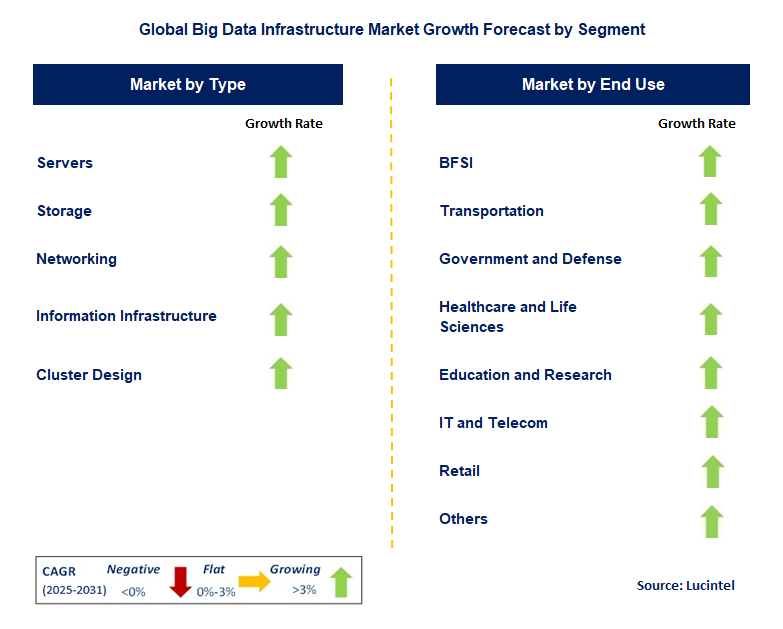
• Servers
• Storage
• Networking
• Information Infrastructure
• Cluster Design
• BFSI
• Transportation
• Government and Defense
• Healthcare and Life Sciences
• Education and Research
• IT and Telecom
• Retail
• Others
• North America
• Europe
• Asia Pacific
• The Rest of the World
• United States: The US is a mature and highly competitive market for big data infrastructure. Recent developments include the dominance of hyperscale cloud providers like AWS, Azure, and Google Cloud, which offer comprehensive big data platforms and services. There is also a strong focus on real-time data processing, with many organizations adopting technologies like Apache Kafka and Apache Spark Streaming. Furthermore, the US market is witnessing significant investment in AI and machine learning for data analytics.
• China: The Chinese big data infrastructure market is characterized by rapid growth and innovation. Domestic cloud providers like Alibaba Cloud and Tencent Cloud are expanding their market share, offering competitive big data solutions. The Chinese government is also heavily investing in the development of a national big data infrastructure. Furthermore, there is a strong focus on data security and privacy, with the government implementing new regulations to protect personal data.
• Germany: The German big data infrastructure market is driven by the country's strong industrial sector and its focus on data privacy and security. German businesses are increasingly adopting hybrid cloud strategies for big data, seeking to balance the benefits of public cloud with the security and control of on-premises infrastructure. There is also a growing emphasis on data governance and compliance with regulations like GDPR.
• India: The Indian big data infrastructure market is experiencing rapid growth, driven by the country's expanding digital economy and increasing adoption of data-driven decision-making. Both global and domestic cloud providers are investing heavily in building data centers in India. There is also a significant focus on providing affordable big data solutions to small and medium-sized businesses.
• Japan: The Japanese big data infrastructure market is characterized by a strong focus on reliability and quality. Japanese businesses are known for their meticulous approach to data management, placing a high value on data accuracy and security. Recent developments include the increasing adoption of hybrid cloud and multi-cloud strategies for big data, as well as a growing interest in data mesh architectures and federated data governance.


• Accenture
• Amazon Web Service
• Dell
• HP
• IBM
• Oracle
• Cisco Cloudera Q5. Which big data infrastructure market segment will be the largest in future? Answer: Lucintel forecasts that the server is expected to witness the highest growth over the forecast period. Q6. In big data infrastructure market, which region is expected to be the largest in next 5 years? Answer: North America will remain the largest region over the forecast period. Q7. Do we receive customization in this report? Answer: Yes, Lucintel provides 10% customization without any additional cost.


Choose a license that fits your team. Instant PDF delivery.
Prices exclude taxes. Instant delivery. Custom licensing available on request.
Market Report · July 15, 2026
Market Report · June 26, 2026
Market Report · June 24, 2026
Trusted partner for strategic intelligence and business growth


Receive a complimentary market analysis tailored to your industry. Our analysts will identify key growth opportunities and competitive dynamics specific to your business.

Market size, growth rate, and key trend analysis for your specific sector.

Top competitor positioning and market share analysis.

Strategic recommendations backed by data-driven insights.
Get curated market intelligence and competitive moves straight to your inbox.
By subscribing, you agree to receive our monthly insights. Unsubscribe anytime.
Receive a complimentary market analysis tailored to your industry. Our analysts will identify key growth opportunities and competitive dynamics specific to your business.
Market size, growth rate, and key trend analysis for your specific sector.
Top competitor positioning and market share analysis.
Strategic recommendations backed by data-driven insights.
Get curated market intelligence, emerging trends, and competitive moves straight to your inbox each month.
By subscribing, you agree to receive our monthly insights. Unsubscribe anytime.
We'll send your sample report shortly.