
Market Report · July 15, 2026

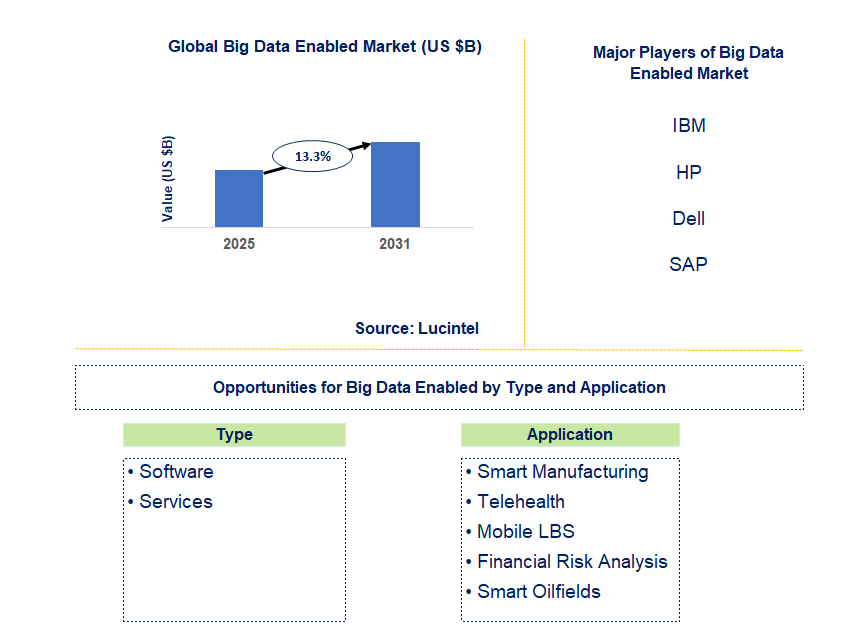
Key data points: The growth forecast = 13.3% annually for the next 7 years. Scroll below to get more insights. This market report covers Trends, opportunity and forecast in big data enabled market to 2031 by type (software and services), application (smart manufacturing, telehealth, mobile LBS, financial risk analysis, and smart oilfields), and region (North America, Europe, Asia Pacific, and the Rest of the World)
We'll send your sample report shortly.
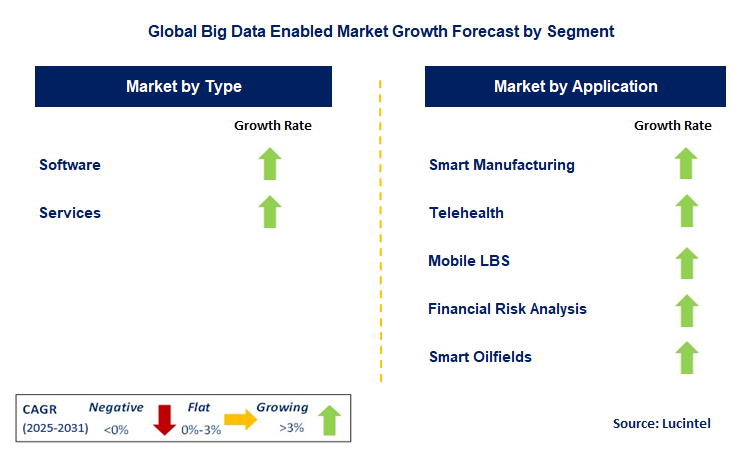
• Lucintel forecasts that, within the type category, software is expected to witness higher growth over the forecast period.
• Within the application category, smart manufacturing is expected to witness the highest growth.
• In terms of region, APAC is expected to witness the highest growth over the forecast period. Gain valuable insights for your business decisions with our comprehensive 150+ page report. Sample figures with some insights are shown below.
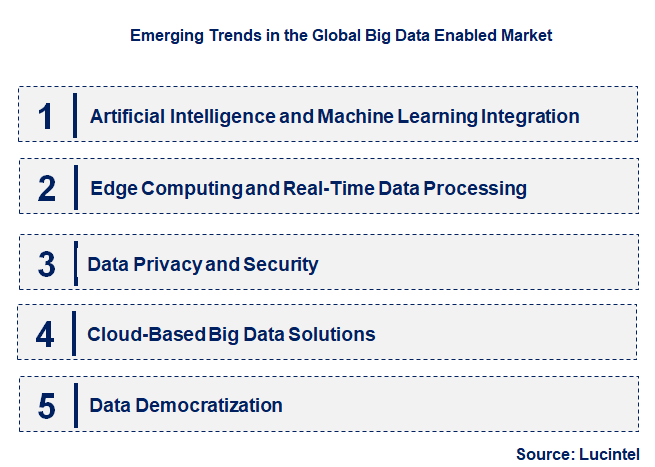
• Artificial Intelligence and Machine Learning Integration: Big Data analytics is increasingly being integrated with Artificial Intelligence (AI) and Machine Learning (ML). These technologies enhance predictive analytics, enabling organizations to derive deeper insights and automate decision-making. AI and ML improve the accuracy of data models while facilitating personalized customer experiences in industries like retail and healthcare. For instance, healthcare providers can use AI-driven Big Data analytics for better diagnosis and treatment plans. As a result, businesses can make faster, data-driven decisions and gain a competitive edge by harnessing the full potential of Big Data.
• Edge Computing and Real-Time Data Processing: Edge computing is becoming an integral part of Big Data strategies as organizations seek to process data closer to its source, reducing latency and enabling real-time analytics. With the growth of the Internet of Things (IoT) and connected devices, edge computing allows data to be processed at the device level before sending it to centralized cloud servers. This trend is significant for healthcare, autonomous vehicles, and manufacturing sectors, where real-time data insights are crucial. The shift towards edge computing enhances operational efficiency and supports faster decision-making by analyzing data at the point of origin.
• Data Privacy and Security: As the volume of data generated increases, ensuring data privacy and security has become a major concern. Regulatory frameworks like GDPR and CCPA are pushing businesses to adopt more stringent data protection practices. Organizations are investing in encryption, data masking, and other security technologies to prevent breaches and ensure compliance. The rise of data privacy concerns is also driving the development of privacy-preserving analytics techniques, where businesses can extract value from data while maintaining confidentiality. This trend is reshaping the Big Data market by pushing companies to rethink how they handle and store sensitive information.
• Cloud-Based Big Data Solutions: Cloud computing is enabling organizations to store, manage, and analyze Big Data more efficiently. Cloud platforms provide scalability, flexibility, and cost-effectiveness, making them an attractive option for businesses looking to leverage Big Data without investing heavily in on-premise infrastructure. By adopting cloud-based Big Data solutions, businesses can access advanced analytics tools, AI, and ML capabilities, as well as collaborate across teams in real-time. This trend is particularly beneficial for small to medium-sized enterprises (SMEs) that may not have the resources to build and maintain large data infrastructure, making Big Data more accessible.
• Data Democratization: Data democratization is a growing trend where organizations are making data and analytics tools available to a wider audience within the company, including non-technical employees. By empowering teams across various departments to access and analyze data, businesses can drive innovation and improve decision-making across the organization. Tools that simplify data analytics, such as self-service BI platforms and data visualization software, are supporting this trend. Data democratization fosters a culture of data-driven decision-making, allowing companies to unlock the full potential of their data and enhance overall business performance. These emerging trends—AI and ML integration, edge computing, data privacy and security, cloud-based solutions, and data democratization—are significantly reshaping the big data enabled market. As organizations adapt to these trends, they are improving their ability to leverage data for strategic decision-making, enhancing operational efficiency, and creating new business models. With data playing an increasingly central role in all sectors, these trends not only drive innovation but also address critical challenges such as data security and privacy. As the market evolves, these trends will continue to guide businesses in utilizing Big Data to its full potential.
• AI and Machine Learning Integration: AI and Machine Learning (ML) are playing a crucial role in the big data enabled market by helping organizations analyze complex datasets more efficiently and accurately. With AI and ML algorithms, businesses can derive predictive insights, automate decision-making, and improve customer personalization. In industries like healthcare, finance, and retail, these technologies are driving innovation by enabling smarter, data-driven solutions. For example, in healthcare, ML models can predict patient outcomes based on historical data, improving treatment plans and operational efficiency. This integration is making Big Data solutions more accessible and actionable for organizations, leading to improved business performance.
• Cloud Adoption for Scalability: The adoption of cloud-based Big Data solutions has been one of the most significant developments, providing organizations with the scalability, flexibility, and cost-efficiency needed to handle ever-increasing data volumes. Cloud platforms offer businesses the ability to store, manage, and process large datasets without investing heavily in on-premise infrastructure. With the growing demand for Big Data analytics tools, cloud providers are offering more specialized services, including AI-driven insights and advanced analytics. This trend is democratizing access to Big Data solutions, especially for small and medium-sized businesses, allowing them to compete with larger organizations in data utilization.
• Real-Time Analytics and Edge Computing: Real-time analytics is becoming a critical factor in industries that rely on time-sensitive data, such as autonomous vehicles, healthcare, and manufacturing. The integration of edge computing with Big Data analytics allows organizations to process data closer to the source, reducing latency and enabling faster decision-making. This development is particularly impactful in IoT-driven industries, where data must be analyzed in real-time for operational efficiency. Edge computing and real-time analytics are transforming industries by improving predictive maintenance, enabling instant insights, and reducing the need for bandwidth-intensive data transmission to centralized data centers, thus optimizing the entire data processing workflow.
• Data Privacy and Security Advancements: Data privacy and security have become paramount as organizations collect and store increasingly sensitive customer and business data. Recent developments in data protection regulations, such as GDPR and CCPA, are pushing businesses to adopt stronger security measures. New encryption techniques, anonymization methods, and blockchain technology are being implemented to secure data while ensuring compliance with regulatory standards. These advancements not only protect sensitive information but also enhance customer trust. As data breaches continue to rise, organizations are focusing on building secure data architectures that prevent unauthorized access, which is crucial for maintaining the integrity of Big Data initiatives.
• Data Democratization: Data democratization is emerging as a significant trend, enabling non-technical users to access and analyze Big Data without relying on data science teams. Self-service business intelligence (BI) tools, data visualization software, and automated analytics platforms are making it easier for employees across departments to derive insights from data. This development empowers organizations to foster a data-driven culture where every team member can contribute to decision-making. By making Big Data accessible to a wider audience, organizations are improving collaboration, innovation, and agility in their operations, ultimately leading to faster and more informed business decisions. These recent developments—AI and ML integration, cloud adoption, real-time analytics, data privacy advancements, and data democratization—are significantly transforming the big data enabled market. Organizations are now better equipped to manage and analyze vast amounts of data, gaining insights that drive efficiency, innovation, and growth. The widespread adoption of cloud technologies and the focus on real-time data processing are expanding the market's reach, while data security and democratization are reshaping how businesses interact with and protect data. As these developments continue to evolve, the big data enabled market will experience even greater opportunities for innovation and global impact.
• Healthcare Analytics and Personalized Medicine: Big Data is revolutionizing healthcare through predictive analytics, personalized medicine, and improving patient outcomes. Advanced data analytics tools enable healthcare providers to process vast amounts of patient data, identifying trends and predicting disease progression. In personalized medicine, data-driven insights help tailor treatments based on individual genetic profiles, lifestyle, and medical history. This opportunity offers growth for Big Data companies providing tools for managing electronic health records (EHRs), clinical data, and population health management. The growing focus on preventative care and improving patient experiences presents substantial growth prospects in the healthcare analytics sector.
• Financial Services and Fraud Detection: In the financial services industry, Big Data is transforming risk management, fraud detection, and customer service. Advanced analytics allow financial institutions to track real-time transaction data, identify suspicious patterns, and prevent fraud before it occurs. By integrating AI and machine learning, Big Data solutions can enhance predictive models, reducing risks associated with lending, trading, and investments. The ability to offer personalized banking services, risk analytics, and algorithmic trading opens up significant growth opportunities for companies providing Big Data tools in finance, particularly for fraud detection and financial compliance services.
• Retail and Customer Experience Optimization: Big Data is playing a pivotal role in transforming retail by enabling businesses to deliver personalized experiences and optimize supply chains. Retailers are using customer data to create personalized marketing campaigns, recommend products, and improve in-store experiences. Advanced analytics also optimize inventory management, ensuring that supply and demand are aligned. As retailers adopt omnichannel strategies, Big Data applications are becoming crucial for improving customer engagement and driving sales. The opportunity lies in providing solutions that integrate customer data across multiple touchpoints, enhancing overall customer satisfaction and increasing sales conversions.
• Smart Cities and Urban Planning: The growth of smart cities is a significant application area for Big Data, with governments and city planners leveraging data to improve infrastructure, transportation, and public services. Sensors, IoT devices, and traffic management systems generate vast amounts of data, which can be analyzed to optimize resource allocation, reduce energy consumption, and enhance urban mobility. Opportunities exist for Big Data companies to provide analytics solutions that monitor air quality, optimize traffic flows, and enhance city management operations. The rise of smart city initiatives presents long-term growth prospects, especially in urban planning and sustainable development.
• Manufacturing and Predictive Maintenance: In the manufacturing sector, Big Data is being utilized to optimize operations, enhance productivity, and predict equipment failures. Predictive maintenance, powered by Big Data analytics, allows manufacturers to identify potential issues in machinery before they lead to costly breakdowns, reducing downtime and maintenance costs. The growing trend of Industry 4.0 and the integration of IoT devices into manufacturing processes creates vast opportunities for Big Data solutions. Companies can provide analytics platforms that integrate machine learning and sensor data to predict equipment performance, improve supply chain logistics, and optimize production schedules. The strategic growth opportunities in the big data enabled market are diverse, ranging from healthcare and financial services to smart cities and manufacturing. As industries continue to adopt data-driven solutions, these applications offer significant potential for growth, innovation, and competitive advantage. Healthcare analytics, fraud detection in finance, personalized retail, smart city initiatives, and predictive maintenance in manufacturing are all driving demand for Big Data technologies. As these opportunities expand, companies in the Big Data market are well-positioned to provide transformative solutions that help businesses optimize their operations and enhance customer experiences, ultimately shaping the future of data-driven industries.
• IBM
• HP
• Dell
• SAP
• Software
• Services
• Smart Manufacturing
• Telehealth
• Mobile LBS
• Financial Risk Analysis
• Smart Oilfields
• North America
• Europe
• Asia Pacific
• The Rest of the World
• United States: The United States remains at the forefront of Big Data innovation, with advancements particularly prominent in industries like healthcare, finance, and technology. The increasing adoption of Artificial Intelligence (AI) and Machine Learning (ML) tools, combined with cloud computing platforms, enables faster data processing and better predictive analytics. In healthcare, for instance, Big Data enhances personalized medicine and patient care. Data privacy regulations such as CCPA and HIPAA are also evolving to ensure the secure handling of sensitive data. Furthermore, the U.S. government invests in smart city initiatives and uses Big Data for urban planning and infrastructure optimization.
• China: China has significantly increased its focus on Big Data as part of its national strategy to become a global leader in data-driven technologies. Government-backed initiatives are enabling large-scale integration of Big Data in sectors such as e-commerce, telecommunications, and transportation. In particular, companies like Alibaba and Tencent are leveraging Big Data to enhance consumer experiences, improve logistics, and support intelligent decision-making. The Chinese government is also exploring Big Data for applications like social governance, public safety, and urban planning. Additionally, China's growing investment in 5G infrastructure is expected to further propel Big Data usage across industries, especially in IoT and smart cities.
• Germany: The adoption of German Big Dapt is primarily driven by its robust manufacturing and automotive sectors, where data is being used to optimize production processes and improve efficiency. Industry 4.0 initiatives increasingly integrate Big Data with the Internet of Things (IoT) to enable smart factories, predictive maintenance, and autonomous vehicles. Germany’s emphasis on data sovereignty and strict adherence to GDPR compliance make data protection a key consideration. The German government has also introduced various funding programs for digitalization and Big Data research, creating opportunities for businesses and startups to integrate Big Data solutions across various industries, including energy and logistics.
• India: India is experiencing significant growth in Big Data adoption, particularly in sectors like healthcare, agriculture, and fintech. The government's "Digital India" initiative is driving digital transformation, creating new opportunities for data collection, analysis, and usage. In healthcare, big Data is used to improve diagnostics and patient care, while in agriculture, it aids in precision farming techniques. India's burgeoning fintech sector is leveraging Big Data analytics for fraud detection, customer segmentation, and risk management. Additionally, India is increasingly focusing on data privacy concerns and ensuring compliance with emerging data protection laws, which will shape the future of Big Data-enabled applications in the country.
• Japan: Japan is a leader in integrating Big Data with robotics, manufacturing, and IoT. The Japanese government has focused on innovative city development, utilizing Big Data to efficiently manage urban infrastructure, traffic systems, and energy consumption. In manufacturing, big data is used to perform predictive maintenance and improve product quality through advanced analytics. Additionally, Japan’s aging population is driving Big Data applications in healthcare, specifically for elderly care, with the help of AI and data analytics. Japan’s commitment to sustainability and innovation is also reflected in its investments in Big Data to support energy management and environmental monitoring efforts.


• IBM
• HP
• Dell
• SAP Q5. Which big data enabled market segment will be the largest in future? Answer: Lucintel forecasts that software is expected to witness higher growth over the forecast period. Q6. In big data enabled market, which region is expected to be the largest in next 5 years? Answer: APAC is expected to witness the highest growth over the forecast period. Q7. Do we receive customization in this report? Answer: Yes, Lucintel provides 10% customization without any additional cost.


Choose a license that fits your team. Instant PDF delivery.
Prices exclude taxes. Instant delivery. Custom licensing available on request.
Market Report · July 15, 2026
Market Report · June 26, 2026
Market Report · June 24, 2026
Trusted partner for strategic intelligence and business growth


Receive a complimentary market analysis tailored to your industry. Our analysts will identify key growth opportunities and competitive dynamics specific to your business.

Market size, growth rate, and key trend analysis for your specific sector.

Top competitor positioning and market share analysis.

Strategic recommendations backed by data-driven insights.
Get curated market intelligence and competitive moves straight to your inbox.
By subscribing, you agree to receive our monthly insights. Unsubscribe anytime.
Receive a complimentary market analysis tailored to your industry. Our analysts will identify key growth opportunities and competitive dynamics specific to your business.
Market size, growth rate, and key trend analysis for your specific sector.
Top competitor positioning and market share analysis.
Strategic recommendations backed by data-driven insights.
Get curated market intelligence, emerging trends, and competitive moves straight to your inbox each month.
By subscribing, you agree to receive our monthly insights. Unsubscribe anytime.
We'll send your sample report shortly.