
Market Report · July 15, 2026

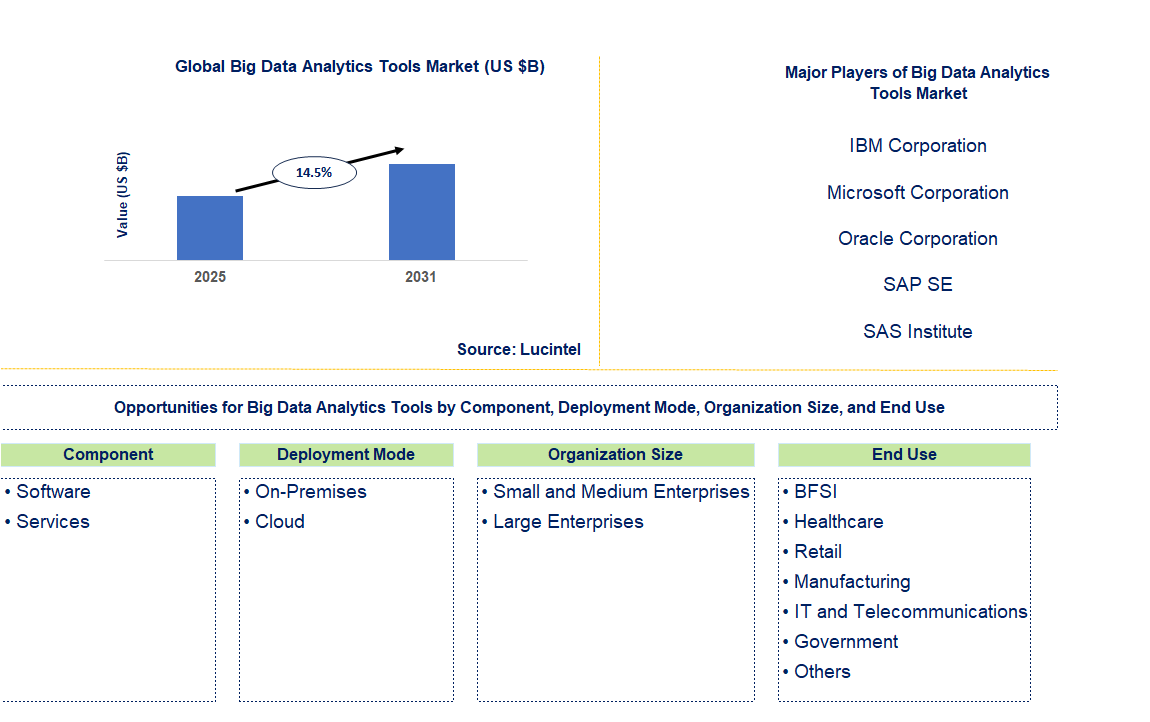
Key data points: The growth forecast = 14.5% annually for the next 7 years. Scroll below to get more insights. This market report covers Trends, opportunity and forecast in big data analytics tools market to 2031 by component (software and services), deployment mode (on-premises and cloud), organization size (small and medium enterprises and large enterprises), end use (BFSI, healthcare, retail, manufacturing, IT and telecommunications, government, and others), and region (North America, Europe, Asia Pacific, and the Rest of the World)
We'll send your sample report shortly.
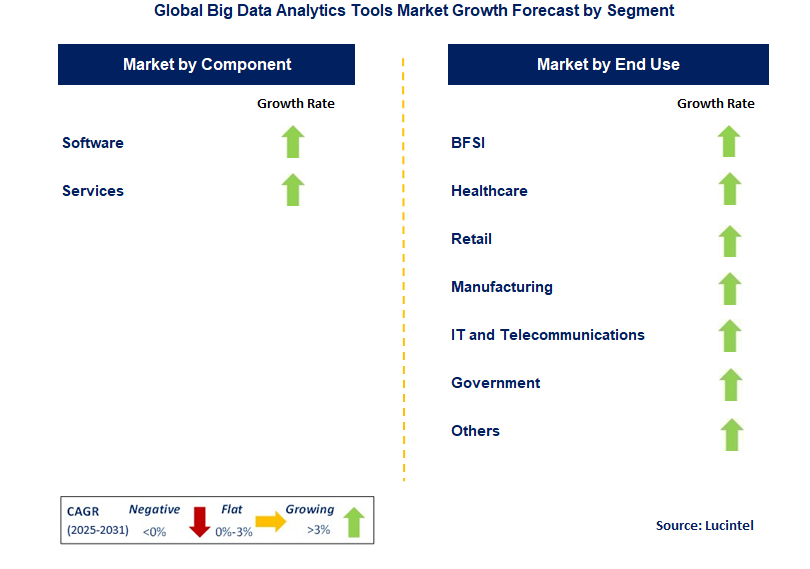
• Lucintel forecasts that, within the component category, software is expected to witness higher growth over the forecast period.
• Within the application category, healthcare is expected to witness the highest growth.
• In terms of region, APAC is expected to witness the highest growth over the forecast period. Gain valuable insights for your business decisions with our comprehensive 150+ page report. Sample figures with some insights are shown below.
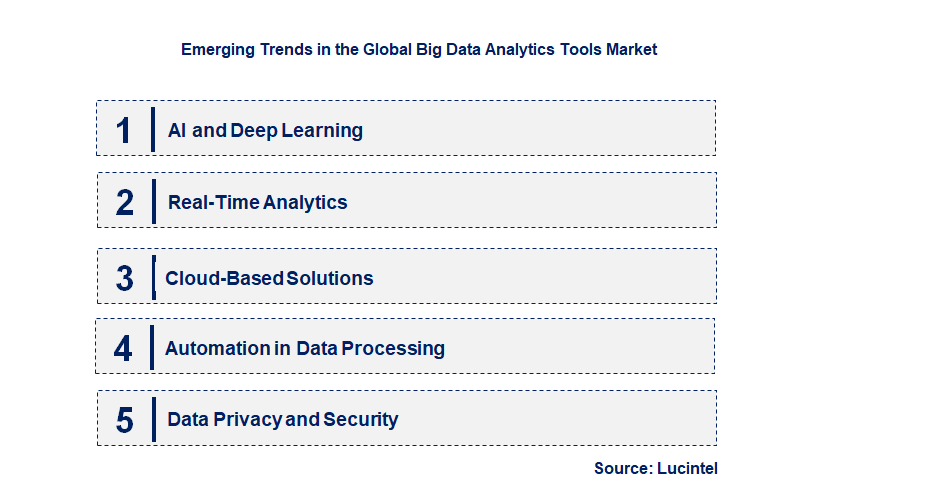
• AI and Deep Learning: The expansion of AI technology integrated into big data analytics tools to automate pattern recognition and data intelligence for business decision-making has progressed significantly. With predictive analytics, business intelligence can be used more effectively, and institutions can greatly automate decision-making while minimizing errors. One such benefit includes processing unstructured data such as text, videos, and images, which provides a broader scope for understanding markets, consumer behavior, and business performance.
• Real-Time Analytics: Many decision-makers across various organizations have begun to rely on cloud-based big data analytics solutions with the expectation of increasing real-time relationships with their customers due to their affordability, scalability, and ease of access. Cloud providers like Amazon Web Services, Microsoft Azure, and Google Cloud give clients the means to deal with huge amounts of data without the necessity of establishing physical office bases. This allows powerful, fast, and collaborative analytics while providing software that can be operated from anywhere on the globe. Because of the flexibility offered by this software, cloud computing has grown to become a necessary component in the modern big data paradigm.
• Cloud-Based Solutions: The increase in dependence on instant decision-making capabilities has led to a rise in interest in analytics that operate in real-time. Waves in industries like finance, healthcare, and e-commerce analytics have yielded further interest from companies in real-time analytics due to the need for quicker decisions to be made, given the rapid transformation in market criteria, customer expectations, and ever-changing operational problems. Incorporating analytics into the core of daily business processes will provide organizations the tools needed to solve problems much faster, gain process improvements, provide great customer service, and enjoy a competitive advantage.
• Automation in Data Processing: The self-sufficient nature of automation has drastically changed how data is collected, processed, and analyzed, contributing to a lesser reliance on humans. Organizations can heighten productivity and quickly make decisions by deploying artificial intelligence and robotic process automation to eliminate monotonous tasks like report writing, data cleaning, and data synchronization. This way, more time gets set aside for tasks of higher value by data analysts and scientists.
• Data Privacy and Security: There is a growing concern over the protection of personal data globally, more than ever before, due to regulations like GDPR. There is an alarming need to focus on the development of techniques that will secure data while performing large-scale analysis. Organizations are spending more and more resources on methods and software tools that can ensure security measures such as data encryption, surveillance, and reporting in order to lessen the chances of data breaches, alongside penalties. These new trends are moving and changing the business landscape in the big data analytics tools market. Optimization of AI, machine learning, and cloud computing is changing the type of workflow automation and predictive analysis that companies can perform. Coupled with real-time analytics being integrated throughout companies to increase the speed at which business decisions are made, improving inefficiencies, and high restrictions on data privacy and security are becoming ever-shifting priorities. These synergistic trends position big data analytics tools as more advanced, simpler to use, and very crucial to the prosperity of any business
• Incorporating artificial intelligence and machine learning: Incorporating AI and ML into big data analytics has made a drastic difference in the patterns and decisions a business can make. In-depth recognition of complex patterns and data anomalies is now realistic. That, along with advanced real-time decision-making, has increased the actionable insights available from big data analytics tools significantly. This further ensures all decisions made are accurate, and the chances of mistakes are minimal.
• Hybrid Cloud Environments Expansion: Hybrid clouds are being increasingly employed for big data analysis due to their ability to merge the elasticity and efficiency of public clouds, alongside the control and protection provided by private clouds. Companies are shifting toward a hybrid approach to process large volumes of data while safeguarding sensitive information and adhering to necessary laws. This change allows businesses to connect local and cloud-based data sources, promoting more collaboration and agility.
• Rise of Data Democratization: The attempt to make data and tools for analysis available and easily understandable to a vast number of employees is termed data democratization, an evolving trend among enterprises. The undergoing shift empowers employees who lack specific skills to take advantage of analytic tools, including self-service dashboards and interactive report generation. Consequently, all members of the organization can utilize factual information to make decisions, which ultimately leads to improvements in productivity as well as innovation among the different units.
• Expansion of Edge Computing: As more and more devices are producing large quantities of data, big data analytics in edge computing is gaining popularity. Through analysis closer to the source of data, edge computing achieves lower levels of latency alongside bandwidth needs, facilitating instantaneous analysis in industries like IoT, manufacturing, and self-driving vehicles. Such advancement provides timely analysis and optimal utilization of resources, especially in stationary or transportable environments.
• Shift Towards Predictive Analytics: In the modern age, predictive analytics is one of the most sought-after features in big data tools. Corporations are increasingly opting for tools that assist them in forecasting trends using algorithms and historical data. By predicting consumer actions, changes in the market, and operational hurdles, businesses can improve efficiency and minimize risk. Industries like finance, retail, and healthcare are reaping the benefits of these advanced tools due to the ease of forecasting today Recent changes have made predictive analytics more ubiquitous while simultaneously making it more affordable. AI and ML are adding the cherry on top by improving the technology's predictive capabilities, and hybrid cloud environments bring flexibility and security. With better access to analytic tools, businesses have become more agile and innovative. Edge computing’s optimization of real-time data processing, especially with the use of machine learning, has further improved decision-making, revising entire frameworks. Alongside these advancements, analytics tools have further aided in increasing big data's relevance across more industries.
• Customer Analytics: In customer analytics, big data tools help businesses understand who their customers are, what they like, and where they spend their money. By studying customer data, marketers can streamline marketing campaigns, enhance products, and improve customer interactions. This application is especially prevalent in retail, e-commerce, and telecom sectors, where the need for a better customer experience is on the rise.
• Supply Chain Optimization: The use of big data tools in analytics is on the rise for supply chain optimization. Businesses can now predict demand, lower inventory costs, and improve logistics. Companies now rely on and actively process the information made available to them from their suppliers, warehouses, and transportation systems in real time. This enables companies to enhance overall decision-making, reduce business disruptions, and achieve increased operational efficiency. This is particularly helpful in industries such as manufacturing, retail, and logistics.
• Risk Management: Big data tools are currently used to manage risk exposure in real-time and diminish it whenever possible. Businesses can identify risks such as fraud activities, currency fluctuations, or even business disruptions by analyzing data from different time periods. Financial service institutions, insurance companies, and even manufacturing industries have become heavy users of these tools, mainly to limit the impact of losses and improve outcomes in decision-making processes where there is a lot of uncertainty.
• Healthcare Analytics: Gradually, a large number of healthcare facilities are adopting big data analytics to provide better healthcare to patients while improving operational efficiency and resource management. Through the analysis of health records, medical imaging, and patient data, healthcare providers are now able to formulate more accurate diagnoses, prognoses, and optimize resources. As the use of medicine and telemedicine services increases, so does the interest and growth of the healthcare analytics industry.
• Financial Services: With the help of big data analytics, the financial sector is improving investment techniques, increasing fraud detection, and enhancing regulatory adherence. Moreover, predictive modeling and machine learning are enabling financial organizations to better predict and manage portfolios. As the complexity of financial markets increases, these tools are becoming essential for risk management and profit maximization. The strategies adopted for growth are creating opportunities for the big data analytics tools market by enabling adoption in key areas. From customer analytics, which provides greater personalization, to supply chain optimization, healthcare applications, and risk management in financial services, businesses can use the data available to make better decisions that lead to profits and productivity. As industries explore their options, analytics is becoming the foundation for the success of the modern, data-driven world.
• IBM Corporation
• Microsoft Corporation
• Oracle Corporation
• SAP SE
• SAS Institute
• Teradata Corporation
• Amazon Web Services
• Software
• Services
• On-Premises
• Cloud
• North America
• Europe
• Asia Pacific
• The Rest of the World
• United States: The tools and technologies for big data analytics in the US are driven by artificial intelligence (AI) and machine learning (ML), which are already prevalent in the country. With the shift to the cloud, almost all solutions tend to become concentrated and cost-efficient for businesses to manage the power of large data sets. Furthermore, companies like Google, Microsoft, and Amazon are actively trying to consolidate the market by offering full-scope analytics solutions. Coupled with the increased market adoption in the healthcare, retail, and finance sectors, market growth has been positive due to the growing popularity of predictive analytics and data-driven decision-making strategies.
• China: China has quickly become one of the major players in the big data analytics tools market. The creation of big data analytics tools is driven by their goals for smart cities as well as the rapid growth of the country’s e-commerce segment. Adoption has also been expedited by government initiatives such as the establishment of AI systems by enterprises like Alibaba and Baidu. Businesses in China are trying to merge data analytics with IoT capabilities to increase productivity. In spite of the apprehensions related to data privacy issues, the use of big data tools is set to increase due to government funding for advanced technologies.
• Germany: The German market for big data analytics tools is making great strides, especially in the manufacturing and automotive industries. The 4th industrial revolution, which focuses on automating and smart housing manufacturing, is the main reason for the adoption of big data technologies. More German firms are turning to predictive analytics to enhance their production and supply chain management. Additionally, Germany is very protective of its data privacy issues with respect to GDPR, and therefore, laws are carefully shaping the market where businesses are looking for compliant analytics tools that provide higher data security. This compliance culture has led to the creation of more GDPR-friendly solutions.
• India: The market for big data analytics tools is booming due to heightened digital activity in sectors such as banking, IT services, and telecom. The ‘Digital India’ program is leading to widespread use of AI-driven analytic tools and cloud computing. Both international and local startups are focused on providing cost-effective, scalable analytic tools that cater to India’s specific requirements, such as data localization. These services are expected to gain tremendous traction with the increased use of mobile phones and the internet in the country. There is a significant need for advanced analytics tools that can process massive amounts of data as mobile phone and internet penetration rises, which in turn creates new opportunities in the industry.
• Japan: Japan is a leader in the application of big data analysis tools in robotics, AI, and IoT. The automotive and manufacturing industries in Japan, as well as other industries, utilize predictive analytics and machine learning to boost productivity. Moreover, the Japanese big data healthcare market is also experiencing growth due to the increasing elderly population and the need for better patient care and hospital management. The commercialization of new healthcare IT tools is also supported by the government, which, combined with the existing technological infrastructure of Japan, ensures that the big data analytics tools industry in Japan continues to grow.


• IBM Corporation
• Microsoft Corporation
• Oracle Corporation
• SAP SE
• SAS Institute
• Teradata Corporation
• Amazon Web Services Q5. Which big data analytics tools market segment will be the largest in future? Answer: Lucintel forecasts that software is expected to witness higher growth over the forecast period. Q6. In big data analytics tools market, which region is expected to be the largest in next 5 years? Answer: APAC is expected to witness the highest growth over the forecast period. Q7. Do we receive customization in this report? Answer: Yes, Lucintel provides 10% customization without any additional cost.


Choose a license that fits your team. Instant PDF delivery.
Prices exclude taxes. Instant delivery. Custom licensing available on request.
Market Report · July 15, 2026
Market Report · June 26, 2026
Market Report · June 24, 2026
Trusted partner for strategic intelligence and business growth


Receive a complimentary market analysis tailored to your industry. Our analysts will identify key growth opportunities and competitive dynamics specific to your business.

Market size, growth rate, and key trend analysis for your specific sector.

Top competitor positioning and market share analysis.

Strategic recommendations backed by data-driven insights.
Get curated market intelligence and competitive moves straight to your inbox.
By subscribing, you agree to receive our monthly insights. Unsubscribe anytime.
Receive a complimentary market analysis tailored to your industry. Our analysts will identify key growth opportunities and competitive dynamics specific to your business.
Market size, growth rate, and key trend analysis for your specific sector.
Top competitor positioning and market share analysis.
Strategic recommendations backed by data-driven insights.
Get curated market intelligence, emerging trends, and competitive moves straight to your inbox each month.
By subscribing, you agree to receive our monthly insights. Unsubscribe anytime.
We'll send your sample report shortly.