
Market Report · July 20, 2026

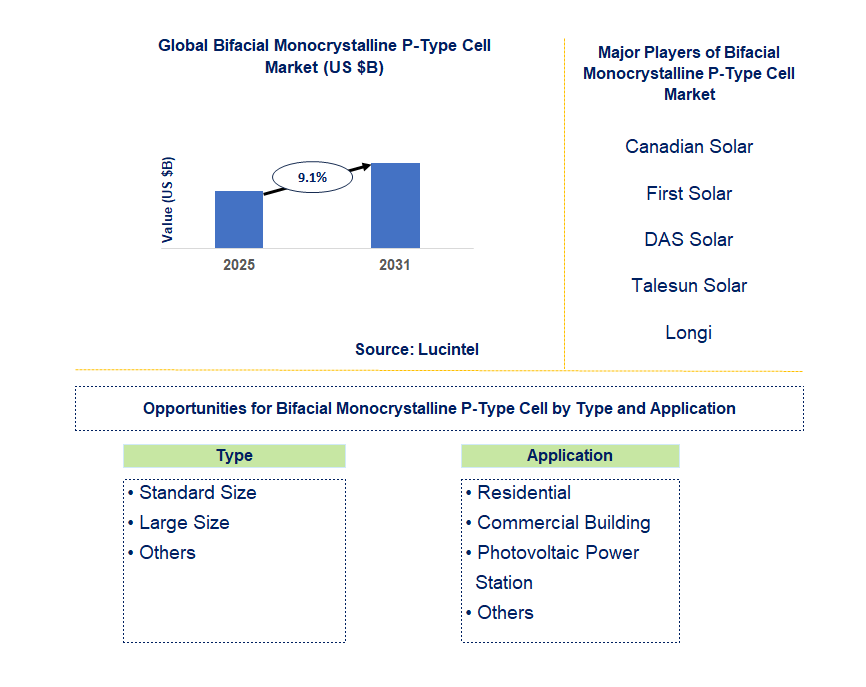
Key data points: The growth forecast = 9.1% annually for the next 7 years. Scroll below to get more insights. This market report covers Trends, opportunities and forecasts in bifacial monocrystalline P-type cell market to 2031 by type (standard size, large size, and others), application (residential, commercial building, photovoltaic power station, and others), and region (North America, Europe, Asia Pacific, and the Rest of the World)
We'll send your sample report shortly.
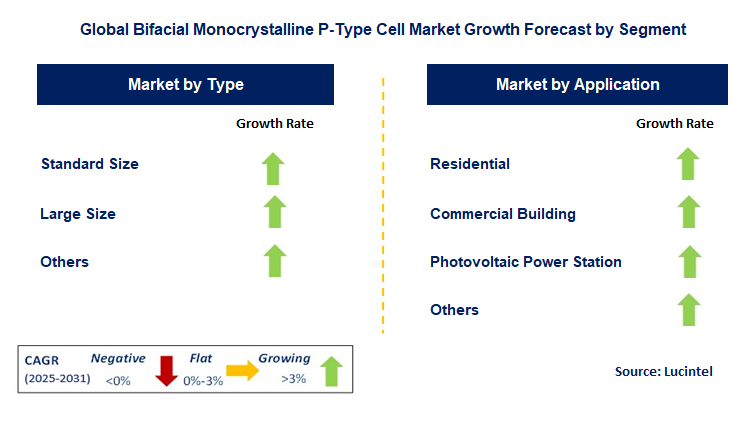
• Lucintel forecasts that, within the type category, large size is expected to witness higher growth over the forecast period.
• Within the application category, photovoltaic power station is expected to witness the highest growth.
• In terms of region, APAC is expected to witness the highest growth over the forecast period.
• Growing Demand for High-Efficiency Solar Panels: Demand for high-efficiency solar panels is on the rise, and bifacial monocrystalline P-type cells are emerging as a solution of choice. These cells harvest light on the front and rear sides, resulting in greater energy yields than conventional panels. As technology in solar improves, consumers seek more efficient and affordable solutions, which will continue to fuel the rise of bifacial panels in residential and commercial applications.
• Solar Energy Government Support and Incentives: Solar energy government support and incentives are also contributing extensively to the implementation of bifacial monocrystalline P-type cells. Most nations, such as the United States, China, and Germany, are providing policy and financial incentives support to encourage the use of renewable energy and limit carbon emissions. These policies are encouraging both residential and commercial installations of solar power systems, including those using bifacial panels, as they are seen as more efficient and cost-effective in the long run.
• Advancements in Solar Panel Manufacturing: Manufacturing technology is advancing rapidly, leading to more efficient and affordable bifacial monocrystalline P-type cells. Manufacturing process innovations, including better material procurement, robotic production lines, and advanced coating technology, are increasing the efficiency of bifacial solar panels while reducing the cost of production. These technologies are making bifacial panels more affordable to a broader group of consumers and are accelerating the uptake of this technology in utility-scale solar power plants.
• Bifacial Cell Integration in Utility-Scale Solar Projects: The use of bifacial cells in utility-scale solar projects is gaining ground due to their efficiency and capacity to harvest additional sunlight, which makes them suitable for utility-scale installations. Bifacial solar panels can boost the energy output of large solar farms by a notable margin, lowering the cost of electricity from solar energy. This trend will persist as more nations promote the use of renewable energy and demand for affordable, high-efficiency solar solutions increase.
• Sustainability and Clean Energy Emphasis: The increased worldwide emphasis on sustainability and clean energy is fueling demand for solar technologies such as bifacial monocrystalline P-type cells. As governments and businesses strive to become carbon neutral and fulfill climate objectives, the need for renewable energy and energy-efficient solutions is on the rise. Bifacial solar cells, being more efficient and capable of producing more energy, are regarded as a leading technology in the move towards a greener and sustainable future.
These new trends are transforming the bifacial monocrystalline P-type cell industry by promoting technological innovation, lowering costs, and escalating demand for clean energy solutions. The industry will continue to expand as these trends shape the implementation of bifacial panels across multiple industries, driving the shift towards cleaner, more efficient energy systems.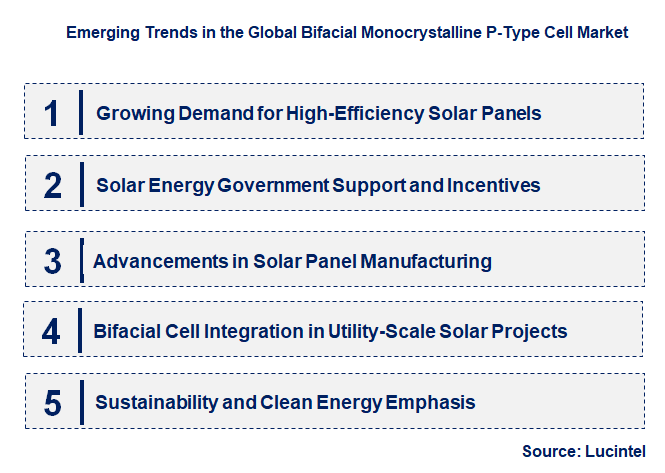
• Enhanced Energy Yield and Efficiency: One of the major developments in the bifacial monocrystalline p-type cell market is the enhancement of energy yield and efficiency. Bifacial cells are able to harness sunlight from both sides of the panel, resulting in more energy production. There has been a lot of improvement from manufacturers in terms of optimizing the efficiency of these cells, making them highly desirable for big solar power projects. It is driving demand for bifacial panels due to higher radiation from the sun in many high-solar-radiation areas.
• Manufacturing Technological Advances: Advances in technology in manufacturing techniques have seen a boost in bifacial monocrystalline P-type cells production. Use of automated methods of production, enhanced quality inspection, and acquisition of superior raw materials are factors that are coming together to manufacture better and more cost-effective bifacial solar panels. All this is enhancing competitiveness of bifacial solar panels and enabling manufacturers to keep up with the increased demand for renewable power solutions.
• Government Incentives for Solar Energy Adoption: Governments across the globe have been providing incentives and support to encourage solar energy adoption, which has helped the bifacial monocrystalline p-type cell market a great deal. Financial incentives in the form of tax credits and subsidies are reducing the cost of solar power systems for consumers and businesses. Furthermore, carbon emission reduction policies and renewable energy source promotion policies are driving the use of bifacial solar panels in residential and commercial sectors.
• Rise in Solar Energy Storage Integration: Solar energy storage systems are being integrated with bifacial monocrystalline P-type cells, which is becoming increasingly prevalent, enabling enhanced energy management. With the ability to store excess energy produced throughout the day, users can utilize solar power at off-peak times, further enhancing the efficiency and sustainability of solar power systems. This is likely to accelerate the use of bifacial panels in areas where sunlight is intermittent or energy demand is high.
• Improved Durability and Reliability: Companies are aiming to enhance the reliability and durability of bifacial monocrystalline P-type cells. Advances in material and design are improving the longevity of these cells, making them more appropriate for extreme environmental conditions. This progress is enhancing the appeal of bifacial solar panels for residential as well as commercial use, as they provide long-term energy output with low maintenance.
These major advancements are revolutionizing the bifacial monocrystalline P-type cell market, enhancing the performance, price, and accessibility of solar energy solutions. With these trends in their progression, the use of bifacial solar panels is bound to increase, driving the global transition towards renewable energy.• Utility-Scale Solar Power Projects: Utility-scale solar power projects are among the most important growth opportunities for bifacial monocrystalline P-type cells. These cells, with their energy yield boosting capability, are best suited for large solar installations. With nations spending on renewable energy infrastructure, utility-scale projects are now increasingly turning to bifacial panels in order to maximize energy output while keeping the cost of electricity production low. This trend holds huge growth potential for the bifacial cell market.
• Residential Solar Installations: Residential solar installations are another expanding market for bifacial monocrystalline P-type cells. Homeowners who want to lower their energy bills and embrace sustainable energy solutions are opting for solar panels. The increased energy yield and efficiency of bifacial panels make them a desirable choice for residential solar systems, and as prices continue to fall, more homeowners are expected to embrace this technology.
• Commercial and Industrial Applications: Commercial and industrial applications are also witnessing growing usage of bifacial monocrystalline P-type cells. Companies looking to save on their energy bills and carbon emissions are opting to fit solar power systems, and bifacial panels provide a more efficient way. The potential for higher energy yield and cost savings makes bifacial solar panels an attractive proposition for commercial and industrial consumers.
• Solar Energy Storage Solutions: With energy storage systems increasingly integrated with solar power solutions, there is increasing potential for bifacial monocrystalline P-type cells. These cells have the potential to enhance the overall efficiency of solar energy storage systems, which will make them a viable option for residential, commercial, and industrial use. This integration will increase the demand for bifacial panels as part of a broader energy solution.
• Government and Corporate Sustainability Initiatives: Government and corporate sustainability programs are pushing the use of renewable energy solutions such as bifacial solar panels. With governments coming up with policies to lower carbon emissions and embrace clean energy, demand for solar solutions with high efficiency is on the rise. Companies with sustainability objectives are also embracing solar energy, such as bifacial panels, to help them achieve their environmental objectives.
These growth prospects illustrate the growing potential for bifacial monocrystalline P-type cells in a variety of applications. As uptake grows further in utility-scale installations, residential systems, and industrial, demand for bifacial solar panels will propel future market growth.• Canadian Solar
• First Solar
• DAS Solar
• Talesun Solar
• Longi
• Jinko Solar
• Trina Solar
• Standard Size
• Large Size
• Others
• Residential
• Commercial Building
• Photovoltaic Power Station
• Others
• North America
• Europe
• Asia Pacific
• The Rest of the World
• United States: In the United States, the market for bifacial monocrystalline p-type cells is increasing due to the increase in demand for solar energy solutions. The government of the United States has instigated policies and tax credits favoring renewable energy, especially solar power, propelling market growth. First Solar is among the companies investing in improving the efficiency of bifacial monocrystalline P-type cells, with technological advancements that enable more energy capture and efficiency. The U.S. market is also witnessing growing demand for big solar power plants, which are now more and more using bifacial solar panels because of their better energy output.
• China: China is a world leader in solar panel production and the use of bifacial monocrystalline p-type cells. China has progressed a lot in the development of high-efficiency bifacial modules, which are now an integral part of China's big solar projects. The Chinese government is pushing for solar power adoption as part of its efforts to achieve carbon neutrality by 2060. As a result, there is an increase in research and production capacities in the solar sector, particularly in bifacial P-type cell development where energy yield from solar installations can be optimized. China's market size remains on the rise thanks to its scale of production and technology advancements.
• Germany: Germany leads Europe in solar energy adoption and has witnessed significant development in bifacial monocrystalline p-type cell technology. Germany's solar sector has led the way in incorporating advanced solar technologies, and bifacial monocrystalline P-type cells are gaining ground in solar farms of massive size. Government policies to reduce carbon emissions are promoting the use of renewable energy, with further investments in research and development in bifacial solar panels. The German industry is at the forefront of researching and developing new technologies and materials that will enhance bifacial cell performance and solar power efficiency and make it more available.
• India: In India, the market for solar power is expanding fast, and bifacial monocrystalline p-type cells adoption is viewed as one of the driving forces of the industry. The Indian government has ambitious solar power targets as part of its efforts to adopt renewable energy and minimize carbon emissions. The country's solar projects, especially in areas with high solar radiation, are increasingly adopting bifacial modules due to their higher performance in capturing reflected sunlight. Indian manufacturers are also investing in local production to meet the growing demand, which is cutting down on the cost of solar power systems.
• Japan: Japan is also experiencing growth in the bifacial monocrystalline p-type cell market, fueled by the nation's drive for renewable energy. Japan has been at the forefront of solar energy adoption and is now looking more towards bifacial solar modules to enhance the efficiency of its solar installations. The government of Japan has put in place policies to encourage clean energy, and there is a strong push towards maximizing energy yield from small areas, including rooftops and small installations. Japanese companies are investing in the development of bifacial cells, and Japan’s solar energy capacity is expected to expand as a result of these advancements.


• Canadian Solar
• First Solar
• DAS Solar
• Talesun Solar
• Longi
• Jinko Solar
• Trina Solar
Q5. Which bifacial monocrystalline P-type cell market segment will be the largest in future?

Choose a license that fits your team. Instant PDF delivery.
Prices exclude taxes. Instant delivery. Custom licensing available on request.
Market Report · July 20, 2026
Market Report · July 20, 2026
Market Report · July 20, 2026
Trusted partner for strategic intelligence and business growth


Receive a complimentary market analysis tailored to your industry. Our analysts will identify key growth opportunities and competitive dynamics specific to your business.

Market size, growth rate, and key trend analysis for your specific sector.

Top competitor positioning and market share analysis.

Strategic recommendations backed by data-driven insights.
Get curated market intelligence and competitive moves straight to your inbox.
By subscribing, you agree to receive our monthly insights. Unsubscribe anytime.
Receive a complimentary market analysis tailored to your industry. Our analysts will identify key growth opportunities and competitive dynamics specific to your business.
Market size, growth rate, and key trend analysis for your specific sector.
Top competitor positioning and market share analysis.
Strategic recommendations backed by data-driven insights.
Get curated market intelligence, emerging trends, and competitive moves straight to your inbox each month.
By subscribing, you agree to receive our monthly insights. Unsubscribe anytime.
We'll send your sample report shortly.