
Market Report · July 16, 2026

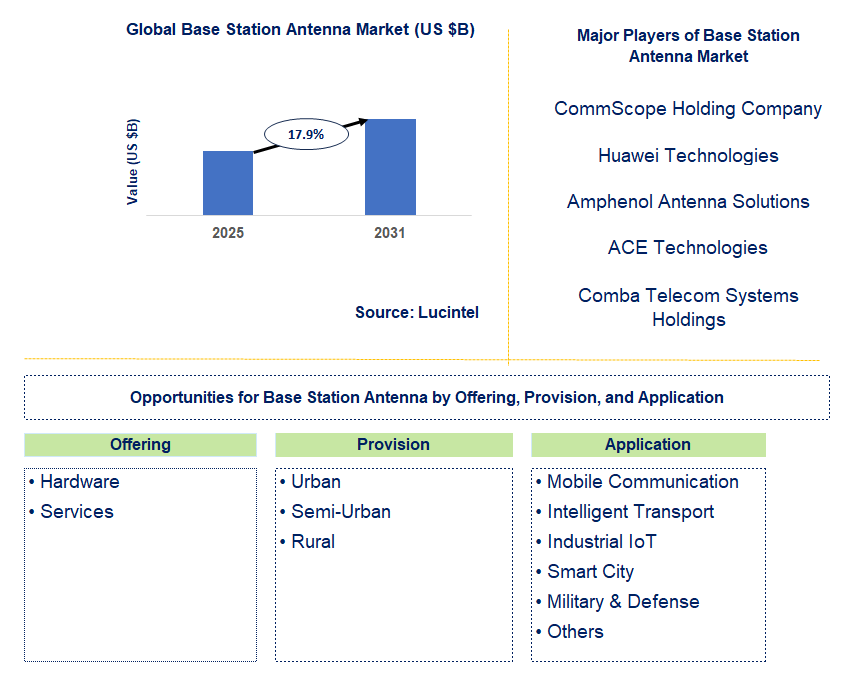
Key data points: The growth forecast = 17.9% annually for the next 7 years. Scroll below to get more insights. This market report covers trends, opportunities and forecasts in base station antenna market to 2031 by offering (hardware and services), provision (urban, semi-urban, and rural), application (mobile communication, intelligent transport, industrial IoT, smart city, military & defense, and others), and region (North America, Europe, Asia Pacific, and the Rest of the World)
We'll send your sample report shortly.
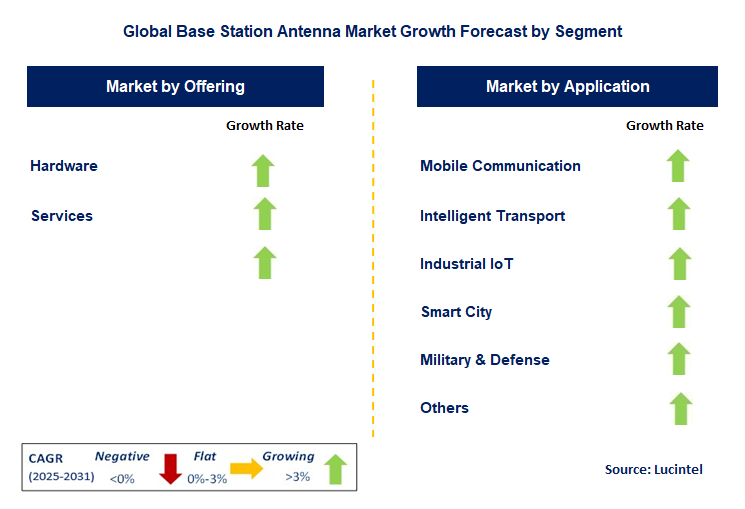
• Lucintel forecasts that, within the offering category, hardware will remain a larger segment over the forecast period.
• Within the application category, mobile communication is expected to witness the highest growth.
• In terms of region, North America is expected to witness the highest growth over the forecast period. Gain valuable insights for your business decisions with our comprehensive 150+ page report. Sample figures with some insights are shown below.
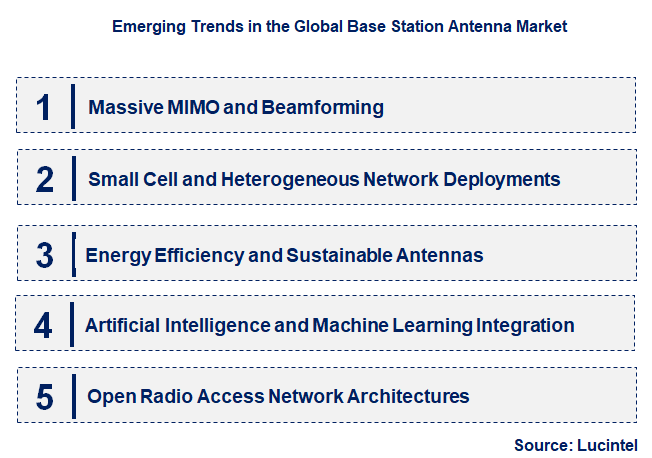
• Massive MIMO and Beamforming: The global deployment of 5G networks is one of the main motivations for base station antenna evolution. This includes a substantial move towards Massive Multiple-Input Multiple-Output (MIMO) and beamforming technologies. Massive MIMO employs a huge array of antenna elements to receive and transmit multiple streams of data at the same time, significantly improving network capacity and spectral efficiency. Beamforming, in contrast, focuses wireless signals sharply on user devices, minimizing interference and improving signal quality. These advances are essential to achieving the ultra-high speeds and low latency 5G is expected to deliver, especially in high-density urban environments and to enable a huge amount of connected devices.
• Small Cell and Heterogeneous Network Deployments: With the continuing growth in network capacity demand, especially in cities and indoor spaces, the market is witnessing increased shifts towards small cell deployments. Small cells are small base stations that offer localized coverage, supplementing conventional macro base stations. This trend requires the invention of small cell antennas that are compact in size, pleasing in appearance, and convenient to deploy. The emergence of heterogeneous networks, which blend diverse kinds of cells (macro, micro, Pico, feta) to offer coverage and capacity continuity, also triggers increased demand for versatile and flexible base station antenna solutions.
• Energy Efficiency and Sustainable Antennas: As there is a growing concern with environmental footprint and operating expenditure, energy efficiency is a key trend in the base station antennas market. Companies are working towards creating "green" antennas with lower power consumption without compromising or even enhancing performance. This is being achieved through innovations in design, materials, and power management methods. The objective is to minimize the carbon footprint of cellular networks and decrease energy costs for telecom operators, leading to a more sustainable and economically sound telecommunications infrastructure.
• Artificial Intelligence and Machine Learning Integration: The convergence of Artificial Intelligence (AI) and Machine Learning (ML) into base station antenna systems is a nascent trend that holds a lot of potential for network optimization and enhancement. AI and ML technologies can process huge volumes of network data in real time to dynamically optimize antenna parameters, including beam patterns, power levels, and frequency allocation. This smart optimization results in better coverage, increased capacity, lower interference, and more effective resource utilization, allowing networks to respond automatically to changing traffic patterns and user requirements.
• Open Radio Access Network Architectures: The Open RAN revolution is picking up steam, driving disaggregated and virtualized radio access networks. This is affecting base station antennas by spurring interoperability across hardware and software components from various providers. Open RAN has the purpose of minimizing vendor lock-in, increasing innovation, and decreasing deployment costs. To antennas, this translates to more standardized interfaces and software-based capabilities, allowing for increased flexibility and customization in antenna deployments and helping create a more competitive and innovative marketplace. These new trends are actually transforming the base station antenna market fundamentally. The shift towards Massive MIMO and beamforming is facilitating the high-performance requirements of 5G, while small cells are tackling localized capacity requirements. Energy efficiency is focusing on a rising concern with sustainability and cost savings. The convergence of AI and ML is opening the way for smart, self-optimizing networks, and Open RAN is making the supply chain more democratic, bringing innovation, and lowering entry barriers. These two together are pushing the evolution of more advanced, efficient, and agile antenna solutions that are key to the wireless communication of the future.
• 5G-Driven Antenna Innovation: The global deployment of 5G networks is the most important trend in the base station antenna market. This has triggered innovations like Massive MIMO (Multiple-Input Multiple-Output) antennas, which utilize hundreds of antenna elements to significantly boost network capacity and spectral efficiency. In addition, sophisticated beamforming technologies enable base stations to accurately steer signals to specific users, minimizing interference and enhancing signal strength. This emphasis on 5G-optimized antennas is key to delivering the ultra-high speeds and low latency of the emerging generation of cellular communication.
• Rise of Active Antennas: Active antennas are also on the rise, where RF elements such as transceivers and amplifiers are coupled directly with the antenna array. This coupling minimizes signal loss, maximizes the overall system efficiency, and allows for more advanced beamforming capabilities. Active antennas are especially important for millimeter-wave (mm Wave) 5G rollouts, where elevated frequencies require more intimate coupling of radio and antenna elements to mitigate signal propagation issues and provide reliable high-speed data transmission.
• Growing Use of Multi-Band and Multi-Port Antennas: To enable the simultaneous existence of different cellular technologies (2G, 3G, 4G, and 5G) and to optimize the usage of the spectrum, there is tremendous growth in the use of multi-band and multi-port antennas. These antennas will work in several frequency bands at once and handle multiple input and output streams, reducing site acquisition and deployment complexity for operators. This integration decreases the number of physical antennas on a tower, making installations more streamlined, cost-efficient, and aesthetically less obtrusive.
• Emphasis on Energy Efficiency and Small Sizes: With increasing energy prices and environmental pressures, compact and energy-efficient base station antennas are a major development. Companies are developing more power-efficient antennas with equivalent or better performance, frequently through more advanced materials and redesigned forms. Demand for lighter, smaller, and more integrated antenna solutions is also growing, especially for urban rollout, where aesthetics and restricted physical space are factors of extreme importance for network densification.
• Intelligent and Software-Defined Antennas: The industry is seeing a move towards software-defined and intelligent antennas, in which antenna parameters can be remotely configured and optimized via software. This enables dynamic adaptation to network conditions, traffic loads, and user demands, increasing overall network performance and adaptability. The inclusion of AI and machine learning functionality further maximizes these antennas, making predictive optimization, fault detection, and automatic network adjustment possible, thus minimizing operational expense and enhancing network reliability. These trends are having a significant impact on the base station antenna market. 5G-empowered innovation, and notably in Massive MIMO and active antennas, is facilitating unprecedented network performance. The shift towards multi-band and multi-port solutions is maximizing site deployments and spectrum utilization. Concerns for economic and environmental factors are met with the emphasis on energy efficiency and compact architectures, and software-defined and intelligent antennas are transforming network management and performance. These developments are imperative for addressing the increasingly high demands of mobile access and establishing the advanced networks of the future.
• Enhanced Mobile Broadband: The booming demand for enhanced mobile broadband services, driven by rising smartphone penetration and use of data-intensive content such as video streaming and online gaming, represents a high-growth opportunity. Base station antennas with high-end capabilities such as Massive MIMO and beamforming are needed to address the high-speed and capacity needs of EMBB. Strategic investments in refarming current 4G LTE networks and installing new 5G networks using these innovative antennas are imperative for operators to provide higher-quality user experience and cope with increasing data traffic.
• Internet of Things Connectivity: The phenomenal growth of IoT devices across industries, ranging from smart homes and wearables to industrial IoT and vehicle connectivity, presents tremendous growth opportunities for base station antennas. IoT use cases typically demand low-power, wide-area data with differing data rate demands. It creates demand for antennas that are designed to be optimized for particular IoT protocols and bands, such as those that enable narrow-band IoT (NB-IoT) and Cat-M1. Cost-efficient and energy-saving antenna development based on targeted IoT use cases will be the way forward to capture this market potential.
• Smart Cities and Urban Infrastructure: The evolution of smart cities all over the world is a large growth market for base station antennas. Smart city programs heavily depend on strong and ubiquitous wireless connectivity for features like smart street lights, intelligent transportation systems, environmental monitoring, and public safety. This calls for the installation of small cell antennas that are compact in size and integrated into the surroundings, as well as multi-functional antennas able to provide multiple services in urban areas. Strategic collaborations with city planners and infrastructure developers to place antennas in an unobtrusive manner within urban environments are essential.
• Industrial IoT and Automation: Growing use of Industrial IoT (IoT) in manufacturing, logistics, and energy industries for automation, real-time monitoring, and predictive maintenance presents promising growth prospects. IoT applications call for rapid, low-latency, and secure wireless communication. This propels the demand for ruggedized base station antennas that are capable of coping with extreme industrial conditions and deliver resilient connectivity to mission-critical operations. The development of antennas specifically designed for private 5G networks in industry environments, frequently with additional security and dedicated spectrum, is a strategic priority.
• Intelligent Transport Systems and Autonomous Vehicles: The development of intelligent transport systems and autonomous vehicles is an emerging application field for base station antennas. They need ultra-reliable low-latency communication (URLLC) for vehicle-to-everything (V2X) communication, real-time traffic control, and navigation. To accommodate this, high-performance antennas will need to be deployed along highways and in transportation centers to facilitate fast data exchange and ensure safety-critical communications. Research and development for optimal vehicular communication and roadside antennas is a strategic priority. These strategic opportunities for growth in the key applications are having a significant impact on the base station antenna market. The demand for high-capacity antennas is being stimulated by the drive for improved mobile broadband, and the growth of IoT is driving the need for specialized, low-energy solutions. Smart city and industrial IoT applications focus on compact, integrated, and rugged antennas, while industrial IoT and wireless sensors focus on rugged, light, and easy-to-maintain antennas. Lastly, intelligent transport and autonomous vehicle applications highlight the stringent need for ultra-reliable and low-latency communication. Focusing on these multi-varied application areas would enable manufacturers and service providers to generate new revenue and cement their place in the changing wireless communication ecosystem.
• CommScope Holding Company
• Huawei Technologies
• Amphenol Antenna Solutions
• ACE Technologies
• Comba Telecom Systems Holdings
• PCTEL
• Tongyu Communication
• Radio Frequency Systems
• Telefonaktiebolaget LM Ericsson
• Kaelus
• Hardware
• Services
• Urban
• Semi-Urban
• Rural
• North America
• Europe
• Asia Pacific
• The Rest of the World
• United States: The United States base station antenna market is observing strong growth, led by aggressive deployments of 5G networks and ongoing investment in upgrades of network infrastructure by key telecommunication operators. The emphasis is on improving coverage and capacity, particularly in dense urban environments, through the installation of next-generation antenna technologies such as Massive MIMO and small cells. The market also experiences higher take-up of multi-band antenna solutions and a high focus on incorporating new technologies to facilitate growing data traffic and smart city projects.
• China: China is a world leader in 5G deployment, with the large-scale deployment of 5G base stations greatly contributing to the higher demand for advanced antennas. The nation is heavily investing in future-generation technologies like Massive MIMO and beamforming to guarantee blanket 5G coverage, even in rural regions. China is also leading the charge in the development of 5G-Advanced (5G-A) technologies, which will further embed artificial intelligence and set the stage for upcoming 6G systems, generating a sustained demand for innovative antenna solutions.
• Germany: In Germany, the market for base station antennas is influenced by the continued roll-out of 5G networks and the growing need for high-speed, reliable mobile connectivity. There is a definite movement towards energy-efficient antennas to achieve sustainability targets and lower operational expenditure. Operators in Germany are concentrating on refarming existing sites with new technologies such as Massive MIMO and intelligent antenna systems to enhance network performance, capacity, and coverage on urban and semi-urban areas.
• India: India's base station antenna industry is growing at a rapid pace because of the nation's aggressive digitalization efforts and the large-scale adoption of 4G and 5G networks. Major telecommunication providers are aggressively investing in building and enhancing their networks, fueling demand for sophisticated base station antennas. Government initiatives such as Bharat Net further contribute to this market by focusing on expanding network coverage to rural and distant regions for digital inclusion and enhanced overall connectivity.
• Japan: The base station antenna market in Japan is dominated by a high focus on technological innovation and cost-efficient network densification. The nation is working actively to deploy small cell solutions to overcome issues of highly concentrated cities and cities as a whole, and ensure indoor and outdoor connectivity without a gap. Joint partnerships between telecom operators and equipment vendors are driving research and development efforts in innovative antenna technology, including eco-friendly solutions such as solar-powered base stations, conforming to Japan's green technology drive.


• CommScope Holding Company
• Huawei Technologies
• Amphenol Antenna Solutions
• ACE Technologies
• Comba Telecom Systems Holdings
• PCTEL
• Tongyu Communication
• Radio Frequency Systems
• Telefonaktiebolaget LM Ericsson
• Kaelus Q5. Which base station antenna market segment will be the largest in future? Answer: Lucintel forecasts that, within the offering category, hardware will remain a larger segment over the forecast period. Q6. In base station antenna market, which region is expected to be the largest in next 5 years? Answer: In terms of region, North America is expected to witness the highest growth over the forecast period. Q7. Do we receive customization in this report? Answer: Yes, Lucintel provides 10% customization without any additional cost.


Choose a license that fits your team. Instant PDF delivery.
Prices exclude taxes. Instant delivery. Custom licensing available on request.
Market Report · July 16, 2026
Market Report · May 18, 2026
Market Report · May 18, 2026
Trusted partner for strategic intelligence and business growth


Receive a complimentary market analysis tailored to your industry. Our analysts will identify key growth opportunities and competitive dynamics specific to your business.

Market size, growth rate, and key trend analysis for your specific sector.

Top competitor positioning and market share analysis.

Strategic recommendations backed by data-driven insights.
Get curated market intelligence and competitive moves straight to your inbox.
By subscribing, you agree to receive our monthly insights. Unsubscribe anytime.
Receive a complimentary market analysis tailored to your industry. Our analysts will identify key growth opportunities and competitive dynamics specific to your business.
Market size, growth rate, and key trend analysis for your specific sector.
Top competitor positioning and market share analysis.
Strategic recommendations backed by data-driven insights.
Get curated market intelligence, emerging trends, and competitive moves straight to your inbox each month.
By subscribing, you agree to receive our monthly insights. Unsubscribe anytime.
We'll send your sample report shortly.