
Market Report · July 15, 2026

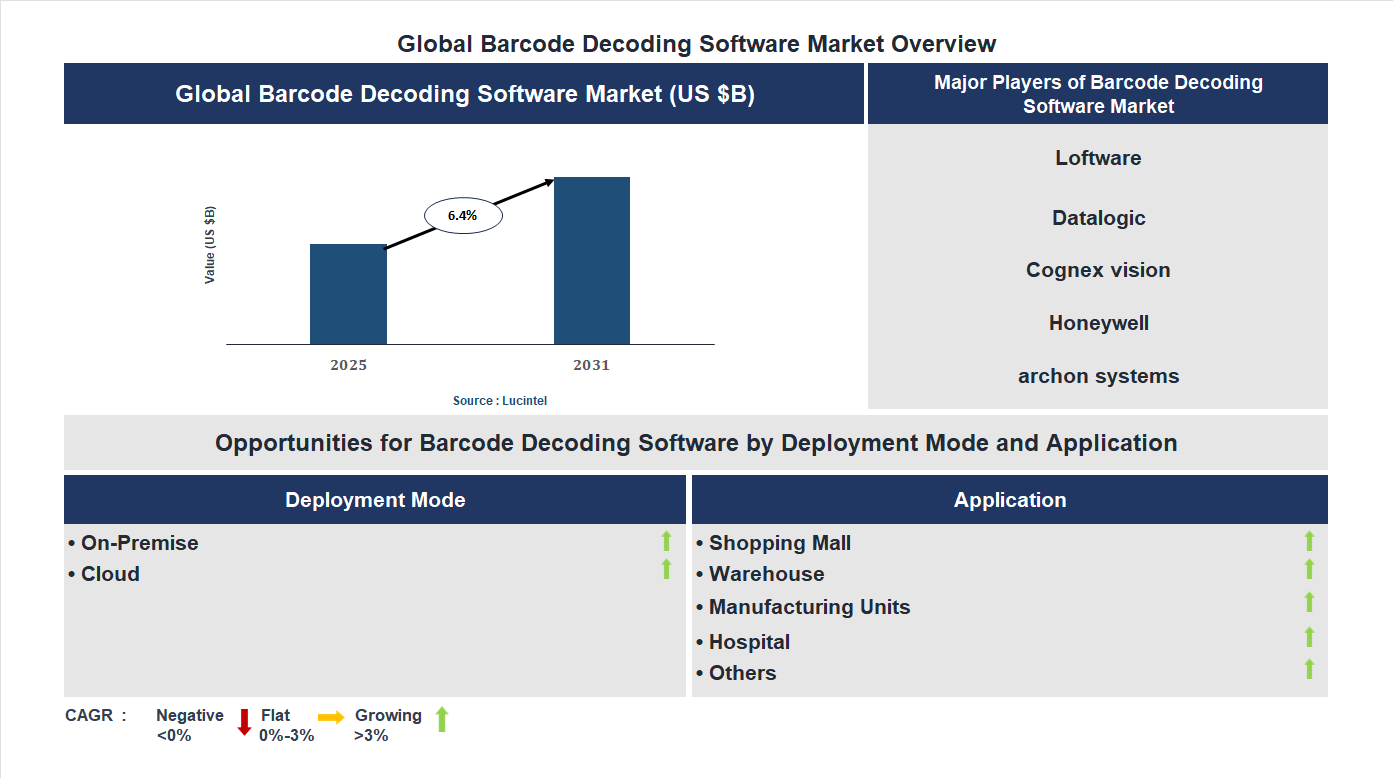
Key data points: The growth forecast = 6.4% annually for the next 7 years. Scroll below to get more insights. This market report covers trends, opportunities and forecasts in barcode decoding software market to 2031 by deployment mode (on-premise and cloud), application (shopping mall, warehouse, manufacturing units, hospital, and others), and region (North America, Europe, Asia Pacific, and the Rest of the World)
We'll send your sample report shortly.
• Lucintel forecasts that, within the deployment mode category, on-premise is expected to witness higher growth over the forecast period.
• Within the application category, manufacturing unit is expected to witness the highest growth.
• In terms of region, APAC is expected to witness the highest growth over the forecast period. Gain valuable insights for your business decisions with our comprehensive 150+ page report. Sample figures with some insights are shown below.
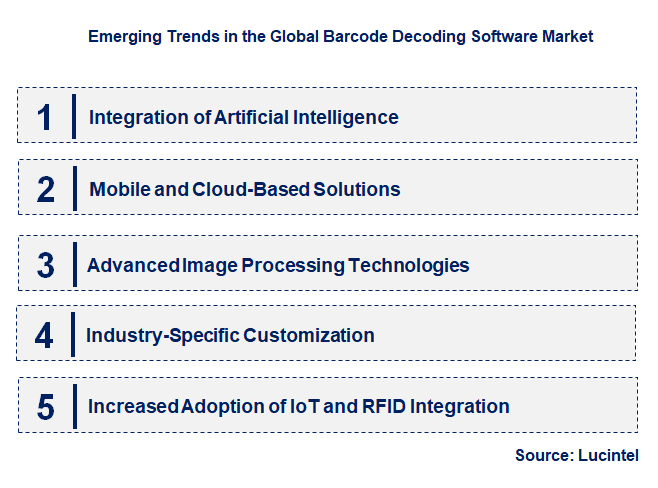
• Integration of Artificial Intelligence (AI): AI-powered barcode decoding software enhances accuracy and speed by leveraging machine learning algorithms. These systems can recognize damaged or poorly printed barcodes, reducing errors and increasing efficiency. AI integration also enables real-time data analysis and predictive maintenance, which benefits supply chain management and inventory control. As AI technology advances, barcode software becomes more adaptable and intelligent, providing businesses with smarter solutions that improve operational workflows and reduce manual intervention.
• Mobile and Cloud-Based Solutions: The shift towards mobile and cloud platforms allows users to access barcode decoding capabilities anytime and anywhere. Mobile apps enable on-the-go scanning for retail, logistics, and field services, increasing flexibility and productivity. Cloud-based solutions facilitate centralized data management, real-time updates, and seamless integration with enterprise systems. This trend reduces hardware costs and enhances scalability, making barcode decoding more accessible for small and large enterprises alike. The proliferation of smartphones and IoT devices accelerates this trend, expanding the market reach.
• Advanced Image Processing Technologies: Innovations in image processing, such as 3D imaging and enhanced camera sensors, improve barcode recognition accuracy in challenging environments. These technologies enable decoding of barcodes on damaged, blurred, or poorly lit surfaces, which was previously difficult. Enhanced image processing also supports the decoding of complex barcode types like QR codes and Data Matrix codes. As these technologies become more affordable and widespread, they significantly boost the reliability and versatility of barcode decoding software across various industries, including healthcare, retail, and manufacturing.
• Industry-Specific Customization: Market players are developing tailored barcode decoding solutions to meet the unique needs of different sectors. For example, healthcare requires compliance with strict data privacy standards, while retail demands rapid checkout processes. Customized software offers features like specialized data formats, integration with industry-specific systems, and compliance with regulatory standards. This trend allows businesses to optimize their operations with solutions designed for their specific workflows, leading to higher adoption rates and better performance. Industry-specific customization is thus a key driver of market growth and differentiation.
• Increased Adoption of IoT and RFID Integration: The integration of barcode decoding with IoT devices and RFID technology is creating more comprehensive asset tracking and inventory management systems. This convergence enables real-time tracking, automated data collection, and improved supply chain visibility. RFID complements barcode systems by providing contactless and faster scanning options, while IoT connectivity allows for remote monitoring and data analytics. The combined use of these technologies enhances operational efficiency, reduces errors, and supports automation initiatives. As IoT and RFID adoption grow, barcode decoding software is evolving into a critical component of intelligent, interconnected systems. In summary, these emerging trends are fundamentally reshaping the barcode decoding software market by making solutions more intelligent, flexible, and integrated. The adoption of AI, mobile/cloud platforms, advanced imaging, customization, and IoT integration is driving increased efficiency, accuracy, and scalability. These developments are enabling industries to optimize their operations, reduce costs, and improve customer experiences, ultimately leading to a more innovative and competitive market landscape.
• Integration of Artificial Intelligence (AI): AI-powered barcode decoding software now offers higher accuracy and faster processing speeds. These systems can recognize damaged or poorly printed barcodes, reducing errors and increasing efficiency. This advancement benefits retail and logistics sectors by streamlining checkout processes and inventory management, ultimately improving customer satisfaction and operational productivity.
• Cloud-Based Solutions Expansion: Cloud integration has become a major trend, enabling real-time data access and remote management of barcode decoding systems. Cloud-based software reduces infrastructure costs and enhances scalability for businesses of all sizes. This development facilitates seamless updates and maintenance, supporting industries like healthcare and retail in maintaining high standards of data accuracy and security.
• Support for 2D and 3D Barcodes: Recent software updates now support a broader range of barcode types, including 2D (QR codes, Data Matrix) and emerging 3D barcodes. This expansion allows businesses to adopt more versatile data encoding methods, improving inventory tracking, product authentication, and marketing strategies. It also opens new avenues for innovation in supply chain management.
• Enhanced Mobile Compatibility: The rise of mobile devices has led to the development of barcode decoding apps with improved camera integration and user interfaces. These mobile solutions enable on-the-go scanning, which is crucial for retail, logistics, and field services. Enhanced mobile compatibility increases flexibility, reduces hardware costs, and accelerates data collection processes.
• Adoption of Machine Learning Algorithms: Machine learning algorithms are now being integrated into barcode decoding software to improve recognition accuracy over time. These algorithms adapt to various barcode conditions, such as distortion or damage, and optimize decoding performance. This development enhances reliability and reduces manual intervention, benefiting sectors that require high-speed, high-volume scanning. In summary, these recent developments are transforming the barcode decoding software market by increasing accuracy, flexibility, and scalability. The integration of AI, cloud solutions, support for diverse barcode types, mobile compatibility, and machine learning are collectively driving market growth. These innovations are enabling industries to achieve higher operational efficiency, reduce costs, and improve customer experiences, positioning the market for continued expansion and technological leadership.
• Retail: Enhanced checkout efficiency : Barcode decoding software enables faster and more accurate transaction processing, reducing wait times and improving customer satisfaction. It also supports inventory management and anti-theft measures, leading to better stock control and loss prevention.
• Healthcare: Improved patient data management : In healthcare, barcode decoding software ensures precise patient identification, medication administration, and specimen tracking. This reduces errors, enhances safety, and streamlines hospital workflows, ultimately improving patient outcomes.
• Logistics: Real-time tracking and inventory control : Logistics companies utilize barcode decoding to facilitate real-time package tracking, inventory management, and route optimization. This increases operational efficiency, reduces delivery times, and minimizes errors in shipment handling.
• Manufacturing: Quality control and automation : In manufacturing, barcode decoding software supports quality assurance processes by tracking components and finished products. It enables automation of assembly lines, reduces manual errors, and accelerates production cycles.
• Hospitality: Streamlined guest services : Hospitality providers use barcode decoding for seamless check-ins, loyalty programs, and inventory management. This enhances guest experience, accelerates service delivery, and optimizes resource utilization. In summary, these growth opportunities are significantly impacting the barcode decoding software market by expanding its application scope, improving operational efficiencies, and fostering innovation across industries. As businesses increasingly adopt these solutions, market growth is expected to accelerate, driven by the demand for smarter, faster, and more reliable data capture technologies.
• Technological Innovation: The rapid development of high-resolution imaging, AI, and machine learning algorithms has revolutionized barcode decoding. These advancements enable faster, more accurate reading of complex and damaged barcodes, expanding application scope across industries. Enhanced software capabilities reduce errors and improve operational efficiency, making barcode decoding more reliable and versatile. As technology continues to evolve, the market benefits from increased adoption of smarter, more adaptable solutions, fostering growth and innovation.
• Growing Adoption in Retail and E-commerce: The retail sector increasingly relies on barcode decoding software for inventory management, checkout processes, and supply chain tracking. The surge in e-commerce has amplified the need for efficient, real-time data capture, driving demand for advanced decoding solutions. Retailers seek to streamline operations, reduce errors, and enhance customer experience, all of which are facilitated by robust barcode software. This trend is expected to persist as online shopping continues to expand globally, further fueling market growth.
• Expansion in Healthcare and Pharmaceuticals: The healthcare industry leverages barcode decoding software for patient identification, medication tracking, and inventory management. Accurate decoding ensures safety, compliance, and efficiency in critical processes. The increasing adoption of electronic health records and regulatory mandates for traceability are propelling demand. As healthcare providers aim to minimize errors and improve operational workflows, the market for specialized barcode decoding solutions is poised for significant expansion.
• Integration with IoT and Automation: The integration of barcode decoding software with Internet of Things (IoT) devices and automation systems enhances supply chain visibility and operational efficiency. Automated warehouses, smart logistics, and inventory robots rely on real-time barcode data for seamless functioning. This convergence accelerates digital transformation across industries, encouraging investments in sophisticated decoding software capable of supporting complex automation ecosystems, thereby expanding market opportunities.
• Regulatory and Standardization Developments: Increasing regulatory requirements for data security, product traceability, and industry standards influence market dynamics. Compliance with standards such as GS1 and ISO ensures interoperability and data integrity, prompting vendors to develop compliant decoding solutions. These regulations also drive innovation to meet stringent security and accuracy demands, shaping product features and deployment strategies. Staying ahead of regulatory changes is crucial for market participants to maintain competitiveness and ensure market acceptance. The challenges facing this barcode decoding software market include:
• Technological Complexity and Compatibility Issues: Rapid technological advancements create challenges in ensuring software compatibility across diverse hardware platforms and barcode types. Integrating new decoding algorithms with existing systems can be complex and costly, potentially hindering adoption. Additionally, maintaining high accuracy in decoding damaged or poorly printed barcodes requires continuous innovation, which can strain resources and delay deployment, especially for small and medium-sized enterprises.
• Data Security and Privacy Concerns: As barcode decoding software increasingly handles sensitive data, concerns over data breaches and privacy violations grow. Ensuring secure data transmission and storage is critical, especially in healthcare and retail sectors. Regulatory compliance adds further complexity, requiring robust security measures that can increase costs and development time. Failure to address these concerns can lead to legal issues and loss of customer trust, impeding market growth.
• Market Fragmentation and Competition: The market is highly fragmented with numerous vendors offering diverse solutions, leading to intense competition. Differentiating products and establishing a strong market presence can be challenging, especially for new entrants. Price wars and rapid technological obsolescence pressure profit margins. Additionally, varying regional standards and customer preferences require tailored solutions, complicating product development and distribution strategies, which can slow overall market expansion. In summary, the barcode decoding software market is driven by technological advancements, expanding industry applications, and regulatory compliance, fostering growth and innovation. However, challenges such as technological complexity, security concerns, and market fragmentation pose significant hurdles. Navigating these factors requires strategic investments in R&D, security measures, and market positioning. Overall, the markets future hinges on balancing innovation with regulatory adherence and addressing operational challenges, ensuring sustainable growth and competitive advantage in a rapidly evolving landscape.
• Loftware
• Datalogic
• Cognex vision
• Honeywell
• archon systems
• Britecheck
• TEKLYNX
• Capterra
• Banner
• Zebra
• On-Premise
• Cloud
• Shopping Mall
• Warehouse
• Manufacturing Units
• Hospital
• Others
• North America
• Europe
• Asia Pacific
• The Rest of the World
• United States: The US market has seen rapid adoption of AI-powered barcode decoding solutions, especially in retail and logistics sectors. Major tech companies are investing in cloud-based platforms that enhance real-time data processing. Innovations include improved decoding of damaged or obscured barcodes, boosting efficiency in supply chains. The government’s focus on smart manufacturing and Industry 4.0 initiatives further drive market growth. Additionally, startups are developing advanced mobile decoding apps, expanding accessibility and use cases across small and medium enterprises.
• China: China’s barcode decoding software market is expanding due to the booming e-commerce and retail sectors. Companies are integrating AI and deep learning to improve decoding accuracy in complex environments. The government’s emphasis on digital infrastructure and smart logistics has accelerated adoption. Local firms are developing cost-effective, high-speed solutions tailored for large-scale warehouse management and delivery services. The rise of mobile payment systems also fuels demand for robust barcode decoding in mobile transactions, fostering innovation in mobile-based decoding technologies.
• Germany: Germany’s market is characterized by a focus on industrial automation and manufacturing efficiency. Companies are adopting advanced barcode decoding software to enhance quality control and inventory management. There is a growing trend toward integrating decoding solutions with IoT devices for real-time tracking. The emphasis on precision and reliability has led to innovations in decoding algorithms capable of handling challenging barcode conditions. The country’s strong engineering sector supports the development of high-performance, durable decoding systems suitable for harsh industrial environments.
• India: The Indian market is witnessing rapid growth driven by expanding retail, logistics, and healthcare sectors. Local companies are adopting AI-driven decoding software to improve accuracy in diverse and challenging environments. The government’s initiatives like Digital India and Make in India promote digital transformation, boosting demand for barcode solutions. Startups are developing affordable, mobile-compatible decoding apps to serve small retailers and local businesses. The focus on automation and supply chain modernization is creating a fertile environment for innovative decoding technologies tailored to regional needs.
• Japan: Japan’s market emphasizes precision and integration with advanced manufacturing processes. Companies are deploying sophisticated barcode decoding software to support automation in automotive and electronics industries. There is a trend toward integrating decoding solutions with robotics and AI systems for seamless production workflows. Innovations include high-speed decoding algorithms capable of handling complex and damaged barcodes. The country’s focus on quality and reliability drives continuous improvements, with a strong emphasis on developing durable, industrial-grade decoding systems suitable for demanding environments.


• Loftware
• Datalogic
• Cognex vision
• Honeywell
• archon systems
• Britecheck
• TEKLYNX
• Capterra
• Banner
• Zebra Q5. Which barcode decoding software market segment will be the largest in future? Answer: Lucintel forecasts that, within the deployment mode category, on-premise is expected to witness higher growth over the forecast period. Q6. In barcode decoding software market, which region is expected to be the largest in next 5 years? Answer: In terms of region, APAC is expected to witness the highest growth over the forecast period. Q7. Do we receive customization in this report? Answer: Yes, Lucintel provides 10% customization without any additional cost.


Choose a license that fits your team. Instant PDF delivery.
Prices exclude taxes. Instant delivery. Custom licensing available on request.
Market Report · July 15, 2026
Market Report · June 26, 2026
Market Report · June 24, 2026
Trusted partner for strategic intelligence and business growth


Receive a complimentary market analysis tailored to your industry. Our analysts will identify key growth opportunities and competitive dynamics specific to your business.

Market size, growth rate, and key trend analysis for your specific sector.

Top competitor positioning and market share analysis.

Strategic recommendations backed by data-driven insights.
Get curated market intelligence and competitive moves straight to your inbox.
By subscribing, you agree to receive our monthly insights. Unsubscribe anytime.
Receive a complimentary market analysis tailored to your industry. Our analysts will identify key growth opportunities and competitive dynamics specific to your business.
Market size, growth rate, and key trend analysis for your specific sector.
Top competitor positioning and market share analysis.
Strategic recommendations backed by data-driven insights.
Get curated market intelligence, emerging trends, and competitive moves straight to your inbox each month.
By subscribing, you agree to receive our monthly insights. Unsubscribe anytime.
We'll send your sample report shortly.