
Market Report · July 29, 2026

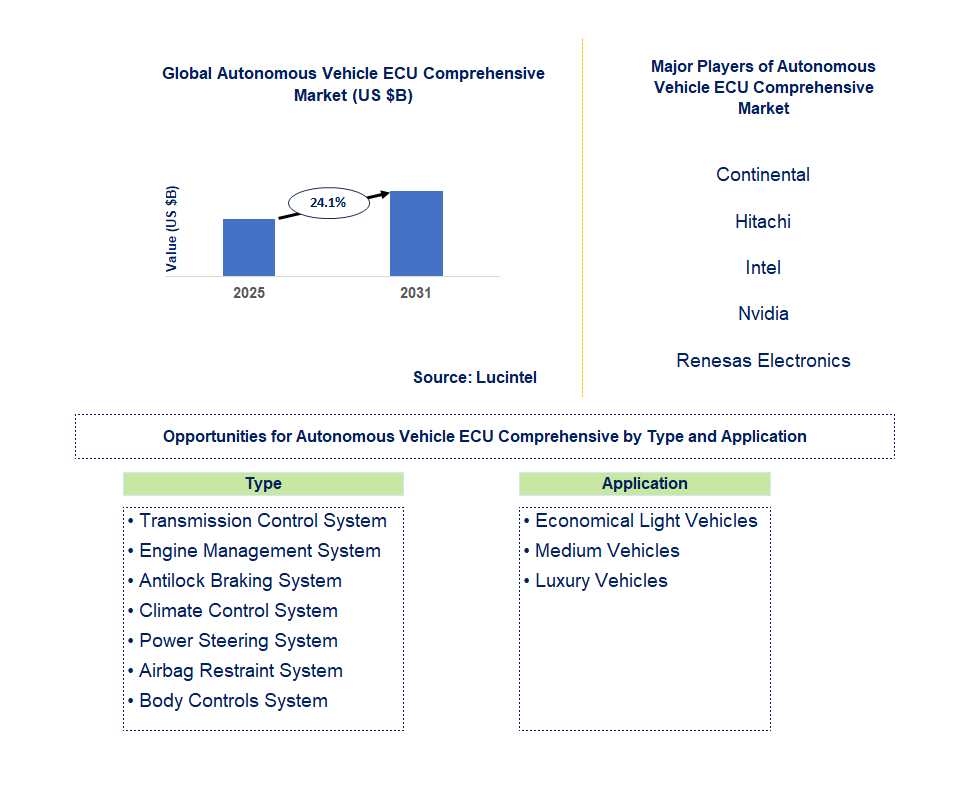
Key data points: The growth forecast = 24.1% annually for the next 7 years. Scroll below to get more insights. This market report covers Trends, opportunity and forecast in autonomous vehicle ECU comprehensive market to 2031 by type (transmission control system, engine management system, antilock braking system, climate control system, power steering system, airbag restraint system, and body controls system), application (economical light vehicles, medium vehicles, and luxury vehicles), and region (North America, Europe, Asia Pacific, and the Rest of the World)
We'll send your sample report shortly.
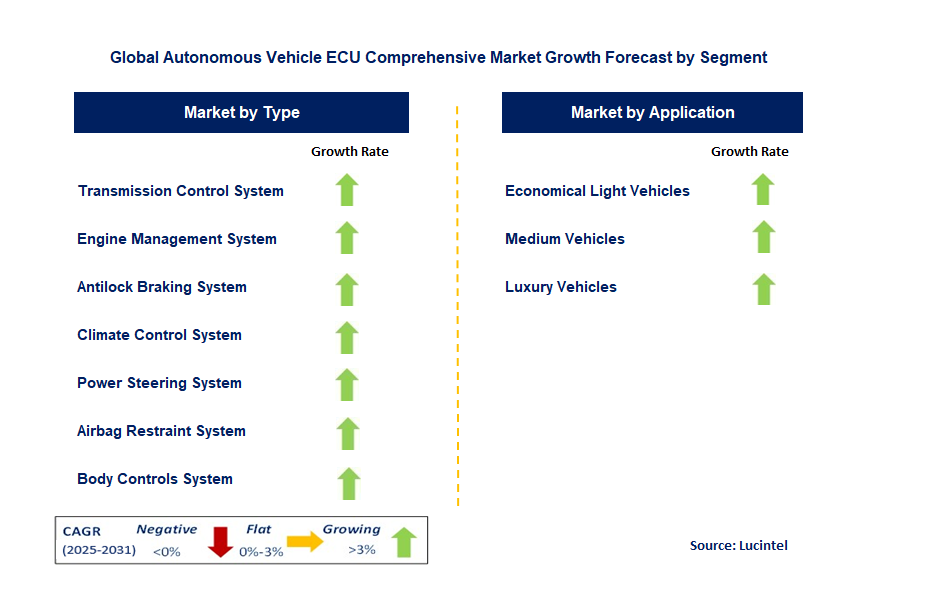
• Lucintel forecasts that, within the type category, engine management system will remain the largest segment over the forecast period due to rising demand for efficient powertrain control systems to optimize performance in autonomous vehicles.
• Within the application category, economical light vehicles will remain the largest segment due to rising demand for cost-effective autonomous mobility solutions in urban and emerging markets.
• In terms of region, North America is expected to witness the highest growth over the forecast period. Gain valuable insights for your business decisions with our comprehensive 150+ page report. Sample figures with some insights are shown below.
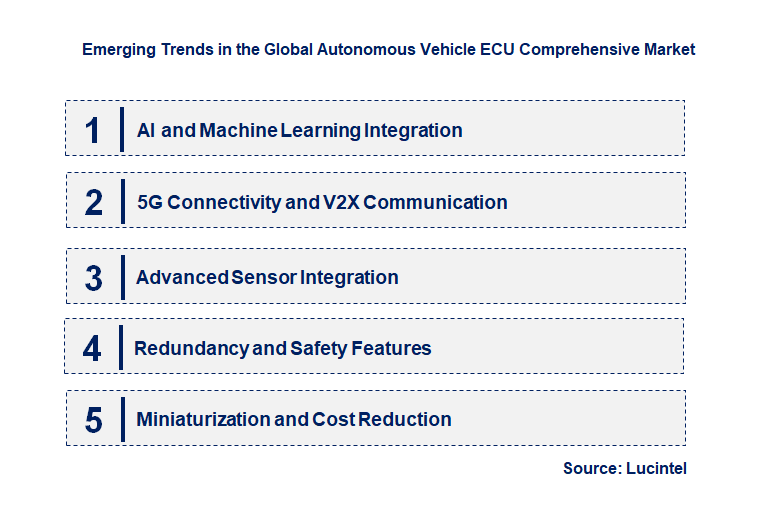
• AI and Machine Learning Integration: The most prominent trend includes the integration of AI and machine learning into the autonomous vehicle ECU. These technologies enable the ECU to learn from real-time data, hence improving decision-making, navigation, and safety. The more AI advances, the more intelligent the ECUs become, changing according to changing road conditions and driving scenarios. This trend is enhancing the performance of autonomous vehicles and accelerating their deployment on roads.
• 5G Connectivity and V2X Communication: The growing 5G networks will provide autonomous vehicle ECUs with more rapid communication speeds with other vehicles, infrastructure, and cloud-based systems. Vehicle-to-everything (V2X) communication enables real-time data exchange to ensure safety and enhance traffic management. This advancement empowers autonomous vehicles to navigate challenging environments, interact with traffic lights, and exchange data with other vehicles within the vicinity to prevent accidents.
• Advanced Sensor Integration: Sensors, such as LiDAR, radar, and cameras, are the backbone of autonomous vehicles. These sensors provide the ECUs with a constant stream of data, which allows for real-time decision-making. Advanced sensor integration ensures that the ECU can detect obstacles, pedestrians, and other vehicles, making the autonomous vehicle safer. As sensor technologies improve, the ECUs' ability to process this information will become more precise, driving greater adoption of autonomous vehicles.
• Redundancy and Safety Features: Safety remains a primary concern for autonomous vehicles, and redundancy in the ECU system is key to addressing this. The trend toward building fail-safe mechanisms into ECUs—where multiple systems can take over in case of failure—is essential for ensuring that autonomous vehicles operate safely. This includes backup systems for critical functions like braking and steering, which are vital for preventing accidents in the event of a system malfunction.
• Miniaturization and Cost Reduction: As the market for autonomous vehicles expands, manufacturers are focusing on miniaturizing ECUs and reducing their production costs. Smaller, more affordable ECUs allow for greater scalability in vehicle production, enabling more manufacturers to incorporate autonomous driving capabilities into their vehicles. Cost reduction is particularly important in markets like India and China, where affordability plays a significant role in the widespread adoption of new technologies. Major trends, such as the integration of AI, 5G connectivity, advancements in sensors, safety features, and miniaturization, are significantly transforming the global autonomous vehicle ECU comprehensive market. These factors improve the performance, safety, and affordability of autonomous vehicles and make self-driving cars more accessible for widespread adoption.
• AI-Powered ECUs for Enhanced Decision Making: The introduction of AI-powered ECUs is changing how autonomous vehicles make decisions and process information. AI-powered ECUs can now assess huge amounts of sensor and camera data to enhance decisions in complex scenarios. AI enables vehicles to make better predictions regarding road conditions, optimize routes, and respond to unknown situations. Such advancements are pivotal for the widespread commercial deployment of fully autonomous vehicles.
• Use of 5G Technology in Real-time Data Exchange: The integration of 5G technology into the ECUs of autonomous vehicles allows for faster communication between vehicles, infrastructure, and cloud systems. The exchange of data in real time will be used to improve the V2V and V2I communication. Deployments of 5G networks will help reduce traffic congestion, accident rates, and ensure the overall safety of the autonomous vehicle, enabling fast decision-making through real-time information.
• Testing Standards for Autonomous Vehicles: As autonomous vehicle technology advances, regulatory bodies are creating frameworks for testing and deploying these vehicles safely. Many countries, including the U.S. and Germany, are implementing testing standards for autonomous vehicles, ensuring that ECUs meet safety and performance criteria. These standards aim to address concerns about the reliability of ECUs in real-world driving conditions and are essential for gaining public trust in autonomous vehicles.
• Partnership Between Automakers and Tech Companies: The collaboration of automakers and tech companies in the development of autonomous vehicle ECUs is also on the rise. Automakers have been teaming up with the tech firms specialized in AI, machine learning, and sensor technologies to upgrade the ECU's capability. This kind of partnership leads to innovation, enabling carmakers to add high-tech capabilities into their vehicles and making them move one step further into autonomous driving.
• Focus on Redundant Systems for Safety: To improve safety, the development of redundant systems within autonomous vehicle ECUs is becoming a key focus. These systems are designed to ensure that if one ECU fails, another can take over to maintain critical vehicle functions such as steering, braking, and navigation. This redundancy is essential for ensuring the safe operation of autonomous vehicles, especially in high-risk driving situations. Recent advancements of autonomous vehicle ECU comprehensive market with AI-powered systems, 5G integration, new testing standards, collaborations, and redundant safety features drive this industry towards higher innovation and adaptation. Such advancements would be essential in the context of real-world operating conditions to ascertain the safety, performance, and reliability of an autonomous vehicle.
• Commercial Fleet Operations: Autonomous vehicle ECUs are highly promising in commercial fleets. Self-driving trucks, delivery vehicles can be used for reducing the expenses of logistics transportation companies, improving on-time delivery speed, and for safety. An increase in this type of common usage will mean an increase in demand for ECUs in commercial fleets.
• Public Transportation Systems: Public transport is another sector where autonomous vehicle ECUs can drive growth. Advanced ECUs in autonomous buses, taxis, and trains can enhance the efficiency of operation, reduce labor costs, and ensure passenger safety. Governments are increasingly exploring autonomous transportation systems, thereby opening up opportunities for ECU manufacturers to develop customized solutions for the public transport sector.
• Personal Mobility Solutions: Autonomous cars and ride-sharing services form a separate market that provides the personal mobility business. Since demand for autonomous vehicles is rising and mainly experienced in developed markets, the importance of ECUs for added functionality, safety, and efficiency has grown. The improvement in driving experience for car owners depends on automakers who add a seamless self-driving experience to ECUs.
• Smart City Integration: Autonomous vehicle ECUs are presented as an opportunity unique to smart cities. These would integrate with infrastructure such as smart traffic lights and sensors on the roads, traffic management systems, or anything else available to optimize flow and reduce congestion in the urban areas. All these will definitely enhance mobility in a city and drive the sustainability targets.
• Aftermarket Solutions: The autonomous vehicle ECU comprehensive market is likely to grow as more autonomous vehicles hit the roads. Consumers may look to upgrade their vehicles with autonomous driving capabilities, creating a demand for retrofit ECUs. This will be an opportunity for ECU suppliers to develop solutions for older vehicles, thereby extending the lifecycle of existing car models and enhancing their autonomous capabilities. The autonomous vehicle ECU comprehensive market is being shaped by strategic growth opportunities in commercial fleets, public transportation, personal mobility, smart city integration, and aftermarket solutions. These opportunities are expected to accelerate the adoption of autonomous vehicles and expand the market for advanced ECUs.
• Continental
• Hitachi
• Intel
• Nvidia
• Renesas Electronics
• ZF Friedrichshafen
• Bosch
• Delphi Automotive PLC
• Hyundai Mobis
• Panasonic Corporation
• Transmission Control System
• Engine Management System
• Antilock Braking System
• Climate Control System
• Power Steering System
• Airbag Restraint System
• Body Controls System
• Economical Light Vehicles
• Medium Vehicles
• Luxury Vehicles
• North America
• Europe
• Asia Pacific
• The Rest of the World
• United States: The United States is the leading player in the autonomous vehicle ECU comprehensive market, with vast investments in technology and infrastructure that will be supportive of self-driving cars. The leading companies, such as Tesla, Waymo, and Cruise, are driving innovations in autonomous vehicle ECUs. The U.S. is currently emphasizing AI and machine learning for improving the capabilities of ECUs to enhance vehicle performance, safety, and user experience. Additional changes at the regulatory level are in place for friendly testing and commercialization of autonomous vehicles. There is much focus on the V2X system for communication as well, integrated into smart cities seamlessly.
• China: China has gained momentum swiftly in the market for autonomous vehicle ECU owing to the government's push to position the country on the world's list in terms of AI and autonomous driving technologies. Some of the key companies that invest heavily in the development of ECUs are Baidu, NIO, and BYD. The Chinese government also has different policies supporting autonomous vehicle technology growth. Such policies even fund and support local automobile manufacturers. Moreover, the 5G technology will penetrate most areas to help improve the communication nature of ECUs, thereby allowing for efficient data transfer between vehicles and infrastructure.
• Germany: The world's biggest automobile-making countries, in terms of global production volume, can be found in Germany, comprising companies such as Volkswagen, BMW, and Daimler. ECUs of their autonomous vehicles would be highly sought in this region in order to boost safety and dependability. Thus, this state has especially seen an increased thrust towards developing LiDAR and other radar technologies through ECU for better safety aspects. Germany is also looking at regulatory challenges of autonomous vehicles and is working on a framework for vehicle testing and road safety standards. The key driver for the growth of the market will be collaboration between the original equipment manufacturers, technology providers, and regulators.
• India: India is still in its nascent stage of embracing autonomous vehicle technology but is gaining fast on the global market. Large auto production in the country, with automotive manufacturers such as Tata Motors and Mahindra and Mahindra, is only now beginning to invest in self-driving vehicle development. The evolution of ECUs is critical in supporting the adoption of self-driving in India, with applications in mobility in cities as well as urban transportation solutions. Indian manufacturers are looking at cost-effective ECUs to meet the increasing demand for smart vehicles, while the government is looking at creating regulations to ensure safe testing and deployment of autonomous vehicles.
• Japan: Japan has been a leader in automotive innovation for a long time, and it continues to push forward in the development of autonomous vehicle ECUs. Companies like Toyota and Honda are heavily involved in installing top-of-the-line ECUs in their products and aiming to achieve self-driving capability by combining sensors, ECUs, and AI. The infrastructure of the country, also in terms of highway systems, is adapting for such vehicles. Japan is keen on making autonomous vehicles safer and more reliable by creating redundant systems within the ECU framework, ensuring fail-safe operations in critical driving situations.


• Continental
• Hitachi
• Intel
• Nvidia
• Renesas Electronics
• ZF Friedrichshafen
• Bosch
• Delphi Automotive PLC
• Hyundai Mobis
• Panasonic Corporation Q5. Which autonomous vehicle ECU comprehensive market segment will be the largest in future? Answer: Lucintel forecasts that engine management system will remain the largest segment over the forecast period due to rising demand for efficient powertrain control systems to optimize performance in autonomous vehicles. Q6. In autonomous vehicle ECU comprehensive market, which region is expected to be the largest in next 5 years? Answer: North America is expected to witness the highest growth over the forecast period. Q7. Do we receive customization in this report? Answer: Yes, Lucintel provides 10% customization without any additional cost.


Choose a license that fits your team. Instant PDF delivery.
Prices exclude taxes. Instant delivery. Custom licensing available on request.
Market Report · July 29, 2026
Market Report · July 20, 2026
Market Report · July 20, 2026
Trusted partner for strategic intelligence and business growth


Receive a complimentary market analysis tailored to your industry. Our analysts will identify key growth opportunities and competitive dynamics specific to your business.

Market size, growth rate, and key trend analysis for your specific sector.

Top competitor positioning and market share analysis.

Strategic recommendations backed by data-driven insights.
Get curated market intelligence and competitive moves straight to your inbox.
By subscribing, you agree to receive our monthly insights. Unsubscribe anytime.
Receive a complimentary market analysis tailored to your industry. Our analysts will identify key growth opportunities and competitive dynamics specific to your business.
Market size, growth rate, and key trend analysis for your specific sector.
Top competitor positioning and market share analysis.
Strategic recommendations backed by data-driven insights.
Get curated market intelligence, emerging trends, and competitive moves straight to your inbox each month.
By subscribing, you agree to receive our monthly insights. Unsubscribe anytime.
We'll send your sample report shortly.