
Market Report · July 13, 2026

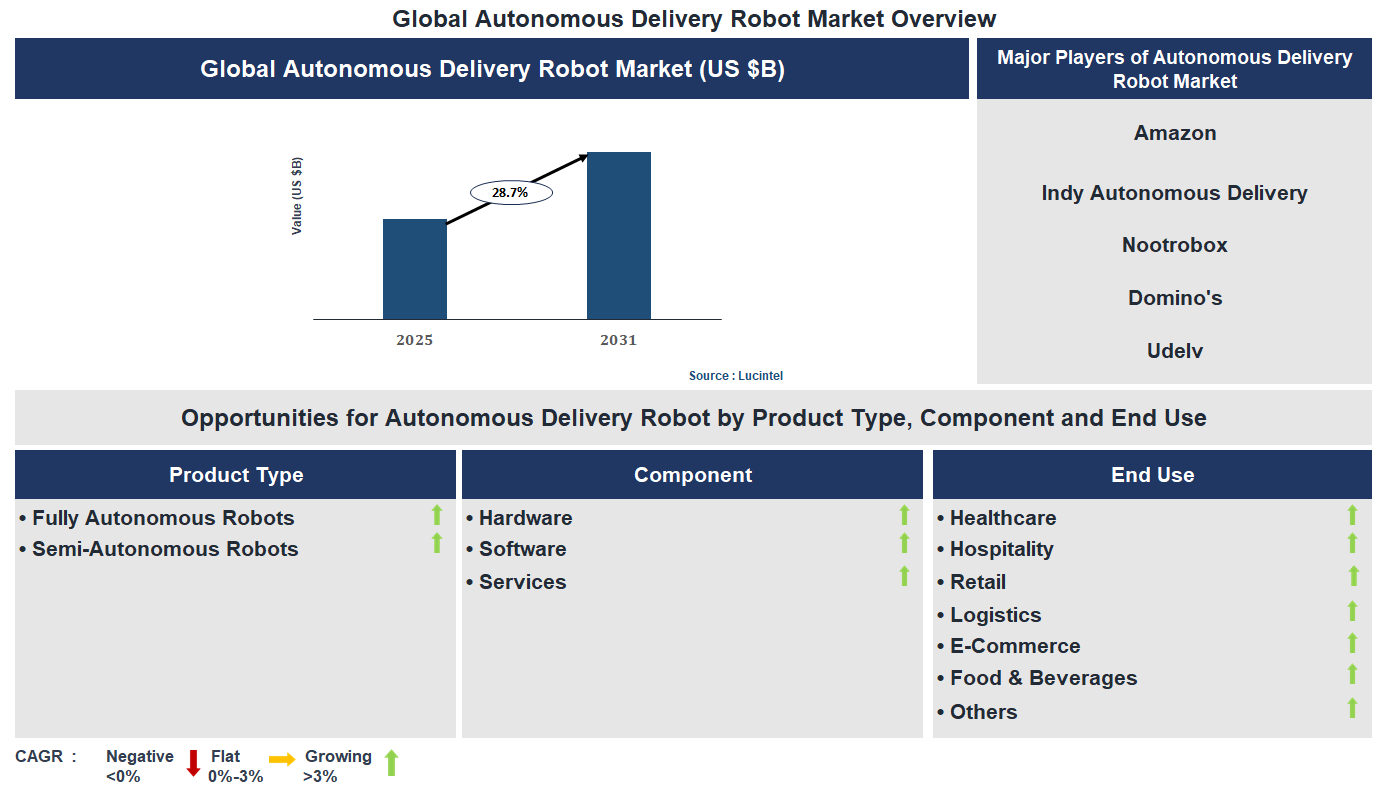
Key data points: The growth forecast = 28.7% annually for the next 7 years. Scroll below to get more insights. This market report covers trends, opportunities and forecasts in autonomous delivery robot market to 2031 by product type (fully autonomous robots and semi-autonomous robots), component (hardware, software, and services), end use (healthcare, hospitality, retail, logistics, E-commerce, food & beverages, and others), and region (North America, Europe, Asia Pacific, and the Rest of the World)
We'll send your sample report shortly.
• Lucintel forecasts that, within the product type category, fully autonomous robot is expected to witness higher growth over the forecast period.
• Within the end use category, retail is expected to witness the highest growth.
• In terms of region, North America is expected to witness the highest growth over the forecast period. Gain valuable insights for your business decisions with our comprehensive 150+ page report. Sample figures with some insights are shown below.
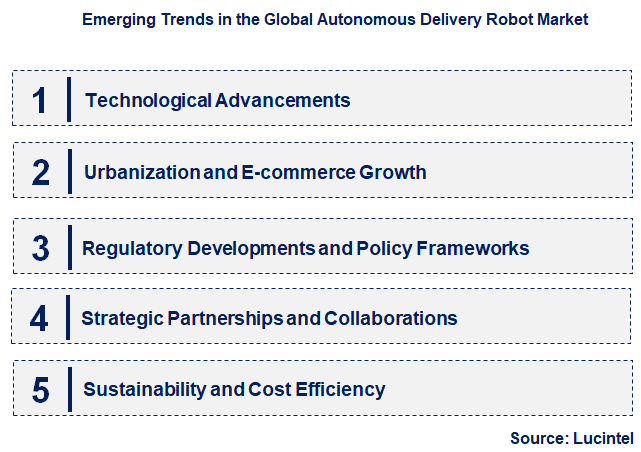
• Technological Advancements: Rapid improvements in AI, machine learning, and sensor technology are enhancing robot navigation, obstacle detection, and route optimization. These innovations enable robots to operate safely and efficiently in complex urban environments, expanding their deployment scope. As technology becomes more affordable and reliable, adoption rates increase, leading to a more competitive market landscape. This trend is also fostering the development of hybrid delivery models combining human and autonomous efforts, ultimately improving delivery speed and accuracy.
• Urbanization and E-commerce Growth: The surge in urban populations and e-commerce sales is driving demand for faster, more efficient delivery solutions. Autonomous robots are well-suited for last-mile delivery in congested city areas, reducing traffic congestion and delivery times. Retailers and logistics companies are investing heavily in autonomous delivery to meet customer expectations for quick service. This trend is reshaping urban logistics, making deliveries more sustainable and cost-effective, and encouraging the development of dedicated delivery corridors and infrastructure.
• Regulatory Developments and Policy Frameworks: Governments and regulatory bodies are establishing guidelines and standards for autonomous delivery operations. Clear regulations are essential for ensuring safety, privacy, and liability management, which in turn fosters market confidence. Progressive policies are encouraging pilot projects and commercial deployments, while also addressing concerns related to safety and employment. The evolving regulatory landscape is a critical factor influencing market growth, with supportive policies accelerating adoption and innovation.
• Strategic Partnerships and Collaborations: Companies across technology, logistics, and retail sectors are forming strategic alliances to accelerate market penetration. Collaborations enable sharing of expertise, resources, and infrastructure, facilitating faster deployment of autonomous delivery solutions. Partnerships with local authorities and urban planners are also crucial for integrating robots into existing transportation networks. These collaborations are fostering innovation, expanding market reach, and creating comprehensive ecosystems that support scalable autonomous delivery services.
• Sustainability and Cost Efficiency: Autonomous delivery robots offer significant environmental benefits by reducing carbon emissions and energy consumption compared to traditional delivery vehicles. Cost savings from lower labor and operational expenses are also driving adoption among logistics providers. As sustainability becomes a key business priority, companies are investing in eco-friendly delivery solutions. This trend is influencing market dynamics by promoting greener logistics practices, appealing to environmentally conscious consumers, and aligning with global sustainability goals. In summary, these trends are collectively reshaping the autonomous delivery robot market by enhancing technological capabilities, addressing urban logistics challenges, establishing supportive regulatory frameworks, fostering strategic collaborations, and emphasizing sustainability. These developments are paving the way for a more efficient, sustainable, and innovative delivery ecosystem, fundamentally transforming how goods are transported and delivered in the modern world.
• Technological Advancements in autonomous delivery robot: Integration of AI and sensor technology has enhanced robot navigation and obstacle detection, increasing reliability and operational efficiency. These improvements enable robots to operate in complex urban environments, expanding their application scope and reducing delivery times, which boosts market growth.
• Regulatory Developments: Governments are establishing new policies and standards for autonomous delivery robots, facilitating their deployment in public spaces. Clear regulations help companies navigate legal challenges, accelerate adoption, and build consumer trust, thereby expanding market reach.
• E-commerce Expansion: The surge in online shopping has increased demand for fast, contactless delivery options. Autonomous robots offer a cost-effective solution for last-mile delivery, especially in densely populated areas, driving market growth and encouraging retailers to adopt autonomous delivery systems.
• Investment and Partnerships: Major tech firms and logistics companies are investing heavily in autonomous delivery solutions and forming strategic alliances. These collaborations accelerate technological innovation, expand deployment networks, and enhance market competitiveness.
• Infrastructure Development: Urban infrastructure is evolving to support autonomous delivery robots, including dedicated lanes and charging stations. Improved infrastructure reduces operational barriers, enhances safety, and promotes widespread adoption, positively impacting market expansion. In summary, technological innovations, supportive regulations, rising e-commerce demand, strategic investments, and infrastructure improvements are collectively propelling the autonomous delivery robot market forward. These developments are making autonomous delivery more efficient, safe, and accessible, thereby transforming last-mile logistics and shaping the future of urban delivery systems.
• Enhanced Customer Experience and Inventory Management : Autonomous delivery robots are transforming retail by enabling faster, contactless delivery directly to consumers, reducing wait times and improving satisfaction. They also assist in inventory management within stores and warehouses, streamlining stock replenishment and reducing labor costs. This integration boosts operational efficiency and supports omnichannel retail strategies, making retail logistics more agile and responsive to consumer demands.
• Efficient Medical Supply and Sample Transportation : In healthcare, autonomous robots facilitate the quick and safe transportation of medicines, medical supplies, and laboratory samples within hospitals and clinics. This reduces human error, minimizes contamination risks, and ensures timely delivery of critical items. The technology enhances hospital workflows, improves patient care, and supports infection control measures, especially vital during pandemics or emergencies.
• Contactless and On-Demand Service Expansion : The food industry benefits from autonomous robots by offering contactless, on-demand delivery services that cater to consumer preferences for safety and convenience. These robots operate in urban environments, navigating traffic and pedestrian areas efficiently. They help restaurants and food providers reduce delivery times, lower operational costs, and expand their reach to customers in remote or high-traffic locations.
• Streamlined Supply Chain Operations : Autonomous delivery robots are revolutionizing logistics by automating last-mile delivery, reducing reliance on traditional vehicles, and decreasing transportation costs. They enable real-time tracking, improve delivery accuracy, and increase flexibility in urban environments. This advancement supports faster, more reliable supply chains, especially in congested areas, and helps logistics companies meet increasing e-commerce demands.
• Innovative Guest Services and Operations : In the hospitality sector, autonomous robots are being deployed for guest services such as delivering amenities, guiding visitors, and managing luggage. These robots enhance guest experiences by providing efficient, contactless service and reducing staffing burdens. They also streamline hotel operations, improve safety protocols, and create a futuristic ambiance that appeals to tech-savvy travelers. In summary, these growth opportunities are significantly impacting the autonomous delivery robot market by driving innovation, reducing operational costs, and enhancing customer experiences across various sectors. As adoption accelerates, the market is poised for substantial expansion, transforming traditional delivery and service paradigms into more efficient, contactless, and intelligent systems.
• Technological Innovation: The rapid development of robotics, AI, and sensor technologies enhances the capabilities of delivery robots, making them more autonomous, efficient, and adaptable to diverse environments. These innovations reduce operational costs and improve delivery speed, attracting logistics companies and retailers to adopt autonomous solutions. As technology continues to evolve, the market is expected to see increased deployment of sophisticated robots capable of handling complex delivery tasks, thus expanding market reach and customer satisfaction.
• Growing E-commerce and Consumer Demand: The surge in online shopping, especially during the COVID-19 pandemic, has heightened the need for fast, contactless delivery options. Autonomous delivery robots offer a cost-effective and scalable solution to meet this demand, especially in urban areas with high delivery volumes. Their ability to operate 24/7 and reduce reliance on human labor makes them attractive to e-commerce giants and logistics providers aiming to improve service levels and reduce delivery times.
• Urbanization and Infrastructure Development: Rapid urban growth necessitates innovative delivery solutions to address traffic congestion and limited parking. Autonomous robots are well-suited for urban environments, navigating complex cityscapes efficiently. Investments in smart city infrastructure, such as dedicated lanes and IoT integration, further facilitate the deployment of these robots, making urban delivery more sustainable and less disruptive, thereby driving market expansion.
• Cost Efficiency and Operational Savings: Autonomous delivery robots significantly reduce labor costs and minimize human error, leading to improved operational efficiency. Businesses are increasingly adopting these robots to streamline last-mile delivery, which is often the most expensive part of the supply chain. The long-term cost savings, coupled with scalability, make autonomous robots an economically attractive option, encouraging widespread adoption across various sectors.
• Strategic Partnerships and Investments: Major technology firms, logistics companies, and startups are forming strategic alliances and investing heavily in autonomous delivery solutions. These collaborations accelerate technological development, expand deployment networks, and foster innovation. Increased funding and partnership activities signal strong market confidence, which in turn attracts further investments, propelling the growth of the autonomous delivery robot industry. The challenges facing this autonomous delivery robot market include:
• Regulatory and Legal Barriers: The deployment of autonomous delivery robots faces complex regulatory hurdles related to safety standards, data privacy, and urban mobility laws. Varying regulations across regions can delay deployment and increase compliance costs. Navigating these legal frameworks requires significant effort and collaboration with authorities, which can slow down market growth and create uncertainty for investors and operators.
• Infrastructure Limitations: Adequate infrastructure, such as dedicated lanes, charging stations, and reliable connectivity, is essential for the effective operation of autonomous robots. Many urban areas lack such infrastructure, posing logistical challenges and increasing deployment costs. Upgrading existing urban infrastructure to support autonomous delivery solutions requires substantial investment and planning, which can hinder rapid market expansion.
• Public Acceptance and Safety Concerns: Consumer trust and acceptance are critical for the widespread adoption of autonomous delivery robots. Concerns about safety, privacy, and job displacement may lead to resistance from the public and policymakers. Ensuring safety standards, educating consumers, and demonstrating reliability are necessary to build confidence, but these efforts require time and resources, potentially slowing market growth. In summary, the autonomous delivery robot market is driven by technological advancements, rising e-commerce, urban infrastructure development, cost efficiencies, and strategic investments. However, regulatory complexities, infrastructure challenges, and public acceptance issues pose significant hurdles. The interplay of these factors will shape the pace and scope of market growth, requiring stakeholders to innovate, collaborate, and adapt to evolving conditions. Overall, the market holds substantial potential for transformation in last-mile delivery, provided these challenges are effectively managed.
• Amazon
• Indy Autonomous Delivery
• Nootrobox
• Dominos
• Udelv
• Starship Technologies
• Dispatch
• Lemonade Robotics
• Postmates
• Nuro
• Fully Autonomous Robots
• Semi-Autonomous Robots
• Hardware
• Software
• Services
• Healthcare
• Hospitality
• Retail
• Logistics
• E-Commerce
• Food & Beverages
• Others
• North America
• Europe
• Asia Pacific
• The Rest of the World
• United States: The US market has seen significant advancements with major tech companies and logistics providers deploying autonomous delivery robots in urban and suburban areas. Innovations in AI and sensor technology have improved navigation and safety features. Regulatory bodies are gradually establishing guidelines, encouraging wider adoption. Companies like Amazon and FedEx are testing autonomous solutions to streamline delivery processes, reducing costs and delivery times. The focus is also on integrating robots with existing delivery infrastructure, enhancing efficiency and customer experience. Investment in R&D remains high, positioning the US as a leader in autonomous delivery technology.
• China: China has rapidly embraced autonomous delivery robots, driven by the booming e-commerce sector and urban density. Major tech giants such as JD.com and Alibaba are deploying robots in densely populated cities, focusing on last-mile delivery. The government actively supports innovation through favorable policies and funding initiatives. Advances in AI, machine learning, and robotics have enabled more sophisticated and reliable delivery solutions. Pilot programs in smart cities are expanding, and collaborations between tech firms and local governments are common. The market is characterized by aggressive expansion and technological integration, making China a key player in this sector.
• Germany: Germanys autonomous delivery robot market is characterized by a focus on safety, regulatory compliance, and integration with existing logistics networks. The country emphasizes sustainable and eco-friendly solutions, with many companies developing electric-powered robots. Partnerships between automotive manufacturers and tech firms are common, leveraging Germanys strong engineering expertise. Pilot projects in urban centers aim to test the feasibility of autonomous delivery in complex environments. Regulatory frameworks are evolving to ensure safety standards, and public acceptance is growing. Germany is positioning itself as a hub for high-quality, reliable autonomous delivery solutions within Europe.
• India: India is witnessing rapid adoption of autonomous delivery robots, especially in urban areas with high population density and traffic congestion. Startups and tech firms are experimenting with low-cost, scalable solutions tailored to local needs. The focus is on affordability, durability, and adaptability to diverse terrains. Government initiatives promoting smart cities and digital infrastructure are facilitating deployment. Pilot projects in metro cities are demonstrating the potential to improve last-mile connectivity. Challenges such as regulatory hurdles and infrastructure gaps are being addressed through collaborations and policy reforms. The market is poised for significant growth as technology matures and adoption increases.
• Japan: Japans autonomous delivery robot market benefits from advanced robotics technology and a strong emphasis on aging population needs. Companies are developing robots capable of navigating complex urban environments and assisting in healthcare and daily errands. The government supports innovation through funding and regulatory adjustments. Pilot programs in smart cities and rural areas aim to test and refine autonomous solutions. Japans focus on safety, reliability, and integration with existing infrastructure makes it a leader in this field. The market is driven by technological excellence and a societal need for efficient delivery options amid demographic challenges.


• Amazon
• Indy Autonomous Delivery
• Nootrobox
• Dominos
• Udelv
• Starship Technologies
• Dispatch
• Lemonade Robotics
• Postmates
• Nuro Q5. Which autonomous delivery robot market segment will be the largest in future? Answer: Lucintel forecasts that, within the product type category, fully autonomous robot is expected to witness higher growth over the forecast period. Q6. In autonomous delivery robot market, which region is expected to be the largest in next 5 years? Answer: In terms of region, North America is expected to witness the highest growth over the forecast period. Q7. Do we receive customization in this report? Answer: Yes, Lucintel provides 10% customization without any additional cost.


Choose a license that fits your team. Instant PDF delivery.
Prices exclude taxes. Instant delivery. Custom licensing available on request.
Market Report · July 13, 2026
Market Report · July 13, 2026
Market Report · July 2, 2026
Trusted partner for strategic intelligence and business growth


Receive a complimentary market analysis tailored to your industry. Our analysts will identify key growth opportunities and competitive dynamics specific to your business.

Market size, growth rate, and key trend analysis for your specific sector.

Top competitor positioning and market share analysis.

Strategic recommendations backed by data-driven insights.
Get curated market intelligence and competitive moves straight to your inbox.
By subscribing, you agree to receive our monthly insights. Unsubscribe anytime.
Receive a complimentary market analysis tailored to your industry. Our analysts will identify key growth opportunities and competitive dynamics specific to your business.
Market size, growth rate, and key trend analysis for your specific sector.
Top competitor positioning and market share analysis.
Strategic recommendations backed by data-driven insights.
Get curated market intelligence, emerging trends, and competitive moves straight to your inbox each month.
By subscribing, you agree to receive our monthly insights. Unsubscribe anytime.
We'll send your sample report shortly.