
Market Report · July 15, 2026

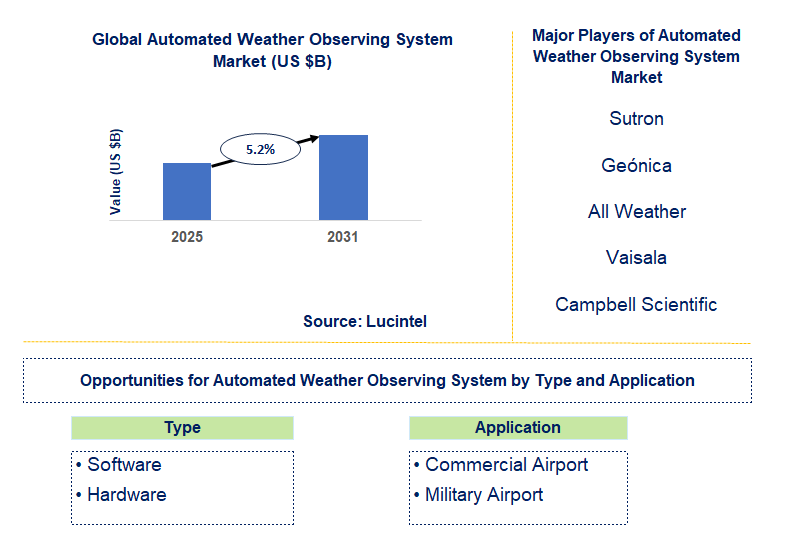
Key data points: The growth forecast = 5.2% annually for the next 7 years. Scroll below to get more insights. This market report covers trends, opportunities and forecasts in automated weather observing system market to 2031 by type (software and hardware), application (commercial airport and military airport), and region (North America, Europe, Asia Pacific, and the Rest of the World)
We'll send your sample report shortly.
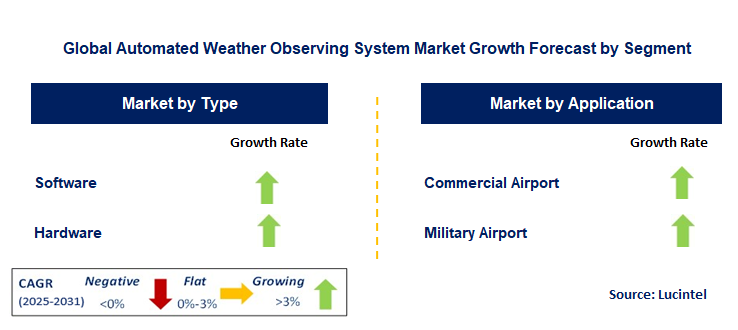
• Lucintel forecasts that, within the type category, software is expected to witness higher growth over the forecast period.
• Within the application category, military airport is expected to witness higher growth.
• In terms of region, APAC is expected to witness the highest growth over the forecast period. Gain valuable insights for your business decisions with our comprehensive 150+ page report. Sample figures with some insights are shown below.
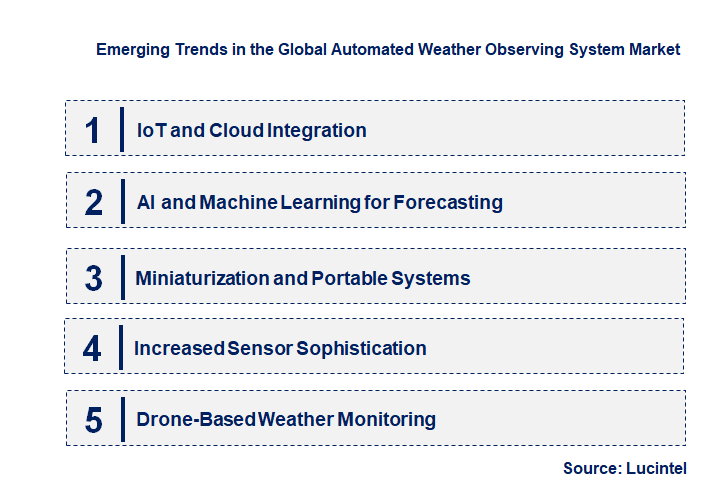
• IoT and Cloud Integration: Seamless connectivity and data accessibility through IoT sensors and cloud platforms. automated weather observing system systems are increasingly integrated with the Internet of Things (IoT) for real-time data collection from distributed sensors. This data is then processed and stored on cloud platforms, enabling remote access, enhanced scalability, and improved data sharing for various applications, from aviation to smart cities.
• AI and Machine Learning for Forecasting: Utilizing artificial intelligence and machine learning algorithms for enhanced predictive accuracy. AI and ML are being applied to analyze vast amounts of historical and real-time weather data from automated weather observing system. This allows for more sophisticated pattern recognition, improved forecasting models, and the ability to predict extreme weather events with greater precision, leading to better preparedness and decision-making.
• Miniaturization and Portable Systems: Development of compact, lightweight, and easily deployable automated weather observing system units. There’s a growing trend towards smaller, more portable automated weather observing system units that can be rapidly deployed in remote locations, disaster zones, or for temporary monitoring needs. These systems often feature lower power consumption and wireless connectivity, expanding their utility beyond fixed installations.
• Increased Sensor Sophistication: Integration of advanced sensors for more precise and diverse meteorological parameters. New automated weather observing system systems are incorporating highly sensitive and specialized sensors for measuring parameters like cloud base height (laser ceilometers), vertical wind profiles (microwave profilers), and atmospheric turbulence. This enhances the detail and accuracy of the collected weather data, crucial for critical applications like aviation.
• Drone-Based Weather Monitoring: Adoption of unmanned aerial vehicles (UAVs) for remote sensing and data collection. Drones equipped with miniature weather sensors are emerging as a flexible and cost-effective way to collect localized weather data, especially in challenging or inaccessible terrains. They complement traditional automated weather observing system networks by providing high-resolution, on-demand meteorological insights for various applications. These trends are profoundly reshaping the automated weather observing system market by pushing towards highly integrated, intelligent, and versatile monitoring solutions. They are expanding the applications of automated weather observing system beyond traditional roles, making them indispensable tools for a broader range of industries, ultimately enhancing safety, efficiency, and preparedness in a climate-sensitive world.
• Integration of Advanced Sensors: Enhanced accuracy and comprehensive data collection. Newer automated weather observing system units incorporate more sophisticated sensors, such as high-resolution laser ceilometers for cloud height, advanced visibility sensors, and precision temperature/humidity probes. This provides more granular and reliable weather parameters essential for critical applications like aviation.
• Connectivity via IoT and Cloud Platforms: Real-time data accessibility and improved operational efficiency. Modern automated weather observing system systems leverage IoT capabilities for seamless data transmission to cloud-based platforms. This allows for real-time data access from anywhere, facilitating better decision-making for airport operations, disaster management, and remote monitoring.
• Miniaturization and Portable Solutions: Increased flexibility and rapid deployment in diverse environments. There’s a growing trend towards compact and portable automated weather observing system, enabling quick deployment at temporary airfields, remote sites, or during emergency response. These units offer robust performance in a smaller footprint, enhancing versatility.
• Emphasis on Data Analytics and AI: Smarter insights and predictive capabilities. Developers are integrating advanced data analytics and artificial intelligence (AI) algorithms into automated weather observing system software. This allows for better interpretation of raw weather data, improved forecasting models, and the ability to identify anomalies or predict severe weather patterns more effectively.
• Compliance with Aviation Regulations: Driving standardization and safety improvements in air travel. Ongoing updates to aviation regulations by bodies like the FAA and ICAO necessitate continuous upgrades and certification of automated weather observing system. This ensures that meteorological data provided to pilots and air traffic control meets the highest safety and reliability standards, fostering market growth. These developments are profoundly impacting the automated weather observing system market by making automated weather observing system more precise, connected, flexible, and intelligent. They are crucial for enhancing safety, optimizing operations, and improving decision-making across various weather-sensitive industries, solidifying automated weather observing system’s role in a data-driven world.
• Aviation Sector: Enhancing safety and operational efficiency at airports globally. The aviation industry remains the largest opportunity. Focus on providing highly reliable automated weather observing system for commercial and military airports, heliports, and drone operations. Opportunities include precise visibility, cloud height, and wind data for safe takeoffs and landings.
• Agriculture and Precision Farming: Optimizing crop yield and resource management. automated weather observing system offers vital real-time data on temperature, humidity, rainfall, and soil moisture. This supports precision agriculture by informing irrigation schedules, pest management, and planting/harvesting decisions, driving demand for localized weather monitoring solutions.
• Renewable Energy Generation: Maximizing efficiency of wind and solar farms. Wind and solar energy sectors require precise weather data for optimal site selection, forecasting energy output, and managing operations. automated weather observing system can provide crucial wind speed/direction and solar radiation data, directly impacting efficiency and profitability.
• Disaster Management and Emergency Services: Improving preparedness and response to extreme weather events. Governments and emergency services utilize automated weather observing system for early warning systems, tracking severe storms, floods, and wildfires. Opportunities lie in rugged, deployable systems for rapid assessment and real-time data in critical situations to enhance public safety.
• Smart Cities and Urban Planning: Integrating weather data for urban infrastructure and environmental monitoring. Smart cities leverage automated weather observing system for microclimate monitoring, air quality management, and optimizing infrastructure operations (e.g., smart lighting, traffic management based on weather). This offers opportunities for compact, network-integrated weather sensors in urban environments. These strategic growth opportunities are impacting the automated weather observing system market by fostering diversification and specialization across application segments. They compel manufacturers to innovate and adapt their offerings to distinct user groups and environments, leading to tailored product lines, expanded market reach, and ultimately, a more robust and responsive industry.
• Sutron
• Geónica
• All Weather
• Vaisala
• Campbell Scientific
• Schneider Electric
• Degreane Horizon
• PULSONIC
• ENAV
• DTN
• Software
• Hardware
• Commercial Airport
• Military Airport
• North America
• Europe
• Asia Pacific
• The Rest of the World
• United States: The U.S. market is heavily focused on integrating automated weather observing system with air traffic control systems for enhanced aviation safety and efficiency. There’s also a growing trend in deploying portable and mobile automated weather observing system for temporary installations and remote areas. Investments in modernizing existing infrastructure and incorporating advanced sensor technology are key.
• China: China is rapidly expanding its automated weather observing system network, especially with massive investments in airport infrastructure and meteorological services. Developments include the deployment of new, more precise systems across various regions to support its growing aviation industry and strengthen its disaster management capabilities against extreme weather events.
• Germany: Germany automated weather observing system market prioritizes high accuracy, reliability, and compliance with stringent international aviation standards. Recent advancements include sophisticated sensor calibration, data redundancy for improved resilience, and integration with broader European meteorological networks to provide comprehensive and dependable weather intelligence for various applications.
• India: India is significantly upgrading its automated weather observing system infrastructure, particularly at airports and for agricultural applications. Recent initiatives involve deploying more integrated automated weather stations across the country, especially in remote or vulnerable regions, to enhance real-time data collection for improved disaster preparedness and precision farming.
• Japan: Japan automated weather observing system market focuses on resilient and highly accurate systems to mitigate the impact of frequent natural disasters. Recent developments include integrating advanced supercomputing capabilities for faster data processing and improved forecasting, alongside deploying robust, redundant systems designed to withstand extreme weather conditions and ensure continuous operation.


• Sutron
• Geónica
• All Weather
• Vaisala
• Campbell Scientific
• Schneider Electric
• Degreane Horizon
• PULSONIC
• ENAV
• DTN Q5. Which automated weather observing system market segment will be the largest in future? Answer: Lucintel forecasts that, within the type category, software is expected to witness higher growth over the forecast period. Q6. In automated weather observing system market, which region is expected to be the largest in next 5 years? Answer: In terms of region, APAC is expected to witness the highest growth over the forecast period. Q7. Do we receive customization in this report? Answer: Yes, Lucintel provides 10% customization without any additional cost.


Choose a license that fits your team. Instant PDF delivery.
Prices exclude taxes. Instant delivery. Custom licensing available on request.
Market Report · July 15, 2026
Market Report · June 26, 2026
Market Report · June 24, 2026
Trusted partner for strategic intelligence and business growth


Receive a complimentary market analysis tailored to your industry. Our analysts will identify key growth opportunities and competitive dynamics specific to your business.

Market size, growth rate, and key trend analysis for your specific sector.

Top competitor positioning and market share analysis.

Strategic recommendations backed by data-driven insights.
Get curated market intelligence and competitive moves straight to your inbox.
By subscribing, you agree to receive our monthly insights. Unsubscribe anytime.
Receive a complimentary market analysis tailored to your industry. Our analysts will identify key growth opportunities and competitive dynamics specific to your business.
Market size, growth rate, and key trend analysis for your specific sector.
Top competitor positioning and market share analysis.
Strategic recommendations backed by data-driven insights.
Get curated market intelligence, emerging trends, and competitive moves straight to your inbox each month.
By subscribing, you agree to receive our monthly insights. Unsubscribe anytime.
We'll send your sample report shortly.