
Market Report · July 15, 2026

Trends, opportunity and forecast in audio software market to 2031 by type (windows, linux, macOS, and other), application (amateurs and professional), and region (North America, Europe, Asia Pacific, and the Rest of the World)
We'll send your sample report shortly.
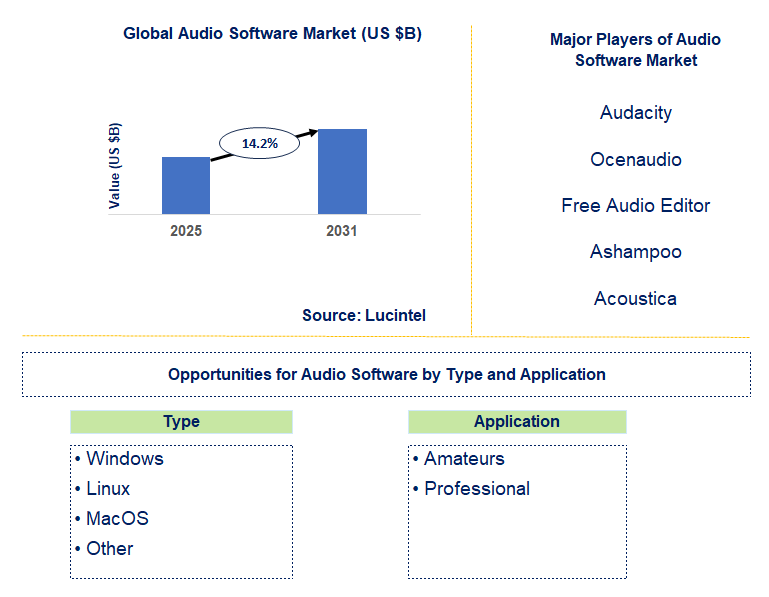
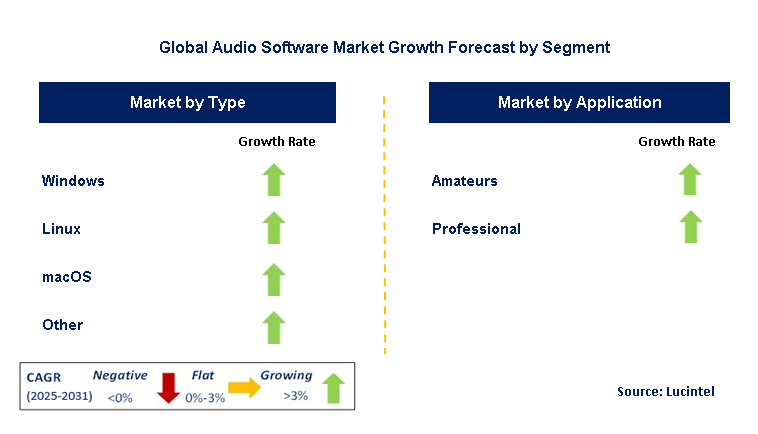
• Lucintel forecasts that window is expected to witness the highest growth over the forecast period due to its widespread adoption, compatibility with a diverse range of hardware, and the availability of professional-grade software.
• Within this market, professional is expected to witness the higher growth due to its higher spending powe and reliance on advanced features.
• North America is expected to witness the highest growth over the forecast period due to increasing demand from its media and entertainment industries.
• AI-Powered Audio Editing: AI-powered audio editing applications are now ubiquitous in the marketplace. Such software can scan an audio file, automatically level audio, remove noise, or compose music. The AI technology promotes faster and easier editing, both for professionals and amateur producers to create quality output. The use of AI technology also allows users to personalize how their sound processing is done to suit their specific needs.
• Cloud-Based Audio Software: Cloud technology is transforming the audio software market, making it possible for users to access their audio projects from any device, at any time. Scalability, cost-effectiveness, and collaboration are some of the benefits offered by cloud-based platforms. This can be helpful to professionals working in teams from various locations. With the increase in the demand for seamless collaboration, the demand for cloud-based audio software solutions will continue to grow.
• Mobile Audio Production: The rise of mobile devices has led to a boom in mobile audio software, allowing users to produce professional-grade audio on the go. Mobile audio production apps are becoming more advanced, offering features such as multi-track editing, high-quality recording, and mixing capabilities. This trend is empowering independent creators, podcasters, and musicians to create and share content with greater ease and flexibility.
• Integration with Virtual and Augmented Reality: The increasing demand of virtual reality (VR) and augmented reality is pushing at the boundaries of audio software development. Audio is, after all the quintessential element of the immersive experience in environments such as VR/AR, making way for the development of software that can generate real, 3D soundscapes. This is especially evident within gaming, film, and interactive media, where realistic sound plays a huge role in user experience.
• Subscription-Based Models: In recent years, the use of subscription-based pricing models has been encouraged in the audio software field. Subscription-based pricing models benefit the consumer with the ability to access premium features without the upfront cost of purchasing a full license, thus also allowing software companies to have a steady stream of revenue through updates and tools. It's obvious that as these subscription-based services increase, more audio software companies will be adopting this model of pricing.
These emerging trends are reshaping the audio software market by offering more accessible, flexible, and innovative solutions for users. AI, cloud-based platforms, mobile production, and integration with VR/AR are key drivers of change, providing new opportunities for content creators and audio professionals alike. As these trends evolve, they will continue to influence the way audio is created, edited, and consumed across various industries.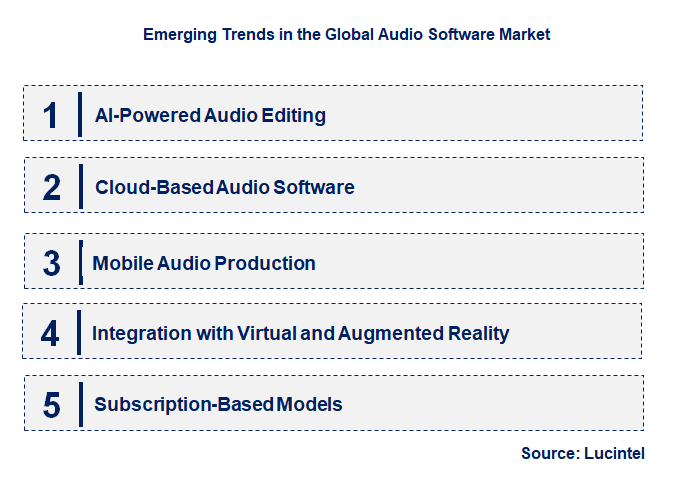
• AI-Driven Sound Editing Tools: The most impactful development is the incorporation of AI-driven tools that can automatically enhance or manipulate audio. Such tools clean up recordings, adjust levels, and even create custom compositions. AI is making audio editing faster and more accessible while reducing the need for manual intervention and delivering high-quality results.
• Cloud Collaboration and Access: The new cloud-based audio software is transforming the way audio creators collaborate and store their projects. This kind of access using the cloud lets users open any device to their projects, share files in real-time with their collaborators, and work remotely. This is significant for professionals working in teams or those who require flexibility in workflow.
• Advances in Mobile Audio Software: In today’s technology, Mobile audio software has become so robust that even anyone creating content can now deliver professional-grade audio produced in a smartphone and tablet. Mobile technology now permits sophisticated editing tools, multi-track mixing, and high-quality recording capabilities, opening opportunities for creators who will not have to spend money on expensive equipment or studio spaces.
• Music and Video Platforms with Integration: Audio software becomes more integrated into music streaming sites, social networks, and video editing applications to share work conveniently, remix a piece of media, or boost existing media content. For example, TikTok and YouTube already integrate audio applications directly into apps, making creating content easier, faster, and more efficient for users.
• Subscription-Based Software Models: The shift toward a subscription-based price model is forcing the re-engineering of ways audio software may be delivered to and consumed. It gives its users access, in exchange for a monthly or yearly fee paid, to get software updates plus support continuously offered. For all users and developers, this creates greater flexibility on how to adapt and keep applications updated with each new feature rolled out.
These key developments are driving innovation in the audio software market, making it more accessible and flexible for users across industries. AI technology, cloud-based solutions, mobile advancements, and subscription models are reshaping the landscape, offering both creators and professionals powerful tools for audio production and collaboration.• Music Production: The demand for professional-grade music production software continues to grow, driven by the increasing number of independent artists, producers, and content creators. Opportunities lie in developing more intuitive, feature-rich software that caters to both professionals and hobbyists. Companies can also explore integrating AI and machine learning features to automate music production tasks, making it easier for users to create high-quality tracks without extensive expertise.
• Podcasting Tools: Podcasting is now one of the most popular media consumption activities. Audio software companies can take advantage of this growing market by creating tools specifically designed for podcasters, such as simple editing software, automated noise reduction, and multi-track recording capabilities. The platforms that will allow easy distribution to podcasting networks and monetization options also have a huge potential.
• Voiceover and Audio for Video Production: As video content becomes the norm, the demand for high-quality voiceover work and audio post-production software is on the rise. Developers can now create software that integrates well with video production workflows, allowing users to edit, mix, and enhance audio with ease. This application is particularly important in film, television, and advertising industries, where top-quality sound is crucial.
• Interactive and Immersive Audio for VR/AR: With the rapid growth of virtual reality (VR) and augmented reality (AR), audio software companies have an immense opportunity to create immersive audio solutions. The high-quality 3D soundscapes and spatial audio are very important in creating engaging VR/AR experiences, especially in gaming and simulations. Companies that innovate in this space can capture the growing demand for immersive media experiences.
• Mobile Audio Production: The growing popularity of smartphones and tablets opens up an opportunity for growth for mobile audio production software. Providers are, therefore able to concentrate on developing powerful yet user-friendly applications that will enable professionals to produce high-quality audio content while on the move. This market is also truly attractive to the content creators who are not able to fit into a standard studio set-up but are interested in producing quality audio for podcasts, music, and video.
These strategic growth opportunities emphasize the wide-ranging applications within the audio software market. As the demand for mobile production tools, immersive audio for VR/AR, and niche solutions for podcasting and music production continues to grow, companies have an opportunity to expand their reach and develop innovative solutions catering to the changing needs of users.• Audacity
• Ocenaudio
• Free Audio Editor
• Ashampoo
• Acoustica
• WavePad Audio Editor
• Apple
• Adobe
• Pro Tools
• Reaper
• Windows
• Linux
• MacOS
• Other
• Amateurs
• Professional
• North America
• Europe
• Asia Pacific
• The Rest of the World
• United States: There remain strong US influences in audio software innovation, for example, and Adobe, Avid, and Apple continue to lead much of the industry progress. Recently there has been more emphasis on audio editing tools in which AI processes enhance and even modify recordings in a very smart way. Both the entertainment industries and podcasters are increasingly calling for high-end production software quality. Cloud-based audio software solutions have become very popular due to their flexibility and cost efficiency for users. The overall market is characterized by rapid advancements, particularly in tools that cater to content creators and the music industry.
• China: The audio software market has been booming in China, especially in music production and social media content creation. Local companies like Tencent and Byte Dance are offering AI-powered audio editing and enhancement tools targeting the fast-increasing user base. These are mobile-first solutions tailored to content creators and influencers, with the primary focus being on mobile-based applications. Since Chinese platforms expand further into other regions, audio software that could be multi-lingual and culturally diverse has gained a market need. There is also considerable growth this way because of the government's interest in technological innovation.
• Germany: The German audio software market focuses a lot on professional sound engineering, mixing, and mastering. The most famous software are Steinberg Cubase and Ableton Live. There have recently been improvements toward virtual instruments that sound much more alive and realistic for music production. Alongside this, film and TV content industries are developing audio postproduction software. An excellent music base and the advent of more numbers of podcasts shall further propel it in Germany.
• India: The audio market in India expands with the phenomenal growth of a digital content production sector. Independent artists, podcasters, and filmmakers are growing in number, demanding affordable yet powerful audio software tools. Local startups are creating niche software tailored to the unique needs of Indian content creators, such as music production and sound design. With an increase in the use of mobile devices, there is a rising mobile audio software market, making it easier for budding creators. The market expands as access to high-speed internet and advanced technology increases.
• Japan: Japan's audio software market is highly affected by the booming music and gaming industries. A ton of new innovative tools are being put forth by the software developers for both professional sound engineers and hobbyists alike. The emphasis on AI and machine learning is immense in order to fully automate sound enhancement and editing processes. The market for game audio production software has also been expanding, with the growing demand for high-quality soundtracks and effects in video games. With Japan's focus on technological advancement, audio software tools are becoming more integrated with other media forms, including virtual reality (VR) and augmented reality (AR).


• Audacity
• Ocenaudio
• Free Audio Editor
• Ashampoo
• Acoustica
• WavePad Audio Editor
• Apple
• Adobe
• Pro Tools
• Reaper
Q5. Which audio software market segment will be the largest in future?

Choose a license that fits your team. Instant PDF delivery.
Prices exclude taxes. Instant delivery. Custom licensing available on request.
Market Report · July 15, 2026
Market Report · June 26, 2026
Market Report · June 24, 2026
Trusted partner for strategic intelligence and business growth


Receive a complimentary market analysis tailored to your industry. Our analysts will identify key growth opportunities and competitive dynamics specific to your business.

Market size, growth rate, and key trend analysis for your specific sector.

Top competitor positioning and market share analysis.

Strategic recommendations backed by data-driven insights.
Get curated market intelligence and competitive moves straight to your inbox.
By subscribing, you agree to receive our monthly insights. Unsubscribe anytime.
Receive a complimentary market analysis tailored to your industry. Our analysts will identify key growth opportunities and competitive dynamics specific to your business.
Market size, growth rate, and key trend analysis for your specific sector.
Top competitor positioning and market share analysis.
Strategic recommendations backed by data-driven insights.
Get curated market intelligence, emerging trends, and competitive moves straight to your inbox each month.
By subscribing, you agree to receive our monthly insights. Unsubscribe anytime.
We'll send your sample report shortly.