
Market Report · July 15, 2026

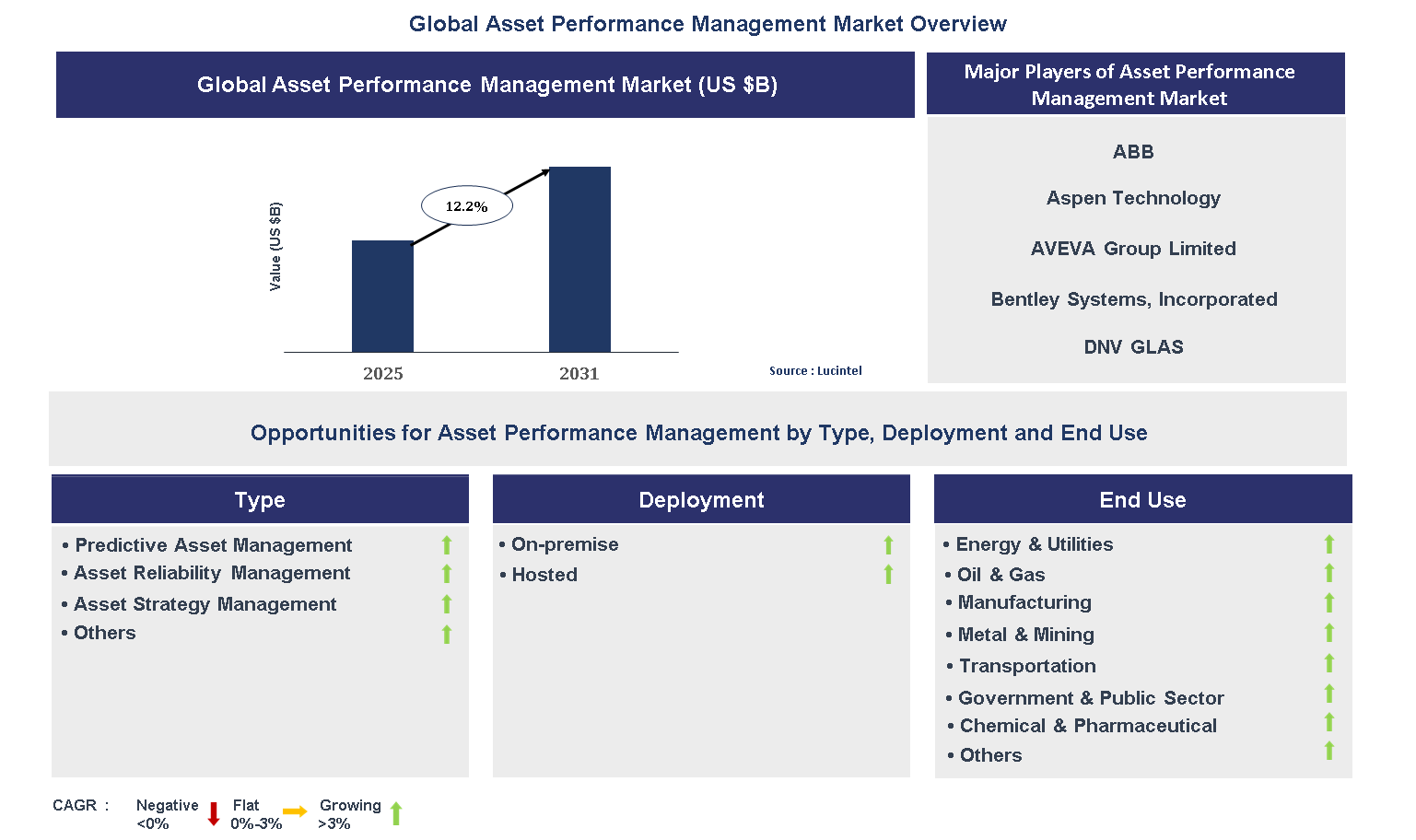
Key data points: The growth forecast = 12.2% annually for the next 7 years. Scroll below to get more insights. This market report covers trends, opportunities and forecasts in asset performance management market to 2031 by type (predictive asset management, asset reliability management, asset strategy management, and others), deployment (on-premise and hosted), end use (energy & utilities, oil & gas, manufacturing, metal & mining, transportation, government & public sector, chemical & pharmaceutical, and others), and region (North America, Europe, Asia Pacific, and the Rest of the World)
We'll send your sample report shortly.
• Lucintel forecasts that, within the type category, asset reliability management is expected to witness the highest growth over the forecast period.
• Within the end use category, energy & utility is expected to witness the highest growth.
• In terms of region, APAC is expected to witness the highest growth over the forecast period. Gain valuable insights for your business decisions with our comprehensive 150+ page report. Sample figures with some insights are shown below.
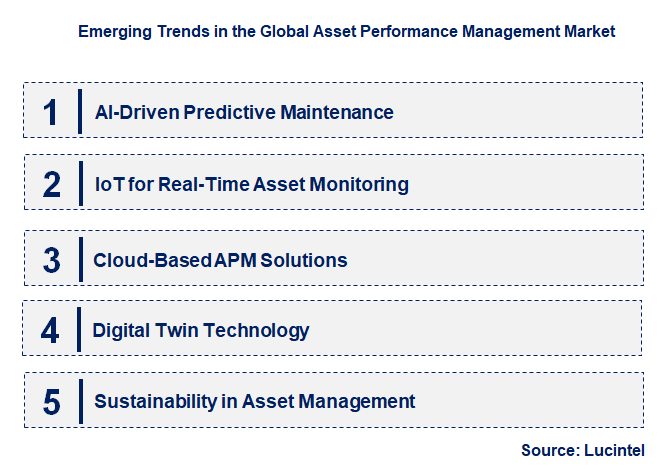
• AI-Driven Predictive Maintenance: AI-powered predictive maintenance is becoming a dominant trend in APM. By analyzing historical and real-time asset data, AI algorithms can predict failures before they occur, allowing for proactive maintenance. This reduces unexpected downtime and increases asset lifespan, improving operational efficiency in industries like manufacturing, energy, and transportation.
• IoT for Real-Time Asset Monitoring: IoT-enabled sensors are providing real-time asset monitoring, enabling continuous data collection on asset health. These sensors are widely used across industries like utilities, energy, and transportation. Real-time data allows businesses to detect issues early, reduce downtime, and optimize performance by identifying inefficiencies or faults in the asset lifecycle.
• Cloud-Based APM Solutions: Cloud-based APM platforms are rapidly gaining popularity, offering scalability, real-time data accessibility, and centralized management. These solutions allow businesses to track assets and monitor performance remotely, enhancing decision-making. The shift toward cloud-based systems enables more flexible, cost-effective, and efficient asset management, particularly for organizations with multiple locations or dispersed assets.
• Digital Twin Technology: Digital twin technology creates virtual replicas of physical assets, allowing companies to simulate and optimize performance in a digital environment. This enables better decision-making for predictive maintenance, asset lifecycle management, and scenario testing. Digital twins are particularly valuable in sectors like manufacturing, energy, and infrastructure, where minimizing downtime is critical.
• Sustainability in Asset Management: Sustainability is becoming a key driver in the APM market. Many organizations are incorporating energy efficiency and environmental impact into their asset management strategies. By integrating sustainability metrics, businesses can optimize energy consumption, reduce waste, and align with regulatory requirements. This trend is prominent in industries such as energy, utilities, and manufacturing. Emerging trends such as AI-powered predictive maintenance, IoT-enabled real-time monitoring, cloud-based APM, digital twins, and sustainability initiatives are shaping the future of the APM market. These technologies are enhancing asset performance, reducing operational costs, and improving sustainability, offering businesses a strategic advantage in a competitive marketplace.
• AI-Powered Predictive Maintenance: AI-driven predictive maintenance solutions are advancing the APM market by enabling businesses to forecast asset failures before they occur. With AI algorithms analyzing asset data, companies can schedule maintenance proactively, reducing unplanned downtime. This has been particularly beneficial in industries such as manufacturing, energy, and transportation, where asset reliability is crucial to operational success.
• Cloud-Based Asset Management Platforms: The introduction of cloud-based platforms has revolutionized APM by enabling centralized, scalable, and remote monitoring of assets. Cloud solutions provide real-time data access, allowing businesses to monitor performance and make informed decisions from anywhere. This has expanded APM capabilities, especially for large organizations with dispersed assets, improving operational efficiency and flexibility.
• IoT Sensors for Continuous Monitoring: IoT sensors have become integral to APM by providing continuous, real-time monitoring of assets. These sensors track various parameters such as temperature, vibration, and pressure, offering valuable insights into asset health. The integration of IoT into APM systems is helping businesses optimize performance and reduce operational costs by detecting issues early.
• Integration of Digital Twin Technology: Digital twin technology is being increasingly integrated into APM solutions, enabling businesses to create virtual replicas of physical assets. This allows for detailed simulations, performance optimization, and maintenance predictions without the risk of disrupting actual operations. Digital twins are particularly advantageous in sectors such as manufacturing and energy, where precision and reliability are paramount.
• Sustainability-Focused APM Solutions: Sustainability is gaining prominence in asset management strategies. Many APM systems now incorporate energy efficiency and environmental impact metrics to help businesses reduce their carbon footprint and comply with regulatory standards. These sustainability-focused solutions are especially relevant in industries like energy, utilities, and manufacturing, where reducing waste and improving efficiency is critical. Recent developments in AI-driven predictive maintenance, cloud-based platforms, IoT sensor integration, digital twin technology, and sustainability-focused solutions are reshaping the APM market. These advancements are driving operational efficiency, reducing downtime, and helping businesses achieve sustainability goals across a range of industries.
• AI-Driven Predictive Maintenance Solutions: AI-driven predictive maintenance is one of the most significant growth opportunities in the APM market. By leveraging machine learning and historical data, companies can predict when assets will fail and schedule maintenance accordingly, reducing downtime and repair costs. This is particularly beneficial in industries like manufacturing, energy, and transportation.
• Cloud-Based APM Platforms: Cloud-based APM solutions are offering significant growth potential due to their scalability and flexibility. These platforms centralize asset data, enable real-time monitoring, and support remote decision-making. The demand for cloud-based APM is expected to grow, especially among businesses with geographically dispersed assets, allowing for more efficient asset management and reduced infrastructure costs.
• IoT-Based Real-Time Monitoring Systems: The integration of IoT for real-time asset monitoring offers another growth opportunity in the APM market. IoT sensors provide continuous monitoring, allowing companies to detect potential issues before they lead to failures. This trend is becoming more prominent in industries like energy, transportation, and utilities, where asset uptime is crucial.
• Digital Twin Technology for Optimization: Digital twin technology is a rapidly growing area in APM. By creating digital replicas of physical assets, businesses can simulate performance, optimize maintenance schedules, and improve decision-making processes. The demand for digital twins is increasing, particularly in industries like manufacturing, energy, and infrastructure, where asset optimization is critical to operational success.
• Sustainability Integration in APM: As businesses focus more on sustainability, APM systems are increasingly incorporating energy efficiency and environmental impact metrics. This integration enables companies to reduce their carbon footprint while improving asset performance. The growing emphasis on sustainability presents a significant growth opportunity, particularly in sectors like energy, utilities, and manufacturing. Growth opportunities in AI-powered predictive maintenance, cloud-based platforms, IoT monitoring, digital twin technology, and sustainability initiatives are driving the expansion of the APM market. These opportunities are helping organizations optimize asset performance, reduce costs, and meet sustainability goals across industries, positioning APM as a key driver of operational efficiency.
• ABB
• Aspen Technology
• AVEVA Group Limited
• Bentley Systems, Incorporated
• DNV GLAS
• GE Vernova
• IBM Corporation
• Rockwell Automation
• SAP
• SAS Institute
• Predictive Asset Management
• Asset Reliability Management
• Asset Strategy Management
• Others
• On-premise
• Hosted
• Energy & Utilities
• Oil & Gas
• Manufacturing
• Metal & Mining
• Transportation
• Government & Public Sector
• Chemical & Pharmaceutical
• Others
• North America
• Europe
• Asia Pacific
• The Rest of the World
• United States: In the U.S., industries are heavily investing in AI-driven APM solutions to predict asset failures and optimize maintenance schedules. The increased adoption of IoT sensors has enabled real-time monitoring, enhancing operational efficiency. Cloud-based APM platforms are becoming increasingly popular, allowing businesses to scale asset management practices. Predictive maintenance tools are widely implemented in manufacturing, energy, and transportation sectors.
• China: China has made significant strides in APM adoption, particularly in smart manufacturing and energy sectors. IoT and AI are increasingly used to monitor and optimize asset performance, allowing for predictive analytics and real-time data integration. Government initiatives and heavy investments in industrial automation have accelerated the deployment of APM solutions, improving operational efficiency and sustainability across various industries.
• Germany: Germany is leading in APM adoption, particularly in industries such as automotive and industrial automation. Industry 4.0 principles are driving innovation, with a focus on IoT, AI, and digital twins for asset performance optimization. The integration of these technologies has enhanced predictive maintenance capabilities, reduced unplanned downtime, and increased operational efficiency in critical manufacturing processes.
• India: In India, APM solutions are gaining traction in the manufacturing, utilities, and energy sectors. The integration of IoT for real-time asset monitoring and the adoption of cloud-based platforms are becoming common. A growing focus on predictive maintenance has allowed businesses to reduce operational costs and improve asset life cycles, especially in the country’s rapidly expanding infrastructure and industrial sectors.
• Japan: Japan is leveraging APM technologies to enhance asset reliability and performance across industries such as manufacturing, automotive, and energy. The integration of AI, IoT, and robotics is accelerating the development of predictive maintenance systems. The government’s push for smart city and smart factory initiatives is driving the widespread adoption of APM technologies for improved asset management and sustainability.


• ABB
• Aspen Technology
• AVEVA Group Limited
• Bentley Systems, Incorporated
• DNV GLAS
• GE Vernova
• IBM Corporation
• Rockwell Automation
• SAP
• SAS Institute Q5. Which asset performance management market segment will be the largest in future? Answer: Lucintel forecasts that, within the type category, asset reliability management is expected to witness the highest growth over the forecast period. Q6. In asset performance management market, which region is expected to be the largest in next 5 years? Answer: In terms of region, APAC is expected to witness the highest growth over the forecast period. Q7. Do we receive customization in this report? Answer: Yes, Lucintel provides 10% customization without any additional cost.


Choose a license that fits your team. Instant PDF delivery.
Prices exclude taxes. Instant delivery. Custom licensing available on request.
Market Report · July 15, 2026
Market Report · June 26, 2026
Market Report · June 24, 2026
Trusted partner for strategic intelligence and business growth


Receive a complimentary market analysis tailored to your industry. Our analysts will identify key growth opportunities and competitive dynamics specific to your business.

Market size, growth rate, and key trend analysis for your specific sector.

Top competitor positioning and market share analysis.

Strategic recommendations backed by data-driven insights.
Get curated market intelligence and competitive moves straight to your inbox.
By subscribing, you agree to receive our monthly insights. Unsubscribe anytime.
Receive a complimentary market analysis tailored to your industry. Our analysts will identify key growth opportunities and competitive dynamics specific to your business.
Market size, growth rate, and key trend analysis for your specific sector.
Top competitor positioning and market share analysis.
Strategic recommendations backed by data-driven insights.
Get curated market intelligence, emerging trends, and competitive moves straight to your inbox each month.
By subscribing, you agree to receive our monthly insights. Unsubscribe anytime.
We'll send your sample report shortly.