
Market Report · July 13, 2026

Key data points: The growth forecast = 24.6% annually for the next 7 years. Scroll below to get more insights. This market report covers trends, opportunities and forecasts in artificial intelligence- powered dynamic discounting market to 2031 by component (software and services), enterprise size (small & medium enterprises and large enterprises), application (retail, E-commerce, BFSI, manufacturing, healthcare, IT & telecommunications, and others), end use (suppliers and buyers), and region (North America, Europe, Asia Pacific, and the Rest of the World)
We'll send your sample report shortly.
• Lucintel forecasts that, within the component category, software is expected to witness higher growth over the forecast period.
• Within the application category, retail is expected to witness the highest growth.
• In terms of region, North America is expected to witness the highest growth over the forecast period.
Gain valuable insights for your business decisions with our comprehensive 150+ page report. Sample figures with some insights are shown below.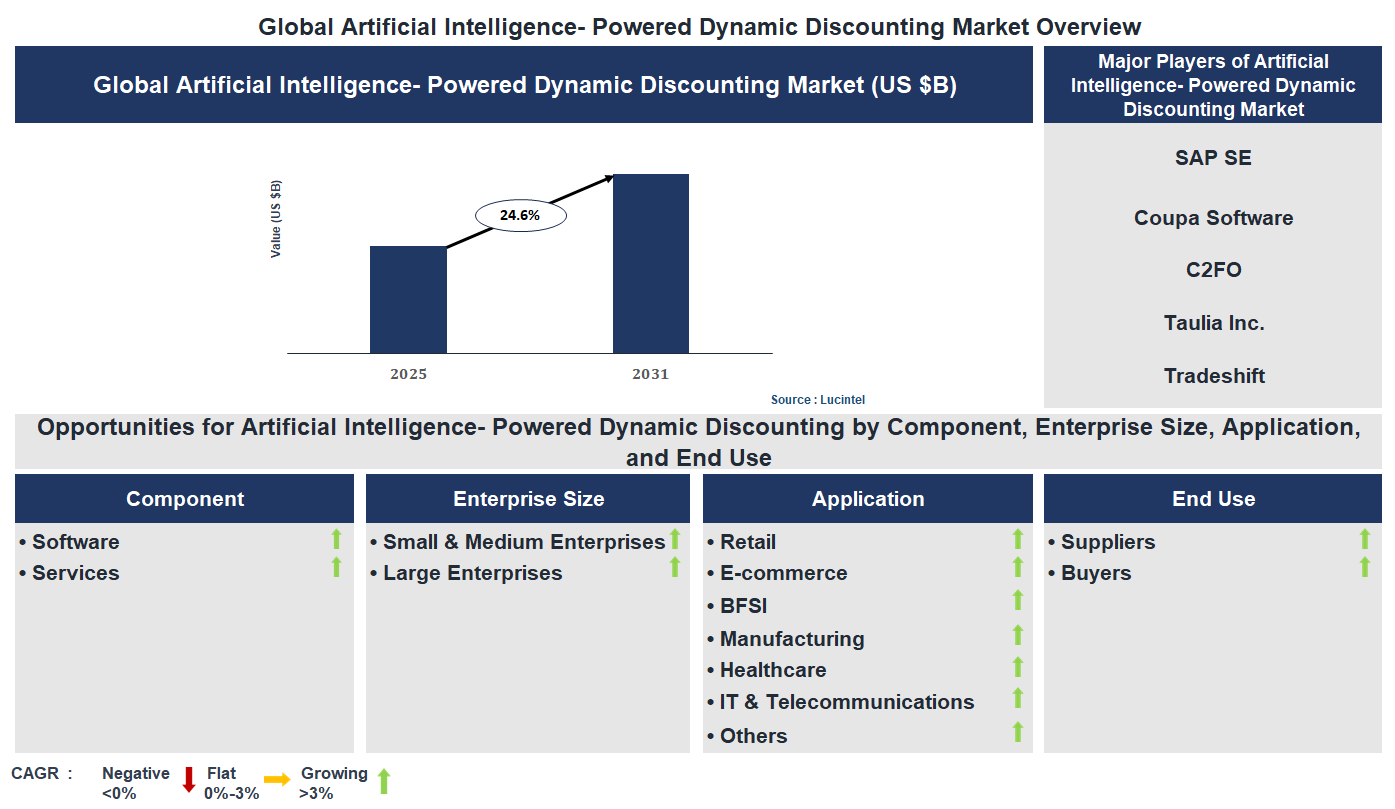
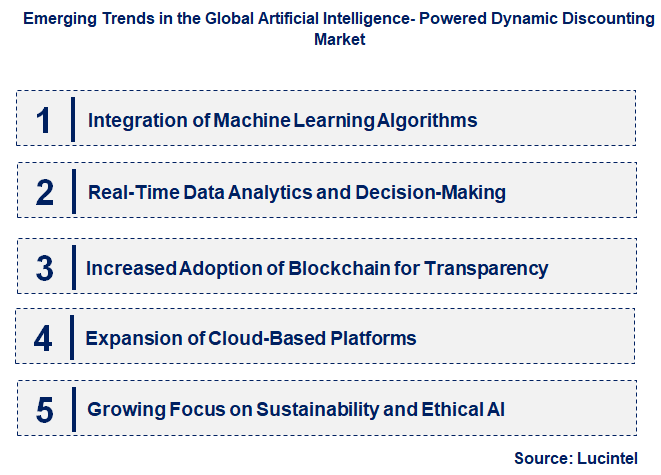
• Integration of Machine Learning Algorithms: Machine learning algorithms are being integrated into dynamic discounting platforms to analyze vast amounts of financial data. This enables more accurate prediction of cash flow patterns and customer behavior, allowing businesses to offer personalized discounts in real-time. The impact is a significant increase in efficiency, reduced risk of default, and improved cash flow management. Companies can dynamically adjust discount rates based on predictive insights, leading to better financial outcomes and enhanced customer satisfaction.
• Real-Time Data Analytics and Decision-Making: The use of real-time data analytics is transforming how businesses make discounting decisions. AI systems continuously monitor market conditions, payment histories, and other relevant data to provide instant recommendations. This immediacy allows companies to optimize discounts dynamically, improving liquidity and reducing days sales outstanding (DSO). The impact is a more agile financial environment where businesses can respond swiftly to market changes, minimize financial risks, and maximize profitability through timely discount adjustments.
• Increased Adoption of Blockchain for Transparency: Blockchain technology is increasingly being integrated with AI-powered discounting platforms to enhance transparency and security. Blockchain ensures tamper-proof transaction records, fostering trust among stakeholders. This integration simplifies audit processes and reduces fraud risks. The impact is a more secure and transparent discounting process, encouraging wider adoption among enterprises and suppliers. It also facilitates smoother cross-border transactions, expanding the market reach and operational efficiency.
• Expansion of Cloud-Based Platforms: Cloud technology is enabling scalable, flexible, and accessible AI-powered discounting solutions. Cloud platforms allow businesses of all sizes to implement sophisticated discounting strategies without heavy upfront investments. They also facilitate seamless integration with existing financial systems and real-time collaboration among stakeholders. The impact is increased market penetration, democratization of advanced financial tools, and enhanced data security. This trend is making dynamic discounting more accessible, fostering innovation, and supporting global expansion efforts.
• Growing Focus on Sustainability and Ethical AI: As AI becomes more embedded in financial decision-making, there is a rising emphasis on ethical AI practices and sustainability. Companies are adopting AI models that promote fair discounting practices, avoid bias, and support sustainable business goals. This trend influences market reputation and compliance with regulations. The impact is a shift towards more responsible AI use, fostering trust among stakeholders, and aligning financial strategies with broader sustainability objectives. It encourages innovation that balances profitability with social and environmental responsibility.
• Adoption of Machine Learning Algorithms: Enhanced predictive analytics and decision-making capabilities are improving discounting strategies, leading to more accurate and personalized offers. This development increases market efficiency and customer satisfaction, fostering greater adoption among businesses seeking tailored financial solutions.
• Integration with Digital Payment Ecosystems: Seamless integration with digital payment platforms enables real-time transactions and instant discounting, reducing processing times and improving cash flow management. This connectivity enhances user experience and operational efficiency, driving market growth.
• Increased Adoption Across Industries: Sectors such as retail, manufacturing, and logistics are increasingly utilizing AI-powered dynamic discounting to optimize working capital. This diversification broadens the market scope and accelerates adoption rates, contributing to overall market expansion.
• Regulatory and Security Enhancements: Implementation of advanced security protocols and compliance standards ensures data protection and builds trust among users. These developments mitigate risks and promote wider acceptance of AI-driven discounting solutions.
• Emergence of Cloud-Based Platforms: Cloud technology offers scalable, cost-effective solutions that facilitate widespread access and deployment of AI-powered discounting tools. This trend lowers entry barriers for small and medium-sized enterprises, expanding the market reach.
• Supply Chain Finance: Enhanced liquidity management through AI-driven dynamic discounting allows suppliers to receive early payments, improving cash flow and strengthening supply chain resilience. This fosters stronger supplier relationships and reduces supply chain disruptions, ultimately leading to more stable and efficient operations.
• Accounts Payable: AI-powered systems automate and optimize payment schedules, reducing manual intervention and errors. This results in cost savings, improved payment accuracy, and better cash flow forecasting, enabling organizations to manage their payables more strategically.
• Treasury Management: Advanced AI analytics facilitate real-time cash position monitoring and predictive modeling, allowing treasurers to make informed decisions on discounting and investments. This enhances financial agility and reduces risk exposure, supporting overall corporate financial health.
• Procurement: Dynamic discounting solutions help procurement teams negotiate better terms by leveraging AI insights into supplier behavior and market conditions. This leads to cost reductions and improved supplier collaboration, fostering long-term strategic partnerships.
• Financial Analytics: AI-powered analytics provide deep insights into discounting patterns, customer behavior, and market trends. These insights enable businesses to refine their discounting strategies, optimize revenue, and identify new growth opportunities in real-time.
• Technological Innovation: The rapid development of AI algorithms and machine learning models enhances the accuracy and efficiency of dynamic discounting solutions. These innovations enable real-time decision-making, predictive analytics, and personalized discount offers, which improve cash flow management for businesses. As AI technology becomes more accessible and scalable, organizations across industries are increasingly adopting these solutions to optimize financial operations. The continuous evolution of AI tools ensures that the market remains competitive and responsive to changing business needs, fostering growth and innovation.
• Increasing Demand for Cash Flow Optimization: Companies face mounting pressure to improve liquidity and manage working capital effectively. AI-powered dynamic discounting offers a strategic approach to accelerate receivables and extend payables intelligently. This demand is driven by economic uncertainties and the need for financial agility, prompting organizations to leverage AI solutions for better cash flow visibility and control. As businesses recognize the benefits of optimized cash management, the adoption of AI-driven discounting platforms is expected to rise, fueling market expansion.
• Cost Reduction and Efficiency Gains: Organizations are seeking ways to reduce operational costs and improve efficiency. AI-powered dynamic discounting automates complex financial processes, minimizes manual intervention, and reduces errors. This automation leads to faster transaction processing and better supplier-buyer relationships. The ability to negotiate discounts dynamically based on real-time data further enhances cost savings. As companies aim to streamline financial workflows and reduce overheads, the market for AI-driven discounting solutions is poised for significant growth.
• Regulatory and Compliance Frameworks: Evolving regulations around data privacy, financial transactions, and digital payments influence market development. Compliance with standards such as GDPR and other regional data protection laws ensures secure handling of sensitive financial data. Regulatory clarity fosters trust among users and encourages wider adoption of AI-powered solutions. Market players must continuously adapt to changing legal requirements, which can both challenge and stimulate innovation within the industry.
• Technological Complexity and Integration: Implementing AI-powered dynamic discounting solutions involves complex integration with existing financial systems and enterprise resource planning (ERP) platforms. Organizations often face difficulties in customizing these solutions to their specific needs, requiring significant technical expertise and resources. The complexity can lead to longer deployment times and higher costs, potentially hindering adoption, especially among small and medium-sized enterprises. Overcoming these technical barriers is essential for broader market penetration.
• Data Security and Privacy Concerns: Handling sensitive financial data necessitates robust security measures. The risk of data breaches and cyberattacks poses a significant challenge, especially as AI systems rely on large volumes of data for training and operation. Ensuring compliance with data privacy laws while maintaining data integrity is critical. Any security lapse can damage reputation and lead to legal penalties, making data security a primary concern for market participants.
• Regulatory Uncertainty and Compliance Costs: Rapidly changing regulatory landscapes across different regions create compliance challenges. Companies must navigate diverse legal requirements related to financial transactions, data privacy, and AI usage, which can increase operational costs and complexity. Uncertainty about future regulations may also delay investment decisions and innovation. Staying compliant while innovating requires continuous monitoring and adaptation, which can strain resources and impede market growth.
• SAP SE
• Coupa Software
• C2FO
• Taulia Inc.
• Tradeshift
• Basware
• Oracle Corporation
• JAGGAER
• Ariba
• PrimeRevenue
• Software
• Services
• Small & Medium Enterprises
• Large Enterprises
• Retail
• E-commerce
• BFSI
• Manufacturing
• Healthcare
• IT & Telecommunications
• Others
• Suppliers
• Buyers
• North America
• Europe
• Asia Pacific
• The Rest of the World
• United States: The US market has seen significant investments in AI-driven financial platforms, with major banks and fintech firms integrating dynamic discounting solutions to enhance liquidity management. Innovations include real-time analytics and predictive modeling, which improve decision-making processes. Regulatory support and a robust technological ecosystem have accelerated adoption, making the US a leader in AI-powered discounting solutions.
• China: China has rapidly expanded its AI capabilities in finance, with numerous startups and tech giants developing advanced dynamic discounting platforms. The focus is on integrating AI with big data to optimize supply chain financing and trade finance. Government initiatives promote digital financial infrastructure, fostering innovation and increasing market penetration across various industries.
• Germany: Germanys market emphasizes the integration of AI in traditional banking and corporate finance sectors. Recent developments include the deployment of AI algorithms for risk assessment and automated discounting processes. The country’s strong industrial base and focus on Industry 4.0 have driven the adoption of AI-powered solutions to streamline financial operations and improve supply chain efficiency.
• India: India has experienced rapid growth in AI-enabled financial services, with startups and large financial institutions adopting dynamic discounting to support small and medium enterprises. The focus is on leveraging AI for credit risk analysis and cash flow optimization. Government initiatives and digital infrastructure development have further accelerated market expansion and innovation.
• Japan: Japan’s market is characterized by the integration of AI in traditional financial institutions, with recent advancements in automated discounting and predictive analytics. The emphasis is on enhancing operational efficiency and managing financial risks. Collaborations between tech firms and banks are fostering innovative AI solutions tailored to Japan’s unique economic landscape.


• SAP SE
• Coupa Software
• C2FO
• Taulia Inc.
• Tradeshift
• Basware
• Oracle Corporation
• JAGGAER
• Ariba
• PrimeRevenue
Q5. Which artificial intelligence- powered dynamic discounting market segment will be the largest in future?

Choose a license that fits your team. Instant PDF delivery.
Prices exclude taxes. Instant delivery. Custom licensing available on request.
Market Report · July 13, 2026
Market Report · July 13, 2026
Market Report · July 2, 2026
Trusted partner for strategic intelligence and business growth


Receive a complimentary market analysis tailored to your industry. Our analysts will identify key growth opportunities and competitive dynamics specific to your business.

Market size, growth rate, and key trend analysis for your specific sector.

Top competitor positioning and market share analysis.

Strategic recommendations backed by data-driven insights.
Get curated market intelligence and competitive moves straight to your inbox.
By subscribing, you agree to receive our monthly insights. Unsubscribe anytime.
Receive a complimentary market analysis tailored to your industry. Our analysts will identify key growth opportunities and competitive dynamics specific to your business.
Market size, growth rate, and key trend analysis for your specific sector.
Top competitor positioning and market share analysis.
Strategic recommendations backed by data-driven insights.
Get curated market intelligence, emerging trends, and competitive moves straight to your inbox each month.
By subscribing, you agree to receive our monthly insights. Unsubscribe anytime.
We'll send your sample report shortly.