
Market Report · July 29, 2026

Key data points: The growth forecast = 40.7% annually for the next 6 years. Scroll below to get more insights. This market report covers trends, opportunities and forecasts in AR array optical waveguide market to 2031 by type (1D pupil expansion and 2D pupil expansion), technology (waveguide-based systems, free-form optics, and holographic waveguides), application (consumer electronics, industrial manufacturing, advanced medical, and others), end use (enterprise, consumer, healthcare, and military & defense), and region (North America, Europe, Asia Pacific, and the Rest of the World)
We'll send your sample report shortly.
• Lucintel forecasts that, within the technology category, waveguide-based system is expected to witness the highest growth over the forecast period.
• Within the end use category, consumer is expected to witness the highest growth.
• In terms of region, North America is expected to witness the highest growth over the forecast period. Gain valuable insights for your business decisions with our comprehensive 150+ page report. Sample figures with some insights are shown below.

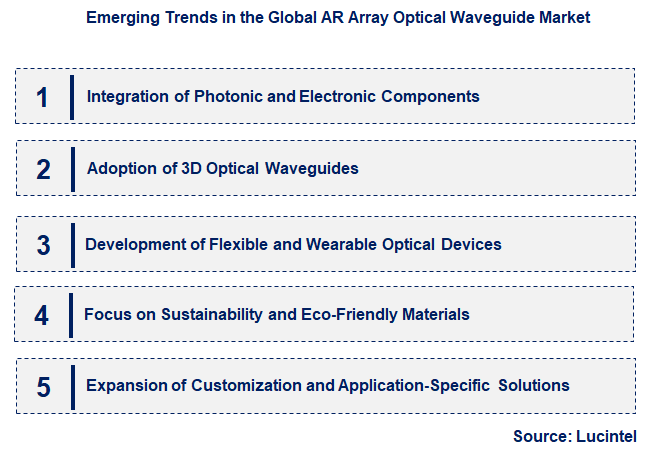
• Integration of Photonic and Electronic Components: This trend involves combining photonic and electronic elements within a single optical waveguide system, leading to enhanced performance and miniaturization. It allows for faster data processing and reduced power consumption, which is critical for high-speed communication networks. The integration supports the development of more compact, efficient devices, enabling new applications in data centers and telecommunications. As a result, manufacturers are investing in hybrid integration techniques, fostering innovation and expanding the market scope.
• Adoption of 3D Optical Waveguides: 3D optical waveguides are gaining traction due to their ability to increase data capacity and improve signal integrity. These structures enable complex routing within a smaller footprint, facilitating high-density integration in optical circuits. The impact includes enhanced bandwidth, reduced crosstalk, and improved scalability for data transmission systems. This trend is particularly significant for applications requiring high data throughput, such as cloud computing and AI data centers, driving demand for advanced manufacturing processes and design innovations.
• Development of Flexible and Wearable Optical Devices: The market is witnessing a shift towards flexible, lightweight, and wearable optical waveguides, driven by the rise of wearable technology and IoT devices. These flexible waveguides enable seamless integration into various form factors, expanding their use in healthcare, consumer electronics, and smart textiles. The impact is increased versatility and new application opportunities, fostering innovation in product design. This trend is expected to open new revenue streams and accelerate market growth by catering to emerging consumer and industrial needs.
• Focus on Sustainability and Eco-Friendly Materials: Environmental concerns are prompting the industry to adopt sustainable materials and manufacturing processes for optical waveguides. This includes using biodegradable polymers and reducing energy consumption during production. The impact is a greener supply chain and products that appeal to environmentally conscious consumers and businesses. This trend not only enhances corporate social responsibility but also aligns with global sustainability goals, potentially providing a competitive advantage and opening markets in regions with strict environmental regulations.
• Expansion of Customization and Application-Specific Solutions: Customization is becoming a key trend, with manufacturers offering tailored optical waveguide solutions for specific applications such as 5G, quantum computing, and medical devices. This approach improves performance and integration efficiency, meeting the unique demands of different sectors. The impact includes increased customer satisfaction, higher value propositions, and the ability to penetrate niche markets. As a result, the market is becoming more diverse and competitive, with companies investing in R&D to develop innovative, application-specific products. In summary, these trends are collectively reshaping the AR array optical waveguide market by fostering innovation, enhancing performance, and expanding application horizons. They are driving market growth, encouraging sustainable practices, and enabling the development of highly customized solutions, ultimately positioning the industry for a more dynamic and competitive future.
• Technological Advancements: New fabrication techniques and materials have improved waveguide performance, leading to higher data transmission rates and lower losses, which enhance AR and VR device capabilities and expand application scope.
• Material Innovation: The development of novel materials such as polymer-based and hybrid composites has increased durability and flexibility, enabling more versatile and lightweight AR devices, thus broadening market applications.
• Integration with 5G Networks: The integration of optical waveguides with 5G infrastructure has facilitated faster data transfer and reduced latency, significantly improving AR experiences and supporting the growth of smart city and IoT applications.
• Manufacturing Process Improvements: Automation and precision manufacturing have reduced costs and increased production efficiency, making AR array optical waveguides more accessible to a wider range of industries and consumers.
• Market Expansion and Strategic Collaborations: Key players are forming strategic alliances and expanding into emerging markets, which accelerates adoption, drives innovation, and boosts overall market growth. These developments are collectively driving the AR array optical waveguide market toward higher performance, broader application, and increased adoption, positioning it as a critical component in next-generation communication and AR/VR systems.
• Expansion of 5G Networks: The deployment of 5G technology requires high-capacity, low-latency optical waveguides, making AR array solutions critical for supporting increased data traffic and network reliability. This growth enhances connectivity and enables new services, boosting market demand.
• Increased Data Processing Needs: As data centers handle exponential data growth, AR array optical waveguides offer scalable, efficient solutions for high-speed interconnects, reducing latency and power consumption, which improves overall data center performance and supports cloud computing expansion.
• Advanced Medical Imaging and Diagnostics: The integration of AR array optical waveguides in medical devices enhances imaging resolution and real-time data transmission, leading to improved diagnostics, minimally invasive procedures, and better patient outcomes, thereby expanding market applications.
• Autonomous Vehicles and Smart Systems: The automotive industry leverages AR array optical waveguides for high-speed data transfer within autonomous vehicles and smart systems, improving safety, navigation, and communication, which accelerates adoption and market growth.
• Augmented Reality Devices and Wearables: The rising popularity of AR-enabled devices and wearables depends on compact, efficient optical waveguides, driving innovation in consumer products and expanding the market for AR array solutions in everyday technology. In summary, these key growth opportunities across applications are significantly impacting the AR array optical waveguide market by driving innovation, increasing demand, and expanding its scope across multiple industries. This evolution is fostering a more connected, efficient, and intelligent technological landscape, positioning the market for sustained growth and competitive advantage.
• Technological Advancements: The continuous development of innovative optical waveguide materials and fabrication techniques enhances performance, efficiency, and integration capabilities. These advancements enable higher data transmission rates and support emerging applications like augmented reality and 5G networks, thereby expanding market potential. As technology evolves, manufacturers can offer more compact, reliable, and cost-effective solutions, attracting a broader customer base and fostering market growth.
• Increasing Data Traffic and Digitalization: The exponential rise in data traffic driven by cloud computing, streaming services, and IoT devices necessitates high-capacity optical communication systems. AR array optical waveguides are crucial for supporting these high-speed networks, ensuring minimal latency and high bandwidth. This surge in demand for data infrastructure directly correlates with increased adoption of advanced optical components, fueling market expansion across various sectors.
• Growing Adoption in AR and VR Applications: The proliferation of augmented reality (AR) and virtual reality (VR) technologies in gaming, healthcare, and industrial training relies heavily on efficient optical waveguides. AR array optical waveguides facilitate compact, lightweight, and high-quality visual displays, making them indispensable for next-generation AR/VR devices. This trend drives innovation and investment in the market, opening new avenues for growth.
• Government Initiatives and Regulatory Support: Governments worldwide are investing in digital infrastructure projects and establishing standards to promote optical communication technologies. Policies supporting 5G deployment, smart cities, and broadband expansion create a favorable environment for market growth. Regulatory frameworks also ensure quality and safety standards, boosting consumer confidence and encouraging adoption. The challenges in the AR array optical waveguide market are:
• High Manufacturing Costs: Producing advanced optical waveguides involves sophisticated fabrication processes, expensive materials, and stringent quality controls. These high costs can limit mass production and make products less affordable for end-users, restricting market penetration, especially in price-sensitive regions. Overcoming cost barriers is essential for broader adoption and competitive pricing.
• Stringent Regulatory Standards: The market faces complex regulatory requirements related to safety, environmental impact, and industry standards. Navigating these regulations can delay product development and market entry, increasing time-to-market and costs. Compliance challenges may also hinder innovation and limit the deployment of new technologies across different regions.
• Technological Complexities: Developing reliable, high-performance AR array optical waveguides involves overcoming technical challenges such as minimizing signal loss, managing heat dissipation, and ensuring durability. These complexities require significant research and development efforts, which can slow down innovation and increase costs. Addressing these technical hurdles is vital for achieving widespread adoption and market stability. In summary, the AR array optical waveguide market is driven by rapid technological progress, increasing data demands, and supportive government policies. However, high manufacturing costs, regulatory hurdles, and technical complexities pose significant challenges. These factors collectively influence the market's growth potential, requiring stakeholders to innovate and adapt strategically. Overcoming challenges while leveraging drivers will be crucial for sustained expansion and technological advancement in this dynamic industry.
• Lumus
• Optinvent
• Shanghai Lipai Optical Crystal Technology
• Lohn Optics
• LINGXI
• Beijing LLVision Technology
• Hangzhou Lili Information Technology
• Gudong Technology
• OPTIX
• Beijing Nai Dejia Display Technology
• 1D Pupil Expansion
• 2D Pupil Expansion
• Waveguide-based Systems
• Free-form Optics
• Holographic Waveguides
• Consumer Electronics
• Industrial Manufacturing
• Advanced Medical
• Others
• Enterprise
• Consumer
• Healthcare
• Military & Defense
• North America
• Europe
• Asia Pacific
• The Rest of the World
• United States: The US market has seen significant investments in AR array optical waveguide technology, with major tech companies and research institutions focusing on integrating these systems into next-generation data centers and 5G infrastructure. Innovations in miniaturization and energy efficiency are prominent, alongside increased collaborations between industry and academia to accelerate commercialization. Government initiatives supporting advanced photonics research further bolster market growth.
• China: China continues to lead in manufacturing capacity and adoption of AR array optical waveguides, driven by government policies promoting optical communication infrastructure. Domestic companies are expanding R&D efforts to develop high-performance, cost-effective solutions for telecommunications and consumer electronics. The country’s focus on 5G deployment and smart city projects has significantly increased demand for advanced optical waveguide systems.
• Germany: Germany’s market is characterized by a strong emphasis on high-precision manufacturing and integration of AR array optical waveguides into industrial applications. Leading research institutes and industry players are collaborating to develop robust, scalable solutions for the automotive and industrial automation sectors. The country’s focus on sustainability and energy-efficient technologies is shaping innovative product development.
• India: India is witnessing rapid growth in the adoption of AR array optical waveguides, primarily driven by expanding telecom infrastructure and government initiatives like Digital India. Local startups and established firms are investing in R&D to develop affordable, high-performance optical components. The increasing demand for reliable internet connectivity and smart city projects is fueling market expansion.
• Japan: Japan remains at the forefront of optical technology innovation, with a focus on integrating AR array optical waveguides into advanced consumer electronics and healthcare devices. Leading corporations are investing in research to improve device miniaturization, durability, and performance. The country’s strong emphasis on R&D and collaboration with global tech firms continues to propel market advancements.


• Lumus
• Optinvent
• Shanghai Lipai Optical Crystal Technology
• Lohn Optics
• LINGXI
• Beijing LLVision Technology
• Hangzhou Lili Information Technology
• Gudong Technology
• OPTIX
• Beijing Nai Dejia Display Technology Q5. Which AR array optical waveguide market segment will be the largest in future? Answer: Lucintel forecasts that, within the technology category, waveguide-based system is expected to witness the highest growth over the forecast period. Q6. In AR array optical waveguide market, which region is expected to be the largest in next 5 years? Answer: In terms of region, North America is expected to witness the highest growth over the forecast period. Q7. Do we receive customization in this report? Answer: Yes, Lucintel provides 10% customization without any additional cost.


Choose a license that fits your team. Instant PDF delivery.
Prices exclude taxes. Instant delivery. Custom licensing available on request.
Market Report · July 29, 2026
Market Report · July 20, 2026
Market Report · July 20, 2026
Trusted partner for strategic intelligence and business growth


Receive a complimentary market analysis tailored to your industry. Our analysts will identify key growth opportunities and competitive dynamics specific to your business.

Market size, growth rate, and key trend analysis for your specific sector.

Top competitor positioning and market share analysis.

Strategic recommendations backed by data-driven insights.
Get curated market intelligence and competitive moves straight to your inbox.
By subscribing, you agree to receive our monthly insights. Unsubscribe anytime.
Receive a complimentary market analysis tailored to your industry. Our analysts will identify key growth opportunities and competitive dynamics specific to your business.
Market size, growth rate, and key trend analysis for your specific sector.
Top competitor positioning and market share analysis.
Strategic recommendations backed by data-driven insights.
Get curated market intelligence, emerging trends, and competitive moves straight to your inbox each month.
By subscribing, you agree to receive our monthly insights. Unsubscribe anytime.
We'll send your sample report shortly.