
Market Report · July 15, 2026

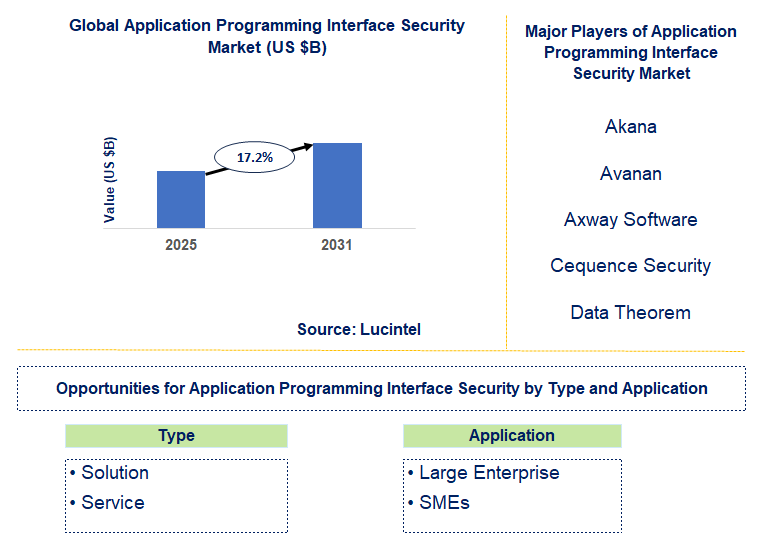
Key data points: The growth forecast = 17.2% annually for the next 7 years. Scroll below to get more insights. This market report covers trends, opportunities and forecasts in application programming interface security market to 2031 by type (solution and service), application (large enterprise and SMEs), and region (North America, Europe, Asia Pacific, and the Rest of the World)
We'll send your sample report shortly.
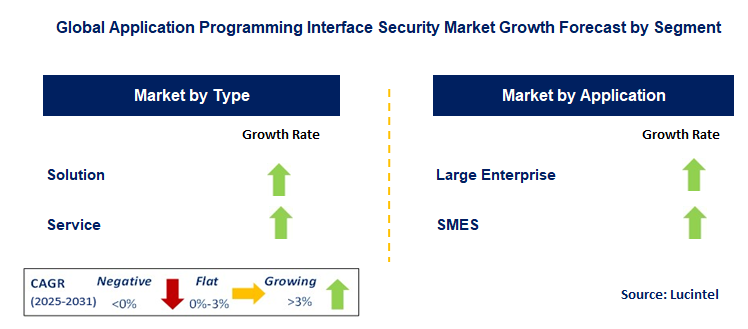
• Lucintel forecasts that, within the type category, service is expected to witness higher growth over the forecast period.
• Within the application category, SME is expected to witness higher growth.
• In terms of region, APAC is expected to witness the highest growth over the forecast period. Gain valuable insights for your business decisions with our comprehensive 150+ page report. Sample figures with some insights are shown below.
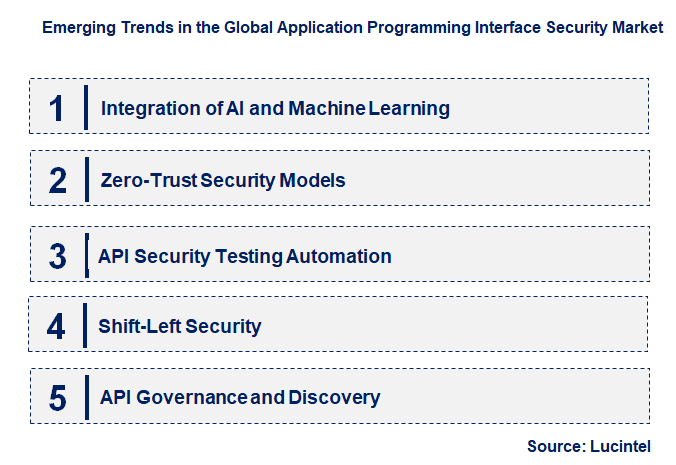
• Integration of AI and Machine Learning: The integration of Artificial Intelligence (AI) and Machine Learning (ML) is emerging as essential for robust threat detection in API security. AI/ML patterns can scrutinize immense volumes of API traffic data to detect aberrant patterns and potential threats in real-time. This anticipatory methodology enables real-time detection and mitigation of complex threats that rule-based systems may fail to detect. For example, AI can be trained to understand the typical behavior of an API and mark deviations that may suggest malicious activity, thus improving the overall security posture.
• Zero-Trust Security Models: The use of Zero-Trust security models is increasingly becoming popular for API security. Zero-Trust works on the concept of "never trust, always verify," imposing rigorous authentication and authorization on all users and devices attempting to access APIs, independent of their position in or out of the network. Micro-segmentation, multi-factor authentication, and continuous verification are used to deploy zero-trust, which dramatically decreases the risk of unauthorized access and lateral movement in the event of a breach.
• API Security Testing Automation: As the number and variety of APIs grow, the need to automate security testing increases. Current API security testing tools are integrated into the development cycle (Dev SecOps), enabling continuous checking for vulnerabilities in APIs. This comprises dynamic application security testing (DAST), static application security testing (SAST), and runtime application self-protection (RASP). Automation means that security is built-in at the outset, not as an afterthought, which yields more secure and resilient APIs.
• Shift-Left Security: The "shift-left" strategy focuses on embedding security practices earlier in the software development cycle. For API security, this involves engaging security teams during the design and development stages, and not only prior to deployment. By recognizing and solving potential security weaknesses early, organizations can minimize the cost and effort for patching vulnerabilities later. This also promotes a culture of security among developers.
• API Governance and Discovery: With more APIs in organizations, proper governance and overall discovery become essential. Governance frameworks provide consistent security policy application over all APIs, whereas discovery tools assist organizations in having a holistic list of their APIs, including shadow or rogue APIs that may be unnoticed. Increased visibility and security control over the API landscape are essential to securing and managing it properly. These trends are all coming together to redefine the application programming interface security market by promoting the need for more advanced, automated, and integrated security. The emphasis is moving from perimeter defense to finer-grained, contextual security controls that are embedded across the API lifecycle. This change is imperative for organizations to secure their digital assets in a rapidly API-enabled world.
• Growing Use of AI-Based Threat Detection: One of the notable trends is the increased use of Artificial Intelligence (AI) and Machine Learning (ML) in API security platforms. AI and ML help to reinforce threat detection and response capabilities to respond to threats in real-time by identifying patterns and anomalies in API traffic that could represent malicious behavior. AI/ML-based algorithms can establish baseline API behavior and alert on deviations, acting as an early warning mechanism for advanced attacks.
• Emergence of API Gateways with Built-In Security Capabilities: API gateways are transforming to encompass stronger and built-in security capabilities. In addition to their historical functions of traffic management and routing, new gateways increasingly now feature capabilities such as threat detection, authentication, authorization, and rate limiting. The bundling of these security capabilities streamlines deployment and maintenance, offering a single point of control for API defense.
• Increased Focus on API Security Testing Tools: There is a significant rise in the usage of specialized tools to test API security. Such tools extend the scope of traditional web application security testing to include the distinctive features and vulnerabilities of APIs. They provide capabilities for fuzzing, API endpoint penetration testing, and verification of authentication and authorization flows, keeping APIs secure against known and new threats.
• Runtime API Protection Emphasis: Runtime Application Self-Protection (RASP) for APIs is becoming more prominent. RASP technology integrates security into the running application, enabling it to identify and neutralize attacks in real-time from inside. It is especially effective against attacks launched via business logic vulnerabilities, which are not usually picked up by perimeter-based security measures.
• Incorporation of API Security into Dev SecOps Pipelines: One key development is the tighter integration of API security processes into the DevOps pipeline, resulting in Dev SecOps. This includes the embedding of security testing and checks into all phases of the API lifecycle, from development and design to deployment and monitoring. By "shifting left," companies are able to detect and fix vulnerabilities early on, leading to more secure APIs. These advancements are driving the application programming interface security market collectively by propelling a shift towards more dynamic, intelligent, and integrated security strategies. The market is witnessing a need for solutions that can not only detect and prevent known threats but also actively identify and defend against emerging and new risks across the API lifecycle.
• Protecting Microservices Architectures: As more deploy microservices, where applications are decomposed into sets of smaller, independently deployable services exchanging messages through APIs, strong API security is essential. Every microservice provides APIs that should be protected against unauthorized access and information disclosure. Opportunity for growth exists in offering security solutions specifically designed for distributed environments, such as service-to-service authentication, authorization, and logging.
• Securing APIs in Cloud-Native Applications: The widespread adoption of cloud-native applications that extensively leverage APIs for communication between components and with cloud-based services is an important growth area. Such APIs need to be secured using solutions that are scalable, cloud-aware, and capable of managing the ephemeral nature of cloud-based deployments. This encompasses securing serverless APIs as well as containerized applications.
• Improving Mobile Backend Security: Mobile apps heavily depend on APIs to fetch and send data. Securing the backend APIs that drive mobile apps is essential to safeguard valuable user information and thwart account takeovers. Growth potential lies in offering mobile-specific API security features, including secure authentication protocols (e.g., OAuth 2.0), rate limiting to thwart abuse, and defense against mobile-specific attack vectors.
• Protecting APIs in IoT Devices: The Internet of Things (IoT) ecosystem relies on APIs for devices to communicate with each other and with central platforms. Nevertheless, most IoT devices do not have high processing power or security features, so their APIs can represent potential attack points. There is an increasing need for lightweight yet effective API security solutions that are tailored to the limitations of IoT environments, emphasizing secure device authentication and data transmission.
• Compliance in Regulated Verticals: Verticals like finance, healthcare, and government have strict regulatory needs around data security and privacy. APIs in these verticals tend to deal with extremely sensitive data, and hence their protection is an utmost concern for compliance. Opportunities to grow come from delivering API security solutions that enable organizations to comply with these regulations, providing capabilities such as data encryption, audit logs, and access controls that map to particular compliance standards (e.g., HIPAA, GDPR, PCI DSS). These development opportunities are affecting the application programming interface security market by propelling the creation of niche solutions that address the specific security needs presented by various areas of application. The market is witnessing a requirement for more context-sensitive and application-specific security solutions to meet the variety of ways APIs are being utilized.
• Akana
• Avanan
• Axway Software
• Cequence Security
• Data Theorem
• Fortinet
• IBM Corporation
• lmperva
• Moesif
• Solution
• Service
• Large Enterprise
• SMEs
• North America
• Europe
• Asia Pacific
• The Rest of the World
• United States: The American market is witnessing large-scale growth in API security due to the extensive deployment of cloud services and harsh data protection requirements. There is heavy emphasis on integrated platforms that integrate access control, encryption, threat detection, and monitoring. Recent developments include partnerships that drive the integration of cloud security posture management with next-generation threat prevention to offer end-to-end security solutions. The financial, healthcare, and e-commerce industries are major inducers of API security adoption based on the sensitive nature of the data they process.
• China: API security is a priority in China, being a top cybersecurity concern. Because of this priority, a difference in cost perception of API security attacks by C-suite and security professionals exists. Securing APIs against threat actors is the focus, with awareness present but actual real-time API testing adoption being low compared to other regions. Regulations such as the Data Security Law act as strong enablers for API security adoption.
• Germany: API security incidents have been increasing in Germany. The market is part of a trend seen in the US and UK where API security is increasingly a priority. Organizations are struggling with the cost of dealing with these incidents, and that argues for more advanced security controls. There is an increasing focus on determining the cause and effect of API security incidents to be able to better allocate resources and strategies.
• India: India's API security environment brings to light a wide gap between the recognition of API inventories and sensitive data awareness among AppSec experts and C-suite leaders. Whereas most leaders report having complete API inventories, a far lower percentage of AppSec teams agree. Similarly, assurance about being aware of which APIs produce sensitive data is also highly varied. This reflects a requirement for stronger internal alignment and greater visibility into API ecosystems to drive security.
• Japan: Japan's strategy towards API security is less of a priority than other places despite the high incidence of reported API security breaches in API-intensive industries such as energy and retail. API security falls lower down the list of general cybersecurity priorities. There is no consensus in various enterprise roles on what the top causes of API security breaches are, indicating the need for a more consensual vision and approach towards securing APIs.


• Akana
• Avanan
• Axway Software
• Cequence Security
• Data Theorem
• Fortinet
• IBM Corporation
• lmperva
• Moesif Q5. Which application programming interface security market segment will be the largest in future? Answer: Lucintel forecasts that, within the type category, service is expected to witness higher growth over the forecast period. Q6. In application programming interface security market, which region is expected to be the largest in next 5 years? Answer: In terms of region, APAC is expected to witness the highest growth over the forecast period. Q7. Do we receive customization in this report? Answer: Yes, Lucintel provides 10% customization without any additional cost.


Choose a license that fits your team. Instant PDF delivery.
Prices exclude taxes. Instant delivery. Custom licensing available on request.
Market Report · July 15, 2026
Market Report · June 26, 2026
Market Report · June 24, 2026
Trusted partner for strategic intelligence and business growth


Receive a complimentary market analysis tailored to your industry. Our analysts will identify key growth opportunities and competitive dynamics specific to your business.

Market size, growth rate, and key trend analysis for your specific sector.

Top competitor positioning and market share analysis.

Strategic recommendations backed by data-driven insights.
Get curated market intelligence and competitive moves straight to your inbox.
By subscribing, you agree to receive our monthly insights. Unsubscribe anytime.
Receive a complimentary market analysis tailored to your industry. Our analysts will identify key growth opportunities and competitive dynamics specific to your business.
Market size, growth rate, and key trend analysis for your specific sector.
Top competitor positioning and market share analysis.
Strategic recommendations backed by data-driven insights.
Get curated market intelligence, emerging trends, and competitive moves straight to your inbox each month.
By subscribing, you agree to receive our monthly insights. Unsubscribe anytime.
We'll send your sample report shortly.