
Market Report · July 15, 2026

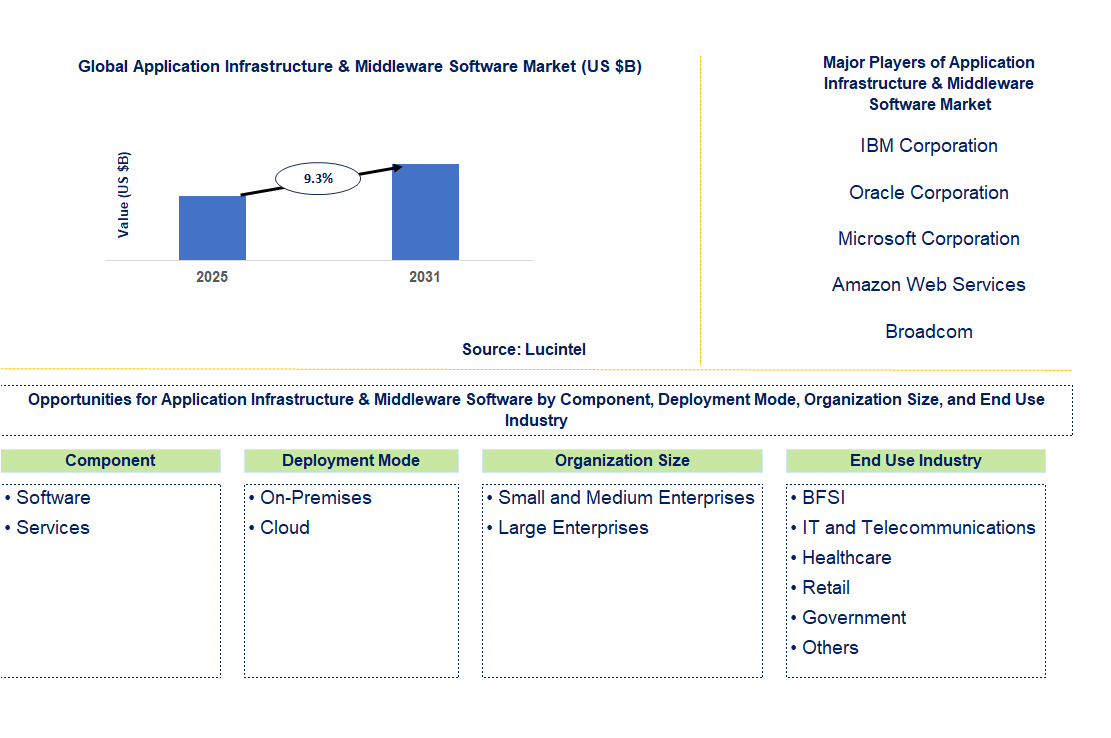
Key data points: The growth forecast = 9.3% annually for the next 7 years. Scroll below to get more insights. This market report covers trends, opportunities and forecasts in application infrastructure & middleware software market to 2031 by component (software and services), deployment mode (on-premises and cloud), organization size (small and medium enterprises and large enterprises), end use industry (BFSI, it and telecommunications, healthcare, retail, government, and others), and region (North America, Europe, Asia Pacific, and the Rest of the World)
We'll send your sample report shortly.
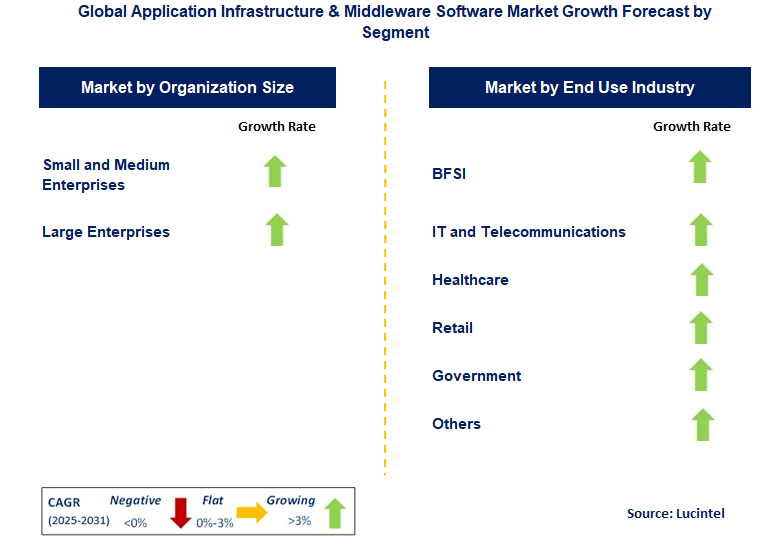
• Lucintel forecasts that, within the organization size category, large enterprises are expected to witness higher growth over the forecast period.
• Within the application category, BFSI is expected to witness the highest growth.
• In terms of region, APAC is expected to witness the highest growth over the forecast period. Gain valuable insights for your business decisions with our comprehensive 150+ page report. Sample figures with some insights are shown below.
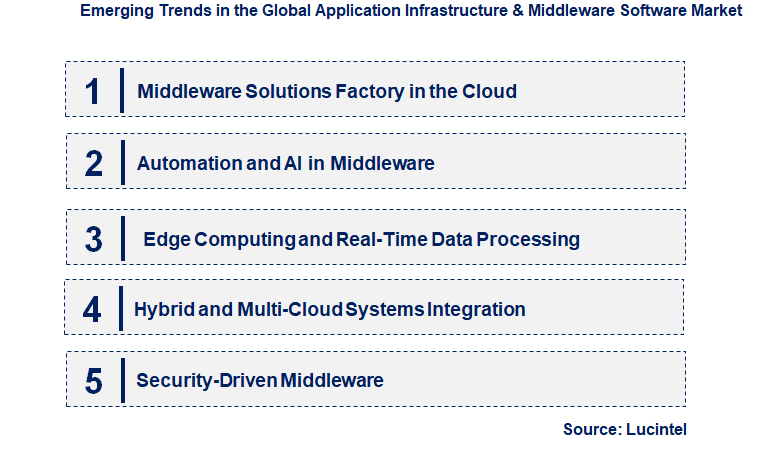
• Middleware Solutions Factory in the Cloud: The auxiliary application components and services that cloud service providers offer, along with their hosting services, are transforming the application middleware framework. Further, the adoption of cloud computing by organizations allows for enhanced flexibility, scalability, and innovation, which drives support for contemporary business models and strategies. Moreover, the associated cost savings provide cloud-native businesses with the ability to scale rapidly. As such, enterprise cloud-native middleware yields better performance, lowers costs, and enriches CI/CD (Continuous Integration and Continuous Deployment) processes.
• Automation and AI in Middleware: Businesses can automate processes and optimize resources with AI-powered middleware solutions. Middleware infused with AI capabilities is aiding in problem prediction, automating system performance metrics, system scaling infrastructure, and providing intricate analytics through automation-powered advanced AI machine learning systems responsible for IT IL analytics-grade decision-making infrastructure. Responsively, the AI-powered middleware systems foster application multi-resilience while simultaneously fortifying security standards and critical tasks response times by seamless automation, executive real-time monitoring systems, superseded automation workings, health analysis, performance figures, and insights qualitatively and quantitatively.
• Edge Computing and Real-Time Data Processing: The demand for connected devices drives the need for computing middleware that processes data at the source. IoT and edge computing allow for instantaneous data processing, enabling rapid real-time actions and insights across diverse industries such as healthcare, manufacturing, and autonomous driving. Edge computing comes with significant benefits but also requires middleware solutions tailored specifically for lower-latency distributed systems management.
• Hybrid and Multi-Cloud Systems Integration: As businesses extend their cloud service subscriptions, hybrid and multi-cloud supporting middleware is becoming more popular. Hybrid cloud middleware solutions allow enterprises to manage applications seamlessly across on-premises and public clouds. Multi-cloud integration mitigates the vendor lock-in risk. With these middleware solutions, businesses can optimize resource utilization, resiliency, and scalability by taking advantage of different cloud platforms.
• Security-Driven Middleware: Application and data security have become one of the challenging digital safety threats of our age. Middleware solution system architectures include defensive mechanisms such as encryption, identity control, and real-time threat monitoring to secure the systems on which they operate. These observations suggest that there is a greater need for flexible, highly automated, and scalable secure deep middleware systems. These advanced trends will remain influential in developing application infrastructure and modifying middleware software technologies after the digital business transformation rush.
• Adoption of Cloud-Native Middleware: The adoption of cloud-native middleware has helped organizations modernize the way they manage and deploy their applications. It offers the needed flexibility along with scalability. In addition, with the introduction of microservices, Kubernetes, and containerization, cloud-native middleware has become essential for modern IT. It enables businesses to step away from older monolithic systems, allowing them to create modular, efficient, scalable, and adaptable systems that support continuous deployment.
• Middleware solutions are being integrated with advanced features powered by artificial intelligence. AI-driven middleware greatly improves the optimization of system performance by automating monotonous tasks, predicting multiple issues beforehand, and providing insights in real-time. As AI evolves continuously, middleware will need to adapt accordingly in order to provide businesses with enhanced features like advanced business intelligence and aid in intelligent decision-making.
• Hybrid Cloud and Multi-Cloud Solutions: The move to hybrid and multi-cloud systems is driving a lot of innovation in middleware systems that enable integration with multiple clouds. Companies are adopting a hybrid cloud model to prevent vendor lock-in and provide better agility in managing business applications. Middleware that supports multi-cloud environments helps organizations manage costs versus performance while enhancing recovery point objectives for disaster recovery and improving data security.
• Edge Computing Middleware: Edge computing middleware is gaining prominence with IoT devices on the rise. Middleware designed for edge computing processes and analyzes data at the network’s edge in real-time, which reduces latency and improves application performance. In healthcare, autonomous vehicles, and manufacturing, the critical nature of edge computing middleware is indispensable because it supports real-time decision-making.
• Enhanced Security Features in Middleware: Securing sensitive information remains a priority as cyber threats become more sophisticated. Advanced security features such as encryption, multi-factor authentication, and identity management are being added by middleware providers to focus more on protecting the data. This is important to guarantee sensitive information is safeguarded and ensures compliance with relevant regulations. The rapid increase in cyberattacks also increases the demand for secure middleware solutions. These changes are literally redefining how companies control their application infrastructure and middleware systems. As the focus of enterprises shifts toward adopting cloud services, automation, security, and edge computing, this particular segment of the market is evolving very quickly.
• Cloud-Native and Microservices Adoption: The rate at which companies are migrating to cloud services is directly proportional to the need for cloud-native middleware. Microservices architectures coupled with containers allow for efficient business application deployment and scaling. Businesses are continually seeking middleware solutions that facilitate faster development cycles, enhanced resource management, and improved agility. This growth opportunity is expected to persist as additional enterprises adopt cloud-first policies.
• AI and Automation in Middleware: Incorporating AI and automation into middleware systems represents an important area of expansion. With AI, middleware applications can perform repetitive functions, enhance system optimization, and provide sophisticated analytics. Automation helps in cutting operational costs, increasing productivity, and improving the quality of business decisions. As AI continues to be a driving force in enterprise IT systems, it is bound to innovate middleware architecture further.
• Edge Computing Middleware: The growing scale of IoT devices generates a greater requirement for middleware that caters to edge computing. With edge computing, businesses can access middleware that allows them to process information at the source and not at a distance, therefore reducing latency. This allows real-time decision-making. The edge of computing is critical for healthcare, manufacturing, and logistics for making real-time data-sensitive decisions. This area of edge computing is a great window for the middleware world to grow significantly.
• Hybrid Cloud and Multi-Cloud Solutions: Growth prospects are significant for middleware suppliers as the use of hybrid and multi-cloud environments increases. Businesses are adopting a multi-cloud approach to bypass vendor lock-in, boost resilience, and optimize performance. The demand for middleware solutions that facilitate effortless integration across numerous cloud platforms is exceptionally high. This demand is expected to persist as businesses continue searching for flexible and economical cloud options.
• Security-Focused Middleware Solutions: Secure middleware solutions are increasingly needed as cyber threats become more sophisticated. The demand for middleware solutions with integrated security features such as encryption, identity management, and threat detection is growing. Businesses are focusing on enhancing security as part of their digital transformation strategy, enabling middleware suppliers to provide more advanced, security-focused offerings. These shifts in application infrastructure and middleware software markets demonstrate the strategic opportunities available. By addressing essential business challenges with emerging technologies, middleware providers can extend their reach to cater to the heightened demand for solutions driven by digital transformation.
• IBM Corporation
• Oracle Corporation
• Microsoft Corporation
• Amazon Web Services
• Broadcom
• Informatica
• Dell Technologies
• Software
• Services
• On-Premises
• Cloud
• North America
• Europe
• Asia Pacific
• The Rest of the World
• United States: American companies are the most advanced in application infrastructure & middleware, concentrating heavily on cloud services and AI technologies. There is significant spending in cloud-native middleware, microservices architectures, and serverless computing. The management of on-premises and cloud systems is becoming easier with advances in hybrid cloud environments. Enhancements on middleware optimization, operational efficiency, and security in complex IT environments also include AI and machine learning to improve IT automation.
• China: China has been persistently investing in middleware support systems to aid the rapid growth of the digital economy. Its government’s emphasis on the digital revolution as well as other supporting technologies such as 5G and AI has fortified the growth of middleware infrastructure. Businesses in China are now adopting containerization and microservices for increased agility. In addition, the government’s push to reduce dependence on foreign technology providers has resulted in the development of cloud-native middleware solutions. This has spurred application infrastructure market growth and supported domestic software vendors.
• Germany: The focus of Germany on Industry 4.0 has strongly influenced the application infrastructure & middleware software market. The country is integrating smart manufacturing and automation into its middleware application, while many companies undergoing digital transformation shift toward microservices and containerized architectures. The adoption and popularity of cloud computing, especially hybrid and multi-cloud, have changed the attitude of German companies regarding the management of application infrastructure. German institutions are known for tight control regarding data governance, which contributes positively to the creation of reliable middleware with high assurance security.
• India: The rise of the digital services sector is enabling the swift adoption of cloud-based middleware in India. Indian businesses are undergoing digital transformation and adopting cloud-native application infrastructure with an emphasis on cost and operational efficiency. Advanced middleware technologies are needed to integrate various government and private sector systems because of the need to meet the goals of the “Digital India” initiative. In addition, the adoption of 5G technology will increase the need for low-latency middleware solutions for e-commerce, education, and healthcare applications that require high-performance speed.
• Japan: The country is shifting to cloud-based middleware and increasing automation in IT systems to improve efficiency. There is a strong emphasis on building adaptable security middleware architecture that supports digitally and traditionally focused businesses. Japan is seeing a rapid increase in demand for fully integrated systems that manage IoT (Internet of Things) devices. Significant advancements in robotics and AI are changing Japan’s application infrastructure & middleware market by adding machine learning, predictive analytics, and edge computing for improved efficiency and real-time data processing.


• IBM Corporation
• Oracle Corporation
• Microsoft Corporation
• Amazon Web Services
• Broadcom
• Informatica
• Dell Technologies Q5. Which application infrastructure & middleware software market segment will be the largest in future? Answer: Lucintel forecasts that, within the organization size category, large enterprises is expected to witness higher growth over the forecast period. Q6. In application infrastructure & middleware software market, which region is expected to be the largest in next 5 years? Answer: In terms of region, APAC is expected to witness the highest growth over the forecast period. Q7. Do we receive customization in this report? Answer: Yes, Lucintel provides 10% customization without any additional cost.


Choose a license that fits your team. Instant PDF delivery.
Prices exclude taxes. Instant delivery. Custom licensing available on request.
Market Report · July 15, 2026
Market Report · June 26, 2026
Market Report · June 24, 2026
Trusted partner for strategic intelligence and business growth


Receive a complimentary market analysis tailored to your industry. Our analysts will identify key growth opportunities and competitive dynamics specific to your business.

Market size, growth rate, and key trend analysis for your specific sector.

Top competitor positioning and market share analysis.

Strategic recommendations backed by data-driven insights.
Get curated market intelligence and competitive moves straight to your inbox.
By subscribing, you agree to receive our monthly insights. Unsubscribe anytime.
Receive a complimentary market analysis tailored to your industry. Our analysts will identify key growth opportunities and competitive dynamics specific to your business.
Market size, growth rate, and key trend analysis for your specific sector.
Top competitor positioning and market share analysis.
Strategic recommendations backed by data-driven insights.
Get curated market intelligence, emerging trends, and competitive moves straight to your inbox each month.
By subscribing, you agree to receive our monthly insights. Unsubscribe anytime.
We'll send your sample report shortly.