
Market Report · July 22, 2026

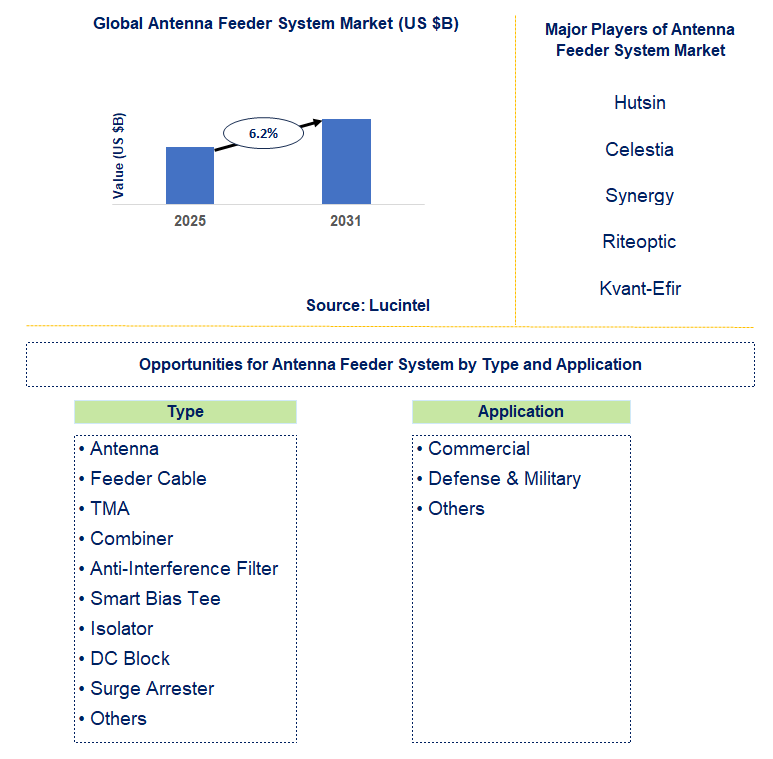
Key data points: The growth forecast = 6.2% annually for the next 7 years. Scroll below to get more insights. This market report covers trends, opportunities and forecasts in antenna feeder system market to 2031 by type (antenna, feeder cable, TMA, combiner, anti-interference filter, smart bias tee, isolator, DC block, surge arrester, and others), application (commercial, defense & military, and others), and region (North America, Europe, Asia Pacific, and the Rest of the World)
We'll send your sample report shortly.
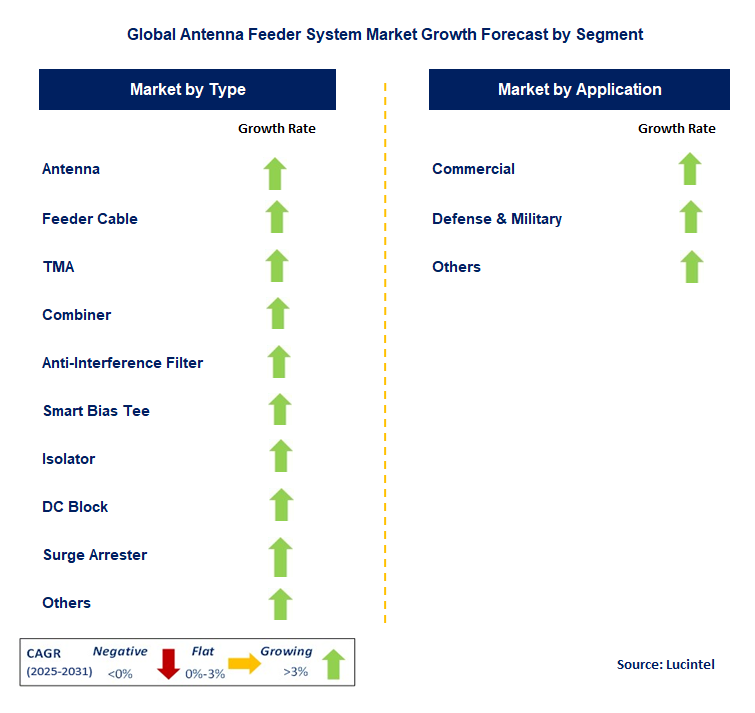
• Lucintel forecasts that, within the type category, TMA is expected to witness the highest growth over the forecast period.
• Within the application category, commercial is expected to witness higher growth.
• In terms of region, APAC is expected to witness the highest growth over the forecast period. Gain valuable insights for your business decisions with our comprehensive 150+ page report. Sample figures with some insights are shown below.
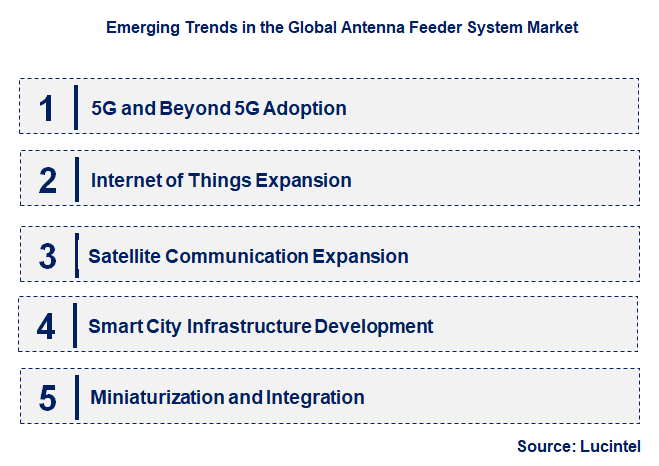
• 5G and Beyond 5G Adoption: The rapid rollout of 5G networks is a chief driver. Such a trend necessitates antenna feeder systems that have increased support for higher frequencies, increased bandwidths, and Massive MIMO and beamforming technologies. 5G infrastructure calls for more antennas and denser deployments, which in turn creates a demand for efficient, compact, and deployable feeder solutions. The ongoing development into Beyond 5G and 6G continues to challenge the limits, requiring more sophisticated antenna and feeder structures with the ability to achieve ultra-high speeds and ultra-low latency.
• Internet of Things Expansion: The sheer proliferation of IoT devices, from smart home sensors to industrial IoT applications, is generating a huge demand for dedicated antenna feeder systems. These systems must be lightweight, affordable, and able to communicate effectively in varied environments with low power consumption, if necessary. The need for pervasive and reliable connectivity for billions of IoT devices, many of which are running in demanding indoor or far-flung locations, is stimulating innovation around multi-band and environmentally sensitive antenna feeder technology.
• Satellite Communication Expansion: The growth of Low Earth Orbit (LEO) satellite constellations and geostationary satellite communications is providing new opportunities for antenna feeder systems. The trend requires satellite ground station, user terminal, and on-the-move feeder systems. The requirements are high gain, high accuracy in beam steering, and reliable performance under severe environmental conditions. The growth in global broadband connectivity requirements, particularly in remote areas, is driving advances in satellite-compatible antenna feeder technology.
• Smart City Infrastructure Development: Smart city development is based significantly on strong and ubiquitous wireless connectivity, which influences the antenna feeder system market. Smart city developments, including smart transportation, public safety, and intelligent infrastructure, involve extensive networks of sensors and communication nodes. This creates demand for well-integrated, high-performance antenna feeder systems capable of handling enormous amounts of data traffic and ensuring seamless coverage of urban environments. The emphasis lies in distributed antenna systems and small cell rollouts to provide comprehensive connectivity.
• Miniaturization and Integration: A ubiquitous phenomenon throughout the electronics sector, miniaturization is increasingly influencing antenna feeder systems. Miniaturized, lighter, and more integrated antenna and feeder components are in greater demand, particularly for space-constrained devices like smartphones, wearables, and self-driving cars. This trend also involves the inclusion of active devices directly within the antenna or feeder, resulting in smart antennas and active antenna units (AAUs), which enhance system performance overall, lower signal loss, and make installation easier. These trends are radically transforming the antenna feeder system market with a focus on demanding higher performance, increased flexibility, and more integrated solutions. The market is shifting towards systems that can support unprecedented data volumes, operate over broader frequency ranges, and easily integrate into sophisticated communication ecosystems. This calls for ongoing innovation in materials, design, and manufacturing processes, which would eventually steer the market towards more intelligent, efficient, and adaptive antenna feeder technologies.
• Rapid 5G Infrastructure Deployment: Fast international deployment of 5G networks is a main development. This resulted in a massive increase in demand for antenna feeder systems capable of handling the higher frequencies (sub-6 GHz and mm Wave) and larger bandwidths of 5G. The development of new feeder cables and connectors with reduced loss, improved shielding, and improved millimeter-wave frequency performance is being made by manufacturers to support efficient signal transfer for user equipment and 5G base stations. This also involves the growing implementation of Massive MIMO antenna systems that demand sophisticated feeder networks.
• Developments in Active Antenna Systems: There is a notable trend toward active antenna systems, in which the radio frequency (RF) electronics such as power amplifiers and transceivers are directly integrated into the antenna unit. This innovation reduces signal loss in feeder cables, improves system efficiency, and facilitates advanced features such as beamforming and massive MIMO more efficiently. This decreases the use of conventional, bulkier feeder cables and makes tower-top installations easier, resulting in more energy-efficient and compact base station deployments.
• Miniaturization and Compact Design Solutions: Continuous advancements in the miniaturization of antenna and feeder elements are a principal development. This trend is important for city deployments, small cells, and consumer equipment where space is limited. Companies are designing smaller, lighter, and less obtrusive feeder cables and connectors. This enables more convenient integration into varied environments, such as smart city infrastructure and in-building solutions, without the compromise of performance, which enables network densification and aesthetic appeal.
• Greater Emphasis on Distributed Antenna Systems: Increasing need for continuous coverage indoors and outdoors, especially in dense environments such as stadiums, airports, and office buildings, is fueling the growth of distributed antenna systems. The latest in DAS is the implementation of hybrid and digital DAS architecture, using fiber optic cable for longer lengths and more effective signal delivery. This minimizes the complexity and materials used in conventional coaxial feeder systems, enhancing network performance and scalability in difficult conditions.
• Improved Materials and Manufacturing Methods: Material science and manufacturing process innovations are resulting in more cost-effective involvement, efficient, and stronger antenna feeder systems. These involve the usage of advanced dielectric material in cables to overcome signal loss, enhanced shielding methods to decrease interference, and automated manufacturing processes to improve consistency and decrease costs of production. All of these improve the overall reliability and lifespan of antenna feeder infrastructure, fundamental to long-term network performance. These newer advancements collectively are influencing the antenna feeder system market by promoting higher performance, greater efficiency, and more flexible solutions. The market is responding to the needs of future-proof wireless technology and expanding uses, leading to a market that is dominated by more integrated, compact, and resilient antenna feeder components that are critical to the future of global connectivity.
• 5G Telecommunications Infrastructure: The worldwide deployment of 5G networks offers the largest growth opportunity. This includes the installation of new base stations, small cells, and large MIMO antenna arrays, all of which need state-of-the-art antenna feeder systems. Growth in this area is dictated by demand for low-loss cable, high-frequency connectors, and integrated solutions capable of handling the higher bandwidth, higher data rates, and lower latency of 5G. Ongoing densification of 5G networks will guarantee continued demand for innovative feeder components.
• IoT and M2M Communications: The growing Internet of Things (IoT) and Machine-to-Machine (M2M) communications market represents enormous growth opportunities. Billions of connected devices, ranging from smart sensors to industrial automation systems, need efficient and reliable antenna feeder connections. The potential is in creating small, affordable, and energy-saving feeder systems designed for diverse IoT applications, such as smart agriculture, asset tracking, and smart manufacturing. These tend to be multi-band and low-power applications.
• Satellite Communication and Ground Stations: The fast growth in satellite communications, especially with the spread of LEO and MEO constellations, is opening up new doors for growth in antenna feeder systems. This encompasses ground station facilities, user terminals for satellite broadband services, and in-flight connectivity solutions. What is in demand are high-performance, rugged feeder systems that can perform at diverse frequency bands (Ku, Ka, Q/V bands) and adverse environmental conditions to ensure secure data communication to and from satellites.
• Smart Cities and Public Safety Networks: The growth of smart cities and public safety communication networks (e.g., TETRA, FirstNet) are significant areas for expansion. Smart city applications necessitate the use of distributed antenna systems (DAS) and specially adapted feeder solutions in order to provide failure-free and interference-free connectivity throughout urban areas, public facilities, and emergency services. The emphasis is on delivering high-capacity, interference-insensitive, and secure feeder systems that will enable critical communications services and a wide variety of smart city functions.
• Connected Cars and Autonomous Vehicles: The new market for autonomous and connected cars is a special growth opportunity. These cars are highly dependent on advanced communication systems for Vehicle-to-Everything (V2X) communication, GPS, radar, and entertainment. This creates demand for very integrated, compact, and reliable antenna feeder systems that can sustain automotive environments and support safety and navigation functions. The ongoing development of autonomous driving technologies will drive long-term demand in this segment. These strategic development opportunities are having a deep effect on the antenna feeder system market by bringing focus to specialized, high-performance, and application-driven solutions. The market is highly diversified and has manufacturers and suppliers requiring innovation across different sectors to address the unique requirements of 5G, IoT, satellite communications, smart cities, and autonomous vehicles. It is an extremely competitive but opportunity-laden environment.
• Hutsin
• Celestia
• Synergy
• Riteoptic
• Kvant-Efir
• Zhuhai Telehof Electrics Company
• Volda
• M2 Antenna Systems
• Sichuan Zhonggng Lightg
• Jiangsu Hengxin Technology
• Antenna
• Feeder Cable
• TMA
• Combiner
• Anti-Interference Filter
• Smart Bias Tee
• Isolator
• DC Block
• Surge Arrester
• Others
• Commercial
• Defense & Military
• Others
• North America
• Europe
• Asia Pacific
• The Rest of the World
• United States: The United States market is growing strongly, largely fueled by assertive 5G rollouts and surging demand for high-end wireless connectivity. Distributed antenna systems (DAS) have a strong emphasis to boost indoor and outdoor coverage in high-density city areas and major public venues. Firms are putting money into solutions that come with enhanced frequencies and massive MIMO technology to satisfy growing data traffic. Furthermore, developments in smart antenna technologies as well as their integration into IoT applications are fueling market growth.
• China: China is a major player in the world antenna feeder system market, fueled by its large and fast-paced 5G infrastructure deployment. China envisions significant investment in base station antennas, with a heavy focus on technologies such as massive MIMO and beamforming to enable its large network and smart city plans. There is also an effort towards affordable solutions to provide broadband penetration in both rural and urban regions, thereby driving innovation in antenna feeder system designs.
• Germany: Germany's antenna feeder system market is dominated by a strong focus on upgrading wireless infrastructure, particularly with the rollout of 5G networks. Distributed antenna systems are essential for enhancing coverage in dense city centers and other large public areas such as stadiums and airports. The market is seeing increased demand for in-building wireless solutions to accommodate growing data traffic from streaming services and IoT devices, and firms are looking to maintain and enhance coverage and capacity.
• India: India's market for antenna feeder systems is growing fast, driven in major part by its accelerated rollout of 5G and "Make in India" initiatives. Swedish major Ericsson, for example, has joined hands with VVDN Technologies to set up antenna manufacturing in India and achieve 100 percent localization of passive antenna production for the Indian market by June 2025. The initiative is in line with quick deployment, local synergy enhancement, and positioning India as a major manufacturing center in the global supply chain to help drive digital transformation of the nation.
• Japan: Japan's antenna feeder system market is dominated by its high-density urban areas, which require good mobile coverage in commercial and public environments, such as mass transit networks. Distributed antenna systems are being invested in to satisfy the growing need for unbroken high-speed mobile data services. A firm focus on telecommunications innovation, combined with planning for upcoming international events, also fuels demand for solid wireless infrastructure and advanced antenna feeder system installations.


• Hutsin
• Celestia
• Synergy
• Riteoptic
• Kvant-Efir
• Zhuhai Telehof Electrics Company
• Volda
• M2 Antenna Systems
• Sichuan Zhonggng Lightg
• Jiangsu Hengxin Technology Q5. Which antenna feeder system market segment will be the largest in future? Answer: Lucintel forecasts that, within the type category, TMA is expected to witness the highest growth over the forecast period. Q6. In antenna feeder system market, which region is expected to be the largest in next 5 years? Answer: In terms of region, APAC is expected to witness the highest growth over the forecast period. Q7. Do we receive customization in this report? Answer: Yes, Lucintel provides 10% customization without any additional cost.


Choose a license that fits your team. Instant PDF delivery.
Prices exclude taxes. Instant delivery. Custom licensing available on request.
Market Report · July 22, 2026
Market Report · July 17, 2026
Market Report · July 17, 2026
Trusted partner for strategic intelligence and business growth


Receive a complimentary market analysis tailored to your industry. Our analysts will identify key growth opportunities and competitive dynamics specific to your business.

Market size, growth rate, and key trend analysis for your specific sector.

Top competitor positioning and market share analysis.

Strategic recommendations backed by data-driven insights.
Get curated market intelligence and competitive moves straight to your inbox.
By subscribing, you agree to receive our monthly insights. Unsubscribe anytime.
Receive a complimentary market analysis tailored to your industry. Our analysts will identify key growth opportunities and competitive dynamics specific to your business.
Market size, growth rate, and key trend analysis for your specific sector.
Top competitor positioning and market share analysis.
Strategic recommendations backed by data-driven insights.
Get curated market intelligence, emerging trends, and competitive moves straight to your inbox each month.
By subscribing, you agree to receive our monthly insights. Unsubscribe anytime.
We'll send your sample report shortly.