
Market Report · July 17, 2026

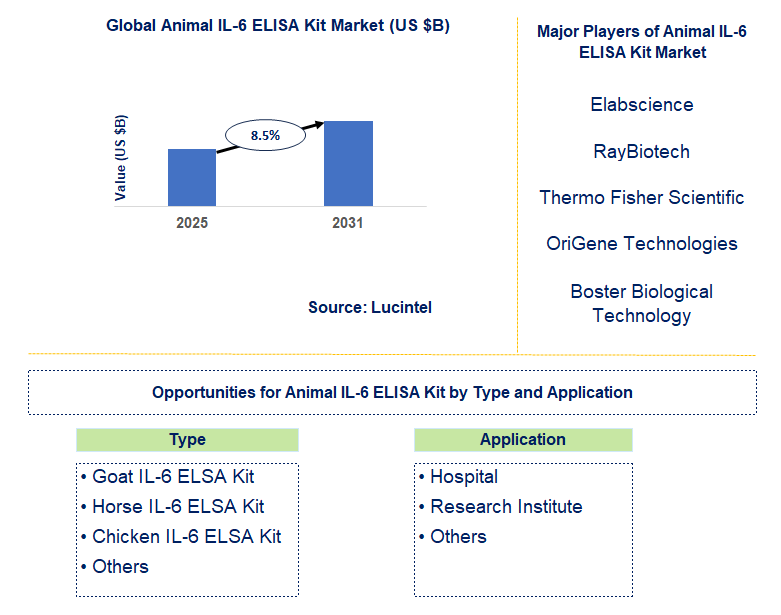
Key data points: The growth forecast = 8.5% annually for the next 7 years. Scroll below to get more insights. This market report covers trends, opportunities and forecasts in animal IL-6 ELISA kit market to 2031 by type (goat IL-6 ELISA kit, horse IL-6 ELISA kit, chicken IL-6 ELISA kit, and others), application (hospital, research institute, and others), and region (North America, Europe, Asia Pacific, and the Rest of the World)
We'll send your sample report shortly.
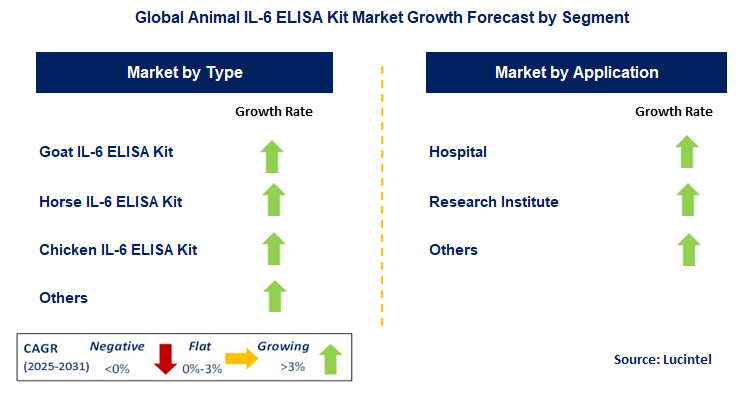
• Lucintel forecasts that, within the type category, goat IL-6 ELISA kit is expected to witness the highest growth over the forecast period.
• Within the application category, research institute is expected to witness higher growth.
• In terms of region, APAC is expected to witness the highest growth over the forecast period. Gain valuable insights for your business decisions with our comprehensive 150+ page report. Sample figures with some insights are shown below.
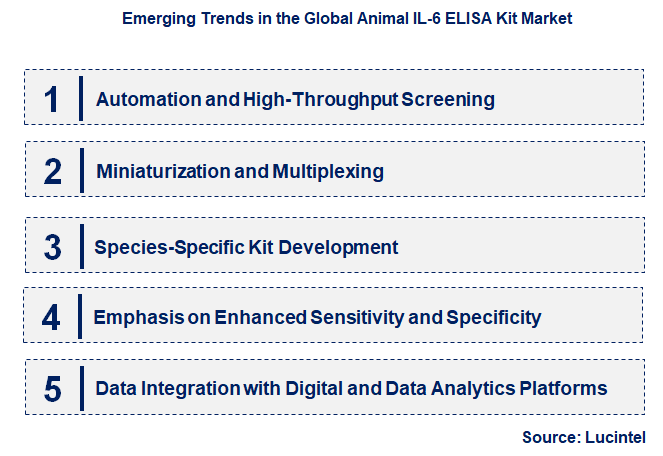
• Automation and High-Throughput Screening: A key trend is the mounting call for kits that are compatible with automated laboratory platforms. This makes high-throughput screening of many samples possible, which is essential for large-scale drug development and preclinical studies. The effect is a dramatic increase in efficiency and a saving on labor costs. Automation also reduces the risk of human error, which is enhancing reproducibility and robustness of the data, an essential need for regulatory filings.
• Miniaturization and Multiplexing: Miniaturization of assay formats and the creation of multiplex kits capable of detecting several cytokines from one sample is becoming increasingly common. Miniaturization decreases the sample volume and reagent usage, which is especially useful in the case of small animal models where limited availability of samples poses a problem. The effect is greater richness in data and greater insight into the immune response. Multiplexing offers an integrated perspective of the inflammatory condition, which is driving research into complicated diseases.
• Species-Specific Kit Development: Although most kits are generally applicable, there is a new trend towards developing highly species-specific kits for use with a broad spectrum of animals, such as farm animals, pet animals, and exotic animals. This is because the role of veterinary diagnostics becomes more significant and there is a need to obtain accurate information in animal health. The impact is enhanced diagnostic accuracy and reliability. Species-specific kits are reducing cross-reactivity and other interference, resulting in more accurate and reliable results.
• Emphasis on Enhanced Sensitivity and Specificity: The industry is witnessing an increase in emphasis on enhancing the analytical performance of the kits. Companies are employing sophisticated antibody engineering and detection chemistries to enhance sensitivity and specificity. This is important in the detection of low levels of IL-6 in biological fluids and its differentiation from other closely related cytokines. The effect is an increased degree of diagnostic accuracy, which is needed for research and clinical purposes. High-quality data are resulting in more confident and trustworthy conclusions.
• Data Integration with Digital and Data Analytics Platforms: Integration of ELISA kits with digital platforms as well as data analytics software is a very significant trend. This facilitates researchers to handle their data easily, analyze it, and interpret it, and also share findings with other collaborators. The effect is an optimized and efficient research process. It facilitates quick discovery of trends and correlations in huge amounts of data, which is speeding up scientific research and enhancing the general quality of research. These new trends as a whole are transforming the animal IL-6 ELISA kit market from a specialized product market into a more technologically sophisticated, merged, and specialized market. The trend towards automation and multiplexing is enhancing efficiency and quality of information. The move into species-specific and highly sensitive kits is expanding the market coverage and offering more value to more researchers and veterinarians. These developments are making the kits a more central and flexible item of current animal research and diagnostics.
• Ready-to-Use and Pre-coated Kit Introduction: One of the significant developments is the introduction of ready-to-use and pre-coated ELISA kits. The kits have pre-measured reagents and a pre-coated plate that minimizes the number of manual steps involved in conducting the assay. The effect is an easy and streamlined workflow. The kits reduce the risk of human error, which is enhancing the reproducibility of results and decreasing the amount of time and labor per experiment.
• Detection Chemistries Advancements: The industry has witnessed an evolution towards more sophisticated detection chemistries like improved colorimetric and chemiluminescence substrates. The new chemistries are enhancing the signal-to-noise ratio, which is resulting in increased sensitivity and an extended dynamic range for the assay. The result is the capability to detect very low levels of IL-6, which is important for researching early-stage inflammation and for research where precious or limited samples are involved.
• Novel and Exotic Species Kit Development: Another essential development is to produce kits validated for more animal species beyond the usual mouse and rat models. This would also involve developing kits in farm animals such as pig and cattle, companion animals, and exotic species utilized in specific research. The effect is a dramatic increase in market expansion to new and under-penetrated segments. These kits are enabling researchers to perform studies in a wider set of animal models.
• Introduction of Automated and High-Throughput Formats: With automation in the laboratory, there was also the introduction of kits that are formulated to be used for high-throughput screening on robotic platforms. The formats are developed to make it possible to carry out several plates at once with little or no manual intervention. The result is a huge boost to the number of samples that are processed. This is important for drug discovery on a grand scale and for screening projects in pharmaceutical and academic research.
• Integration of Quality Control and Validation Data: New advances have been the practice of shipping extensive quality control and validation data with every kit. This covers specificity, linearity, and reproducibility data. The effect is an increased level of trust and confidence for the end user. This openness is important for regulatory submissions and to ensure that the data generated are reliable and accurate. These important advancements are all converging to change the animal IL-6 ELISA kit market in aggregate by making diagnostic products more powerful, easy-to-use, and consistent. The kit format and detection chemistry advancements are streamlining research and clinical workflows. The new species expansion and emphasis on quality control are expanding the market reach and delivering higher value to more end users. These developments are making the kits an increasingly vital and adaptive tool in contemporary animal studies and diagnostics.
• Preclinical Drug Development: The growing application of animal models in preclinical drug development offers a substantial growth opportunity. The opportunity is offering high-sensitivity, high-throughput kits that are certified for a variety of standard animal models, including mice, rats, and non-human primates. The effect is a new, high-value customer base that is willing to pay for high-end kits for essential safety and efficacy studies. Such kits can fetch premium prices and create a strong brand name in the high-value biopharma market.
• Livestock Diagnostics and Health: The increased demand to prevent and control diseases in livestock offers an opportunity. This includes creating cost-effective and rugged kits that are optimized for farm animals such as cattle, pigs, and poultry. The kits would be utilized to monitor herd health and for inflammatory disease screening. The effect is a large increase of the market into a new and fast-expanding field. It enables proactive disease management, which can minimize farm economic losses and guarantee food safety.
• Academic and Government Research: These organizations use a vast array of kits for a variety of research applications, from general immunology to infectious disease research. The chance is to offer highly customizable and reliable kits with a tremendous amount of validation data in order to achieve the stringent requirements of academic research. The effect is a high-prestige market segment that raises the bar for the rest of the industry. Having a presence in these institutions is very validating for the product and can translate into profitable long-term deals.
• Veterinary Clinics and Hospitals: With increased willingness by owners to pay for high-tech diagnostics, there is potential to offer easy-to-use and low-cost kits to veterinary clinics. The kits would be applied to diagnose inflammatory disorders in domestic companion animals such as cats and dogs. The effect is a new market that is accessible and of high growth rate. These packages are utilized to assist with clinical decision-making, which is enhancing the quality of veterinary practice and generating a new revenue source for clinics.
• Contract Research Organizations: Preclinical research is where CROs have strong involvement and need a constant supply of high-throughput and reliable kits. The opportunity lies in selling volume kits in large volumes and in providing end-to-end package services to these companies. The packages would feature technical support and data analysis services. The effect is a more valuable sale and a closer relationship with the customer. Offering a complete product suite and services streamlines the buying process for CROs and provides consistent data quality for a portfolio of projects. These strategic growth opportunities play a crucial role in the growth of the animal IL-6 ELISA kit market. By focusing on particular applications and adapting product offerings to address the distinctive requirements of each segment, firms are able to create adoption and market share. The diversification into preclinical, livestock, and veterinary clinic markets is not merely about sales growth but, more importantly, about making animal IL-6 ELISA kits a multi-purpose and critical tool for virtually all research and diagnostic applications.
• Elabscience
• RayBiotech
• Thermo Fisher Scientific
• OriGene Technologies
• Boster Biological Technology
• Abbexa
• Bio-Techne
• BioLegend
• Abcam
• LS Bio
• Goat IL-6 ELSA Kit
• Horse IL-6 ELSA Kit
• Chicken IL-6 ELSA Kit
• Others
• Hospital
• Research Institute
• Others
• North America
• Europe
• Asia Pacific
• The Rest of the World
• United States: The United States market is characterized by its maturity and strong focus on automated and high-throughput solutions. Recent advances have seen the introduction of next-generation kits that are compatible with automated liquid handling systems, which is facilitating high-volume testing in pharmaceutical and research labs at universities. It is also emphasizing increasing the sensitivity and specificity of its kits, which is important in detecting low levels of IL-6 in complex biological samples. This focus on technology is supported by high research and development spending in the biopharma industry.
• China: China’s market is defined by growth that is fast paced and domestic manufacturing and cost emphasis. Recent trends are a rapid increase in local firms that are making a variety of cheap and reliable kits across all animal species. The market also is witnessing an increasing trend of producing kits designed for certain livestock diseases, which is driving the enhancement of animal health management in the agricultural sector. This is driven by a fast-growing research and development environment and state efforts to enhance veterinary infrastructure in the country.
• Germany: Germany is a developed market that specializes in precision engineering and clinical standardization. Recent trends include a significant emphasis on kit validation and quality assurance, whereby manufacturers are developing good-quality products that pass very stringent regulatory requirements. The industry is also experiencing the creation of multiplex assays with capabilities for measuring several cytokines at once, which is improving assay efficiency and data richness in research environments. This is prompted by a well-developed network of professional veterinary and research institutions.
• India: India’s market is price-conscious and dynamic, and recent trends have centered around market penetration and affordability. Both international and domestic manufacturers are coming into the market with a variety of products, with the focus especially being on less expensive, entry-level units to meet the needs of smaller research laboratories and diagnostic facilities. In addition, there is increasing concern for animal welfare and a surge in veterinary diagnostics driving market expansion. Of particular interest is making the latest diagnostic technology available to a wider segment of the research and veterinary community.
• Japan: Japanese customers are characterized by a penchant for miniaturization, technological advancement, and ease of use. Recent innovations involve the creation of miniaturized formats suitable for use with lower sample volumes, which is particularly important in rare or small animal models. Manufacturers are also adding features such as enhanced stability and increased shelf life to accommodate the stringent quality requirements of Japanese research and diagnostic laboratories. The market is fueled by an advanced level of animal research and a robust consumer demand for top-of-the-range, reliable, and easy-to-use diagnostic kits.


• Elabscience
• RayBiotech
• Thermo Fisher Scientific
• OriGene Technologies
• Boster Biological Technology
• Abbexa
• Bio-Techne
• BioLegend
• Abcam
• LS Bio Q5. Which animal IL-6 ELISA kit market segment will be the largest in future? Answer: Lucintel forecasts that, within the type category, goat IL-6 ELISA kit is expected to witness the highest growth over the forecast period. Q6. In animal IL-6 ELISA kit market, which region is expected to be the largest in next 5 years? Answer: In terms of region, APAC is expected to witness the highest growth over the forecast period. Q7. Do we receive customization in this report? Answer: Yes, Lucintel provides 10% customization without any additional cost.


Choose a license that fits your team. Instant PDF delivery.
Prices exclude taxes. Instant delivery. Custom licensing available on request.
Market Report · July 17, 2026
Market Report · July 16, 2026
Market Report · July 10, 2026
Trusted partner for strategic intelligence and business growth


Receive a complimentary market analysis tailored to your industry. Our analysts will identify key growth opportunities and competitive dynamics specific to your business.

Market size, growth rate, and key trend analysis for your specific sector.

Top competitor positioning and market share analysis.

Strategic recommendations backed by data-driven insights.
Get curated market intelligence and competitive moves straight to your inbox.
By subscribing, you agree to receive our monthly insights. Unsubscribe anytime.
Receive a complimentary market analysis tailored to your industry. Our analysts will identify key growth opportunities and competitive dynamics specific to your business.
Market size, growth rate, and key trend analysis for your specific sector.
Top competitor positioning and market share analysis.
Strategic recommendations backed by data-driven insights.
Get curated market intelligence, emerging trends, and competitive moves straight to your inbox each month.
By subscribing, you agree to receive our monthly insights. Unsubscribe anytime.
We'll send your sample report shortly.