
Market Report · May 18, 2026

This market report covers trends, opportunities, and forecasts in the global amc cpu card market to 2031 by technology (advancedtca and microtca), application (communications & network infrastructure, healthcare, industrial automation & control, military & aerospace, and transportation), and region (North America, Europe, Asia Pacific, and the Rest of the World)
We'll send your sample report shortly.

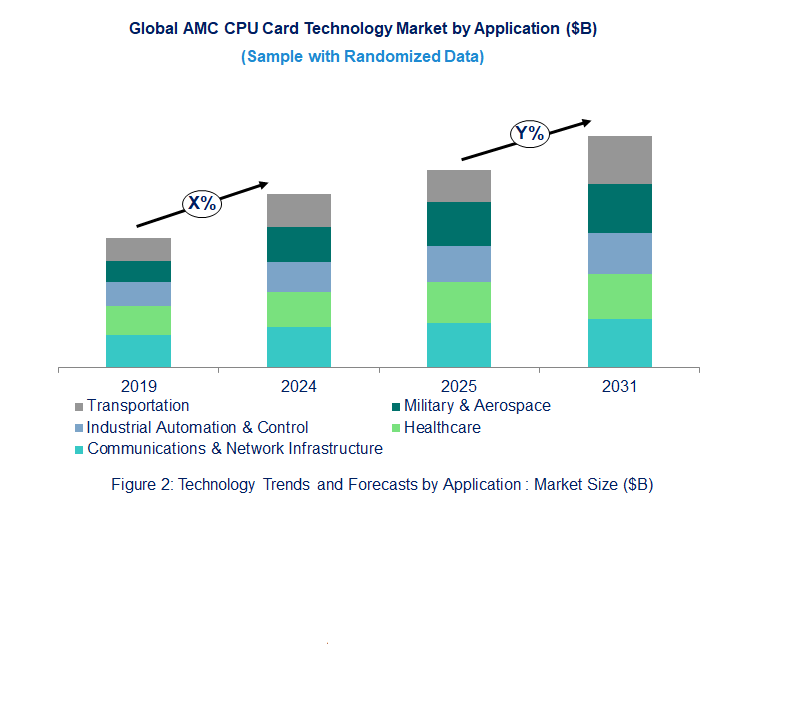
• Transition Towards High-Performance Processing: The industries are now demanding high-performance processing. AMC CPU cards are thus being transformed to support high-performance computing applications. The cards are optimized to offer greater speed and increased processing capability. This demand for real-time data processing as well as complex computational tasks arises mainly in the fields of telecommunication and defense.
• Integration with 5G Networks: The adoption of 5G technology is placing greater demands on AMC CPU cards. These cards represent a critical component of infrastructure in 5G networks that provides the necessary computational capacity for network equipment and edge computing systems. Adoption will increase further as the transition toward 5G continues.
• Miniaturization and Power EfficiencyThere's a tendency to reduce AMC size, at the same time enhancing its power efficiency. Form factors of smaller dimensions, which optimize power use, open the opportunity for these cards to be integrated into tighter systems that are suitable in constrained environments such as in aerospace, industrial automation, and many more.
• Support for AI and Machine Learning Applications: As the use of artificial intelligence (AI) and machine learning (ML) is becoming prevalent, the AMC CPU cards are also being designed to handle AI/ML workloads. This allows for a high performance of algorithms and data models, thereby supporting more advanced computing capabilities in automotive, robotics, and healthcare industries.
• Higher use in edge computing: As applications keep moving to the edge, AMC CPU cards are increasingly a part of edge computing systems. They help to have faster processing close to the origin of data generation and bring down latency while making a system such as smart city, IoT, or industrial automation more efficient. Trends such as high-performance processing, 5G integration, miniaturization, AI support, and edge computing adoption are reshaping the AMC CPU card market. These factors are driving innovation, improving system performance, and expanding the use of AMC CPU cards in a wide range of applications.
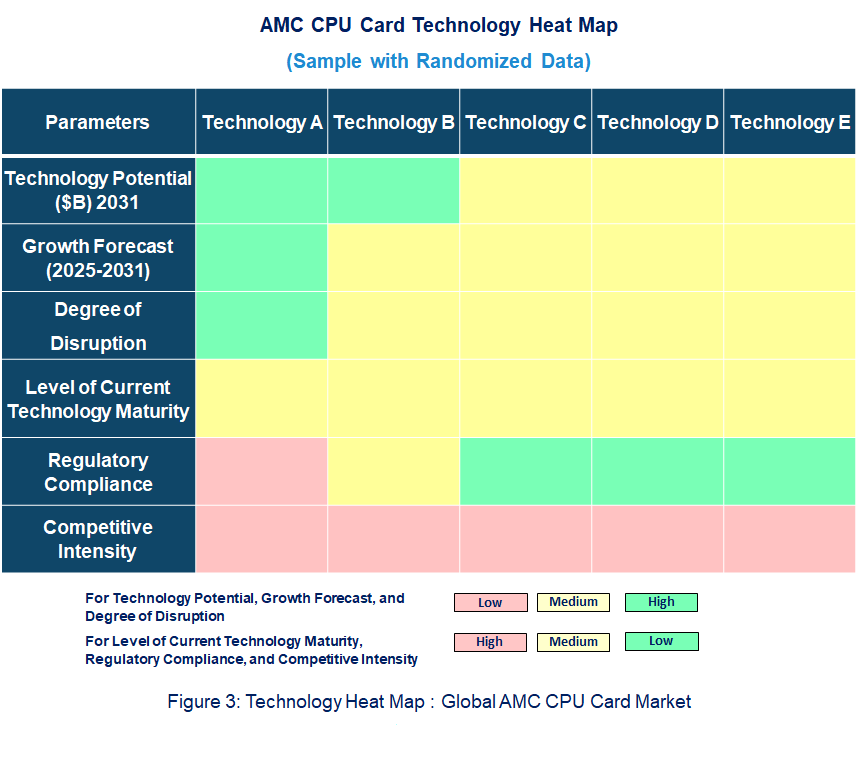
• Technology Potential: AMC CPU cards have considerable potential in advancing modular computing architectures. They are versatile and easy to upgrade or configure to meet specific demands, which is ideal for industries such as telecommunications, defense, and industrial automation, which have fast-changing operational demands. They are optimized for space and energy efficiency while providing high computational power, hence becoming increasingly valuable in mission-critical applications.
• Degree of Disruption: The degree of disruption in the market is moderate but significant. AMC CPU cards change the way systems are built and deployed, making scaling easier and integration faster. Their ability to fit into a modular setup while delivering powerful computing capabilities disrupts traditional systems that rely on bulky, standalone servers.
• Current Technology Maturity Level: AMC CPU card technology is mature, and many industries rely on these cards for stable and reliable computing solutions.
• Regulatory Compliance: The most important regulatory compliance is required in industries such as aerospace and defense, where safety and performance standards have to be met to ensure compliance with international regulations.
• Adax: Adax has released its new line of AMC CPU cards that provide high-speed data transfer and low-latency performance in the telecommunications and industrial automation sectors. The cards are optimized to handle complex networking and data processing applications by leveraging next-gen FPGA and multi-core processor technologies, thus further establishing Adax as a leader in the market.
• Extreme Engineering Solutions: Extreme Engineering Solutions launched a series of embedded AMC CPU cards with the latest processing power and rugged design for military and aerospace applications. These cards use high-performance Intel processors and support high-speed interconnects such as PCIe Gen 3, offering robust and reliable computing solutions in challenging environments.
• Kontron: Kontron has announced its scalable AMC CPU platform focused on telecommunications and network infrastructure applications. The platform can include next-generation multi-core processors and advanced connectivity capabilities, making it suitable for massive deployments in 5G networks and large-scale data centers, enhancing network reliability and throughput for service providers.
• Mercury Systems: Mercury Systems focused on the integration of AI and edge computing functionalities into its AMC CPU cards for military and aerospace sectors. The new products from Mercury Systems, featuring advanced processing units and real-time data analytics, allow faster decision-making and improved operational capabilities in mission-critical environments. These developments reflect the continued effort of key players in AMC CPU card technology, focused on performance, scalability, and adaptability to meet the needs of different industries.
• High-Performance Computing: With increasing demand for processing power across the telecommunications, defense, and healthcare sectors, AMC CPU cards are being increasingly demanded. The AMC CPU cards are a fundamental part of supporting data-intensive applications and provide the necessary computational capability to meet the high performance and reliability standards required by these industries.
• Integration with 5G Networks: As 5G networks are expanding, the requirement for efficient and powerful computing solutions is increasing. AMC CPU cards are required to make the processing power necessary for 5G infrastructure and edge computing applications possible. Their ability to support real-time processing of data boosts the performance of 5G networks, encouraging widespread adoption.
• Miniaturization and Energy Efficiency: Where a demand for smaller, yet power-efficient solutions in embedded as well as industrial systems exist, AMC CPU cards will increasingly be optimized for power efficiency as well as compactness. Trends tend to reduce the overall footprint of systems, making them not only more cost-effective but also suitable for environments in which space and power are very constrained. Challenges in the AMC CPU card market are:
• Technological Complexity and Customization: Increasing complexity of systems and customization requirements in various verticals challenge the development of AMC CPU cards. Customization for a particular application, ensuring that the performance is not compromised, incurs heavy design efforts, thus potentially increasing costs and time-to-market.
• High Research and Development and Manufacturing Cost: The R&D and manufacturing costs for AMC CPU cards remain high, mainly because the cards require advanced materials and technologies. This will increase the total cost of deploying AMC CPU cards and restrict its adoption in price-sensitive markets, which will deter market growth. The high-performance computing demands, 5G integration, miniaturization, and efficiency of energy are the most prominent growth drivers for AMC CPU card. However, techno complexity, customization difficulties, and high development costs are the drawbacks of the market that needs to be overcome to provide better opportunities for faster adaptation in the market.
• Adax
• Extreme Engineering Solutions
• Kontron
• Mercury Systems
• Technology Readiness by Technology Type: AdvancedTCA is well-matured, widely used in high-demand applications, and ready for large-scale deployment. MicroTCA is also matured and more and more increasingly applied in compact, cost-sensitive environments. Both of the technologies are competitive with an expectation to follow regulatory guidelines for safety and interoperability. Key applications of this include telecommunications, defense, and industrial automation.
• Competitive Intensity and Regulatory Compliance: Competition in the AMC CPU card market for AdvancedTCA and MicroTCA is increasing, since both have their benefits. AdvancedTCA has dominated high-performance sectors, whereas MicroTCA is emerging as a leader in lower-cost, smaller-scale applications. Regulatory compliance is still very important for ensuring that both technologies meet industry standards, particularly in aerospace and telecommunications.
• Disruption Potential: AdvancedTCA and MicroTCA have significant disruption potential in the AMC CPU Card market. They provide modular, scalable solutions that enable faster deployment and integration. AdvancedTCA supports high-performance applications, whereas MicroTCA provides compact, cost-effective solutions for smaller systems, thereby improving efficiency and reducing space requirements.
• AdvancedTCA
• MicroTCA
• Communications & Network Infrastructure
• Healthcare
• Industrial Automation & Control
• Military & Aerospace
• Transportation
• North America
• Europe
• Asia Pacific
• The Rest of the World
• Latest Developments and Innovations in the AMC CPU Card Technologies
• Companies / Ecosystems
• Strategic Opportunities by Technology Type


Choose a license that fits your team. Instant PDF delivery.
Prices exclude taxes. Instant delivery. Custom licensing available on request.
Market Report · May 18, 2026
Market Report · May 18, 2026
Market Report · May 18, 2026
Trusted partner for strategic intelligence and business growth


Receive a complimentary market analysis tailored to your industry. Our analysts will identify key growth opportunities and competitive dynamics specific to your business.

Market size, growth rate, and key trend analysis for your specific sector.

Top competitor positioning and market share analysis.

Strategic recommendations backed by data-driven insights.
Get curated market intelligence and competitive moves straight to your inbox.
By subscribing, you agree to receive our monthly insights. Unsubscribe anytime.
Receive a complimentary market analysis tailored to your industry. Our analysts will identify key growth opportunities and competitive dynamics specific to your business.
Market size, growth rate, and key trend analysis for your specific sector.
Top competitor positioning and market share analysis.
Strategic recommendations backed by data-driven insights.
Get curated market intelligence, emerging trends, and competitive moves straight to your inbox each month.
By subscribing, you agree to receive our monthly insights. Unsubscribe anytime.
We'll send your sample report shortly.