Aluminum Ingot Market Report: Trends, Forecast and Competitive Analysis to 2035

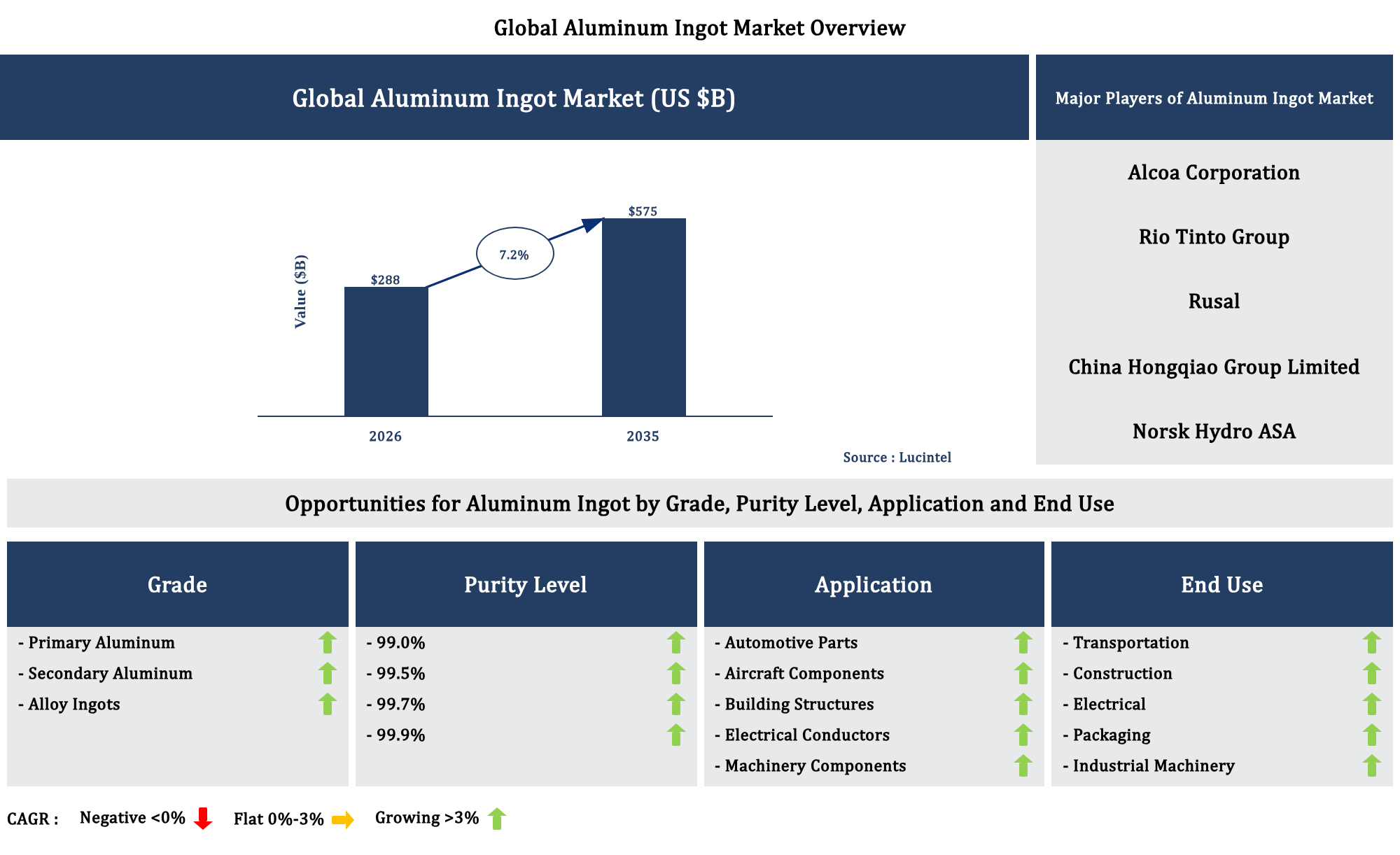
Key data points: The market size in 2035 = $575 billion, growth forecast = 7.2% annually for the next 9 years. Scroll below to get more insights. This market report covers trends, opportunities, and forecasts in the global aluminum ingot market to 2035 by grade (primary aluminum, secondary aluminum and alloy ingots), purity level (99.0%, 99.5%, 99.7% and 99.9%), application (automotive parts, aircraft components, building structures, electrical conductors and machinery components), end use (transportation, construction, electrical, packaging and industrial machinery), and region (North America, Europe, Asia Pacific, and the Rest of the World)

Publisher: Lucintel Last Updated: June 2026
See Pricing

Download Sample Report

| ✨ New Download Sample report — Get instant insights! | ✨ New Download Sample report — Get instant insights!

Aluminum Ingot Market Report: Trends, Forecast and Competitive Analysis to 2035

Aluminum Ingot Market


The future of the global aluminum ingot market looks promising with opportunities in the transportation, construction, electrical, packaging and industrial machinery markets. The global aluminum ingot market is expected to reach an estimated $575 billion by 2035 with a CAGR of 7.2% from 2026 to 2035. The major drivers for this market are the increasing demand for aluminum production, the rising infrastructure development boosting consumption and the growing adoption of lightweight automotive manufacturing.

• Lucintel forecasts that, within the grade category, primary aluminum will remain the largest segment over the forecast period as the rising use in industrial manufacturing applications.

• Within the end use category, transportation will remain the largest segment due to the the rising adoption of fuel efficient vehicles.

• In terms of regions, APAC will remain the largest region over the forecast period due to the the rising electronics output boosting aluminum usage.

Gain valuable insights for your business decisions with our comprehensive 150+ page report.
Aluminum Ingot Market

Emerging Trends in the Aluminum Ingot Market

The aluminum ingot market is undergoing steady transformation as end-use industries demand lighter, cleaner, and more cost-efficient materials. Rising automotive lightweighting, construction growth, and packaging innovation are reshaping how primary and secondary aluminum ingots are produced, traded, and consumed. At the same time, energy costs, carbon regulations, and geopolitical supply risks are pushing producers to rethink sourcing and technology choices. Digitalization of smelting and casting operations, greater use of recycled feedstock, and new alloy developments are emerging as key levers of competitiveness, setting the direction for capacity investments, trade flows, and long-term pricing dynamics.
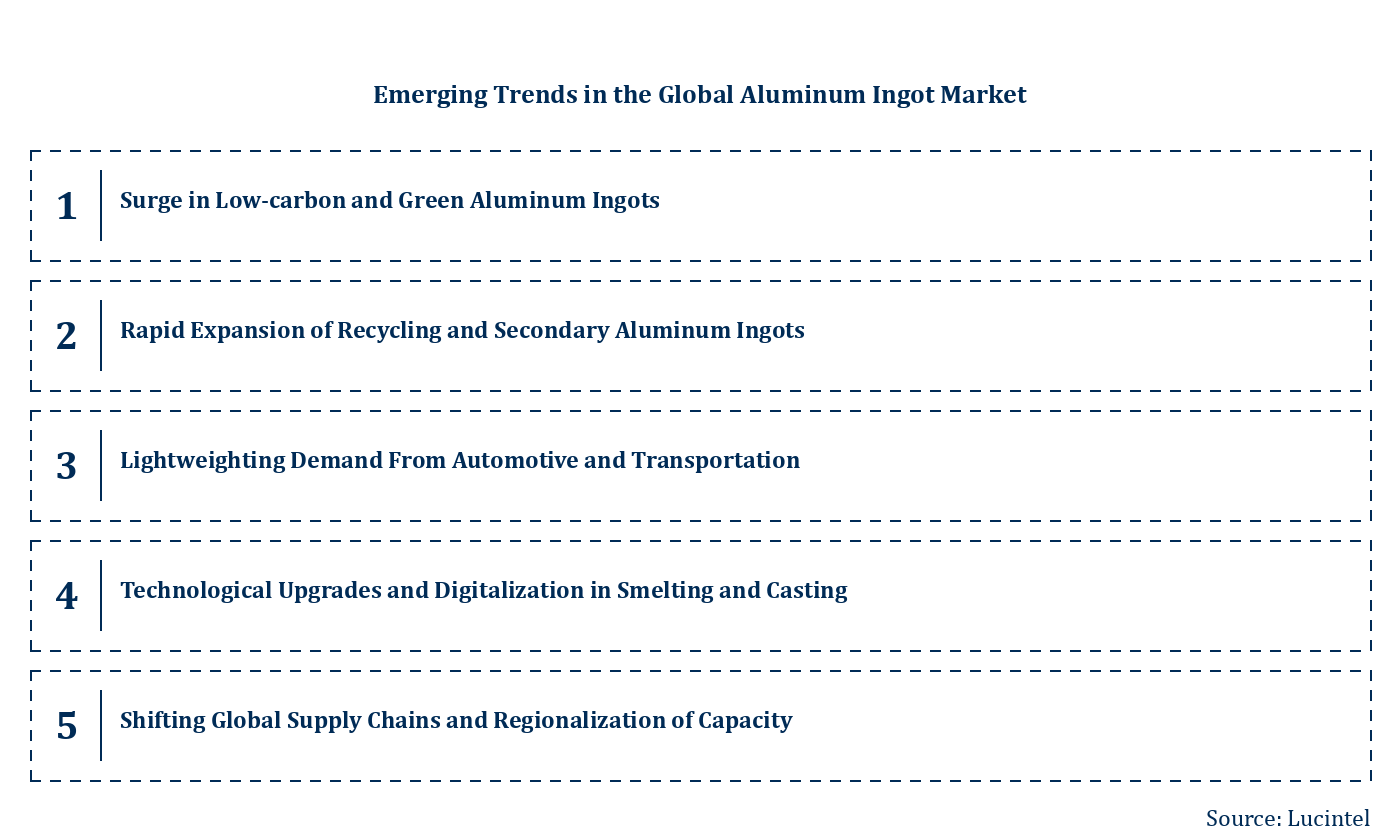
  • Surge in Low-Carbon and Green Aluminum Ingots: Producers in the aluminum ingot market are investing heavily in low-carbon smelting powered by hydro, solar, and wind energy, as well as carbon capture technologies and more efficient electrolysis cells. Buyers in automotive, electronics, and consumer goods increasingly specify certified low‑carbon ingots to meet Scope 3 emission targets and sustainability mandates. This trend is reshaping contract structures, with premiums emerging for green ingots and new certification schemes for traceability. Over time, producers with greener energy mixes are likely to gain pricing power and preferential access to top-tier, sustainability-focused customers.
  • Rapid Expansion of Recycling and Secondary Aluminum Ingots: The aluminum ingot market is seeing accelerating growth in scrap collection, sorting, and remelting to produce secondary ingots with significantly lower energy intensity and emissions. Policy incentives, landfill restrictions, and circular economy regulations are driving investment in advanced recycling technologies, including sensor-based sorting and closed-loop systems with automotive and beverage can producers. This shift increases the share of recycled content in final products, reduces dependency on bauxite and alumina, and cushions the market from raw material price volatility. Competition is intensifying around guaranteed scrap supply, quality control, and alloy consistency.
  • Lightweighting Demand from Automotive and Transportation: The aluminum ingot market is strongly influenced by automakers and transportation OEMs seeking to reduce vehicle weight to meet fuel economy and emissions standards and to extend range in electric vehicles. This is boosting demand for specific ingot grades that can be cast and transformed into structural components, body panels, battery housings, and chassis parts. Producers are tailoring ingot chemistries and quality standards to support high-pressure die casting and advanced forming processes. The trend supports long-term volume growth but also raises requirements for tighter tolerances, better surface quality, and consistent mechanical properties.
  • Technological Upgrades and Digitalization in Smelting and Casting: The aluminum ingot market is adopting digital tools such as advanced process control, real-time data analytics, and predictive maintenance to optimize smelting and casting operations. Smelters are using sensors, AI-driven models, and automation to stabilize electrolysis cells, reduce specific energy consumption, and limit process-related emissions. In casting, digital monitoring helps minimize defects, improve yield, and ensure ingot homogeneity. These advancements enhance cost competitiveness for producers facing tight margins and volatile power prices, while enabling more reliable supply for downstream users requiring consistent quality for high-performance applications.
  • Shifting Global Supply Chains and Regionalization of Capacity: The aluminum ingot market is undergoing structural changes as trade tensions, tariffs, and energy price differentials alter investment decisions and trade flows. Some regions are adding smelting and casting capacity closer to key demand centers to reduce logistics risks and carbon footprints, while others are consolidating or idling high-cost, carbon-intensive plants. Long-term offtake agreements, joint ventures with downstream manufacturers, and regional free-trade agreements are reshaping sourcing strategies. This trend increases the importance of geopolitical risk assessment, contract flexibility, and diversification of suppliers for buyers seeking secure and resilient ingot supply.

Aluminum Ingot Market by country

Recent Developments in the Aluminum Ingot Market

The aluminum ingot market is undergoing notable shifts driven by decarbonization pressures, evolving demand from downstream industries, and rapid technological change in smelting and recycling. Producers are rebalancing capacity between primary and secondary aluminum as customers in automotive, construction, and packaging seek lower-carbon materials. At the same time, geopolitical tensions and energy price volatility are reshaping regional cost competitiveness and trade flows. Digitalization and process automation are improving plant efficiency and quality control, while new alloys target high-performance applications. These developments collectively redefine cost structures, supply security, and sustainability benchmarks across the global aluminum ingot market.

  • Expansion of Low-Carbon and Green Aluminum Offerings: Producers are ramping up investment in renewable-powered smelters, carbon capture pilots, and certified low-carbon ingots to meet OEM sustainability targets and regulatory pressure. This shift is creating product differentiation based on carbon footprint, enabling premium pricing in some segments while forcing laggards to modernize or exit. Over time, low-carbon ingots are expected to become the market standard, reshaping procurement criteria, influencing long-term supply contracts, and accelerating portfolio realignment toward greener production assets and technologies.
  • Surge in Secondary Aluminum and Closed-Loop Recycling: Rising scrap availability, stricter recycling mandates, and cost advantages versus primary output are driving growth in secondary aluminum ingot production. Automotive, beverage, and building material players are establishing closed-loop systems that return scrap directly to smelters, improving metal yield and traceability. This development reduces reliance on energy-intensive primary smelting, cuts Scope 1 and 2 emissions, and cushions the market against bauxite and alumina price swings, while increasing the strategic importance of scrap collection infrastructure and sorting technologies.
  • Technological Upgrades in Smelting and Casting Processes: The aluminum ingot market is seeing widespread adoption of advanced process controls, AI-driven optimization, and upgraded furnaces that enhance energy efficiency and metallurgical consistency. Innovations such as improved inert anode concepts, better refractory materials, and automated casting lines are lowering operational costs and defect rates. These upgrades enable producers to offer more precise alloy compositions and surface qualities, which are critical for high-spec automotive, aerospace, and electronics applications, ultimately strengthening competitiveness and expanding potential end-use markets.
  • Shifting Trade Flows and Regional Capacity Realignments: Energy price disparities, environmental regulations, and trade policies are prompting capacity closures in high-cost regions and expansions in areas with cheaper power and supportive industrial policies. Recent tariffs, anti-dumping measures, and sanctions are redirecting aluminum ingot exports and imports, altering traditional supply corridors. This development heightens the importance of regional self-sufficiency, encourages localized value chains, and increases price volatility, as market participants reassess sourcing strategies and negotiate more flexible, diversified supply agreements.
  • Growing Demand from EV, Renewable, and Lightweighting Applications: Accelerated electrification of transport, expansion of renewable energy infrastructure, and lightweighting trends in multiple industries are boosting demand for specialized aluminum ingots. Battery housings, EV chassis components, solar frames, and wind turbine parts increasingly rely on tailored alloys with stringent mechanical and corrosion performance. This is encouraging producers to develop application-specific grades and collaborative R&D with OEMs, shifting the market toward higher-value ingots and deepening integration between upstream smelters and downstream fabricators.

Strategic Growth Opportunities in the Aluminum Ingot Market

The aluminum ingot market is entering a period of strategic expansion as downstream industries accelerate light-weighting, sustainability, and electrification initiatives. Demand is rising across transportation, construction, packaging, electrical, and machinery applications, supported by both primary and recycled aluminum ingot supply. Producers are exploring value-added alloys, process innovations, and long-term partnerships with end users to capture higher-margin opportunities and mitigate price volatility. At the same time, regulatory pressure on carbon emissions and circularity is reshaping procurement criteria, favoring suppliers with low-carbon production and strong recycling capabilities. These trends create clear, application-specific growth pathways for market participants.

  • Automotive and Transportation: Growing adoption of light-weighting, electric vehicles, and stricter fuel-efficiency and emissions regulations is boosting the use of aluminum ingot in body-in-white, structural components, wheels, and battery housings. Suppliers that develop advanced alloys for crash performance, corrosion resistance, and thermal management, while ensuring consistent quality for high-volume casting and extrusion, can secure long-term contracts. Vertical integration with recycling streams and closed-loop scrap programs further differentiates providers, reducing lifecycle emissions and total cost for automakers and commercial vehicle manufacturers.
  • Building and Construction: Urbanization, infrastructure renewal, and green building standards are increasing reliance on aluminum ingot for façades, windows, doors, roofing, curtain walls, and structural systems. Fire-resistant, corrosion-resistant, and thermally efficient profiles derived from specialized ingots are in demand for high-rise, coastal, and industrial projects. Producers that collaborate with architects and engineering firms to deliver customized alloys and finishes, backed by Environmental Product Declarations and low-carbon certifications, can capture premium projects and government-backed investments in sustainable construction.
  • Packaging and Consumer Goods: Shifts from plastic to metal packaging for sustainability and recyclability are lifting demand for aluminum ingot in beverage cans, food containers, and personal care packaging. High-purity ingots that support superior formability, printability, and barrier properties are essential for brand differentiation. Market participants who invest in closed-loop can-to-can recycling, lightweight can sheet development, and partnerships with major consumer goods companies can gain share, improve margins, and secure resilient demand even during economic cycles.
  • Electrical and Power Infrastructure: Expansion of power grids, renewable energy, and data centers is driving higher consumption of aluminum ingot for conductors, busbars, transformer components, and electrical enclosures. Aluminum offers a cost-effective, lightweight alternative to copper in many applications, particularly where long spans and overhead lines are involved. Producers that engineer ingots optimized for electrical conductivity, mechanical strength, and corrosion resistance, along with strong compliance to utility standards, can benefit from large-scale grid modernization and electrification initiatives.
  • Industrial Machinery and Aerospace Components: The need for high-performance, lightweight, and durable components in industrial machinery, aerospace, and defense supports demand for specialized aluminum ingot grades. Precision casting, forging, and machining operations require tight compositional control and superior metallurgical quality to meet fatigue, strength, and safety requirements. Suppliers that develop advanced alloys for high-temperature performance, additive manufacturing feedstock, and complex geometries, while providing technical support and certification, can secure strategic positions in high-value industrial and aerospace supply chains.

Aluminum Ingot Market Drivers and Challenges

The aluminum ingot market is shaped by a complex set of technological, economic, and regulatory dynamics that influence both supply and demand across downstream industries. Advances in smelting technologies, shifting energy prices, and evolving environmental standards are key forces determining production costs and capacity decisions. At the same time, demand is strongly tied to construction, automotive, packaging, and electrical sectors, all of which respond to broader macroeconomic trends and consumer preferences. Trade policies, recycling initiatives, and decarbonization commitments further affect competitiveness among producers. Understanding these intertwined drivers and challenges is critical for anticipating price movements, capacity expansions, and regional shifts in aluminum ingot production.

The factors responsible for driving the aluminum ingot market include:

  • Lightweighting in Automotive and Transportation: Growing pressure to reduce vehicle emissions and improve fuel economy is accelerating the substitution of steel with lightweight aluminum in passenger cars, commercial vehicles, rail, and aerospace applications, which directly boosts demand for primary and secondary aluminum ingots.
  • Expansion in Construction and Infrastructure: Urbanization, renovation cycles, and infrastructure upgrades are increasing the use of aluminum in windows, façades, roofing, bridges, and structural components, thereby driving sustained demand for ingots as feedstock for extrusions and rolled products.
  • Rising Use in Packaging and Consumer Goods: The proliferation of aluminum cans, flexible foils, and durable consumer products such as appliances and electronics is underpinned by aluminum’s recyclability, corrosion resistance, and premium appearance, which stimulates continuous offtake of ingots by downstream fabricators.
  • Growth in Renewable Energy and Electrical Applications: Expansion of solar, wind, and grid infrastructure, combined with the electrification of end uses, is increasing aluminum’s role in cables, busbars, frames, and enclosures, supporting higher ingot consumption due to its favorable conductivity-to-weight ratio and resistance to environmental degradation.
  • Strategic Push Toward Circular Economy and Recycling: Strengthening policy and corporate commitments to reduce carbon footprints are encouraging higher collection and recycling of aluminum scrap, which in turn supports steady production of secondary aluminum ingots that offer lower embedded emissions and often more attractive cost profiles.

The challenges in the aluminum ingot market are:

  • High Energy Intensity and Exposure To Power Costs: Aluminum smelting is extremely electricity-intensive, so volatility in energy prices and the increasing cost of low-carbon power significantly affect production economics and can render some smelters uncompetitive or force capacity curtailments.
  • Environmental and Regulatory Pressures: Tightening regulations on greenhouse gas emissions, air pollutants, and waste management, along with rising expectations for traceability and responsible sourcing, require ongoing investment in cleaner technologies and compliance systems, which can strain margins for producers of aluminum ingots.
  • Supply Chain Disruptions and Raw Material Risks: Dependence on bauxite, alumina, and anodes, combined with geopolitical tensions, trade restrictions, and logistics bottlenecks, introduces substantial uncertainty in raw material availability and cost, increasing price volatility and complicating planning for both producers and downstream buyers of aluminum ingots.

Overall, the aluminum ingot market reflects a balance between strong structural demand drivers and mounting operational constraints. Lightweighting, infrastructure development, and electrification continue to underpin long-term consumption growth, while advances in recycling and low-carbon technologies reshape cost structures and competitive positioning. At the same time, exposure to energy markets, evolving environmental regulations, and supply chain fragilities can limit capacity growth and introduce price instability. Market participants must therefore combine technological upgrading, portfolio diversification, and strategic sourcing to capture emerging opportunities while mitigating downside risks in an increasingly decarbonized and policy-driven global metals landscape.

List of Aluminum Ingot Market Companies

Companies in the market compete on the basis of product quality offered. Major players in this market focus on expanding their manufacturing facilities, R&D investments, infrastructural development, and leverage integration opportunities across the value chain. Through these strategies aluminum ingot market companies cater increasing demand, ensure competitive effectiveness, develop innovative products & technologies, reduce production costs, and expand their customer base. Some of the aluminum ingot market companies profiled in this report include-

  • Alcoa Corporation
  • Rio Tinto Group
  • Rusal
  • China Hongqiao Group Limited
  • Norsk Hydro ASA
  • South32 Limited
  • Kaiser Aluminum Corporation

Aluminum Ingot Market by Segment

The study includes a forecast for the global aluminum ingot market by grade, purity level, application, end use, and region.

  • Aluminum Ingot Market by Grade [Value ($B) from 2019 to 2035]:
    • Primary Aluminum
    • Secondary Aluminum
    • Alloy Ingots
  • Aluminum Ingot Market by Purity Level [Value ($B) from 2019 to 2035]:
    • 99.0%
    • 99.5%
    • 99.7%
    • 99.9%
  • Aluminum Ingot Market by Application [Value ($B) from 2019 to 2035]:
    • Automotive Parts
    • Aircraft Components
    • Building Structures
    • Electrical Conductors
    • Machinery Components
  • Aluminum Ingot Market by End Use [Value ($B) from 2019 to 2035]:
    • Transportation
    • Construction
    • Electrical
    • Packaging
    • Industrial Machinery
  • Aluminum Ingot Market by Region [Value ($B) from 2019 to 2035]:
    • North America
    • Europe
    • Asia Pacific
    • The Rest of the World

Country Wise Outlook for the Aluminum Ingot Market

The global aluminum ingot market is undergoing notable shifts driven by decarbonization pressures, surging demand from automotive light-weighting, energy transition infrastructure, and packaging. Producers are investing in low‑carbon smelting technologies, advanced recycling, and digitalized supply chains to manage volatility in energy and raw material costs. Trade policies, sanctions, and regional re‑shoring of manufacturing are reshaping supply flows, while customers increasingly demand certified, traceable, and sustainable ingots. Across the United States, China, Germany, India, and Japan, distinct policy frameworks, industrial strengths, and technology roadmaps are shaping how each country upgrades capacity, improves efficiency, and competes in higher‑value aluminum segments.

  • United States: The United States aluminum ingot market is seeing renewed investment in domestic smelting and secondary production, supported by infrastructure spending and incentives under industrial and clean energy legislation. Producers are upgrading legacy smelters with energy‑efficient technologies, expanding scrap‑based recycling, and pursuing low‑carbon certifications to serve automotive, aerospace, and construction customers. Trade actions on imports, including tariffs and anti‑dumping measures, continue to influence domestic pricing and capacity utilization. Growing demand for aluminum in electric vehicles, power transmission, and renewable energy projects is prompting strategic long‑term supply contracts and more integrated value chains.
  • China: China remains the world’s largest producer and consumer of aluminum ingots and is actively rebalancing capacity toward regions with cleaner energy and better environmental controls. The government’s “dual‑control” policies on energy intensity and carbon emissions are driving closures or relocations of inefficient smelters and encouraging hydropower‑based production in western provinces. Producers are integrating upstream bauxite and alumina assets for cost stability while expanding recycled aluminum capacity to support circular economy goals. Domestic demand from electric vehicles, solar, wind, and high‑speed rail continues to grow, and export dynamics are influenced by adjustments to value‑added tax rebates and geopolitical trade frictions.
  • Germany: Germany’s aluminum ingot market is adapting to high electricity prices and stringent climate targets by emphasizing recycled content and low‑carbon production. Many producers are shifting toward secondary aluminum, leveraging the country’s strong automotive and engineering scrap flows to reduce energy use and emissions. Investments focus on advanced sorting, melting, and alloying technologies to supply premium ingots for automotive body sheet, battery housings, and industrial components. Policy frameworks under the EU Green Deal and Carbon Border Adjustment Mechanism are shaping competitiveness, encouraging efficiency improvements, and driving collaboration across the supply chain to ensure secure and sustainable aluminum inputs for German manufacturers.
  • India: India’s aluminum ingot market is expanding on the back of robust infrastructure development, growing automotive production, and government initiatives like Make in India. Domestic smelters are adding capacity, improving power efficiency, and integrating captive power—often coal‑based—while also beginning to explore renewables and green aluminum pathways. The country is investing in downstream rolling and extrusion capacity to move up the value chain and reduce reliance on imported value‑added products. Recycling infrastructure is gradually improving, with more focus on organized scrap collection and secondary smelting. Policy support for construction, railways, and power transmission is expected to sustain strong demand for primary and secondary ingots.
  • Japan: Japan’s aluminum ingot market is characterized by a high reliance on imported primary metal and a strong emphasis on precision, quality, and recycling. Domestic producers and traders are prioritizing low‑carbon and certified ingot supplies, aligning with Japanese manufacturers’ decarbonization commitments, especially in automotive, electronics, and packaging. Secondary aluminum production and high‑purity alloy development are key focus areas, supported by advanced scrap sorting and closed‑loop arrangements with major industrial customers. Energy efficiency, supply chain resilience, and diversification of import sources are central themes, as Japan responds to global logistics disruptions and evolving trade risks while maintaining its reputation for high‑specification aluminum products.

Features of the Aluminum Ingot Market

  • Market Size Estimates: Aluminum ingot market size estimation in terms of value ($B).
  • Trend and Forecast Analysis: Market trends (2019 to 2025) and forecast (2026 to 2035) by various segments and regions.
  • Segmentation Analysis: Aluminum ingot market size by various segments, such as by grade, purity level, application, end use and region in terms of value ($B).
  • Regional Analysis: Aluminum ingot market breakdown by North America, Europe, Asia Pacific, and the Rest of the World.
  • Growth Opportunities: Analysis of growth opportunities in different grade, purity level, application, end use and regions for the aluminum ingot market.
  • Strategic Analysis: This includes M&A, new product development, and competitive landscape of the aluminum ingot market.
  • Analysis of competitive intensity of the industry based on Porter's Five Forces model.

Article

Aluminum Ingot Market: Are New Forces Reshaping a Foundational Material?

Dallas, June 5, 2026 – The aluminum ingot market is entering a new phase of strategic importance as decarbonization, electrification, and digital manufacturing converge. Once viewed as a mature, cost-driven commodity space, aluminum ingots are now at the center of innovation in low-carbon metallurgy, advanced alloys, and data-enabled supply chains. This shift is redefining competitive advantage across automotive, construction, packaging, and technology industries, while exposing structural challenges around energy costs, raw material security, and recycling capacity.

As net-zero commitments accelerate and governments tighten emissions and trade rules, producers, OEMs, and investors are reassessing how aluminum ingots are made, sourced, and specified. The outcome will determine which market participants capture emerging price premiums for low-carbon material, which regions become strategic hubs, and how technology-enabled use cases redefine value creation in downstream sectors.

How Are Low-Carbon and Recycled Aluminum Ingots Redrawing the Competitive Map?

A decisive trend reshaping the aluminum ingot market is the rapid migration toward low-carbon and recycled-based products. Major automakers, consumer electronics companies, and beverage brands are embedding explicit carbon intensity thresholds into procurement specifications, turning emissions profiles into a core buying criterion alongside cost and quality.

  • Automotive and transportation manufacturers are pivoting toward low-carbon aluminum ingots for body-in-white structures, crash components, and e-mobility platforms to reduce lifecycle emissions and comply with tightening fleet standards.
  • Packaging companies in the beverage and food sectors are increasingly demanding high-recycled-content ingots to secure circularity claims and meet retailer and regulator expectations.
  • Technology and consumer electronics brands see low-carbon aluminum housings and structural components as a visible sustainability differentiator for premium devices and data center infrastructure.

In many markets, this shift is already creating a two-tier pricing environment in which green or near-zero-carbon ingots command a growing premium over conventional, coal-intensive primary metal. Producers with access to hydropower or other renewable energy, strong scrap collection networks, and advanced sorting and remelting technologies are well positioned to benefit. Regions with carbon-heavy power grids and weak recycling ecosystems face margin pressure and potential market share erosion as downstream buyers reorient sourcing.

Why Are Advanced Alloys and Application-Specific Ingots Becoming Strategic?

Another powerful trend is the rise of alloy-engineered aluminum ingots tailored to high-performance and high-value applications. As electrification, lightweighting, and miniaturization reshape product design, generic ingot chemistries are being replaced with specialized formulations optimized for strength-to-weight ratio, thermal management, corrosion resistance, and formability.

  • The electric vehicle sector is driving demand for high-strength structural alloys that enable lighter chassis, battery enclosures, and crash structures, supporting longer range and improved safety.
  • Construction and infrastructure developers are utilizing corrosion-resistant alloys in bridges, facades, and modular building systems to extend asset life and reduce maintenance costs.
  • Technology manufacturers integrated into thermal management solutions are relying on alloys engineered for heat sinks, enclosures, and power electronics components to handle growing heat densities.

This movement toward application-specific alloys is shifting value to producers that invest in metallurgical R&D, tight process control, and close collaboration with downstream fabricators and OEMs. It also introduces new barriers to entry, as customers lock in proprietary or co-developed alloy recipes and require consistent performance across large volumes and multiple regions.

Will Digitalization and Traceability Turn Aluminum Ingots into Data-Rich Products?

Digital transformation is increasingly shaping how aluminum ingots are produced, traded, and consumed. Producers and large buyers are deploying advanced analytics, industrial IoT, and traceability solutions to improve process yields, reduce downtime, and track ESG attributes across the value chain.

  • Smelters leveraging predictive maintenance, process optimization algorithms, and real-time quality monitoring are achieving higher recovery rates, lower energy intensity, and more consistent ingot properties.
  • Large OEMs are piloting digital passports for aluminum ingots that capture provenance, carbon footprint, and recycling content, enabling more granular procurement and compliance reporting.
  • Trading houses and distributors are experimenting with platforms that integrate logistics, inventory, and quality data to optimize stock positioning and respond quickly to regional demand shifts.

As traceability demands rise from regulators and end consumers, digitally tagged ingots with verified carbon and origin attributes are likely to gain preferential access to premium contracts. Companies that remain opaque or data-poor risk being relegated to lower-value segments and facing scrutiny on sustainability and ethical sourcing.

How Is Decarbonization of Smelting and Energy Use Disrupting Cost Structures?

Decarbonization of smelting processes and power supply is both a disruptive force and a central battleground in the aluminum ingot market. Traditional primary production is intensely energy-dependent, and carbon pricing, electricity volatility, and ESG pressures are rapidly altering economics.

  • Producers investing in hydropower, solar, wind, and emerging technologies such as inert anode smelting are targeting steep reductions in carbon intensity and long-term cost stability.
  • Countries with abundant low-cost renewable energy see a strategic opportunity to attract new smelting capacity and become hubs for low-carbon ingot production.
  • High-cost, carbon-heavy producers are being forced to rationalize capacity, renegotiate power contracts, or pivot toward recycling and secondary ingots to remain competitive.

As more downstream buyers adopt internal carbon pricing or face regulatory carbon costs, total delivered carbon per ton of aluminum is becoming a strategic metric. Those able to combine low-carbon power, process efficiency, and high utilization of scrap stand to command premium positions in supply negotiations and to capture new investment.

Which Markets Will See the Strongest Impact from Aluminum Ingot Innovations?

Several end-use markets are likely to experience pronounced disruption as aluminum ingot innovations scale. Automotive will see material substitution and platform redesign accelerate as lightweight, crash-optimized, and low-carbon aluminum becomes central to electric and hybrid vehicles. Carmakers that secure stable access to advanced ingots will gain flexibility in meeting emissions and range targets.

Construction and infrastructure are poised for a steady shift toward aluminum-intensive designs, particularly in modular housing, bridges, and coastal structures. Long-lasting, corrosion-resistant alloys, combined with circular recycling models at end of life, will appeal to developers seeking lower total cost of ownership and stronger ESG credentials.

The packaging sector will continue to be a major battleground for recycled-based ingots as beverage, food, and personal care brands commit to high recycled content and closed-loop programs. The ability to guarantee traceable, high-quality recycled ingots at scale will influence brand strategies and retailer partnerships.

In the technology industry, where performance and sustainability converge, innovations in aluminum ingots will shape device design, data center architecture, and clean energy hardware. Companies that align their material choices with both functional and ESG goals will differentiate in highly visible, consumer-facing markets.

What Are the Key Challenges Holding Back the aluminum ingot market?

Despite strong demand and compelling innovation, the aluminum ingot market faces structural constraints that could slow transformation. Energy price volatility and grid decarbonization unevenness create significant uncertainty for producers considering long-term capacity investments. Where electricity remains expensive or carbon-intensive, smelters must weigh retrofit costs against potential shutdowns and relocations.

  • Limited high-quality scrap availability and fragmented collection systems constrain the growth of recycled-based ingots, especially in regions without mature circular economies.
  • Capital intensity and lengthy permitting for new smelting and remelting capacity make it difficult to respond quickly to demand spikes or shifts in regional consumption.
  • Geopolitical tensions and trade measures, including tariffs and sanctions, disrupt traditional trade flows and complicate sourcing strategies for downstream manufacturers.

Data gaps and inconsistent standards around carbon accounting and traceability also create friction. Without harmonized methodologies and widely trusted verification, both producers and buyers struggle to compare offers, validate claims, and structure differentiated pricing for low-carbon or circular products.

Which Opportunities Stand Out for Producers, OEMs, and Investors?

Amid the challenges, the aluminum ingot market presents substantial opportunities for those willing to invest ahead of the curve. Producers that anchor operations near renewable energy sources, build robust scrap networks, and adopt advanced process technology can secure a defensible low-carbon cost base and attract premium customers.

  • OEMs in automotive, packaging, and technology can use material strategy as a lever for brand differentiation, supply risk reduction, and compliance with future carbon and recycling regulations.
  • Investors have an opening to back infrastructure for recycling, advanced sorting, and digital traceability that underpins a more circular and transparent aluminum ecosystem.
  • Alloy innovation partnerships between smelters, casthouses, and end-use sectors can create proprietary formulations that deliver performance advantages and stickier customer relationships.

Strategic alliances and long-term offtake agreements around low-carbon or recycled ingots are likely to proliferate as companies move from opportunistic buying to structured, risk-managed sourcing frameworks. Those that secure early access to scarce low-carbon capacity may lock in a competitive edge over rivals constrained by legacy material portfolios.

How Is the Technology Industry Using Aluminum Ingots in New Ways?

In the technology industry, aluminum ingots underpin a wide spectrum of high-performance applications. Device manufacturers depend on precision-cast and rolled aluminum components for smartphone and laptop frames, where the combination of stiffness, thermal conductivity, and surface finish enables sleek yet robust designs. As sustainability expectations grow, many brands are pivoting toward alloys derived from recycled ingots to reduce the footprint of flagship product lines.

  • Data centers are increasingly applying aluminum-based heat sinks, chassis elements, and busbars to manage rising power densities and enable more compact rack designs.
  • Renewable energy equipment manufacturers rely on aluminum ingots for frames and structural elements in solar panels and certain wind components, balancing corrosion resistance with weight and cost considerations.
  • Power electronics and electric charging infrastructure make use of thermal management components based on advanced aluminum alloys to maintain system reliability under heavy loads.

Emerging technology use cases are expanding this footprint further. Electric aviation startups, drone manufacturers, and robotics companies are evaluating optimized aluminum alloys for lightweight structures, while semiconductor tools and precision manufacturing equipment incorporate aluminum components where dimensional stability, machinability, and cleanliness are crucial. As these sectors grow, demand will tilt toward ingots that meet tight impurity, consistency, and surface quality requirements, reinforcing the importance of process control and digital quality assurance.

What Recent Developments Signal the Next Phase for the aluminum ingot market?

Recent developments indicate that the aluminum ingot market is transitioning from incremental change to structural reconfiguration. Several leading producers have announced large-scale investments in inert anode and other low-carbon smelting technologies, aiming to cut direct process emissions and unlock access to sustainability-linked financing and premium contracts. At the same time, multi-region scrap processing and remelting projects are being launched to tap into urban mines and reduce reliance on primary metal.

  • Major OEMs in automotive and consumer electronics are signing long-term supply agreements tied to specific carbon intensity levels, effectively underwriting new capacity and signaling confidence in premium green aluminum pricing.
  • Industry consortia and standards bodies are advancing work on common frameworks for emissions accounting and digital material passports, laying groundwork for more transparent and tradable low-carbon attributes.
  • Policy initiatives in multiple regions, including carbon border measures and extended producer responsibility schemes, are reshaping trade flows and encouraging investment in cleaner and more circular aluminum value chains.

Digital pilots are moving from proof of concept to scaled deployment, with smelters rolling out integrated data platforms that span from bauxite sourcing and alumina refining through casting and delivery. As these systems mature, the market is likely to see more dynamic pricing structures linked to verified carbon content, delivery risk, and even real-time energy mix during production.

Taken together, these developments suggest that the aluminum ingot market is evolving from a predominantly cost-and-volume game into a strategically segmented space where carbon performance, alloy innovation, and data-enabled transparency determine who captures value. Companies that move quickly to align technology, partnerships, and capital allocation with this new reality will be positioned to shape the next chapter of a material that remains foundational to modern industry.

Top 5 Companies

1. Alcoa Corporation

  • Headquarters: Pittsburgh, Pennsylvania, United States.
  • Website: https.www.alcoa.com.
  • Total Revenue (2024): Approximately USD 10–11 billion (company guidance and recent filings; final 2024 figure may vary as reporting is completed).
  • Establishment Year: 1888.

Alcoa Corporation is one of the longest-standing and most influential players in the global aluminum ingot market, operating an integrated value chain that spans bauxite mining, alumina refining, primary aluminum smelting, and casting. Headquartered in Pittsburgh and established in 1888, Alcoa employs tens of thousands of people across North America, South America, Europe, Australia, and select Asian markets, supplying standard and value-added ingots, slabs, and foundry alloys to automotive, construction, packaging, electrical, and aerospace customers. The company’s aluminum ingot portfolio includes high-purity ingots, billet and slab feedstock for rolling and extrusion, and specialty alloys engineered for lightweighting and improved formability. Over recent years Alcoa has optimized its geographic footprint by rationalizing older capacity and investing in lower‑carbon smelting operations in Canada, Norway, and Iceland, positioning its ingot products for customers seeking reduced CO₂ intensity. The company has pursued selective expansions and joint ventures around bauxite and alumina assets that underpin its ingot production, while also engaging in portfolio pruning transactions to exit non-core downstream operations. Although not dominated by blockbuster mergers and acquisitions strictly around primary ingot plants, Alcoa has executed targeted asset swaps and divestitures to sharpen focus on high-quality, cost-competitive smelters and cast houses, reinforcing its role as a key global supplier of primary aluminum ingots.

2. Rio Tinto Group

  • Headquarters: London, United Kingdom (dual-listed group with significant management presence in Melbourne, Australia).
  • Website: https.www.riotinto.com.
  • Total Revenue (2024): Approximately USD 54–56 billion (driven primarily by iron ore, copper, and aluminum; final 2024 figure subject to audited reporting).
  • Establishment Year: 1873.

Rio Tinto Group is a diversified mining and metals company with a major global presence in the aluminum ingot market through its Rio Tinto Aluminium division. Founded in 1873 and jointly anchored in the United Kingdom and Australia, Rio Tinto employs more than 50,000 people across over 30 countries, including key aluminum operations in Canada, Australia, New Zealand, Iceland, and France. The company’s integrated aluminum business covers bauxite mining, alumina refining, smelting, and casting, producing a broad range of primary aluminum ingots, sow ingots, extrusion billets, and rolling slabs. Rio Tinto is known for its hydro‑powered smelters in Canada, which generate low‑carbon aluminum ingots marketed under the RenewAl and broader responsible sourcing frameworks that appeal to automotive, packaging, and industrial customers seeking sustainability credentials. The company has invested in incremental capacity upgrades and debottlenecking at Canadian and Australian casting centers to support regional demand growth and premium ingot products. It has also pursued technology partnerships, such as the ELYSIS joint venture with Alcoa and government partners, aimed at developing inert-anode zero‑carbon smelting that would ultimately transform aluminum ingot production economics and emissions. While Rio Tinto’s recent corporate M&A has focused more broadly on copper, lithium, and iron ore assets, the group has executed portfolio adjustments within aluminum, including divestments of higher‑cost smelters and stakes in downstream assets, to concentrate on competitively advantaged, low‑carbon ingot production hubs.

3. Rusal

  • Headquarters: Moscow, Russian Federation (corporate offices and registration have also included jurisdictions such as Jersey and Hong Kong in past structures).
  • Website: https.www.rusal.ru.
  • Total Revenue (2024): Approximately USD 10–12 billion (subject to exchange-rate impacts and geopolitical conditions; final 2024 figure may vary).
  • Establishment Year: 2000 (current entity formed through consolidation of Russian aluminum assets in the late 1990s and early 2000s).

Rusal is one of the world’s largest producers of primary aluminum and a major supplier in the global aluminum ingot market, with a strong resource base in Russia and distribution channels across Europe, Asia, and the Middle East. Established around 2000 through the consolidation of multiple smelters and alumina refineries, Rusal employs tens of thousands of workers across smelting, refining, power generation, and logistics operations. The company’s aluminum ingot portfolio includes standard LME-grade ingots, high-purity sow ingots, foundry alloys, and billets tailored for automotive castings, construction profiles, and packaging applications. Rusal benefits from access to low‑cost hydro and other power sources at several smelters, allowing it to position a large portion of its ingot output as relatively low in carbon intensity compared with global averages. In terms of geographic presence, Rusal historically exported significant volumes to Europe, Japan, China, and emerging Asian markets, although trade flows have been reshaped by sanctions and logistics constraints in recent years. The company has focused recent expansion capital on modernizing and expanding existing Russian smelters and cast houses rather than building entirely new greenfield facilities, directing investments into energy efficiency, environmental controls, and higher-value alloy ingots. Rusal itself was the product of major M&A activity in the Russian metals sector and has continued to rebalance its portfolio through transactions involving alumina assets and power companies, aiming to secure raw material supply and energy integration that underpin stable, large‑scale aluminum ingot production.

4. China Hongqiao Group Limited

  • Headquarters: Binzhou, Shandong Province, China.
  • Website: https.www.hongqiaochina.com.
  • Total Revenue (2024): Approximately USD 25–30 billion (based on publicly available disclosures and market estimates; final 2024 figure subject to company reporting).
  • Establishment Year: 1994 (developed rapidly from textile and power roots into one of China’s largest private aluminum producers).

China Hongqiao Group Limited is one of the largest primary aluminum producers in the world and a dominant participant in the aluminum ingot market, particularly within China and across Asia. Headquartered in Binzhou, Shandong and established in 1994, the company employs many tens of thousands of people, operating an integrated model that includes self‑owned power generation, alumina refining, and large-scale smelting and casting facilities. Hongqiao’s aluminum ingot offerings include standard primary ingots, alloy ingots, billets, and slabs that serve downstream customers in construction, transportation, consumer durables, and packaging. The company has historically concentrated capacity in Shandong but has undertaken geographic expansion by relocating and adding smelting and casting capacity to hydro‑rich Yunnan Province, aligning with China’s policy direction toward cleaner power and lower‑carbon aluminum ingots. This move has effectively created a new regional production base closer to Southwest Asian markets and Belt and Road logistics corridors. Hongqiao’s product portfolio increasingly emphasizes higher-value alloy ingots for automotive and industrial applications while still supplying large volumes of commodity-grade ingots to domestic fabricators and traders. From a corporate development standpoint, China Hongqiao was itself built through aggressive capacity investment and consolidation of regional smelters and power plants, and it has engaged in various restructuring and cooperation agreements across its upstream and midstream segments. These moves, along with partnerships with local governments and state-owned entities, have reinforced its position as a cornerstone supplier of primary aluminum ingots in China’s vast and evolving market.

5. Norsk Hydro ASA

  • Headquarters: Oslo, Norway.
  • Website: https.www.hydro.com.
  • Total Revenue (2024): Approximately NOK 180–190 billion (equivalent to roughly USD 16–18 billion, depending on exchange rates; final 2024 figure to be confirmed in audited statements).
  • Establishment Year: 1905.

Norsk Hydro ASA is a vertically integrated aluminum and energy company and one of the leading global producers of primary aluminum ingots, with a strong reputation for low‑carbon and recycled aluminum solutions. Founded in 1905 and headquartered in Oslo, the company employs around 30,000 people across more than 40 countries, with major smelting and casting operations in Norway, Germany, Brazil, and Qatar, as well as significant downstream extrusion and rolled products activities throughout Europe and the Americas. Hydro’s aluminum ingot portfolio includes standard primary ingots, foundry alloys, extrusion billets, and rolling slabs, together with specialized low‑carbon brands such as Hydro REDUXA and recycled-based Hydro CIRCAL, which are targeted at automotive, building, and packaging customers seeking to reduce lifecycle emissions. Hydro has expanded its geographic presence in the ingot market via investments and capacity upgrades in European and Brazilian smelters and cast houses, often leveraging renewable hydropower to lower the carbon footprint of its products. In recent years the company has also expanded recycling and remelt capacity in Europe and the United States, enhancing its ability to supply secondary ingots based on post-consumer and post-industrial scrap. Mergers and acquisitions have played an important role in shaping Hydro’s aluminum portfolio, including the acquisition of Sapa (completed in 2017) that created a global leader in extruded products and expanded demand and channels for billet and slab ingots. Hydro continues to evaluate selective M&A and joint ventures in bauxite, alumina, recycling, and low‑carbon smelting technologies to strengthen its integrated platform and support growth opportunities in the global aluminum ingot market.

Table of Contents

1. Executive Summary

List of Figures

Figure 10.1: Trends and Forecast for the Europe Aluminum Ingot Market in (2019-2035) Figure 10.2: Europe Aluminum Ingot Market by Grade in 2019, 2025, and 2035 Figure 10.3: Trends of the Europe Aluminum Ingot Market ($B) by Grade (2019-2025) Figure 10.4: Forecast for the Europe Aluminum Ingot Market ($B) by Grade (2026-2035) Figure 10.5: Europe Aluminum Ingot Market by Purity Level in 2019, 2025, and 2035 Figure 10.6: Trends of the Europe Aluminum Ingot Market ($B) by Purity Level (2019-2025) Figure 10.7: Forecast for the Europe Aluminum Ingot Market ($B) by Purity Level (2026-2035) Figure 10.8: Europe Aluminum Ingot Market by Application in 2019, 2025, and 2035 Figure 10.9: Trends of the Europe Aluminum Ingot Market ($B) by Application (2019-2025) Figure 10.10: Forecast for the Europe Aluminum Ingot Market ($B) by Application (2026-2035) Figure 10.11: Europe Aluminum Ingot Market by End Use in 2019, 2025, and 2035 Figure 10.12: Trends of the Europe Aluminum Ingot Market ($B) by End Use (2019-2025) Figure 10.13: Forecast for the Europe Aluminum Ingot Market ($B) by End Use (2026-2035) Figure 10.14: Trends and Forecast for the Germany Aluminum Ingot Market ($B) (2019-2035) Figure 10.15: Trends and Forecast for the Spain Aluminum Ingot Market ($B) (2019-2035) Figure 10.16: Trends and Forecast for the United Kingdom Aluminum Ingot Market ($B) (2019-2035) Figure 10.17: Trends and Forecast for the Italy Aluminum Ingot Market ($B) (2019-2035) Figure 10.18: Trends and Forecast for the Netherlands Aluminum Ingot Market ($B) (2019-2035) Figure 10.19: Trends and Forecast for the Turkey Aluminum Ingot Market ($B) (2019-2035)
Figure 11.1: Trends and Forecast for the APAC Aluminum Ingot Market in (2019-2035) Figure 11.2: APAC Aluminum Ingot Market by Grade in 2019, 2025, and 2035 Figure 11.3: Trends of the APAC Aluminum Ingot Market ($B) by Grade (2019-2025) Figure 11.4: Forecast for the APAC Aluminum Ingot Market ($B) by Grade (2026-2035) Figure 11.5: APAC Aluminum Ingot Market by Purity Level in 2019, 2025, and 2035 Figure 11.6: Trends of the APAC Aluminum Ingot Market ($B) by Purity Level (2019-2025) Figure 11.7: Forecast for the APAC Aluminum Ingot Market ($B) by Purity Level (2026-2035) Figure 11.8: APAC Aluminum Ingot Market by Application in 2019, 2025, and 2035 Figure 11.9: Trends of the APAC Aluminum Ingot Market ($B) by Application (2019-2025) Figure 11.10: Forecast for the APAC Aluminum Ingot Market ($B) by Application (2026-2035) Figure 11.11: APAC Aluminum Ingot Market by End Use in 2019, 2025, and 2035 Figure 11.12: Trends of the APAC Aluminum Ingot Market ($B) by End Use (2019-2025) Figure 11.13: Forecast for the APAC Aluminum Ingot Market ($B) by End Use (2026-2035) Figure 11.14: Trends and Forecast for the Australia Aluminum Ingot Market ($B) (2019-2035) Figure 11.15: Trends and Forecast for the India Aluminum Ingot Market ($B) (2019-2035) Figure 11.16: Trends and Forecast for the China Aluminum Ingot Market ($B) (2019-2035) Figure 11.17: Trends and Forecast for the Japan Aluminum Ingot Market ($B) (2019-2035) Figure 11.18: Trends and Forecast for the South Korea Aluminum Ingot Market ($B) (2019-2035) Figure 11.19: Trends and Forecast for the Indonesia Aluminum Ingot Market ($B) (2019-2035) Figure 11.20: Trends and Forecast for the Malaysia Aluminum Ingot Market ($B) (2019-2035) Figure 11.21: Trends and Forecast for the Thailand Aluminum Ingot Market ($B) (2019-2035)

List of Tables

Table 10.1: Trends of the Europe Aluminum Ingot Market (2019-2025) Table 10.2: Forecast for the Europe Aluminum Ingot Market (2026-2035) Table 10.3: Market Size and CAGR of Various Grade in the Europe Aluminum Ingot Market by Value (2019-2025) Table 10.4: Market Size and CAGR of Various Grade in the Europe Aluminum Ingot Market by Value (2026-2035) Table 10.5: Market Size and CAGR of Various Purity Level in the Europe Aluminum Ingot Market by Value (2019-2025) Table 10.6: Market Size and CAGR of Various Purity Level in the Europe Aluminum Ingot Market by Value (2026-2035) Table 10.7: Market Size and CAGR of Various Application in the Europe Aluminum Ingot Market by Value (2019-2025) Table 10.8: Market Size and CAGR of Various Application in the Europe Aluminum Ingot Market by Value (2026-2035) Table 10.9: Market Size and CAGR of Various End Use in the Europe Aluminum Ingot Market by Value (2019-2025) Table 10.10: Market Size and CAGR of Various End Use in the Europe Aluminum Ingot Market by Value (2026-2035) Table 10.11: Trends and Forecast for the Germany Aluminum Ingot Market (2019-2035) Table 10.12: Trends and Forecast for the Spain Aluminum Ingot Market (2019-2035) Table 10.13: Trends and Forecast for the United Kingdom Aluminum Ingot Market (2019-2035) Table 10.14: Trends and Forecast for the Italy Aluminum Ingot Market (2019-2035) Table 10.15: Trends and Forecast for the Netherlands Aluminum Ingot Market (2019-2035) Table 10.16: Trends and Forecast for the Turkey Aluminum Ingot Market (2019-2035)
Table 11.1: Trends of the APAC Aluminum Ingot Market (2019-2025) Table 11.2: Forecast for the APAC Aluminum Ingot Market (2026-2035) Table 11.3: Market Size and CAGR of Various Grade in the APAC Aluminum Ingot Market by Value (2019-2025) Table 11.4: Market Size and CAGR of Various Grade in the APAC Aluminum Ingot Market by Value (2026-2035) Table 11.5: Market Size and CAGR of Various Purity Level in the APAC Aluminum Ingot Market by Value (2019-2025) Table 11.6: Market Size and CAGR of Various Purity Level in the APAC Aluminum Ingot Market by Value (2026-2035) Table 11.7: Market Size and CAGR of Various Application in the APAC Aluminum Ingot Market by Value (2019-2025) Table 11.8: Market Size and CAGR of Various Application in the APAC Aluminum Ingot Market by Value (2026-2035) Table 11.9: Market Size and CAGR of Various End Use in the APAC Aluminum Ingot Market by Value (2019-2025) Table 11.10: Market Size and CAGR of Various End Use in the APAC Aluminum Ingot Market by Value (2026-2035) Table 11.11: Trends and Forecast for the Australia Aluminum Ingot Market (2019-2035) Table 11.12: Trends and Forecast for the India Aluminum Ingot Market (2019-2035) Table 11.13: Trends and Forecast for the China Aluminum Ingot Market (2019-2035) Table 11.14: Trends and Forecast for the Japan Aluminum Ingot Market (2019-2035) Table 11.15: Trends and Forecast for the South Korea Aluminum Ingot Market (2019-2035) Table 11.16: Trends and Forecast for the Indonesia Aluminum Ingot Market (2019-2035) Table 11.17: Trends and Forecast for the Malaysia Aluminum Ingot Market (2019-2035) Table 11.18: Trends and Forecast for the Thailand Aluminum Ingot Market (2019-2035)

Methodology

Lucintel has been in the business of market research and management consulting since 2000 and has published over 1000 market intelligence reports in various markets / applications and served over 1,000 clients worldwide. This study is a culmination of four months of full-time effort performed by Lucintel's analyst team. The analysts used the following sources for the creation and completion of this valuable report:

  • In-depth interviews of the major players in this market
  • Detailed secondary research from competitors' financial statements and published data
  • Extensive searches of published works, market, and database information pertaining to industry news, company press releases, and customer intentions
  • A compilation of the experiences, judgments, and insights of Lucintel's professionals, who have analyzed and tracked this market over the years.

Extensive research and interviews are conducted across the supply chain of this market to estimate market share, market size, trends, drivers, challenges, and forecasts. Below is a brief summary of the primary interviews that were conducted by job function for this report.

Lucintel's methodology for market research

Thus, Lucintel compiles vast amounts of data from numerous sources, validates the integrity of that data, and performs a comprehensive analysis. Lucintel then organizes the data, its findings, and insights into a concise report designed to support the strategic decision-making process. The figure below is a graphical representation of Lucintel's research process.

Primary interviews by job function

Buy Now

Choose a license that fits your team. Instant PDF delivery.

Market Report

1 User PDF

$4,850
Buy Now

Market Report

2-5 Users PDF

$6,700
Buy Now

Market Report

Corporate PDF

$8,850
Buy Now

Market Report

Global PDF

$10,000
Buy Now

Prices exclude taxes. Instant delivery. Custom licensing available on request.

Frequently Asked Questions

What is the Aluminum Ingot Market size?
The global Aluminum Ingot Market is expected to reach an estimated $575 billion by 2035.
What is the growth forecast for Aluminum Ingot Market?
The global Aluminum Ingot Market is expected to grow with a CAGR of 7.2% from 2026 to 2035.
What are the major drivers influencing the growth of the Aluminum Ingot Market?
The major drivers for this market are the increasing demand for aluminum production, the rising infrastructure development boosting consumption and the growing adoption of lightweight automotive manufacturing.
What are the major segments for Aluminum Ingot Market?
The future of the Aluminum Ingot Market looks promising with opportunities in the Transportation, Construction, Electrical, Packaging, and Industrial Machinery markets.
Who are the key Aluminum Ingot Market companies?
Some of the key Aluminum Ingot Market companies are as follows: • Alcoa Corporation • Rio Tinto Group • Rusal • China Hongqiao Group Limited • Norsk Hydro ASA • South32 Limited • Kaiser Aluminum Corporation
Which Aluminum Ingot Market segment will be the largest in future?
Lucintel forecasts that, within the Grade category, Primary Aluminum will remain the largest segment over the forecast period.
In Aluminum Ingot Market, which region is expected to be the largest in next 9 years?
In terms of region, APAC is expected to witness the highest growth over the forecast period.
Do we receive customization in this report?
Yes, Lucintel provides 10% customization without any additional cost.

Key Questions

  • What are some of the most promising, high-growth opportunities for the Aluminum Ingot Market by Grade (Primary Aluminum, Secondary Aluminum, and Alloy Ingots), Purity Level (99.0%, 99.5%, 99.7%, and 99.9%), Application (Automotive Parts, Aircraft Components, Building Structures, Electrical Conductors, and Machinery Components), End Use (Transportation, Construction, Electrical, Packaging, and Industrial Machinery), and region (North America, Europe, Asia Pacific, and the Rest of the World)?
  • Which segments will grow at a faster pace and why?
  • Which region will grow at a faster pace and why?
  • What are the key factors affecting market dynamics? What are the key challenges and business risks in this market?
  • What are the business risks and competitive threats in this market?
  • What are the emerging trends in this market and the reasons behind them?
  • What are some of the changing demands of customers in the market?
  • What are the new developments in the market? Which companies are leading these developments?
  • Who are the major players in this market? What strategic initiatives are key players pursuing for business growth?
  • What are some of the competing products in this market and how big of a threat do they pose for loss of market share by material or product substitution?
  • What M&A activity has occurred in the last 9 years, and what has its impact been on the industry?
Why Choose Us

The Lucintel Advantage

Trusted partner for strategic intelligence and business growth

25+ Years Excellence

25+ Years Excellence

Quarter century of proven expertise in management consulting and market research across global markets.
Game-Changer Ideas

Game-Changer Ideas

Innovative strategies and actionable insights that help clients become the smartest in their industry.
Global Reach

Global Reach

Extensive coverage across 50+ industries and markets worldwide with localized expertise.
Start Your Growth Journey

Get Your Free
Market Intelligence
Briefing

Receive a complimentary market analysis tailored to your industry. Our analysts will identify key growth opportunities and competitive dynamics specific to your business.

Custom Market Snapshot

Market size, growth rate, and key trend analysis for your specific sector.

Competitive Landscape Overview

Top competitor positioning and market share analysis.

Growth Opportunity Identification

Strategic recommendations backed by data-driven insights.

Subscribe

Subscribe to our Newsletter

Get curated market intelligence and competitive moves straight to your inbox.

By subscribing, you agree to receive our monthly insights. Unsubscribe anytime.

Industry Trends Market Signals Opportunities Competitor Moves