
Market Report · July 20, 2026

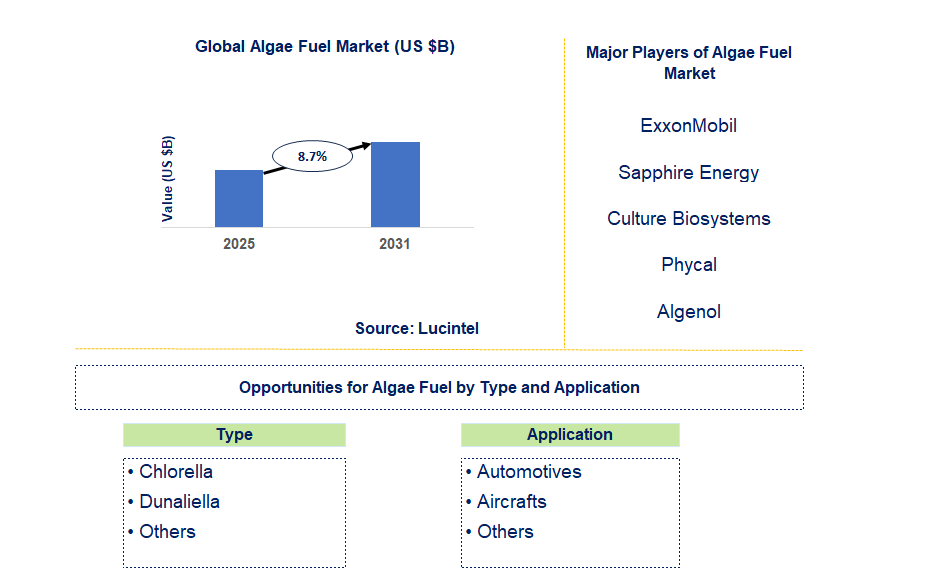
Key data points: The growth forecast = 8.7% annually for the next 7 years. Scroll below to get more insights. This market report covers trends, opportunities and forecasts in algae fuel market to 2031 by type (chlorella, dunaliella, and others), application (automotives, aircrafts, and others), and region (North America, Europe, Asia Pacific, and the Rest of the World)
We'll send your sample report shortly.
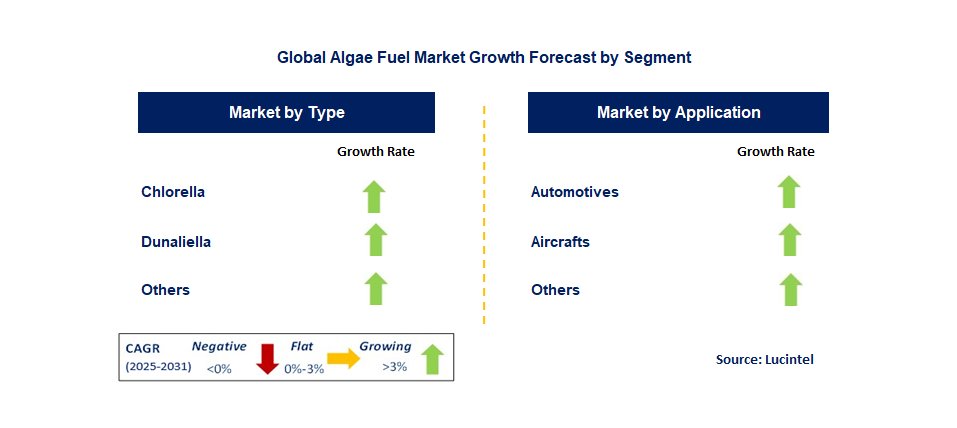
• Lucintel forecasts that, within the type category, dunaliella is expected to witness higher growth over the forecast period.
• Within the application category, aircraft is expected to witness higher growth.
• In terms of region, North America is expected to witness the highest growth over the forecast period due to the increasing government policies and incentives in the region. Gain valuable insights for your business decisions with our comprehensive 150+ page report. Sample figures with some insights are shown below.
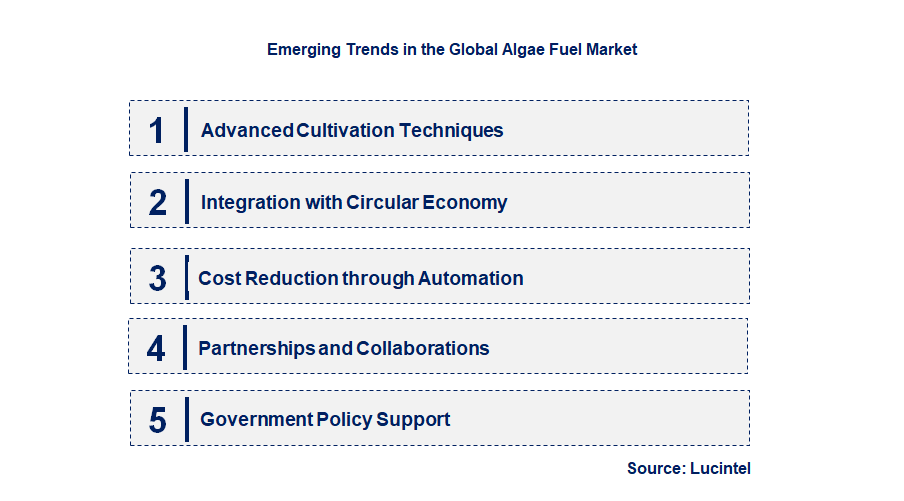
• Advanced Cultivation Techniques: New cultivation methods, such as photobioreactors and vertical farming, are being developed to optimize algae growth and reduce production costs. These techniques help in enhancing the yield of algae, making it a more economically viable fuel source. Additionally, the use of waste CO2 from industrial processes as a feedstock for algae cultivation is gaining momentum. These advancements are significantly improving the scalability and sustainability of algae-based biofuels.
• Integration with Circular Economy: Algae fuel is increasingly seen as part of the circular economy, where the waste produced in one process becomes a resource for another. By using CO2 emissions and wastewater as inputs for algae production, algae biofuels contribute to a closed-loop system that reduces environmental impact. This trend is gaining support from governments and industries looking to create sustainable energy solutions with minimal waste.
• Cost Reduction through Automation: Automation in algae fuel production processes, such as harvesting, processing, and oil extraction, is lowering production costs. Robotics and artificial intelligence are being integrated to improve efficiency and scalability. This trend is crucial in making algae biofuels competitive with traditional fossil fuels and other biofuels. As automation technologies continue to advance, the algae fuel market is expected to see further cost reductions, accelerating its commercialization.
• Partnerships and Collaborations: Increasingly, companies, research institutions, and governments are forming strategic partnerships to accelerate algae fuel development. These collaborations combine expertise in biotechnology, energy production, and environmental sustainability. By pooling resources, stakeholders can enhance R&D efforts, commercialize algae biofuels more effectively, and create economies of scale. Collaborative efforts are driving the market toward a more diverse and mature algae fuel industry.
• Government Policy Support: Government policies and regulations are playing a pivotal role in shaping the algae fuel market. Many countries have introduced incentives, subsidies, and tax benefits to promote the development of renewable energy sources, including algae biofuels. These policies not only support R&D but also encourage private investments and facilitate the scaling of algae fuel production. As governments push for greener energy alternatives, algae fuel is gaining traction as a viable solution. These trends are collectively reshaping the global algae fuel market by making it more efficient, economically viable, and environmentally sustainable. The market is evolving as a result of innovation, strategic collaborations, and supportive policies, positioning algae fuel as a key player in the renewable energy sector.
• Technological Innovation in Cultivation Systems: Recent innovations in algae cultivation systems, such as the development of photobioreactors and offshore algae farming, are improving algae yield and reducing costs. These technologies optimize the growth conditions for algae, leading to higher oil production per hectare. As these technologies become more refined, they are expected to make algae fuel a more viable and cost-competitive option for mass production.
• Public and Private Investments: Both government and private investments in algae biofuel research and development have been increasing. Governments, especially in the U.S. and Europe, are providing grants and incentives to foster innovation in algae-based fuel technologies. Private companies, such as Sapphire Energy and ExxonMobil, are also investing heavily in algae fuel projects. This influx of capital is accelerating the commercialization of algae-based fuels and scaling production.
• Advancements in Algae Strain Development: Genetic engineering and selective breeding are being used to develop algae strains with higher oil yields and faster growth rates. These advancements are aimed at making algae biofuel production more efficient and cost-effective. Research into optimizing algae strains for specific climates and conditions is also ongoing, which will further improve the scalability of algae-based fuel production.
• Expansion of Algae Fuel Production Facilities: Several companies are scaling up algae biofuel production by building larger and more advanced facilities. These new production plants are designed to produce biofuels on a commercial scale, providing a significant boost to the global algae fuel market. The expansion of production capacity is critical to meeting the growing demand for renewable fuels.
• Integration with Existing Infrastructure: Efforts are being made to integrate algae-based fuels into existing fuel infrastructure, including blending algae fuel with conventional biofuels. This integration makes it easier to adopt algae biofuels in current energy systems without the need for significant changes to distribution networks. This development is crucial for the widespread adoption of algae-based fuels. These developments are positioning algae biofuels as a promising and sustainable energy solution. With continued technological advancements and increased investment, the algae fuel market is poised for significant growth.
• Aviation Fuel: Algae fuel holds significant potential in the aviation industry as a sustainable alternative to conventional jet fuel. Algae-derived biofuels can reduce carbon emissions, which is a critical concern for the aviation sector. Several airlines and aircraft manufacturers are exploring algae-based fuels for their environmental benefits. As technology advances, the commercialization of algae biofuels for aviation could become a major growth area.
• Marine Fuel: The shipping industry is a major contributor to global carbon emissions. Algae fuel presents an opportunity to reduce the carbon footprint of maritime transport. Algae-derived biofuels can be blended with conventional marine fuels to lower emissions. Given the industry’s focus on sustainability, algae biofuels are positioned to become an important part of the global marine fuel market.
• Bioelectricity Generation: Algae can be used not only as a biofuel but also for bioelectricity generation. Algae-based bioelectricity systems are being developed to harness the energy from algae to generate power. This technology is still in the early stages, but as efficiency improves, algae-based electricity could become a viable renewable energy source, providing an additional growth opportunity in the energy sector.
• Sustainable Feedstocks for Biofuels: Algae can be used to produce feedstocks for other biofuels, such as biodiesel and bioethanol. By providing a sustainable and scalable source of raw materials, algae fuel contributes to the broader biofuel market. The versatility of algae as a feedstock material enhances its potential in various biofuel applications, offering long-term growth opportunities.
• Carbon Capture and Storage (CCS) Applications: Algae can be integrated into carbon capture and storage systems, helping industries reduce their CO2 emissions. Algae’s ability to absorb carbon dioxide during its growth makes it an ideal candidate for use in CCS technologies. This synergy between algae fuel production and carbon capture could be a key area for growth, particularly in industries looking to meet stringent emissions regulations. These opportunities demonstrate the versatility and potential of algae fuel across diverse applications, making it a key area for future growth in the renewable energy sector. The continued development of these applications will likely drive market expansion and establish algae biofuels as a cornerstone of sustainable energy systems.
• ExxonMobil
• Sapphire Energy
• Culture Biosystems
• Phycal
• Algenol
• Chlorella
• Dunaliella
• Others
• Automotives
• Aircrafts
• Others
• North America
• Europe
• Asia Pacific
• The Rest of the World
• United States: In the United States, the algae fuel market is witnessing considerable investments in research and development. Federal initiatives, such as the Department of Energy’s funding for algae biofuel projects, are driving innovation. Companies like Sapphire Energy and Algenol are focusing on improving algae strains to boost oil yields and reduce production costs. Furthermore, several U.S. states are implementing biofuel policies that support algae-based fuel production as part of their green energy initiatives. This focus on algae fuel development is contributing to the nation’s overall renewable energy goals.
• China: China has been scaling up efforts to commercialize algae fuel, focusing on both technological improvements and infrastructure. With a strong push from the government, the country is making strides toward integrating algae biofuels into its energy matrix. Leading research institutions and companies are working on enhancing algae cultivation and processing methods. China is also leveraging its large-scale manufacturing capabilities to reduce costs and scale algae fuel production. These efforts are positioning China as a key player in the global algae fuel market as the country looks to diversify its energy sources and reduce reliance on fossil fuels.
• Germany: Germany, known for its strong commitment to renewable energy, has made algae biofuels a key part of its strategy for sustainable fuel development. The country has invested heavily in R&D, with collaborations between universities, research centers, and private companies. Germany is focusing on improving the efficiency of algae cultivation and refining production processes to bring down costs. The development of algae-based fuel aligns with Germany’s broader goals of achieving carbon neutrality by 2050. Additionally, Germany is working on integrating algae fuel with existing infrastructure, which will provide opportunities for scaling production in the coming years.
• India: India has recognized the potential of algae-based fuel to meet its growing energy needs sustainably. The country is taking steps to develop algae fuel production through a mix of public-private partnerships. Indian research institutions are investigating the use of local algae strains to ensure that fuel production is both cost-effective and viable in India’s diverse climates. Given India’s energy challenges, algae biofuel presents an opportunity to reduce dependency on imported crude oil. Additionally, India is focusing on algae’s potential to generate jobs and boost the local economy in rural areas, making algae fuel an attractive option for sustainable growth.
• Japan: Japan has been a leader in adopting and developing advanced biofuels, with algae fuel being a key area of focus. The Japanese government supports algae-based fuel projects through funding and regulatory frameworks. Companies such as Euglena Co. are actively working on algae biofuel production, focusing on improving efficiency and scaling up operations. Japan’s emphasis on energy security, alongside its commitment to reducing carbon emissions, makes algae fuel an attractive option. The country is investing in research and commercial-scale production to make algae fuel a reliable part of its energy mix in the future.


• ExxonMobil
• Sapphire Energy
• Culture Biosystems
• Phycal
• Algenol Q5. Which algae fuel market segment will be the largest in future? Answer: Lucintel forecasts that, within the type category, dunaliella is expected to witness higher growth over the forecast period. Q6. In algae fuel market, which region is expected to be the largest in next 5 years? Answer: In terms of region, North America is expected to witness the highest growth over the forecast period due to the increasing government policies and incentives in the region. Q7. Do we receive customization in this report? Answer: Yes, Lucintel provides 10% customization without any additional cost.


Choose a license that fits your team. Instant PDF delivery.
Prices exclude taxes. Instant delivery. Custom licensing available on request.
Market Report · July 20, 2026
Market Report · July 20, 2026
Market Report · July 20, 2026
Trusted partner for strategic intelligence and business growth


Receive a complimentary market analysis tailored to your industry. Our analysts will identify key growth opportunities and competitive dynamics specific to your business.

Market size, growth rate, and key trend analysis for your specific sector.

Top competitor positioning and market share analysis.

Strategic recommendations backed by data-driven insights.
Get curated market intelligence and competitive moves straight to your inbox.
By subscribing, you agree to receive our monthly insights. Unsubscribe anytime.
Receive a complimentary market analysis tailored to your industry. Our analysts will identify key growth opportunities and competitive dynamics specific to your business.
Market size, growth rate, and key trend analysis for your specific sector.
Top competitor positioning and market share analysis.
Strategic recommendations backed by data-driven insights.
Get curated market intelligence, emerging trends, and competitive moves straight to your inbox each month.
By subscribing, you agree to receive our monthly insights. Unsubscribe anytime.
We'll send your sample report shortly.