
Market Report · July 15, 2026

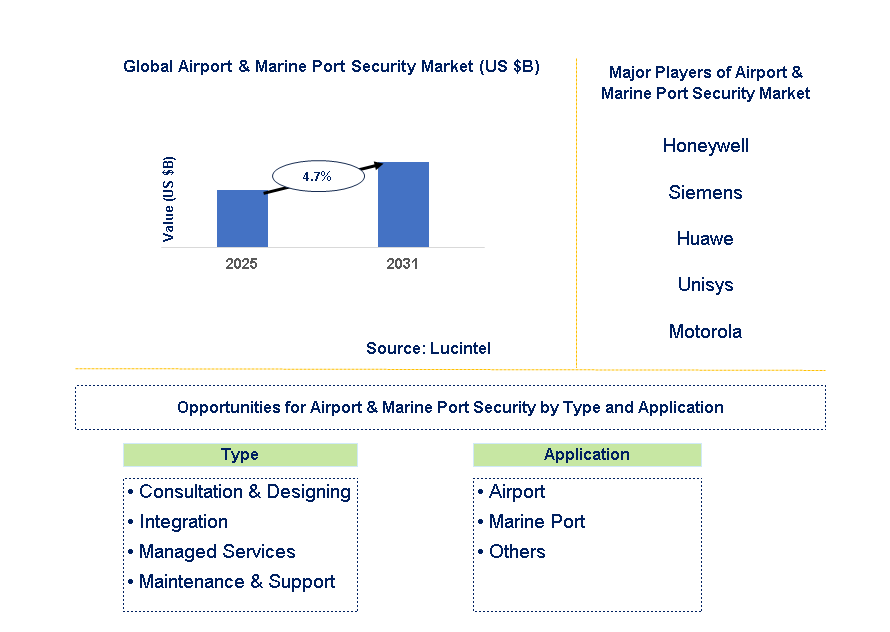
Key data points: The growth forecast = 4.7% annually for the next 7 years. Scroll below to get more insights. This market report covers trends, opportunities and forecasts in airport & marine port security market to 2031 by type (consultation & designing, integration, managed services, and maintenance & support), application (airport, marine port, and others), and region (North America, Europe, Asia Pacific, and the Rest of the World)
We'll send your sample report shortly.
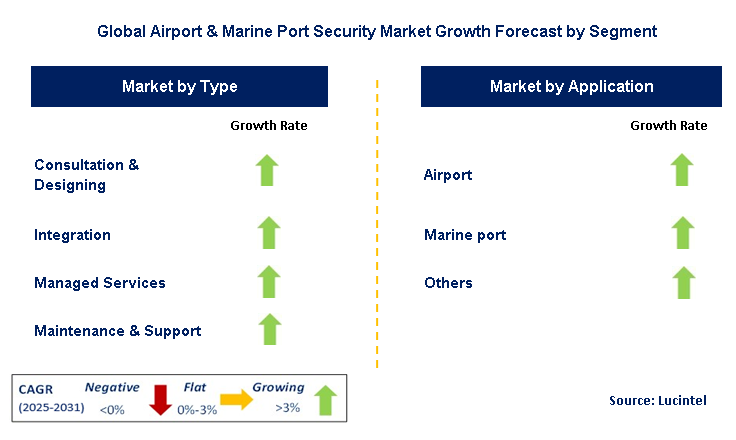
• Lucintel forecasts that, within the type category, integration is expected to witness the highest growth over the forecast period.
• Within the application category, airport is expected to witness higher growth.
• In terms of region, North America is expected to witness the highest growth over the forecast period. Gain valuable insights for your business decisions with our comprehensive 150+ page report. Sample figures with some insights are shown below.
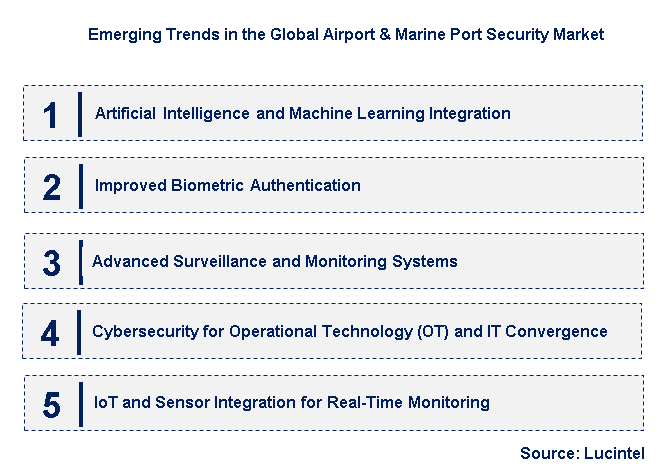
• Artificial Intelligence and Machine Learning Integration: AI and ML are revolutionizing security operations by facilitating sophisticated analytics, predictive threat identification, and automated decision-making. These technologies process large volumes of data from surveillance feeds, sensors, and other sources to recognize anomalous activity, forecast potential security breaches, and automate response procedures. The effect is a major boost in threat detection capacity, minimizing false alarms and enhancing the effectiveness of security officers, enabling more proactive and smart security interventions.
• Improved Biometric Authentication: The increased use of sophisticated biometric technologies, such as facial, fingerprint, and iris scanning, is one of the leading upcoming trends. These technologies find application in passenger identification, access control to sensitive areas, and fast-tracking boarding processes. The effect is an increased accuracy and efficiency in identity verification, minimizing wait times and improving overall passenger and cargo throughputs. It also enhances security through the generation of unique, non-transferable credentials, making it more difficult for unauthorized persons to access.
• Advanced Surveillance and Monitoring Systems: This trend entails the use of high-resolution cameras, thermal imaging, radar technology, and drone-based surveillance, usually incorporated with AI-based video analytics. These systems deliver in-depth situational awareness throughout large and complex airport and port environments, including operational areas, critical infrastructure, and perimeters. The effect is improved real-time monitoring capability, which allows for earlier detection of potential threats, automated tracking of suspicious behavior, and more effective optimization of security resources for rapid response.
• Cybersecurity for Operational Technology (OT) and IT Convergence: With airport and sea port systems increasingly being digitalized and connected, the IT-OT convergence brings with it novel cybersecurity threats. The trend involves creating strong cybersecurity frameworks to secure key operational systems like air traffic control, ship navigation, and cargo handling systems from cyber attacks. The effect is most important for ensuring operational continuity and security, since cyberattacks can cause profound disruptions, financial losses, and even pose safety risks.
• IoT and Sensor Integration for Real-Time Monitoring: The Internet of Things (IoT) is more and more integrated into airport and port security systems, utilizing networks of sensors to deliver real-time information on a number of parameters such as environmental conditions, asset location, and perimeter intrusions. This enables ongoing monitoring and automated notification. The effect is improved situational awareness and proactive risk management, which allows instantaneous responses to incidents and maximizes operational effectiveness by utilizing data-driven insights, for example, real-time tracking of people and cargo. These new trends are essentially transforming the airport & marine port security market by instituting an impetus towards more intelligent, networked, and anticipatory security solutions. The coming together of AI, biometrics, advanced surveillance, strong cybersecurity, and IoT integration is producing a world where security is not merely a response but an integrated, smart part of overall operational effectiveness and resilience. This evolution guarantees greater protection and more seamless operations within these important global gateways.
• Application of AI-Powered Threat Detection Systems: One major development is the growing application of artificial intelligence and machine learning in threat detection systems. These include AI-based video analytics for detecting anomalies in surveillance feeds, smart baggage screening systems that can detect prohibited items with increased accuracy, and predictive analytics for spotting suspicious behavior. The effect is a notable enhancement in the accuracy and velocity of threat detection, curbing false alarms and making security operations at airports and sea ports overall more efficient.
• Large-Scale Biometric Identity Verification Expansion: The utilization of biometric technologies, including facial recognition, fingerprint scanning, and iris recognition, is growing fast outside of conventional checkpoints. This advancement consists of biometric boarding of passengers, automated restricted-area access control for personnel, and biometric cargo tracking. The effect is increased security through accurate identification verification, efficient passenger and cargo processing, and decreased wait times, resulting in enhanced operational flow and a better experience for travelers and logistics staff.
• Strengthened Cybersecurity Controls for Critical Infrastructure: As operations at airports and ports become more digitized, there has been an imperative evolution in bolstering cybersecurity defenses. This includes the installation of stringent network security, real-time sharing of threat intelligence, and safeguarding of operational technology (OT) systems. The effect is crucial in mitigating cyberattacks that may impair air traffic control, vessel navigation, cargo handling, or breach sensitive information, thereby ensuring the uninterrupted and safe operations of such critical transportation infrastructure.
• IoT and Sensor Network Integration for Total Surveillance: Another notable development is the extensive use of IoT devices and high-end sensor networks for real-time, total surveillance and monitoring of vast airport and port campuses. This includes intrusion detection systems at the periphery of a facility, sensors under water along the sea side of ports for security, and weather monitoring. The effect is enhanced situation awareness, enabling security personnel to identify and counter threats faster and better, maximizing resource utilization, and overall security resilience.
• Upgrading to Advanced Screening and Scanning Technology: Recent advances feature the utilization of next-generation screening and scanning technology for passengers, bags, and cargo. These technologies encompass baggage CT scanners, body scanners to identify non-metallic threats, and high-energy X-ray systems for cargo inspection. The effect is a measurable increase in the ability to detect a broader variety of threats with enhanced accuracy, together with an improvement in throughput and decreased manual inspection needs, rendering security procedures more efficient and less invasive. These five major developments are significantly influencing the airport & marine port security market by propelling a paradigm shift towards more intelligent, integrated, and proactive security solutions. These developments are empowering airports and marine ports to more effectively counter emerging threats, improve operational efficiencies, and meet stringent international security standards. The ongoing application of these advanced technologies is essential for sustaining the safety and resilience of global supply chains and passenger travel.
• Perimeter Security and Intrusion Detection: An important growth opportunity is in further developing perimeter security and intrusion detection systems for airports as well as marine ports. This includes mounting sophisticated technologies like smart fences, ground surveillance radar, thermal imaging cameras, and unmanned aerial vehicles (UAVs) for round-the-clock monitoring. The effect is giving a vital first line of defense against unwanted access, smuggling, and possible terrorist activities, with early detection and quick response to violations over large and complex boundary regions.
• Access Management and Identity: Fortifying access control and identity management solutions is another key growth opportunity. This involves the deployment of biometric access solutions for staff, incorporating visitor management solutions, and creating secure credentialing solutions for employees and authorized personnel. The effect is to allow only authorized staff to access restricted areas, cutting insider risk, enhancing operational flow, and overall security by carefully controlling and authenticating identities in these sensitive facilities.
• Cargo and Baggage Screening: Advanced cargo and baggage screening technologies represent a huge growth area. This involves the deployment of high-resolution CT and X-ray scanners, explosive trace detection (ETD) equipment, and artificial intelligence-based threat detection algorithms. Its effect is important to identify illicit materials, contraband, and explosives, ensuring their exclusion from air and sea transport streams. Development in this space is focused on enhancing accuracy, speed, and minimizing human intervention.
• Operational Technology (OT) and Information Technology (IT) Cybersecurity: With the rise in the digitalization of airport and port operations, cybersecurity is a top growth area, especially in safeguarding converged IT and OT systems. This includes solutions for network segmentation, vulnerability management, threat intelligence, and incident response for critical control systems. The effect is to ensure operational continuity against cyber threats, which otherwise would delay indispensable services such as air traffic management, ship navigation, and cargo processing, making global trade and travel resilient.
• Integrated Surveillance and Command & Control Systems: Establishing and deploying integrated surveillance and command and control systems presents a strategic growth opportunity. These systems integrate information from multiple security technologies such as CCTV, radar, sensors, and access control into one platform for situational awareness and centralized management. The effect is to empower security personnel with a complete picture of the security environment, allowing for quicker decision-making, enhancing coordination in the event of incidents, and maximizing resource utilization for better security and operational effectiveness. These strategic growth prospects are essentially transforming the airport & marine port security market through the impetus of specialized, technologically sophisticated, and integrated solutions. Through solutions tailored to the distinctive security needs of each application, market participants are promoting innovation, improving overall security posture at airports and marine ports, and ensuring the uninterrupted, safe, and efficient movement of world commerce and travel. This focused effort is essential to long-term market growth and value generation.
• Honeywell
• Siemens
• Huawe
• Unisys
• Motorola
• Johnson Controls
• Flir
• James Fisher and Sons
• L-3 Communications
• Rapiscan
• Consultation & Designing
• Integration
• Managed Services
• Maintenance & Support
• Airport
• Marine Port
• Others
• North America
• Europe
• Asia Pacific
• The Rest of the World
• United States: The US airport & marine port security market is well developed, with a keen focus on technology integration and regulation compliance. Recent advancements involve more investment in state-of-the-art screening technology, including AI-driven baggage scanners and auto-screening lanes to make screening quicker and more effective as well as better detect threats. There is rising implementation of biometric verification for airport passenger processing to speed up check-ins and boarding. Cybersecurity tops the list with ongoing efforts to strengthen digital infrastructure against advanced cyberattacks aimed at core aviation and maritime infrastructure.
• China: China's airport and marine port security sector is growing rapidly due to huge infrastructure construction, smart city plans, and booming air and maritime traffic volume. The latest trends involve serious deployment of AI and IoT technologies for real-time monitoring, cargo tracking, and automated port management. China is also investing heavily in integrated security systems that combine radar, CCTV, and communication systems for holistic situational awareness. Emphasis is placed on using system technology for achieving security and efficiency in high volume environments.
• Germany: The airport and maritime port security market of Germany is defined by emphasis on advanced technology and stringent regulatory standards. Recent trends have seen the implementation of advanced perimeter intrusion detection systems and system integration sensor networks to secure critical infrastructure. There is a growing trend towards smart video monitoring systems with AI-based analytics for anomaly detection and predictive security. Germany is also focused on the role of cybersecurity protection of operational technology systems against cyber threats to make its transportation hubs resilient.
• India: India's airport & marine port security market is experiencing significant growth, driven by increasing air and maritime traffic, upgradation of existing infrastructure, and growing security concerns. Recent. are increased security protocols at ports, such as blackout procedures and surprise security exercises, in anticipation of threats. Cybersecurity procedures are given a high priority within port facilities. Although hardware devices continue to be the mainstay, there is a heightened need for software-based integrated solutions and services, including sophisticated surveillance and access systems, to enhance overall security.
• Japan: Japan's airport and marine port security industry is dominated by a high push for automation and high-tech integration. Recent trends involve the shift towards automated cargo transportation systems and the higher use of security robots for monitoring and patrol. There is an intensive focus on the integration of AI and IoT in surveillance systems for real-time threat detection and cargo monitoring, as witnessed in the "PORT 2030" plan. Biometric authentication to control access is also picking up steam,


• Honeywell
• Siemens
• Huawe
• Unisys
• Motorola
• Johnson Controls
• Flir
• James Fisher and Sons
• L-3 Communications
• Rapiscan Q5. Which airport & marine port security market segment will be the largest in future? Answer: Lucintel forecasts that, within the type category, integration is expected to witness the highest growth over the forecast period. Q6. In airport & marine port security market, which region is expected to be the largest in next 5 years? Answer: In terms of region, North America is expected to witness the highest growth over the forecast period. Q7. Do we receive customization in this report? Answer: Yes, Lucintel provides 10% customization without any additional cost.


Choose a license that fits your team. Instant PDF delivery.
Prices exclude taxes. Instant delivery. Custom licensing available on request.
Market Report · July 15, 2026
Market Report · June 26, 2026
Market Report · June 24, 2026
Trusted partner for strategic intelligence and business growth


Receive a complimentary market analysis tailored to your industry. Our analysts will identify key growth opportunities and competitive dynamics specific to your business.

Market size, growth rate, and key trend analysis for your specific sector.

Top competitor positioning and market share analysis.

Strategic recommendations backed by data-driven insights.
Get curated market intelligence and competitive moves straight to your inbox.
By subscribing, you agree to receive our monthly insights. Unsubscribe anytime.
Receive a complimentary market analysis tailored to your industry. Our analysts will identify key growth opportunities and competitive dynamics specific to your business.
Market size, growth rate, and key trend analysis for your specific sector.
Top competitor positioning and market share analysis.
Strategic recommendations backed by data-driven insights.
Get curated market intelligence, emerging trends, and competitive moves straight to your inbox each month.
By subscribing, you agree to receive our monthly insights. Unsubscribe anytime.
We'll send your sample report shortly.