Aircraft Autopilot System Market Report: Trends, Forecast and Competitive Analysis to 2035

Key data points: The market size in 2035 = $10 billion, growth forecast = 6.1% annually for the next 8 years. Scroll below to get more insights. This market report covers trends, opportunities and forecasts in aircraft autopilot system market to 2035 by aircraft type (narrowbody jets, widebody jets, regional & commuter aircraft, business jets, helicopters, unmanned aerial vehicles, and urban air mobility/eVTOL), system (attitude & heading reference systems, flight director systems, flight control computers, autothrottle & thrust management, air-data & inertial reference units, servo actuators, and autopilot software suites), end use (OEM fitment and retrofit/aftermarket), and region (North America, Europe, Asia Pacific, and the Rest of the World)

Publisher: Lucintel Last Updated: July 2026
See Pricing

Download Sample Report

| ✨ New Download Sample report — Get instant insights! | ✨ New Download Sample report — Get instant insights!

Aircraft Autopilot System Market Report: Trends, Forecast and Competitive Analysis to 2035

Aircraft Autopilot System Market

The future of the global aircraft autopilot system market looks promising with opportunities in the attitude & heading reference system, flight director system, flight control computer, autothrottle & thrust management, air-data & inertial reference unit, servo actuator, and autopilot software suite markets. The global aircraft autopilot system market is expected to reach an estimated $10 billion by 2035 with a CAGR of 6.1% from 2026 to 2035. The major drivers for this market are the increasing demand for automated flight control systems, the rising adoption of advanced navigation technologies, and the growing need for efficient aircraft operations.

  • Lucintel forecasts that, within the aircraft type category, narrowbody jet is expected to witness the highest growth over the forecast period due to the increasing adoption of automation in narrowbody aircraft for efficiency and safety.
  • Within the system category, flight control computer is expected to witness the highest growth due to the rising integration of advanced flight control computers in modern autopilot systems.
  • In terms of regions, North America is expected to witness the highest growth over the forecast period due to the strong aviation technology ecosystem and increasing adoption of advanced avionics systems.

Gain valuable insights for your business decisions with our comprehensive 150+ page report. Sample figures with some insights are shown below.
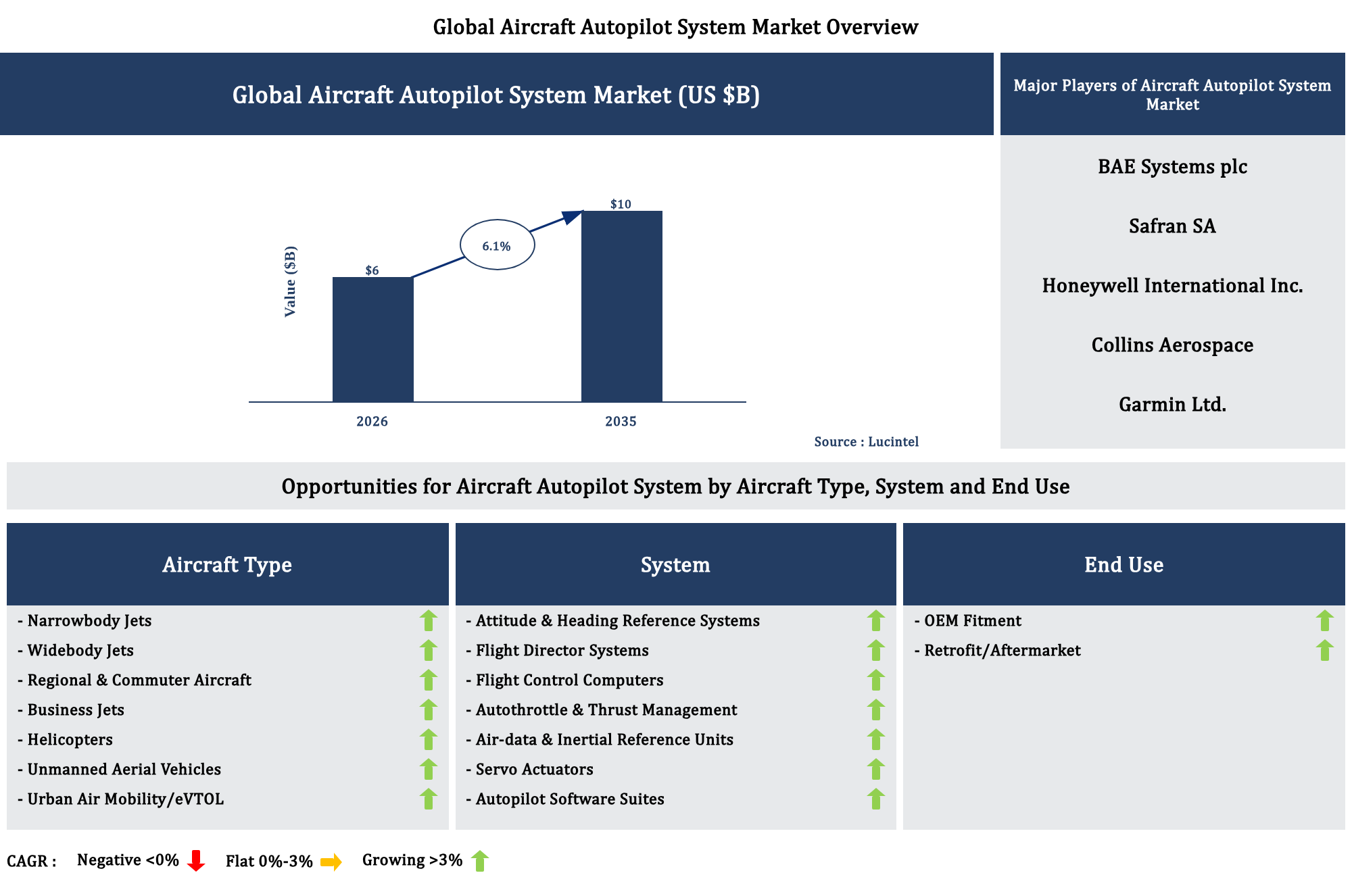
Aircraft Autopilot System Market

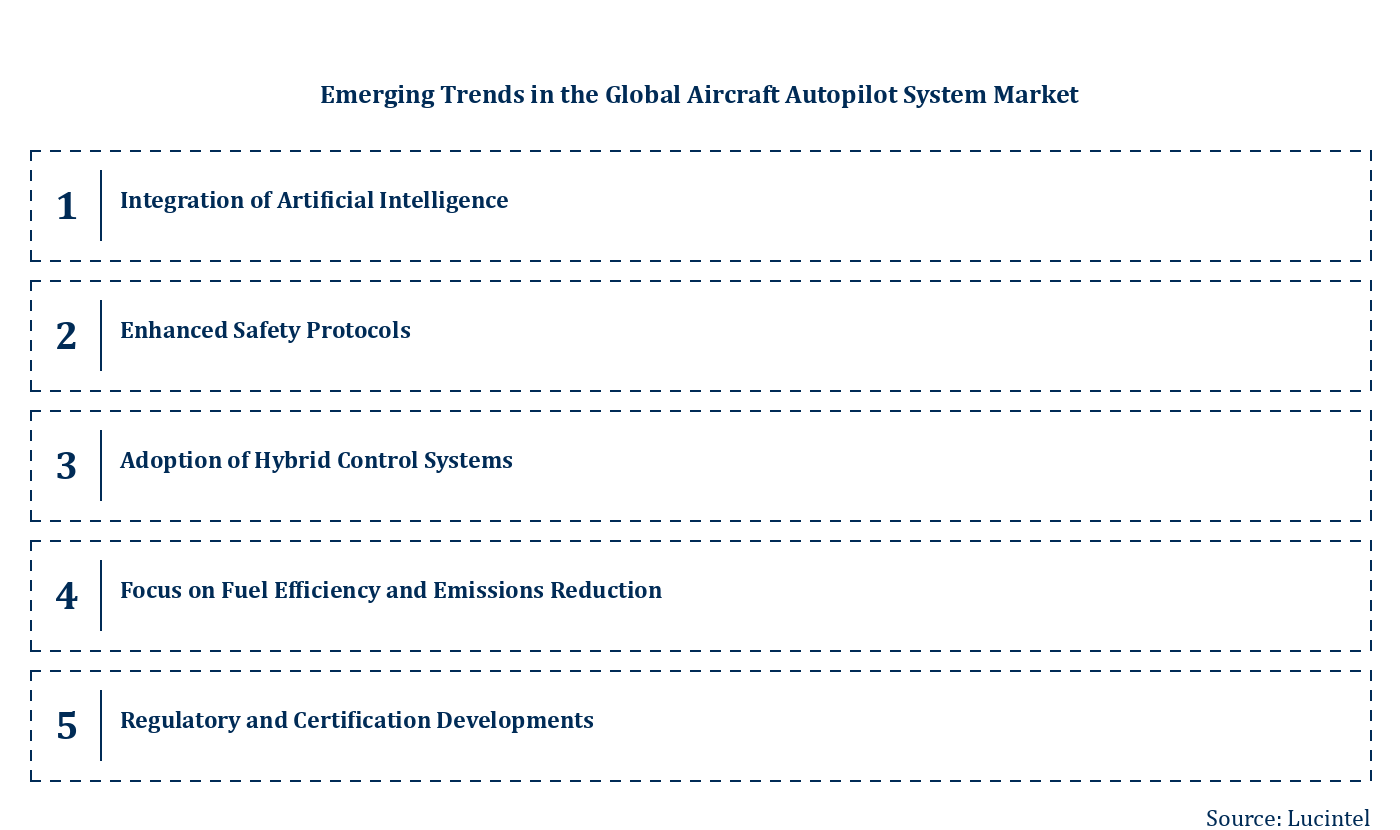
Emerging Trends in the Aircraft Autopilot System Market

The aircraft autopilot system market is experiencing rapid evolution driven by technological advancements, increasing safety regulations, and the demand for fuel efficiency. As airlines and manufacturers seek to optimize operations and enhance passenger safety, several emerging trends are shaping the future of autopilot systems. These developments are not only improving system capabilities but also redefining industry standards and operational practices. Understanding these key trends is essential for stakeholders aiming to stay competitive and innovative in this dynamic market landscape.

  • Integration of Artificial Intelligence: AI is increasingly embedded in autopilot systems to enable adaptive decision-making and predictive maintenance. This integration allows for more autonomous operations, reducing pilot workload and enhancing safety. AI-driven systems can analyze vast amounts of data in real-time, improving responsiveness to changing flight conditions and potential hazards. As a result, airlines benefit from increased operational efficiency and reduced human error, making AI a pivotal component in next-generation autopilot solutions.
  • Enhanced Safety Protocols: The market is witnessing a focus on advanced safety features, including fault-tolerant architectures and real-time monitoring. These improvements aim to minimize risks associated with system failures and ensure compliance with stringent aviation safety standards. Enhanced safety protocols also include automated emergency response capabilities, which can take corrective actions without human intervention. This trend boosts passenger confidence and aligns with regulatory requirements, ultimately leading to safer skies and more reliable autopilot systems.
  • Adoption of Hybrid Control Systems: Hybrid control architectures combining traditional autopilot functions with modern digital controls are gaining popularity. These systems offer greater flexibility, redundancy, and precision in flight management. They enable seamless transitions between manual and automated control, improving overall system robustness. The adoption of hybrid systems also facilitates easier integration with other aircraft systems, supporting future upgrades and interoperability, thereby extending the lifespan and functionality of autopilot solutions.
  • Focus on Fuel Efficiency and Emissions Reduction: Autopilot systems are being optimized to support more efficient flight paths and altitude management, contributing to significant fuel savings. These enhancements help airlines reduce operational costs and meet environmental regulations. Advanced autopilot features enable precise navigation and altitude adjustments, minimizing fuel consumption and emissions. This trend aligns with the global push towards sustainable aviation, making fuel-efficient autopilot systems a key differentiator for manufacturers and operators.
  • Regulatory and Certification Developments: Evolving regulatory frameworks are driving the standardization and certification processes for advanced autopilot systems. Authorities are establishing stricter guidelines to ensure safety, interoperability, and reliability. This trend encourages innovation while maintaining safety standards, leading to faster approval cycles for new technologies. It also fosters industry collaboration and standardization, which are crucial for widespread adoption and integration of cutting-edge autopilot solutions across different aircraft types.

These emerging trends are fundamentally transforming the aircraft autopilot system market by enhancing safety, efficiency, and automation capabilities. They are fostering innovation, improving operational reliability, and supporting sustainability goals. As these developments continue, the market is poised for significant growth, driven by technological integration, regulatory support, and a focus on safety and environmental responsibility.
Aircraft Autopilot System Market by country

Recent Developments in the Aircraft Autopilot System Market

The aircraft autopilot system market is experiencing rapid advancements driven by technological innovation, increasing demand for automation in aviation, and the need for enhanced safety and efficiency. These developments are transforming the industry landscape, offering new opportunities for manufacturers and service providers. As airlines seek to optimize operations and reduce costs, the integration of advanced autopilot systems is becoming a strategic priority. The following key developments highlight the current trajectory and future potential of this dynamic market.

  • Integration of AI and Machine Learning: This development enhances autopilot capabilities by enabling real-time decision-making, predictive maintenance, and adaptive flight control. AI-driven autopilot systems improve safety, reduce pilot workload, and optimize fuel efficiency. The integration allows for more autonomous operations, especially in complex scenarios like adverse weather or emergency situations. As AI technology matures, its adoption is expected to accelerate, making autopilot systems smarter, more reliable, and capable of handling increasingly complex flight environments, thus significantly impacting market growth.
  • Adoption of Hybrid and Electric Autopilot Systems: The shift towards sustainable aviation fuels and electric aircraft is driving innovation in autopilot technology. Hybrid and electric systems offer benefits such as reduced emissions, lower operational costs, and enhanced energy efficiency. These systems are designed to support the unique requirements of electric propulsion, including precise control and energy management. Their adoption is expected to expand as environmental regulations tighten and airlines seek greener solutions, positioning these systems as a key growth driver in the market.
  • Enhanced Safety and Redundancy Features: Recent developments focus on improving safety through advanced redundancy and fail-safe mechanisms. These features ensure continuous operation even in the event of component failure, minimizing risks during flight. Innovations include multiple backup systems, real-time diagnostics, and autonomous emergency procedures. The emphasis on safety is driven by regulatory requirements and passenger expectations. As safety standards become more stringent, the market for sophisticated, redundant autopilot systems is poised for significant expansion, reinforcing trust in automated flight.
  • Integration with Next-Generation Avionics: The convergence of autopilot systems with modern avionics enhances overall aircraft performance and situational awareness. This integration facilitates seamless communication between systems, enabling more precise navigation, obstacle avoidance, and traffic management. It also supports the implementation of digital cockpit environments and pilot-assist features. The trend toward integrated avionics is driven by advancements in data processing and sensor technology, leading to more efficient, safer, and more automated flight operations, thereby expanding market opportunities.
  • Development of Autonomous Flight Technologies: The push toward fully autonomous aircraft is a major trend shaping the autopilot market. Innovations include autonomous takeoff, landing, and in-flight decision-making capabilities. These technologies aim to reduce pilot workload, improve operational efficiency, and enable new flight paradigms such as urban air mobility and drone delivery. Regulatory frameworks are gradually evolving to accommodate autonomous flight, and industry investments are increasing. This development promises to revolutionize aviation, opening new markets and significantly impacting the autopilot system landscape.

The overall impact of these developments is a more efficient, safer, and environmentally friendly aviation industry. Enhanced automation capabilities are reducing operational costs, improving safety standards, and enabling new flight services. As technology continues to evolve, the market is expected to see increased adoption of intelligent, integrated, and autonomous systems, driving growth and innovation across the aerospace sector.

Strategic Growth Opportunities in the Aircraft Autopilot System Market

The aircraft autopilot system market is experiencing rapid growth driven by technological advancements, increasing demand for safety, and the need for fuel efficiency in aviation. As airlines and manufacturers seek to optimize operations, the integration of sophisticated autopilot systems offers significant opportunities for market expansion. Innovations in automation, regulatory support, and the rise of commercial and military aircraft are further fueling this growth, making it a critical component in modern aviation infrastructure.

  • Enhanced Safety and Reliability Through Advanced Autopilot Technologies: The adoption of cutting-edge autopilot systems improves flight safety by reducing human error and providing precise control during critical phases of flight. These systems incorporate sophisticated sensors, AI, and redundancy features, ensuring reliable operation even in adverse conditions. As safety standards tighten globally, airlines and manufacturers are investing heavily in autopilot solutions that enhance operational safety, minimize accidents, and meet regulatory requirements.
  • Growing Demand for Fuel Efficiency and Cost Reduction: Autopilot systems enable optimized flight paths, altitude adjustments, and speed management, leading to significant fuel savings. Airlines are increasingly adopting these systems to reduce operational costs amid rising fuel prices. Enhanced autopilot capabilities facilitate smoother flights, reduce pilot workload, and improve overall efficiency, making them essential for airlines aiming to remain competitive in a cost-sensitive industry.
  • Rising Integration of Autopilot with Next-Generation Avionics: The integration of autopilot systems with advanced avionics and digital cockpit displays enhances situational awareness and operational control. This synergy allows for more precise navigation, automated decision-making, and seamless communication with ground control. As aircraft become more technologically sophisticated, the demand for integrated autopilot solutions that support next-generation aircraft is expanding rapidly.
  • Increasing Adoption in Military and Unmanned Aerial Vehicles (UAVs): The military sector is increasingly deploying autopilot systems in combat aircraft, drones, and UAVs for enhanced mission precision and reduced pilot fatigue. These systems enable autonomous operation, complex maneuvers, and extended mission durations. The rising use of UAVs for surveillance, reconnaissance, and combat missions is a significant driver for autopilot technology development and market growth in defense applications.
  • Expansion of Autopilot Systems in Regional and Business Aircraft: Smaller regional jets and business aircraft are increasingly equipped with autopilot systems to improve safety, reduce pilot workload, and ensure compliance with regulations. The trend is driven by the need for operational efficiency and safety in diverse flight environments. As these aircraft become more prevalent, the demand for compact, reliable autopilot solutions tailored to their specific needs is expected to grow substantially.

The overall market is poised for substantial expansion as these opportunities converge, fostering innovation and adoption across commercial, military, and regional aviation sectors, ultimately transforming the future landscape of aircraft autopilot systems.

Aircraft Autopilot System Market Drivers and Challenges

The aircraft autopilot system market is influenced by a variety of technological, economic, and regulatory factors that shape its growth and development. Advances in avionics technology, increasing demand for fuel efficiency, and stringent safety regulations are key drivers propelling the market forward. Conversely, challenges such as high implementation costs, regulatory compliance complexities, and cybersecurity concerns pose significant hurdles. Understanding these drivers and challenges is essential for stakeholders to navigate the evolving landscape effectively. The interplay of these factors determines the pace of innovation, market expansion, and overall competitiveness within the industry.

The factors responsible for driving the aircraft autopilot system market include:-

  • Technological Advancements: The rapid evolution of avionics technology, including integration of AI and machine learning, enhances autopilot capabilities. These innovations improve flight safety, reduce pilot workload, and enable more precise navigation, which is highly attractive to aircraft manufacturers and airlines. As technology becomes more sophisticated and cost-effective, adoption rates increase, fueling market growth. Continuous R&D investments are expected to further expand system functionalities, making autopilot systems more reliable and efficient.
  • Rising Air Traffic and Fleet Expansion: The global increase in air travel demand and the expansion of airline fleets drive the need for advanced autopilot systems. Larger and more complex aircraft require sophisticated automation to ensure safety and efficiency. Emerging markets, especially in Asia-Pacific, are witnessing rapid fleet growth, creating a substantial market for autopilot systems. This trend is supported by economic growth, urbanization, and increased disposable incomes, which collectively boost air travel and necessitate improved autopilot solutions.
  • Focus on Safety and Regulatory Compliance: Stringent safety standards mandated by aviation authorities such as FAA and EASA compel airlines and manufacturers to adopt advanced autopilot systems. These systems are crucial for meeting safety regulations, reducing human error, and ensuring compliance with international standards. The emphasis on safety has led to increased investments in autopilot technology, fostering market expansion. Regulatory frameworks also encourage the integration of new features, pushing manufacturers to innovate continuously.
  • Cost Efficiency and Fuel Savings: Autopilot systems contribute significantly to operational cost reductions by optimizing flight paths, reducing fuel consumption, and minimizing pilot fatigue. Airlines are increasingly adopting these systems to improve efficiency and profitability. As fuel prices fluctuate, the economic benefits of autopilot systems become more pronounced, encouraging wider adoption. Additionally, automation reduces crew requirements and operational costs, making autopilot systems a strategic investment for airlines aiming to enhance competitiveness.
  • Integration with Next-Generation Aircraft: The development of next-generation aircraft with advanced avionics and digital architectures drives the demand for compatible autopilot systems. These systems are designed to seamlessly integrate with modern aircraft, supporting features like fly-by-wire and enhanced navigation. The trend toward more automated and connected aircraft necessitates sophisticated autopilot solutions, creating new opportunities for manufacturers. This integration also ensures future-proofing, aligning autopilot capabilities with evolving aircraft design standards.

The Challenges in The aircraft autopilot system market Are: -

  • High Implementation and Maintenance Costs: The deployment of advanced autopilot systems involves substantial capital investment in hardware, software, and training. Maintenance and upgrades further add to operational expenses, which can be prohibitive for smaller airlines and emerging markets. These costs may slow down adoption rates, especially in regions with tight budgets. Balancing technological benefits with affordability remains a key challenge for market players seeking widespread deployment.
  • Regulatory and Certification Complexities: Navigating the complex regulatory landscape for autopilot systems is a significant hurdle. Certification processes are rigorous, time-consuming, and costly, often delaying product launches and updates. Variations in standards across different regions complicate global deployment. Ensuring compliance while maintaining innovation requires substantial resources and expertise, which can hinder rapid market growth and technological advancement.
  • Cybersecurity Risks: As autopilot systems become more connected and integrated with digital networks, they are increasingly vulnerable to cyber threats. Cyberattacks could compromise flight safety, data integrity, and aircraft control systems. Addressing these cybersecurity concerns requires continuous investment in security measures, which adds to development costs. The threat of cyber vulnerabilities poses a significant challenge to the reliability and acceptance of autopilot systems in the aviation industry.

The aircraft autopilot system market is shaped by technological innovations, increasing air traffic, safety regulations, cost efficiencies, and integration with modern aircraft. However, high costs, regulatory hurdles, and cybersecurity risks present notable challenges. These factors collectively influence the pace of market growth, technological development, and adoption strategies. Stakeholders must navigate these dynamics carefully to capitalize on opportunities while mitigating risks, ensuring sustainable expansion in this evolving industry.

List of Aircraft Autopilot System Market Companies

Companies in the market compete on the basis of product quality offered. Major players in this market focus on expanding their manufacturing facilities, R&D investments, infrastructural development, and leverage integration opportunities across the value chain. Through these strategies aircraft autopilot system market companies cater increasing demand, ensure competitive effectiveness, develop innovative products & technologies, reduce production costs, and expand their customer base. Some of the aircraft autopilot system market companies profiled in this report include-

  • BAE Systems plc
  • Safran SA
  • Honeywell International Inc.
  • Collins Aerospace
  • Garmin Ltd.
  • Thales Group
  • Moog Inc.
  • Avidyne Corporation
  • Dynon Avionics
  • Genesys Aerosystems

Aircraft Autopilot System Market by Segment

The study includes a forecast for the global aircraft autopilot system market by aircraft type, system, end use, and region.

  • Aircraft Autopilot System Market by Aircraft Type [Value from 2019 to 2035]:
    • Narrowbody Jets
    • Widebody Jets
    • Regional & Commuter Aircraft
    • Business Jets
    • Helicopters
    • Unmanned Aerial Vehicles
    • Urban Air Mobility/eVTOL
  • Aircraft Autopilot System Market by System [Value from 2019 to 2035]:
    • Attitude & Heading Reference Systems
    • Flight Director Systems
    • Flight Control Computers
    • Autothrottle & Thrust Management
    • Air-data & Inertial Reference Units
    • Servo Actuators
    • Autopilot Software Suites
  • Aircraft Autopilot System Market by End Use [Value from 2019 to 2035]:
    • OEM Fitment
    • Retrofit/Aftermarket
  • Aircraft Autopilot System Market by Region [Value ($B) from 2019 to 2035]:
    • North America
    • Europe
    • Asia Pacific
    • The Rest of the World

Country Wise Outlook for the Aircraft Autopilot System Market

The aircraft autopilot system market has experienced significant technological advancements and increased adoption across the globe, driven by the demand for enhanced safety, efficiency, and automation in aviation. Countries are investing in innovative solutions to improve aircraft performance and meet stringent safety standards. The market's growth is also fueled by the rising number of commercial and military aircraft, along with advancements in digital and AI technologies. As the aviation industry evolves, key players are focusing on developing smarter, more reliable autopilot systems to meet the increasing complexity of modern aircraft operations. Here are recent developments in this market for the United States, China, Germany, India, and Japan.

  • United States: The US market has seen substantial growth with major aerospace companies like Honeywell and Collins Aerospace launching next-generation autopilot systems featuring AI integration and enhanced automation capabilities. The Federal Aviation Administration (FAA) has approved several advanced autopilot systems, promoting widespread adoption. Additionally, US-based startups are innovating in autonomous flight technology, aiming to reduce pilot workload and improve safety standards. The focus is also on integrating autopilot systems with advanced avionics and digital cockpit solutions to streamline aircraft operations.
  • China: China is rapidly expanding its aerospace industry, with significant investments in autopilot technology development. Chinese firms are collaborating with international aerospace companies to develop domestically produced autopilot systems that meet global standards. The government’s push for self-reliance in aviation technology has accelerated research in AI-powered autopilot solutions. Chinese airlines are increasingly adopting these systems to improve operational efficiency and safety, especially in regional and commercial aircraft. The country is also focusing on integrating autopilot systems with emerging urban air mobility projects.
  • Germany: Germany’s aerospace sector, led by Airbus and other key players, is advancing autopilot systems with a focus on fuel efficiency and environmental sustainability. Recent developments include the integration of machine learning algorithms to enhance autopilot decision-making processes. Germany is also investing in research to improve system reliability and fault tolerance, aligning with European safety standards. The country’s emphasis on digitalization has led to the deployment of more sophisticated autopilot systems in both commercial and military aircraft, emphasizing automation and safety enhancements.
  • India: India’s aerospace industry is witnessing rapid growth, with increased adoption of autopilot systems in both commercial and military aircraft. Indian aerospace companies are collaborating with global technology providers to develop cost-effective, reliable autopilot solutions tailored to regional needs. The government’s initiatives to modernize the military fleet include upgrading autopilot systems for enhanced operational capabilities. Additionally, India is investing in research to develop indigenous autopilot technologies, aiming to reduce dependence on foreign suppliers and boost self-sufficiency in aerospace manufacturing.
  • Japan: Japan’s aerospace industry is focusing on integrating advanced sensors and AI into autopilot systems to improve aircraft safety and efficiency. Leading companies are developing systems that support autonomous flight and reduce pilot workload, especially for long-haul flights. Japan is also emphasizing the development of autopilot systems compatible with next-generation aircraft, including environmentally friendly and fuel-efficient models. The country’s aerospace research institutions are collaborating with industry leaders to innovate in fault detection and system resilience, ensuring high safety standards in commercial and defense aviation sectors.

Features of the Aircraft Autopilot System Market

  • Market Size Estimates: Aircraft autopilot system market size estimation in terms of value ($B).
  • Trend and Forecast Analysis: Market trends (2019 to 2025) and forecast (2026 to 2035) by various segments and regions.
  • Segmentation Analysis: Aircraft autopilot system market size by aircraft type, system, end use, and region in terms of value ($B).
  • Regional Analysis: Aircraft autopilot system market breakdown by North America, Europe, Asia Pacific, and Rest of the World.
  • Growth Opportunities: Analysis of growth opportunities in different aircraft types, systems, end uses, and regions for the aircraft autopilot system market.
  • Strategic Analysis: This includes M&A, new product development, and competitive landscape of the aircraft autopilot system market.
  • Analysis of competitive intensity of the industry based on Porter’s Five Forces model.

Top 5 Companies

  • BAE Systems plc
  • Safran SA
  • Honeywell International Inc.
  • Collins Aerospace
  • Garmin Ltd.

Table of Contents

1. Executive Summary
14.1 Competitive Analysis Overview

List of Figures

List of Tables

Table 4.1: Attractiveness Analysis for the Global Aircraft Autopilot System Market by Aircraft Type Table 4.2: Market Size and CAGR of Various Aircraft Type in the Global Aircraft Autopilot System Market (2019-2025) Table 4.3: Market Size and CAGR of Various Aircraft Type in the Global Aircraft Autopilot System Market (2026-2035) Table 4.4: Trends of Narrowbody Jets in the Global Aircraft Autopilot System Market (2019-2025) Table 4.5: Forecast for Narrowbody Jets in the Global Aircraft Autopilot System Market (2026-2035) Table 4.6: Trends of Widebody Jets in the Global Aircraft Autopilot System Market (2019-2025) Table 4.7: Forecast for Widebody Jets in the Global Aircraft Autopilot System Market (2026-2035) Table 4.8: Trends of Regional & Commuter Aircraft in the Global Aircraft Autopilot System Market (2019-2025) Table 4.9: Forecast for Regional & Commuter Aircraft in the Global Aircraft Autopilot System Market (2026-2035) Table 4.10: Trends of Business Jets in the Global Aircraft Autopilot System Market (2019-2025) Table 4.11: Forecast for Business Jets in the Global Aircraft Autopilot System Market (2026-2035) Table 4.12: Trends of Helicopters in the Global Aircraft Autopilot System Market (2019-2025) Table 4.13: Forecast for Helicopters in the Global Aircraft Autopilot System Market (2026-2035) Table 4.14: Trends of Unmanned Aerial Vehicles in the Global Aircraft Autopilot System Market (2019-2025) Table 4.15: Forecast for Unmanned Aerial Vehicles in the Global Aircraft Autopilot System Market (2026-2035) Table 4.16: Trends of Urban Air Mobility/eVTOL in the Global Aircraft Autopilot System Market (2019-2025) Table 4.17: Forecast for Urban Air Mobility/eVTOL in the Global Aircraft Autopilot System Market (2026-2035)
Table 5.1: Attractiveness Analysis for the Global Aircraft Autopilot System Market by System Table 5.2: Market Size and CAGR of Various System in the Global Aircraft Autopilot System Market (2019-2025) Table 5.3: Market Size and CAGR of Various System in the Global Aircraft Autopilot System Market (2026-2035) Table 5.4: Trends of Attitude & Heading Reference Systems in the Global Aircraft Autopilot System Market (2019-2025) Table 5.5: Forecast for Attitude & Heading Reference Systems in the Global Aircraft Autopilot System Market (2026-2035) Table 5.6: Trends of Flight Director Systems in the Global Aircraft Autopilot System Market (2019-2025) Table 5.7: Forecast for Flight Director Systems in the Global Aircraft Autopilot System Market (2026-2035) Table 5.8: Trends of Flight Control Computers in the Global Aircraft Autopilot System Market (2019-2025) Table 5.9: Forecast for Flight Control Computers in the Global Aircraft Autopilot System Market (2026-2035) Table 5.10: Trends of Autothrottle & Thrust Management in the Global Aircraft Autopilot System Market (2019-2025) Table 5.11: Forecast for Autothrottle & Thrust Management in the Global Aircraft Autopilot System Market (2026-2035) Table 5.12: Trends of Air-data & Inertial Reference Units in the Global Aircraft Autopilot System Market (2019-2025) Table 5.13: Forecast for Air-data & Inertial Reference Units in the Global Aircraft Autopilot System Market (2026-2035) Table 5.14: Trends of Servo Actuators in the Global Aircraft Autopilot System Market (2019-2025) Table 5.15: Forecast for Servo Actuators in the Global Aircraft Autopilot System Market (2026-2035) Table 5.16: Trends of Autopilot Software Suites in the Global Aircraft Autopilot System Market (2019-2025) Table 5.17: Forecast for Autopilot Software Suites in the Global Aircraft Autopilot System Market (2026-2035)"

Methodology

Lucintel has been in the business of market research and management consulting since 2000 and has published over 1000 market intelligence reports in various markets / applications and served over 1,000 clients worldwide. This study is a culmination of four months of full-time effort performed by Lucintel's analyst team. The analysts used the following sources for the creation and completion of this valuable report:

  • In-depth interviews of the major players in this market
  • Detailed secondary research from competitors' financial statements and published data
  • Extensive searches of published works, market, and database information pertaining to industry news, company press releases, and customer intentions
  • A compilation of the experiences, judgments, and insights of Lucintel's professionals, who have analyzed and tracked this market over the years.

Extensive research and interviews are conducted across the supply chain of this market to estimate market share, market size, trends, drivers, challenges, and forecasts. Below is a brief summary of the primary interviews that were conducted by job function for this report.

Lucintel's methodology for market research

Thus, Lucintel compiles vast amounts of data from numerous sources, validates the integrity of that data, and performs a comprehensive analysis. Lucintel then organizes the data, its findings, and insights into a concise report designed to support the strategic decision-making process. The figure below is a graphical representation of Lucintel's research process.

Primary interviews by job function

Buy Now

Choose a license that fits your team. Instant PDF delivery.

Market Report

1 User PDF

$4,850
Buy Now

Market Report

2-5 Users PDF

$6,700
Buy Now

Market Report

Corporate PDF

$8,850
Buy Now

Market Report

Global PDF

$10,000
Buy Now

Prices exclude taxes. Instant delivery. Custom licensing available on request.

Frequently Asked Questions

What is the aircraft autopilot system market size?
The global aircraft autopilot system market is expected to reach an estimated $10 billion by 2035.
What is the growth forecast for aircraft autopilot system market?
The global aircraft autopilot system market is expected to grow with a CAGR of 6.1% from 2026 to 2035.
What are the major drivers influencing the growth of the aircraft autopilot system market?
The major drivers for this market are the increasing demand for automated flight control systems, the rising adoption of advanced navigation technologies, and the growing need for efficient aircraft operations.
What are the major segments for aircraft autopilot system market?
The future of the aircraft autopilot system market looks promising with opportunities in the attitude & heading reference system, flight director system, flight control computer, autothrottle & thrust management, air-data & inertial reference unit, servo actuator, and autopilot software suite markets.
Who are the key aircraft autopilot system market companies?

Some of the key aircraft autopilot system companies are as follows:

  • BAE Systems plc
  • Safran SA
  • Honeywell International Inc.
  • Collins Aerospace
  • Garmin Ltd.
  • Thales Group
  • Moog Inc.
  • Avidyne Corporation
  • Dynon Avionics
  • Genesys Aerosystems
Which aircraft autopilot system market segment will be the largest in future?
Lucintel forecasts that, within the aircraft type category, narrowbody jet is expected to witness the highest growth over the forecast period.
In aircraft autopilot system market, which region is expected to be the largest in next 8 years?
In terms of region, North America is expected to witness the highest growth over the forecast period.
Do we receive customization in this report?
Yes, Lucintel provides 10% customization without any additional cost.

Key Questions

  • What are some of the most promising, high-growth opportunities for the aircraft autopilot system market by aircraft type (narrowbody jets, widebody jets, regional & commuter aircraft, business jets, helicopters, unmanned aerial vehicles, and urban air mobility/eVTOL), system (attitude & heading reference systems, flight director systems, flight control computers, autothrottle & thrust management, air-data & inertial reference units, servo actuators, and autopilot software suites), end use (OEM fitment and retrofit/aftermarket), and region (North America, Europe, Asia Pacific, and the Rest of the World)?
  • Which segments will grow at a faster pace and why?
  • Which region will grow at a faster pace and why?
  • What are the key factors affecting market dynamics? What are the key challenges and business risks in this market?
  • What are the business risks and competitive threats in this market?
  • What are the emerging trends in this market and the reasons behind them?
  • What are some of the changing demands of customers in the market?
  • What are the new developments in the market? Which companies are leading these developments?
  • Who are the major players in this market? What strategic initiatives are key players pursuing for business growth?
  • What are some of the competing products in this market and how big of a threat do they pose for loss of market share by material or product substitution?
  • What M&A activity has occurred in the last 5 years and what has its impact been on the industry?
Why Choose Us

The Lucintel Advantage

Trusted partner for strategic intelligence and business growth

25+ Years Excellence

25+ Years Excellence

Quarter century of proven expertise in management consulting and market research across global markets.
Game-Changer Ideas

Game-Changer Ideas

Innovative strategies and actionable insights that help clients become the smartest in their industry.
Global Reach

Global Reach

Extensive coverage across 50+ industries and markets worldwide with localized expertise.
Start Your Growth Journey

Get Your Free
Market Intelligence
Briefing

Receive a complimentary market analysis tailored to your industry. Our analysts will identify key growth opportunities and competitive dynamics specific to your business.

Custom Market Snapshot

Market size, growth rate, and key trend analysis for your specific sector.

Competitive Landscape Overview

Top competitor positioning and market share analysis.

Growth Opportunity Identification

Strategic recommendations backed by data-driven insights.

Subscribe

Subscribe to our Newsletter

Get curated market intelligence and competitive moves straight to your inbox.

By subscribing, you agree to receive our monthly insights. Unsubscribe anytime.

Industry Trends Market Signals Opportunities Competitor Moves