
Market Report · July 13, 2026

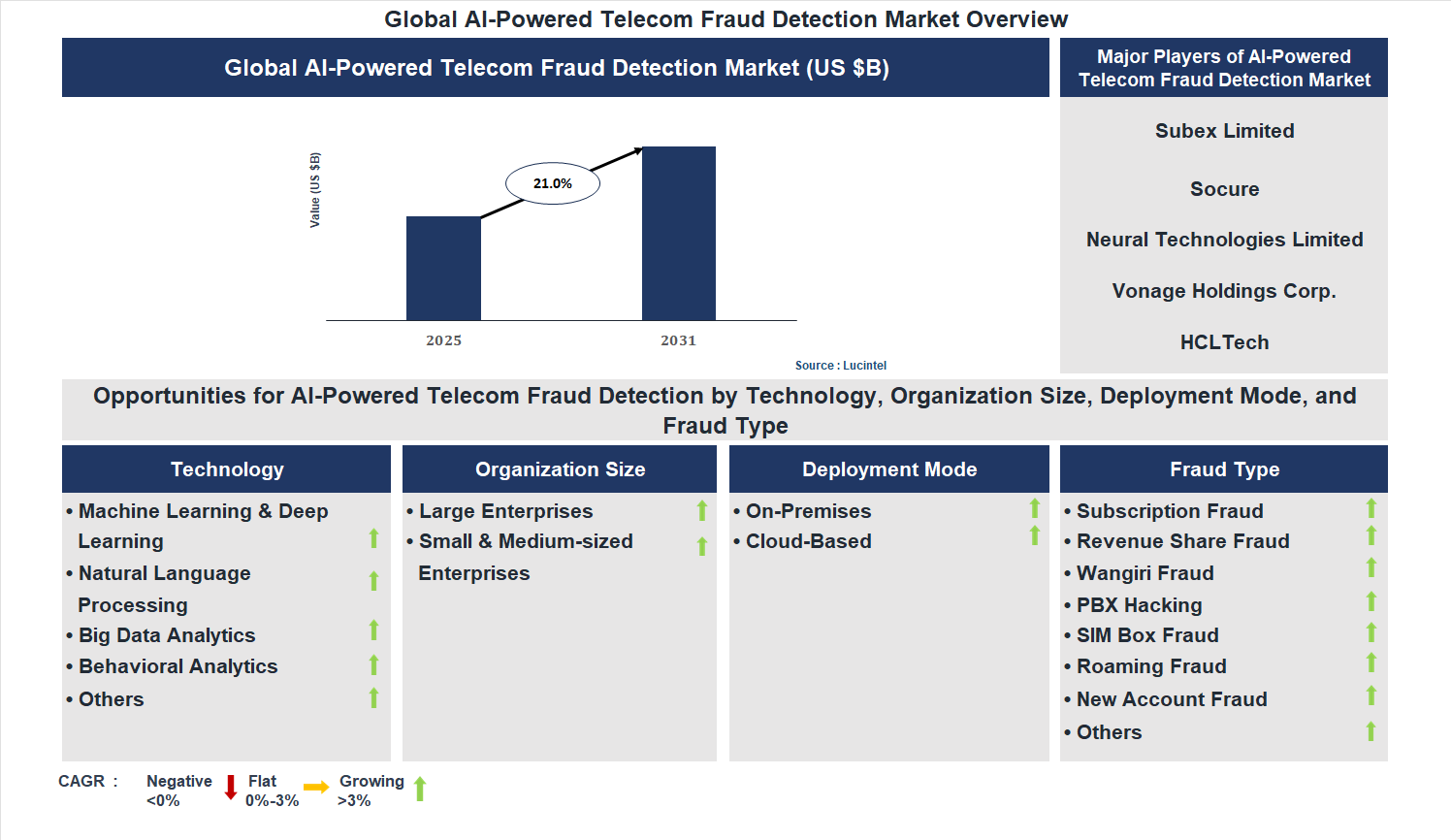
Key data points: The growth forecast = 21% annually for the next 7 years. Scroll below to get more insights. This market report covers trends, opportunities and forecasts in AI-powered telecom fraud detection market to 2031 by technology (machine learning & deep learning, natural language processing, big data analytics, behavioral analytics, and others), organization size (large enterprises and small & medium-sized enterprises), deployment mode (on-premises and cloud-based), fraud type (subscription fraud, revenue share fraud, wangiri fraud, PBX hacking, SIM box fraud, roaming fraud, new account fraud, and others), and region (North America, Europe, Asia Pacific, and the Rest of the World)
We'll send your sample report shortly.
• Lucintel forecasts that, within the technology category, machine learning & deep learning is expected to witness higher growth over the forecast period.
• Within the fraud type category, roaming fraud is expected to witness the highest growth.
• In terms of region, APAC is expected to witness the highest growth over the forecast period. Gain valuable insights for your business decisions with our comprehensive 150+ page report. Sample figures with some insights are shown below.
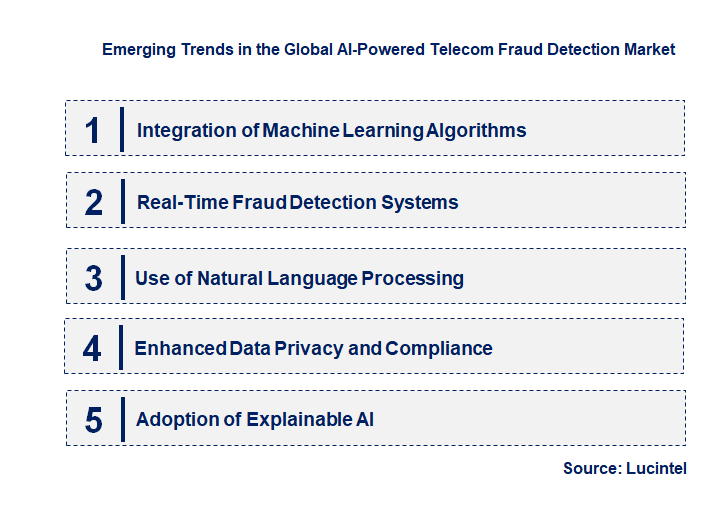
• Integration of Machine Learning Algorithms: This trend involves deploying advanced machine learning models that analyze vast amounts of data to identify patterns indicative of fraudulent activity. These algorithms continuously learn and adapt to new fraud tactics, improving detection accuracy over time. The impact is significant, as it reduces false positives and enables proactive fraud prevention, ultimately saving costs and enhancing customer trust.
• Real-Time Fraud Detection Systems: Telecom providers are increasingly implementing AI-powered systems capable of monitoring transactions and network activity in real time. This allows immediate identification and response to suspicious behavior, minimizing potential damage. The impact includes faster threat mitigation, reduced financial losses, and improved customer experience through seamless service without interruptions caused by fraud.
• Use of Natural Language Processing (NLP): NLP techniques are being integrated into fraud detection platforms to analyze unstructured data such as customer communications, call transcripts, and social media interactions. This helps identify social engineering scams and insider threats. The impact is a more comprehensive security approach, enabling detection of complex fraud schemes that traditional methods might miss, thereby strengthening overall security posture.
• Enhanced Data Privacy and Compliance: As AI systems process sensitive customer data, there is a growing emphasis on ensuring data privacy and regulatory compliance. Market players are adopting privacy-preserving AI techniques and adhering to regulations like GDPR. The impact is increased customer confidence and reduced legal risks, fostering sustainable growth in the market.
• Adoption of Explainable AI (XAI): Transparency in AI decision-making is gaining importance, with the development of explainable AI models that provide insights into how fraud detections are made. This trend improves trust among users and regulators, facilitating easier audits and compliance. The impact includes better stakeholder confidence and smoother integration of AI solutions within existing telecom infrastructure. In summary, these emerging trends are fundamentally reshaping the AI-powered telecom fraud detection market by enhancing detection capabilities, ensuring compliance, and building greater trust. They enable telecom companies to stay ahead of evolving fraud tactics, improve operational efficiency, and deliver more secure services to customers, thus driving market growth and innovation.
• Integration of AI with 5G Networks: The deployment of 5G has enabled faster data processing and real-time fraud detection, significantly reducing response times and minimizing financial losses for telecom providers.
• Adoption of Machine Learning Algorithms: Advanced machine learning models are now capable of identifying complex fraud patterns more accurately, leading to improved detection rates and fewer false positives.
• Real-Time Data Analytics: Enhanced data analytics platforms allow telecom companies to monitor transactions and network activity continuously, enabling immediate fraud alerts and swift action.
• Regulatory Compliance and Data Privacy: Increasing regulatory requirements have prompted the development of AI solutions that ensure compliance while maintaining user privacy, fostering trust and legal adherence.
• Strategic Partnerships and Collaborations: Telecom firms are partnering with AI technology providers to develop customized fraud detection solutions, accelerating innovation and market penetration. These developments are collectively transforming the AI-powered telecom fraud detection market by increasing detection accuracy, reducing response times, and ensuring compliance. The integration of advanced AI technologies with telecom infrastructure is enabling more proactive and efficient fraud prevention strategies, ultimately strengthening security and customer confidence in telecom services worldwide.
• Customer Authentication: Enhanced security measures are being implemented through AI-driven biometric verification and behavioral analysis, reducing identity theft and unauthorized access. This improves customer trust and minimizes fraud-related losses, leading to more secure and seamless user experiences.
• Call Monitoring and Analysis: AI algorithms enable real-time monitoring of calls to detect suspicious patterns and anomalies. This proactive approach helps telecom providers identify potential fraud attempts early, reducing financial risks and improving overall network security.
• Transaction Fraud Detection: AI models analyze transaction data to identify unusual activities indicative of fraud. This application minimizes financial losses, enhances compliance with regulations, and boosts customer confidence by ensuring secure transactions.
• Network Security and Intrusion Detection: AI-powered systems continuously monitor network traffic for signs of intrusion or malicious activity. This proactive defense mechanism strengthens network integrity, prevents data breaches, and maintains service reliability.
• Customer Behavior Analytics: AI analyzes customer behavior patterns to identify potential fraud risks and personalize security measures. This application enhances targeted fraud prevention strategies, improves customer engagement, and reduces false positives. In summary, these growth opportunities are significantly impacting the AI-powered telecom fraud detection market by driving innovation, improving security, and reducing financial and reputational risks. As applications become more sophisticated, the market is poised for sustained expansion, offering telecom providers more effective tools to combat evolving fraud threats.
• Technological Advancements: The continuous evolution of AI and machine learning algorithms enhances the accuracy and efficiency of fraud detection systems. These technologies enable real-time analysis of vast data sets, identifying suspicious patterns swiftly. As telecom data becomes more complex, advanced AI models are essential for detecting sophisticated fraud schemes. The integration of big data analytics further improves detection capabilities, reducing false positives and operational costs. This technological progress encourages telecom providers to upgrade their fraud prevention infrastructure, fostering market expansion and innovation.
• Increasing Telecom Data Volume: The exponential growth in telecom data, driven by the proliferation of mobile devices and IoT, creates both opportunities and challenges. Larger data sets provide richer insights for fraud detection but require more robust processing capabilities. AI systems can analyze this data in real-time, identifying anomalies indicative of fraud. The surge in data volume necessitates scalable AI solutions, prompting investments in cloud computing and data management infrastructure. This trend ensures that telecom companies can better protect their networks, boosting market demand for advanced AI-powered detection tools.
• Regulatory Compliance and Data Security: Governments and regulatory bodies worldwide are imposing stricter data security and fraud prevention standards. Telecom operators must comply with regulations such as GDPR and local data protection laws, which demand transparent and secure handling of customer data. AI-powered fraud detection systems help meet these compliance requirements by providing detailed audit trails and automated reporting. Moreover, regulatory pressure encourages telecom companies to adopt innovative solutions to avoid penalties and reputational damage, thereby fueling market growth and technological adoption.
• Rising Incidence of Telecom Fraud: The increasing sophistication and frequency of telecom fraud schemes, including SIM swapping, subscription fraud, and call spoofing, drive the need for advanced detection systems. Fraudsters continually evolve their tactics, making traditional methods ineffective. AI-powered solutions offer adaptive learning capabilities, enabling telecom providers to stay ahead of emerging threats. The financial losses associated with fraud motivate investments in AI-based detection tools, which can significantly reduce fraud-related costs and protect customer trust, further propelling market expansion.
• Growing Adoption of Cloud-Based Solutions: The shift towards cloud computing offers scalable, flexible, and cost-effective platforms for deploying AI-powered fraud detection systems. Cloud-based solutions facilitate rapid deployment, easier updates, and integration with existing telecom infrastructure. They also support real-time analytics across distributed networks, essential for timely fraud detection. As telecom companies seek to modernize their IT environments, the adoption of cloud-based AI solutions accelerates, expanding market opportunities and enabling broader reach for advanced fraud prevention tools. The challenges facing this Market include:
• Data Privacy and Ethical Concerns: While AI enhances fraud detection, it raises significant privacy issues. Handling vast amounts of customer data necessitates strict adherence to data protection laws, which can limit data sharing and analysis. Ethical concerns about AI decision-making and potential biases also pose risks, potentially leading to false positives or unfair treatment of customers. Balancing effective fraud detection with privacy rights remains a complex challenge, requiring transparent policies and robust security measures to maintain customer trust and regulatory compliance.
• High Implementation and Maintenance Costs: Deploying advanced AI-powered fraud detection systems involves substantial initial investments in technology, infrastructure, and skilled personnel. Ongoing maintenance, updates, and training further add to operational costs. Smaller telecom providers may find these expenses prohibitive, limiting market penetration. Additionally, the rapid pace of technological change necessitates continuous upgrades, which can strain budgets. These financial barriers can slow adoption rates and hinder the widespread deployment of cutting-edge fraud detection solutions.
• Evolving Fraud Tactics: Fraudsters are constantly developing new methods to bypass detection systems, making it difficult for AI models to stay effective over time. Adaptive fraud schemes, such as synthetic identity fraud and AI-generated call spoofing, challenge existing detection algorithms. Keeping pace with these evolving tactics requires continuous model training, data collection, and system updates, which can be resource-intensive. Failure to adapt quickly may result in increased fraud losses and diminished trust in AI-based solutions, posing a significant challenge to market growth. In summary, the AI-powered telecom fraud detection market is driven by technological innovations, increasing data volumes, regulatory pressures, rising fraud incidents, and cloud adoption. However, challenges such as privacy concerns, high costs, and evolving fraud tactics must be addressed to sustain growth. The interplay of these factors shapes a competitive landscape that demands continuous innovation and strategic adaptation. Overall, the markets future depends on balancing technological progress with regulatory and ethical considerations, ensuring effective, secure, and scalable fraud prevention solutions.
• Subex Limited
• Socure
• Neural Technologies Limited
• Vonage Holdings Corp.
• HCLTech
• SAS Institute
• Inform Software
• Sift Science
• Quantexa Limited
• Feedzai
• Machine Learning & Deep Learning
• Natural Language Processing
• Big Data Analytics
• Behavioral Analytics
• Others
• Large Enterprises
• Small & Medium-sized Enterprises
• On-Premises
• Cloud-Based
• Subscription Fraud
• Revenue Share Fraud
• Wangiri Fraud
• PBX Hacking
• SIM Box Fraud
• Roaming Fraud
• New Account Fraud
• Others
• North America
• Europe
• Asia Pacific
• The Rest of the World
• United States: The US market has seen rapid adoption of AI-powered fraud detection solutions, driven by major telecom providers and tech giants investing in advanced analytics. Regulatory agencies are emphasizing data security and privacy, prompting innovations in compliance-focused systems. Companies are integrating AI with existing infrastructure to enable real-time fraud detection, reducing financial losses significantly. The US also witnesses increased collaboration between telecom firms and AI startups to develop tailored solutions, fostering a competitive environment. Overall, the US remains a leader in deploying cutting-edge AI technologies for telecom fraud prevention.
• China: China’s telecom sector is rapidly adopting AI-driven fraud detection systems, supported by government initiatives promoting AI innovation. The market benefits from large-scale data availability and a focus on digital transformation, enabling more sophisticated detection algorithms. Chinese telecom companies are leveraging AI to combat increasingly complex fraud schemes, including SIM swapping and identity theft. The government’s emphasis on cybersecurity and smart city projects further accelerates AI integration. Domestic AI startups are playing a crucial role, and partnerships with global tech firms are expanding. The Chinese market is characterized by aggressive growth and technological innovation in telecom fraud detection.
• Germany: Germany’s telecom industry is increasingly integrating AI solutions to enhance fraud detection capabilities, driven by stringent data protection regulations like GDPR. The focus is on developing privacy-preserving AI models that comply with legal standards while maintaining high detection accuracy. Major telecom operators are investing in AI research and collaborating with European AI firms to develop localized solutions. The market is also witnessing a push towards automation and predictive analytics to prevent fraud proactively. Germany’s emphasis on data security and ethical AI use shapes the development of sophisticated, compliant fraud detection systems, positioning it as a key player in Europe.
• India: India’s telecom fraud detection market is experiencing rapid growth due to the expanding telecom subscriber base and rising fraud incidents. The adoption of AI-powered solutions is driven by telecom operators seeking cost-effective, scalable, and real-time detection methods. Government initiatives promoting digital payments and mobile banking have increased the need for robust fraud prevention. Local startups and global tech firms are collaborating to develop innovative AI solutions tailored to the Indian market’s unique challenges. The focus is on detecting SIM card fraud, phishing, and identity theft. Overall, India’s market is characterized by rapid innovation and increasing adoption of AI to secure telecom infrastructure.
• Japan: Japan’s telecom sector is increasingly deploying AI-based fraud detection systems to address sophisticated fraud tactics. The market benefits from advanced technological infrastructure and a strong emphasis on cybersecurity. Japanese telecom companies are investing in AI research to develop highly accurate, real-time detection tools that comply with strict privacy laws. The integration of AI with IoT and 5G networks is enhancing fraud prevention capabilities. The government’s focus on digital security and innovation supports ongoing development. Japan’s market is marked by high-quality solutions, strategic partnerships, and a focus on maintaining consumer trust through advanced AI-driven security measures.


• Subex Limited
• Socure
• Neural Technologies Limited
• Vonage Holdings Corp.
• HCLTech
• SAS Institute
• Inform Software
• Sift Science
• Quantexa Limited
• Feedzai Q5. Which AI-powered telecom fraud detection market segment will be the largest in future? Answer: Lucintel forecasts that, within the technology category, machine learning & deep learning is expected to witness higher growth over the forecast period. Q6. In AI-powered telecom fraud detection market, which region is expected to be the largest in next 5 years? Answer: In terms of region, APAC is expected to witness the highest growth over the forecast period. Q7. Do we receive customization in this report? Answer: Yes, Lucintel provides 10% customization without any additional cost.


Choose a license that fits your team. Instant PDF delivery.
Prices exclude taxes. Instant delivery. Custom licensing available on request.
Market Report · July 13, 2026
Market Report · July 13, 2026
Market Report · July 2, 2026
Trusted partner for strategic intelligence and business growth


Receive a complimentary market analysis tailored to your industry. Our analysts will identify key growth opportunities and competitive dynamics specific to your business.

Market size, growth rate, and key trend analysis for your specific sector.

Top competitor positioning and market share analysis.

Strategic recommendations backed by data-driven insights.
Get curated market intelligence and competitive moves straight to your inbox.
By subscribing, you agree to receive our monthly insights. Unsubscribe anytime.
Receive a complimentary market analysis tailored to your industry. Our analysts will identify key growth opportunities and competitive dynamics specific to your business.
Market size, growth rate, and key trend analysis for your specific sector.
Top competitor positioning and market share analysis.
Strategic recommendations backed by data-driven insights.
Get curated market intelligence, emerging trends, and competitive moves straight to your inbox each month.
By subscribing, you agree to receive our monthly insights. Unsubscribe anytime.
We'll send your sample report shortly.