
Market Report · July 15, 2026

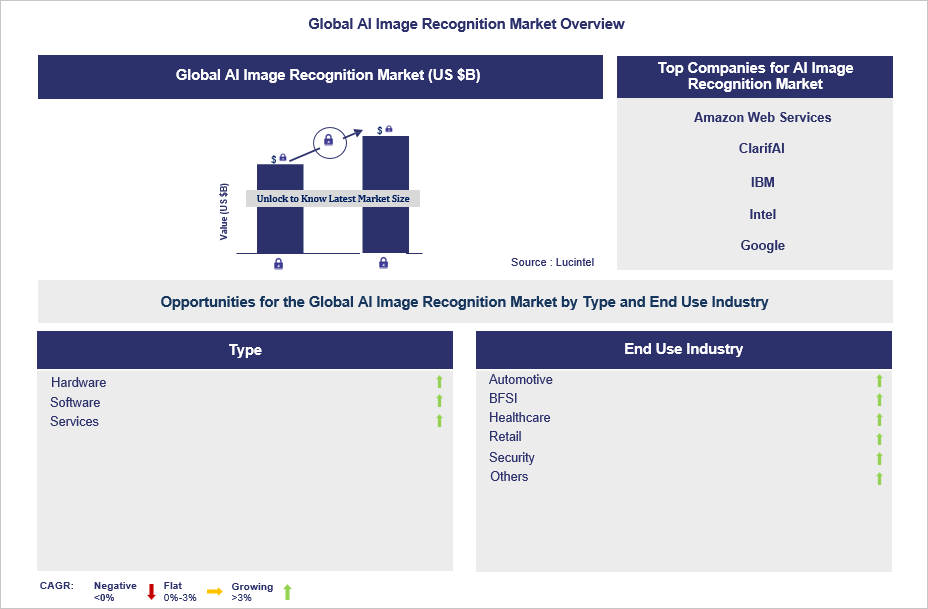
Key data points: The market size in 2030 = $14.3 billion, growth forecast = 20.0% annually for the next 6 years. Scroll below to get more insights. This market report covers trends, opportunities, and forecasts in the global AI image recognition market to 2030 by type (hardware, software, and services), end use industry (automotive, BFSI, healthcare, retail, security, and others), and region (North America, Europe, Asia Pacific, and the Rest of the World)
We'll send your sample report shortly.
• Lucintel forecasts that, within the type category, the software is expected to witness the highest growth over the forecast period due to its significant use to identify places, objects, people, writing, and actions in images.
• Within the end use industry category, Security will remain the largest segment due to the widespread use of image recognition in various security applications, such as facial recognition, object detection, and license plate recognition.
• In terms of region, APAC is expected to witness the highest growth over the forecast period due to rapid digitization, growing use of AI image recognition integrated ecommerce platforms in the region, and growing use of facial recognition cameras in high-tech gates at china schools. Gain valuable insight for your business decisions with our comprehensive 150+ page report.
• Advancements in Deep Learning Algorithms: Deep learning algorithms, particularly Convolutional Neural Networks (CNNs), have led to revolutionary strides in image recognition capabilities. These algorithms help identify complex patterns and features in images, which translates into applications such as facial recognition and autonomous navigation. Improved accuracy and efficiency through continuous refinement of these algorithms enable better performance, especially in security and healthcare diagnostics.
• Integration with Augmented and Virtual Reality: The convergence between image recognition, augmented reality (AR), and virtual reality (VR) is leading to immersive experiences across different sectors. Retailers use AR for virtual try-ons, allowing customers to visualize products before buying them. This integration not only enhances customer engagement but also streamlines shopping processes, thereby driving sales revenues and customer satisfaction. Consequently, greater interaction between consumers and these products is expected from this kind of technological union.
• Increased Adoption in Healthcare: AI image recognition is gaining ground within the medical field, where it is used to analyze medical images such as X-rays and MRIs. By automating the identification of abnormalities, these technologies increase diagnostic accuracy while decreasing the time spent on diagnosis by doctors, thus reducing their workload significantly. Its ability to detect conditions like tumors quickly can enhance patient outcomes by enabling timely interventions, making it a crucial tool in contemporary medicine.
• Rise of Transfer Learning: Transfer learning is emerging as a key trend in AI image recognition, where pre-trained models can be adapted for new tasks with minimal data. This saves time in training models, especially in domains like healthcare, where labeled data may be scarce. Image classification and object detection can be done with high accuracy through the use of existing models, which fast-tracks the adoption of AI solutions.
• Growing Focus on Ethical AI and Data Privacy: As AI-enhanced image recognition technology advances, greater attention is being paid to ethical concerns and data privacy. Companies are working to instill trust in their AI systems by making them more transparent and accountable. This has led to the establishment of robust measures for protecting data and ensuring compliance with regulatory provisions. Addressing these issues allows firms to practice responsible development of AI, boosting public confidence in image recognition technologies. The result is a convergence of these trends that is reshaping the landscape for AI image recognition, spurring innovation and expanding its reach across different sectors. In terms of the sustainable expansion of this dynamic market, the inclusion of ethical practices and design thinking focused on users will be important as technologies continue to advance.

• Improved Deep Learning Architectures: Innovations such as Vision Transformers and EfficientNets have outperformed classical CNNs, leading to enhanced accuracy and efficiency during image recognition tasks.
• Generative Adversarial Networks (GANs): GANs have become popular for producing real-looking synthesized images, which is essential for the data augmentation process or when it is difficult to obtain a high volume of datasets.
• Edge AI and Real-time Processing: Image recognition models can now be deployed on edge devices, thanks to advancements in hardware and software. This enables real-time applications and reduces latency.
• Multimodal Image Recognition: The integration of text or audio information from various modalities has improved the understanding of intricate visual scenes and increased accuracy in identification.
• Ethical Considerations and Bias Mitigation: Increased awareness of biases in AI systems has led to research focused on eliminating biases that discriminate against certain individuals, making these systems fairer for use in image recognition applications. These developments have significantly impacted the AI image recognition market, enabling new applications and improving performance across various domains. Enhanced deep learning architectures have boosted accuracy, GANs have addressed data scarcity, edge AI has facilitated real-time processing, multimodal recognition has improved understanding, and ethical considerations have ensured fairness. As these technologies continue to evolve, we can expect even more innovative and impactful applications of AI image recognition in the future.
• Healthcare Diagnostics: AI image recognition enhances healthcare by improving diagnostic accuracy through better analysis of medical imaging. Early disease detection, personalized treatment plans, improved patient outcomes, and reduced healthcare costs can be achieved with this technology.
• Retail and E-commerce: Retail customers benefit from AI image recognition, as it provides personalized product recommendations and helps manage inventory effectively. This leads to higher customer engagement, increased sales volumes, and optimized supply chains.
• Automotive Safety: Enhanced object detection and real-time decision-making support ADAS (Advanced Driver Assistance Systems) and autonomous vehicles in autonomous driving technologies. Road safety is improved, accidents are reduced, and adoption rates for self-driving cars are accelerated, especially when supported by such vision systems.
• Security and Surveillance: Real-time facial recognition using image recognition technology has improved security systems with real-time anomaly detection. It also reduces crime rates while enhancing public safety across sectors due to its applicability in various surveillance operations.
• Manufacturing Quality Control: AI image recognition assists in detecting defects during manufacturing processes and ensuring consistent production quality. This application lowers mistakes, enhances operational efficiency, and reduces costs incurred at many stages of production. The accuracy, effectiveness, and safety of these industries make AI image recognition's growth opportunities across these applications significant in transforming them. Traditional systems' capabilities have been improved by each opportunity, promoting innovation and expanding market reach. The incorporation of AI image recognition is restructuring how industries function, making industry-based solutions smarter and more efficient.
• Technological Advancements: Significant progress has been made in improving image recognition accuracy and efficiency through developments in deep learning algorithms and neural networks. This advancement has enabled AI systems to process large amounts of visual data, leading to broader applications, particularly in healthcare, automotive, and retail sectors.
• Growing Demand Across Industries: One major driver of the market is the adoption of AI image recognition solutions across diverse industries. For instance, the healthcare industry uses AI for medical image analysis, while car manufacturing companies use it for object detection and autonomous driving. This wide range of applications results in a strong demand for AI image recognition technologies.
• Economic Benefits: The adoption of AI image recognition brings large economic gains. For example, in manufacturing, AI-powered visual inspection systems can reduce defects, improving product quality and reducing associated costs. AI can also automate tasks, increasing productivity and enhancing decision-making processes, thus boosting the economy at large.
• Increasing Availability of Data: The proliferation of digital devices and the increasing volume of visual data have generated large datasets for training and improving AI image recognition models. Large-scale datasets are essential for developing accurate and robust algorithms.
• Government Initiatives and Investments: Government support and investments in AI research have bolstered the growth of the market segment related to image recognition. Many governments acknowledge AI's potential to drive innovation and economic development, so they are actively promoting its research and adoption. Challenges in the AI Image Recognition Market:
• Data Privacy and Security Concerns: The use of AI image recognition involves collecting and processing large amounts of personal data. Ensuring data privacy and security is a significant challenge, as breaches can have far-reaching consequences. Regulations such as the General Data Protection Regulation (GDPR) and the California Consumer Privacy Act (CCPA) specify how data should be handled, affecting the development and implementation of AI systems.
• Ethical Considerations: The use of AI image recognition raises ethical concerns, particularly regarding bias and discrimination. Bias may occur when AI systems are trained using data with discriminatory features. Addressing these issues is crucial for ensuring that AI is used responsibly, impartially, and equitably.
• Infrastructure and Computational Resources: Training and deploying AI image recognition models require significant computational resources and infrastructure. Access to high-performance computing hardware or cloud-based platforms may pose challenges, especially for small enterprises or countries with developing economies. The growth drivers for the AI image recognition market include technological advancements, increasing demand across industries, economic value, the growing availability of data, and government support. However, challenges such as privacy concerns, ethical issues, and the need for adequate infrastructure must be addressed for sustainable growth. By understanding these drivers and challenges, stakeholders can better position themselves to take advantage of opportunities in AI image recognition.
• Amazon Web Services
• Clarifai
• IBM
• Intel
• Hardware
• Software
• Services
• Automotive
• BFSI
• Healthcare
• Retail
• Security
• Others
• North America
• Europe
• Asia Pacific
• The Rest of the World
• United States: The US has made significant strides in AI image recognition, with major tech companies like Google and Microsoft leading the way. Recent advancements include facial recognition systems and real-time object detection. There is also an increasing investment in integrating AI image recognition into healthcare diagnostics and autonomous vehicles to improve accuracy and efficiency.
• China: The Chinese AI image recognition market is growing rapidly, with innovations from companies like Baidu and Alibaba. The country focuses on facial recognition technology for security and surveillance in public spaces and smart cities. Additionally, China's emphasis on retail and manufacturing has led to smarter inventory management and automatic quality control through AI.
• Germany: Germany is leveraging its strong automotive sector and industrial base to advance AI image recognition. Manufacturers such as Siemens and Bosch are incorporating AI technologies into their production processes and autonomous vehicle systems. Recent developments include machine vision systems that provide quality assurance checks on assembly lines, as well as advanced driver assistance systems (ADAS) that improve safety and efficiency.
• India: The Indian AI image recognition market is expanding, driven by both startups and large technology companies. Recent developments involve using AI for crop monitoring and pest detection in the agriculture sector. Additionally, AI image recognition systems are being implemented in security and surveillance applications, spurred by rapid urbanization that calls for increased safety measures.
• Japan: Japan has made progress in robotics and consumer electronics, incorporating AI image recognition into its products. Companies like Sony and Panasonic have adopted cutting-edge image recognition technologies in their smart cameras and robotic systems. Notably, recent developments include improved visual recognition for robotics and AI-driven features in consumer electronics to enhance user experience and automation.


• Amazon Web Services
• Clarifai
• IBM
• Intel
• Google Q6. Which AI image recognition market segment will be the largest in the future? Answer: Lucintel forecast that software is expected to witness the highest growth over the forecast period due to its significant use to identify places, objects, people, writing, and actions in images. Q7. In the AI image recognition market, which region is expected to be the largest in the next 5 years? Answer: APAC is expected to witness the highest growth over the forecast period due to rapid digitization, growing use of AI image recognition integrated ecommerce platforms in the region, and growing use of facial recognition cameras in high-tech gates at China schools. Q.8 Do we receive customization in this report? Answer: Yes, Lucintel provides 10% customization without any additional cost.


Choose a license that fits your team. Instant PDF delivery.
Prices exclude taxes. Instant delivery. Custom licensing available on request.
Market Report · July 15, 2026
Market Report · June 26, 2026
Market Report · June 24, 2026
Trusted partner for strategic intelligence and business growth


Receive a complimentary market analysis tailored to your industry. Our analysts will identify key growth opportunities and competitive dynamics specific to your business.

Market size, growth rate, and key trend analysis for your specific sector.

Top competitor positioning and market share analysis.

Strategic recommendations backed by data-driven insights.
Get curated market intelligence and competitive moves straight to your inbox.
By subscribing, you agree to receive our monthly insights. Unsubscribe anytime.
Receive a complimentary market analysis tailored to your industry. Our analysts will identify key growth opportunities and competitive dynamics specific to your business.
Market size, growth rate, and key trend analysis for your specific sector.
Top competitor positioning and market share analysis.
Strategic recommendations backed by data-driven insights.
Get curated market intelligence, emerging trends, and competitive moves straight to your inbox each month.
By subscribing, you agree to receive our monthly insights. Unsubscribe anytime.
We'll send your sample report shortly.