
Market Report · July 13, 2026

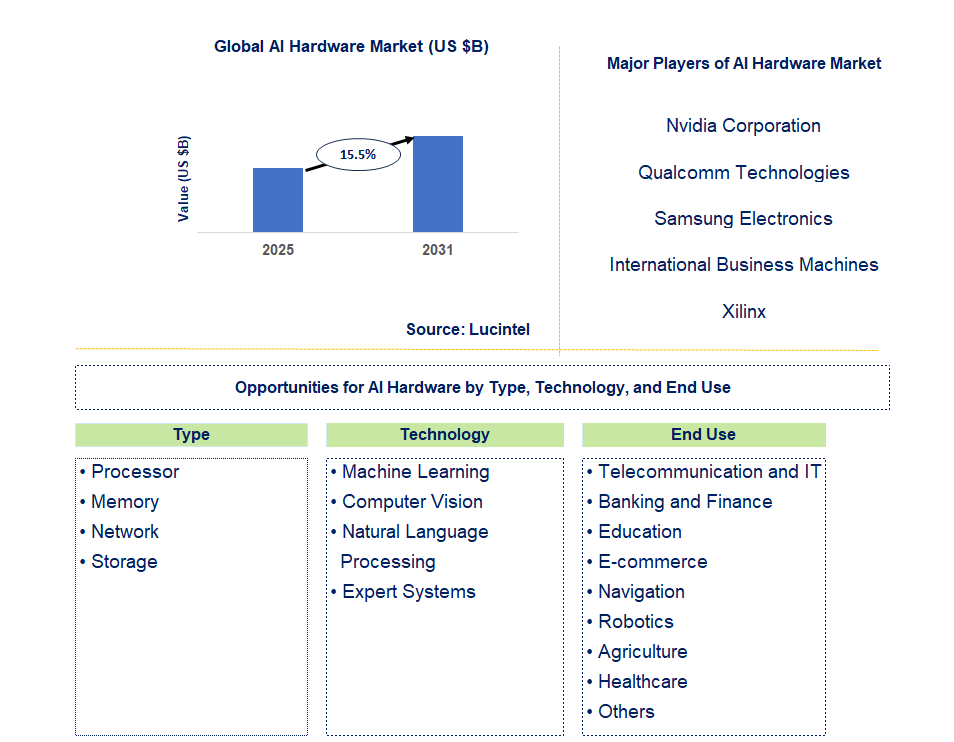
Key data points: The growth forecast = 15.5% annually for the next 7 years. Scroll below to get more insights. This market report covers Trends, opportunity and forecast in AI hardware market to 2031 by type (processor, memory, network, and storage), technology (machine learning, computer vision, natural language processing, and expert systems), end use (telecommunication and IT, banking and finance, education, e-commerce, navigation, robotics, agriculture, healthcare, and others), and region (North America, Europe, Asia Pacific, and the Rest of the World)
We'll send your sample report shortly.
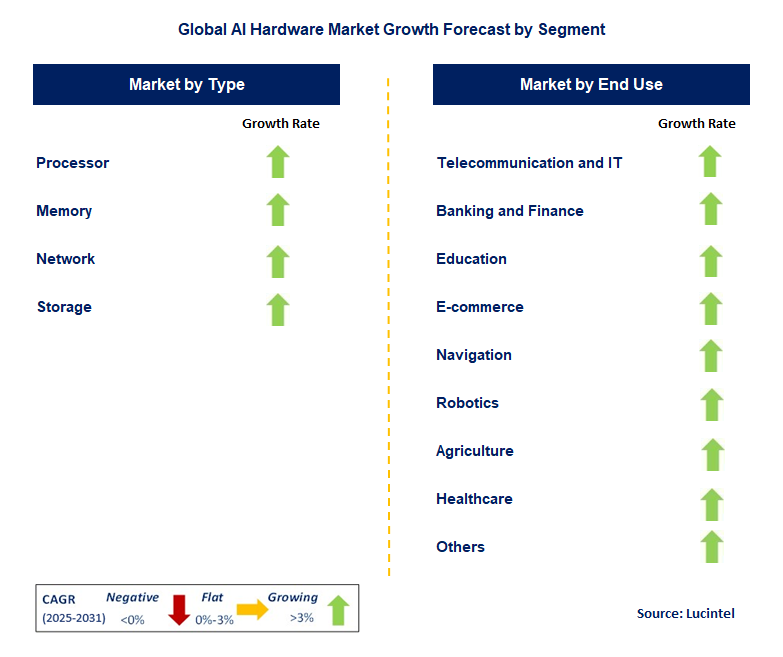
• Lucintel forecasts that, within the type category, processor is expected to witness the highest growth over the forecast period.
• Within the application category, telecommunication and IT is expected to witness the highest growth.
• In terms of region, APAC is expected to witness the highest growth over the forecast period. Gain valuable insights for your business decisions with our comprehensive 150+ page report. Sample figures with some insights are shown below.
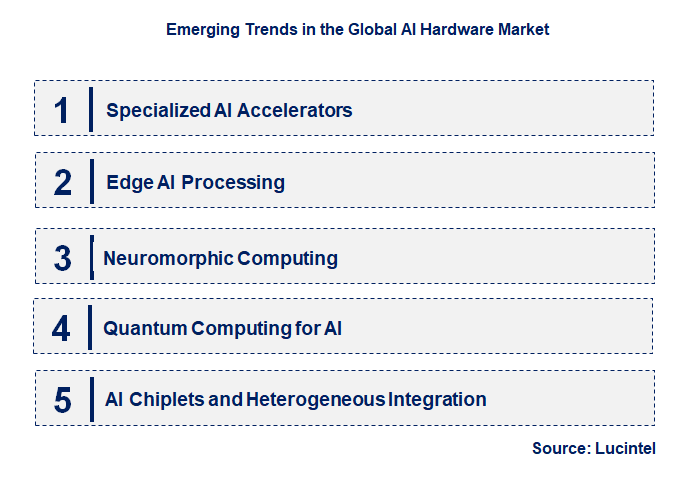
• Specialized AI Accelerators: GPUs, FPGAs, and ASICs are increasingly used as AI accelerators, designed to perform specific AI operations much faster than general-purpose CPUs. GPUs excel at parallel processing, making them ideal for training deep learning models. FPGAs offer flexibility and can be customized for specific AI workloads. ASICs are designed for maximum performance and energy efficiency for specific AI tasks. This specialization significantly speeds up AI training and inference.
• Edge AI Processing: Moving AI processing from the cloud to the edge (i.e., devices like smartphones, IoT sensors, and autonomous vehicles) is a growing trend. Edge AI reduces latency, improves privacy, and enables real-time decision-making. This requires AI hardware that is low-power, compact, and robust enough to operate in challenging environments. This trend is enabling a new wave of intelligent devices and applications.
• Neuromorphic Computing: Inspired by the human brain, neuromorphic chips mimic the structure and function of neurons and synapses. They offer the potential for massively parallel processing, low power consumption, and event-driven computation. While still in its early stages, neuromorphic computing has the potential to revolutionize AI by enabling more efficient and adaptive AI systems.
• Quantum Computing for AI: Quantum computers leverage the principles of quantum mechanics to perform certain computations exponentially faster than classical computers. While still largely experimental, quantum computing has the potential to revolutionize AI by enabling the solution of previously intractable problems, such as drug discovery and materials science.
• AI Chiplets and Heterogeneous Integration: To further improve performance and efficiency, AI chips are increasingly being designed using chiplets – smaller, specialized units that are interconnected. This heterogeneous integration allows for combining different types of processing units (CPUs, GPUs, etc.) on a single chip, optimizing performance for diverse AI workloads. This approach allows for greater flexibility and scalability in AI hardware design. These trends are fundamentally reshaping the AI hardware market, driving innovation and creating a more diverse and specialized landscape. The focus on specialized accelerators, edge computing, neuromorphic computing, quantum computing, and chiplet architectures is leading to a new era of AI hardware that is more powerful, efficient, and adaptable to the demands of increasingly complex AI applications.
• Advanced GPU Architectures: GPUs continue to be a dominant force in AI, and recent advancements in GPU architecture have significantly boosted AI performance. Newer GPUs offer increased memory bandwidth, more specialized cores for AI workloads, and improved interconnect technologies. This translates to faster training times for deep learning models and the ability to handle larger, more complex datasets.
• Rise of Specialized AI Accelerators: Beyond GPUs, the market is seeing a proliferation of specialized AI accelerators, including FPGAs and ASICs. FPGAs offer a balance of performance and flexibility, while ASICs are designed for maximum performance and energy efficiency for specific AI tasks. These accelerators are optimized for particular AI operations, leading to significant speedups and reduced power consumption compared to general-purpose CPUs.
• Edge AI Chips and Systems: The demand for edge AI processing is growing rapidly, leading to the development of specialized AI chips and systems designed for deployment on edge devices. These chips are low-power, compact, and robust, enabling AI processing closer to the data source. This reduces latency, improves privacy, and enables real-time decision-making in applications like autonomous vehicles, smart cameras, and industrial IoT devices.
• Neuromorphic Computing Progress: Neuromorphic computing, inspired by the human brain, is showing promising progress. Neuromorphic chips mimic the structure and function of neurons and synapses, offering the potential for massively parallel processing and event-driven computation. While still in its early stages, neuromorphic computing has the potential to revolutionize AI by enabling more efficient and adaptive AI systems.
• Software and Tooling Ecosystem: The AI hardware market is not just about the chips themselves; the software and tooling ecosystem is also crucial. Development tools, frameworks, and libraries are becoming more sophisticated, making it easier for developers to build and deploy AI applications on specialized hardware. This includes optimized compilers, libraries for deep learning frameworks, and tools for model quantization and pruning. These developments are significantly impacting the AI hardware market, creating a more diverse and competitive landscape. The focus on specialized accelerators, edge computing, neuromorphic computing, and a robust software ecosystem is accelerating the pace of AI innovation and enabling the development of more powerful and efficient AI applications across a wide range of industries.
• Autonomous Vehicles: Self-driving cars rely heavily on AI for perception, planning, and control. This creates a massive market for AI hardware optimized for autonomous driving, including high-performance processors, specialized sensors, and robust edge computing platforms. The need for real-time processing and safety-critical applications drives the demand for highly reliable and robust AI hardware.
• Healthcare and Medical Imaging: AI is revolutionizing healthcare through applications like medical image analysis, drug discovery, and personalized medicine. This creates opportunities for AI hardware that can accelerate these tasks, including GPUs for image processing, FPGAs for customized algorithms, and cloud-based AI platforms for large-scale data analysis. The need for accuracy and efficiency in healthcare applications drives the demand for specialized AI hardware.
• Industrial Automation and Robotics: AI-powered robots and automation systems are transforming manufacturing and logistics. This creates a market for AI hardware that can enable real-time control, object recognition, and predictive maintenance in industrial settings. Edge AI processing is crucial for these applications, driving demand for low-power and robust AI hardware for industrial environments.
• Smart Cities and Surveillance: AI is being deployed in smart cities for applications like traffic management, public safety, and environmental monitoring. This creates opportunities for AI hardware that can process large amounts of data from various sources, including cameras, sensors, and other IoT devices. Edge AI processing is essential for these applications, driving demand for scalable and efficient AI hardware for smart city deployments.
• Consumer Electronics and Edge Devices: AI is becoming increasingly prevalent in consumer electronics, from smartphones and smart speakers to wearables and home appliances. This creates a massive market for low-power and cost-effective AI hardware that can enable AI processing on edge devices. This includes specialized AI chips for image recognition, natural language processing, and personalized user experiences. These growth opportunities are significantly impacting the AI hardware market, driving innovation and specialization. Vendors who can develop hardware solutions that meet the specific needs of these key applications, offering high performance, energy efficiency, and cost-effectiveness, will be well-positioned for success in this rapidly expanding market.
• Nvidia Corporation
• Qualcomm Technologies
• Samsung Electronics
• International Business Machines Corporation (IBM)
• Xilinx
• Micron Technology
• Huawei Technologies
• Intel Corporation
• Microsoft Corporation
• Processor
• Memory
• Network
• Storage
• Machine Learning
• Computer Vision
• Natural Language Processing
• Expert Systems
• North America
• Europe
• Asia Pacific
• The Rest of the World
• United States: The US dominates the AI hardware market, with major players like NVIDIA and Intel leading the development of GPUs and other AI accelerators. Recent developments include advancements in GPU architecture, the rise of cloud-based AI platforms, and significant investments in neuromorphic computing research. The US also sees considerable activity in developing AI chips for edge devices and specialized applications.
• China: China is rapidly catching up in the AI hardware race, with companies like Huawei and Cambricon developing their own AI chips. Recent developments include substantial government funding for AI research and development, a focus on developing AI hardware for specific sectors like surveillance and autonomous driving, and increasing competition among domestic AI chip manufacturers.
• Germany: Germany has a strong focus on industrial AI and robotics, leading to developments in AI hardware tailored for these applications. Recent trends include collaborations between research institutions and industry players, a growing emphasis on edge computing for AI in manufacturing, and increasing investment in AI chip development for automotive and industrial automation.
• India: The Indian AI hardware market is still emerging, but is expected to grow significantly. Recent developments include government initiatives to promote AI adoption, increasing investment in AI startups, and a growing focus on developing AI hardware for healthcare, agriculture, and smart city applications. There's a strong emphasis on developing talent and infrastructure to support AI growth.
• Japan: Japan is focusing on AI hardware for robotics, automation, and edge computing applications. Recent developments include advancements in neuromorphic computing, collaborations between academia and industry to develop AI chips, and a growing emphasis on using AI to address societal challenges like an aging population and labor shortages. There is significant investment in R&D for next-generation AI hardware.


• Nvidia Corporation
• Qualcomm Technologies
• Samsung Electronics
• International Business Machines Corporation (IBM)
• Xilinx
• Micron Technology
• Huawei Technologies
• Intel Corporation
• Microsoft Corporation Q5. Which AI hardware market segment will be the largest in future? Answer: Lucintel forecasts that processor is expected to witness the highest growth over the forecast period. Q6. In AI hardware market, which region is expected to be the largest in next 5 years? Answer: APAC is expected to witness the highest growth over the forecast period. Q7. Do we receive customization in this report? Answer: Yes, Lucintel provides 10% customization without any additional cost.


Choose a license that fits your team. Instant PDF delivery.
Prices exclude taxes. Instant delivery. Custom licensing available on request.
Market Report · July 13, 2026
Market Report · July 13, 2026
Market Report · July 2, 2026
Trusted partner for strategic intelligence and business growth


Receive a complimentary market analysis tailored to your industry. Our analysts will identify key growth opportunities and competitive dynamics specific to your business.

Market size, growth rate, and key trend analysis for your specific sector.

Top competitor positioning and market share analysis.

Strategic recommendations backed by data-driven insights.
Get curated market intelligence and competitive moves straight to your inbox.
By subscribing, you agree to receive our monthly insights. Unsubscribe anytime.
Receive a complimentary market analysis tailored to your industry. Our analysts will identify key growth opportunities and competitive dynamics specific to your business.
Market size, growth rate, and key trend analysis for your specific sector.
Top competitor positioning and market share analysis.
Strategic recommendations backed by data-driven insights.
Get curated market intelligence, emerging trends, and competitive moves straight to your inbox each month.
By subscribing, you agree to receive our monthly insights. Unsubscribe anytime.
We'll send your sample report shortly.