
Market Report · May 18, 2026

This market report covers trends, opportunities, and forecasts in the global ai dash cams market to 2031 by technology (on the network edge ai processing, in the cloud ai processing, and edge-to-cloud implementation ai processing), application (passenger vehicle, commercial vehicle, and others), and region (North America, Europe, Asia Pacific, and the Rest of the World)
We'll send your sample report shortly.
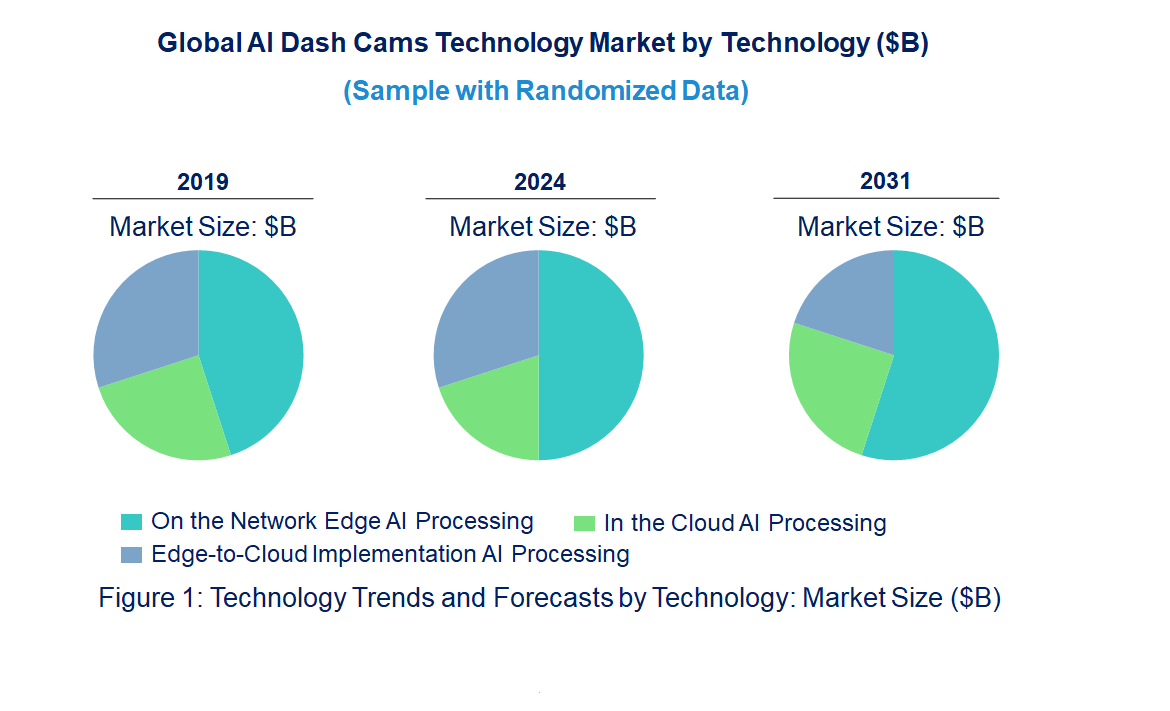
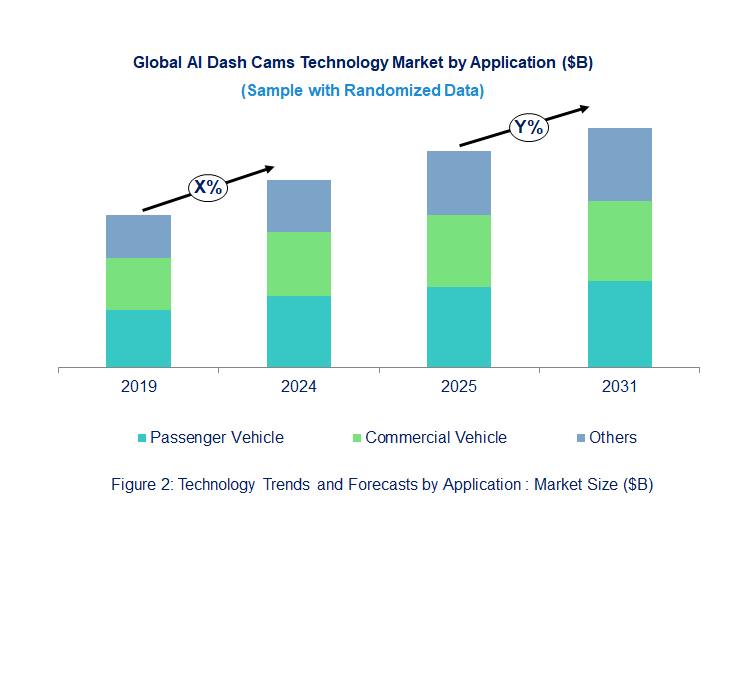
• Hybrid Edge and Cloud AI Processing: The increased utilization of edge-to-cloud hybrid systems will balance the benefits of both technologies that AI dash cams can use, including on-device real-time analysis and cloud-based data storage and processing. This scenario ensures faster decision-making, better analytics, and lower latency in critical applications.
• Advanced Driver Assistance Systems: AI dash cameras are increasingly paired with advanced driver-assistance systems, which significantly improve safety features like collision warning, lane departure alerts, and driver fatigue alerts. These innovations help reduce accidents on roads and improve driving conditions.
• Increased Video Analytics: AI-powered video analytics is becoming more advanced, allowing dash cams to identify and interpret events such as traffic violations, unsafe driving behaviors, and accident identification. This trend is changing the role of dash cams from simple recording devices to critical safety and surveillance tools.
• Fleet Management Solutions: AI dash cams are now integrated with fleet management systems that enable businesses to monitor and track driver behavior, vehicle health, and route optimization. This is particularly strong in the commercial vehicle sector, which is highly sensitive to operational efficiency, safety, and accountability.
• Cloud-based Data Storage and Processing: The increasing trend in cloud computing means that most AI dash cams now rely on cloud storage for large-scale data processing and storage. Benefits include access to historical data, software updates, and potential remote real-time monitoring of fleets and vehicles with such advancements. The emerging trends highlight how AI-powered dash cams are evolving from simple recording devices to more advanced safety systems that enhance driving security, improve fleet management, and optimize data usage through the integration of edge and cloud computing technologies.
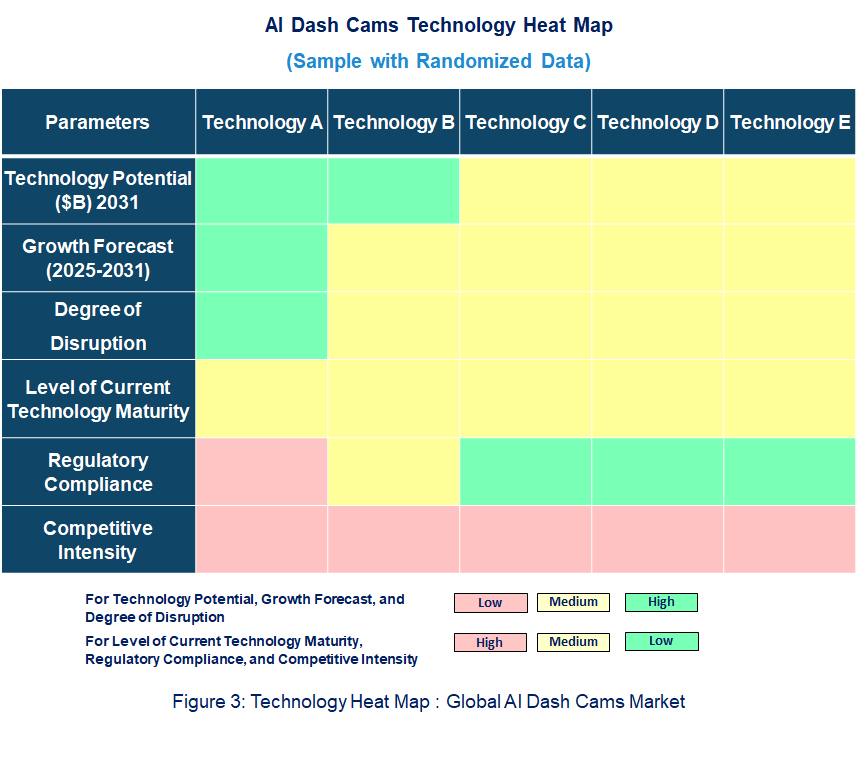
• Technology Potential: AI Dash Cams will offer more than just recording capabilities; they can provide real-time alerts on safety for drivers, accident detection, and even assistance in autonomous driving. These devices can potentially revolutionize vehicle safety as AI models improve.
• Degree of Disruption: AI Dash Cams can be a disruptive innovation in traditional vehicle safety systems because they offer smarter, more dynamic features such as collision warning, lane-keeping assistance, and driver fatigue detection. This could change the face of car safety and insurance models.
• Technology Maturity Level: The technology is at a mature stage but offers many available features. Further developments in AI algorithms, camera sensors, and integration with autonomous driving systems will lead to wide-scale usage.
• Regulatory Challenges: AI Dash Cams face regulatory challenges due to data privacy concerns, as these devices store sensitive information. Companies must adhere to GDPR in Europe and other countries with similar legislation. The AI dash cam market is promising but must overcome regulatory hurdles and technology upgrades.
• Nauto: Nauto has released AI-powered dash cams that can analyze real-time video to provide drivers with feedback about their behavior and give fleet operators a clear view of what is risky for them. The company’s system is increasingly being integrated with vehicle telematics and fleet management tools to create comprehensive safety solutions.
• Samsara: Samsara’s AI-enabled dash cams have become standard across fleets, providing real-time video, driver coaching, and safety alerts. Using advanced AI capabilities through the cloud platform allows fleet managers to track vehicle performance, monitor driver behavior, and even analyze video footage to mitigate risk.
• KeepTruckin: KeepTruckin provides an advanced AI-powered dash cam with real-time video streaming and safety monitoring capabilities. The company continues to innovate by integrating machine learning models to automatically detect events such as harsh braking or swerving, allowing for quick responses and fleet optimization.
• ViaTech: ViaTech has developed a series of AI dash cams designed to provide advanced safety features, such as collision detection and driver behavior analysis. Their systems integrate with GPS and telematics data, providing real-time insights into fleet performance and enabling operators to improve overall safety and efficiency.
• Nexar: Nexar is expanding its AI dash cam solutions with advanced computer vision technology, which improves safety for drivers. The dash cams from Nexar analyze the surroundings in real time, giving proactive safety alerts and optimizing routes, which reduces accidents and improves road safety.
• Magic Earth: Magic Earth has introduced AI-enabled dash cams that offer accurate navigation and route mapping. Their solution uses AI to identify obstacles, monitor traffic conditions, and provide real-time alerts, helping improve driver awareness and reduce accident risks.
• AnyConnect: AnyConnect’s AI dash cams process cloud-based data by combining edge computing for real-time data streaming. They enhance the video analysis process as their AI models are set up to identify events that cause unsafe driving. They will alert the fleet manager in due course to enable proper interventions.
• Mix Vision: Mix Vision has developed AI dash cams that are specifically designed to offer high-definition video capture along with advanced AI-driven event recognition. Their system can automatically detect risky driving behaviors and provide feedback to drivers to promote safer driving.
• Azuga: Azuga has integrated AI-powered dash cams with fleet management solutions. This allows for enhanced visibility into driver performance and real-time video analysis. This system uses AI to detect dangerous driving behaviors such as speeding or aggressive lane changes and provides actionable insights for the fleet manager.
• Lytx: Lytx offers AI dash cam solutions that assist in real-time video analysis by improving driver safety. The platform utilizes machine learning to identify specific risky driving events and automatically captures footage of unsafe driving events. Expansion is also driven through predictive analytics as they seek improvements in fleet management and safety for their fleet users. Key players in the AI dash cams market are pushing the boundaries of real-time video analytics, fleet management, and driver safety, with a strong focus on integrating AI and cloud technologies to offer more sophisticated solutions to customers.
• Growing Demand for Vehicle Safety and Fleet Management Solutions: The rising demand for vehicle safety and fleet management solutions is the main driver for adopting AI dash cams. They are used by fleet owners and insurance companies to minimize accidents, reduce insurance costs, and provide quality drivers.
• AI and Machine Learning: With continuous advancements in AI and machine learning, dash cams are offering real-time event detection, behavioral analysis, and accident prevention. As AI improves, dash cams become more accurate in identifying unsafe driving patterns and offering real-time feedback.
• Integration with Telematics and IoT: The combination of AI dash cams with telematics and IoT platforms gives fleets the capacity to monitor vehicle performance and track real-time data, further bringing valuable insights into fleet operations. This connectivity has improved overall operational efficiency and helps reduce costs.
• Government Rules and Safety Norms: Governments are enforcing regulations mandating a specified level of safety technologies in vehicles, thereby fueling the demand for AI dash cams. Regulatory pressure is encouraging adoption, particularly within commercial fleets, to adhere to safety standards. Challenges in the AI dash cams market include:
• Very High Installation and Maintenance Costs: Even though the advantages of AI dash cams are clear, installation and running such a system carry a cost that may be out of reach for many small businesses or independent drivers.
• Data Privacy and Security: The gathering of video footage and information regarding driver behavior raises concerns about data privacy and security. Companies must ensure that their AI dash cams comply with regulations like GDPR and offer robust measures for data protection.
• Technical Limitations in Harsh Environments: AI dash cams may not perform well in challenging environments, such as extreme weather conditions, poor lighting, or dust. These limitations could affect the reliability and accuracy of AI models, leading to suboptimal performance in certain scenarios. The AI dash cams market benefits from strong growth drivers such as safety, AI advancements, and regulatory support, it also faces challenges related to cost, privacy concerns, and technical limitations. Overcoming these hurdles will be essential for sustained growth and broader market adoption.
• Nauto
• Samsara
• Keeptruckin
• Viatech
• Nexar
• Magic Earth
• Technology Readiness: Edge AI is mature but limited by hardware, and cloud AI is ready but constrained by latency, while edge-to-cloud implementations are gaining traction and offering balanced solutions for end-users. The most competitive space: Cloud-based systems face the highest competition due to large infrastructure providers, compliance with data security and privacy regulations, and key applications in ADAS, hazard detection, and fleet management.
• Disruption Potential: AI Dash cams with on-network edge AI processing can provide real-time video analysis with reduced latency and data transfer costs, making them ideal for safety applications. Cloud-based AI provides powerful computational resources for complex models but suffers from latency and bandwidth limitations. Edge-to-cloud systems combine both, enabling real-time processing at the edge and offloading complex tasks to the cloud, providing a flexible, scalable solution. These technologies drive disruption by enhancing dash cam functionalities in safety, navigation, and data optimization.
• Competitive Intensity & Regulatory Compliance: Edge AI is highly competitive with hardware constraints, while cloud-based AI is dominated by large tech players but limited by latency. Edge-to-cloud solutions are emerging with moderate competition, balancing flexibility and scalability. Regulatory compliance is vital across all technologies, focusing on data privacy (e.g., GDPR) and safety standards, especially for real-time processing and data security.
• On the Network Edge AI Processing
• In the Cloud AI Processing
• Edge-to-Cloud Implementation AI Processing
• Passenger Vehicle
• Commercial Vehicle
• Others
• North America
• Europe
• Asia Pacific
• The Rest of the World
• Latest Developments and Innovations in the AI Dash Cams Technologies
• Companies / Ecosystems
• Strategic Opportunities by Technology Type


Choose a license that fits your team. Instant PDF delivery.
Prices exclude taxes. Instant delivery. Custom licensing available on request.
Market Report · May 18, 2026
Market Report · May 18, 2026
Market Report · May 18, 2026
Trusted partner for strategic intelligence and business growth


Receive a complimentary market analysis tailored to your industry. Our analysts will identify key growth opportunities and competitive dynamics specific to your business.

Market size, growth rate, and key trend analysis for your specific sector.

Top competitor positioning and market share analysis.

Strategic recommendations backed by data-driven insights.
Get curated market intelligence and competitive moves straight to your inbox.
By subscribing, you agree to receive our monthly insights. Unsubscribe anytime.
Receive a complimentary market analysis tailored to your industry. Our analysts will identify key growth opportunities and competitive dynamics specific to your business.
Market size, growth rate, and key trend analysis for your specific sector.
Top competitor positioning and market share analysis.
Strategic recommendations backed by data-driven insights.
Get curated market intelligence, emerging trends, and competitive moves straight to your inbox each month.
By subscribing, you agree to receive our monthly insights. Unsubscribe anytime.
We'll send your sample report shortly.