
Market Report · July 29, 2026

Key data points: The growth forecast = 8.5% annually for the next 7 years. Scroll below to get more insights. This market report covers trends, opportunities and forecasts in AgTech market to 2031 by technology (precision agriculture, biotechnology, automation & robotics, and farm management software), application (crop management, soil management, livestock management, and greenhouse management), end use (farms, agricultural cooperatives, and research institutions), and region (North America, Europe, Asia Pacific, and the Rest of the World)
We'll send your sample report shortly.
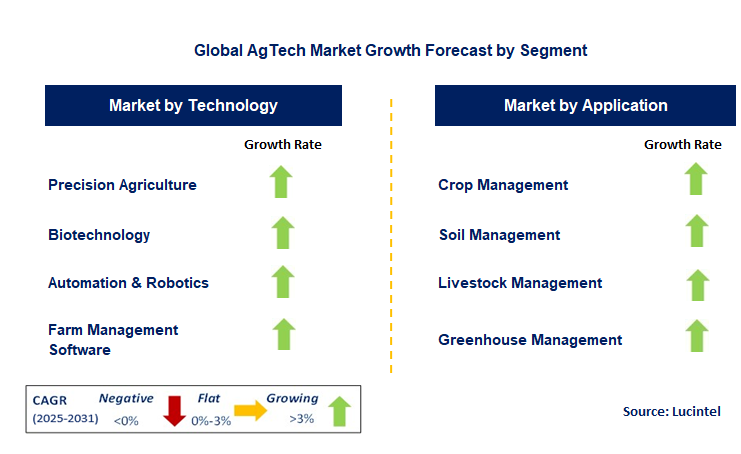
• Lucintel forecasts that, within the technology category, automation & robotics is expected to witness the highest growth over the forecast period.
• Within the end use category, farm is expected to witness the highest growth.
• In terms of region, APAC is expected to witness the highest growth over the forecast period.
Gain valuable insights for your business decisions with our comprehensive 150+ page report. Sample figures with some insights are shown below.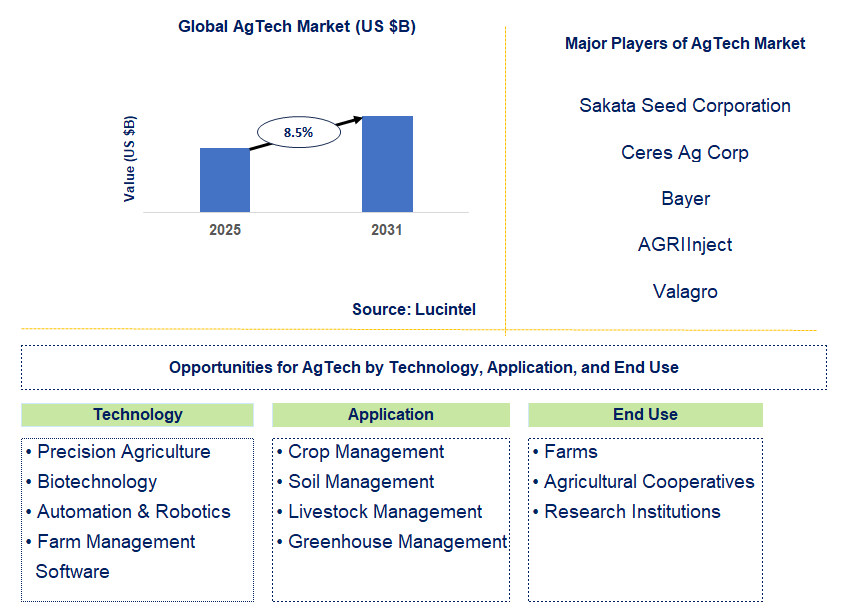
• AI-powered Precision Agriculture: This trend involves using artificial intelligence and machine learning to analyze vast amounts of data from sensors, drones, and satellites. This allows for hyper-specific application of water, fertilizers, and pesticides. The impact is a more efficient use of resources, leading to higher crop yields, reduced environmental impact, and lower operational costs for farmers, which directly enhances profitability.
• Agricultural Robotics and Automation: The use of robots and autonomous machinery for tasks like planting, weeding, harvesting, and sorting is a key trend. These technologies address labor shortages and increase operational efficiency. The impact is a reduction in manual labor dependence and a significant increase in productivity, enabling farming operations to scale and become more resilient to demographic and economic shifts.
• Vertical Farming and Controlled Environments: Vertical farming and other forms of controlled-environment agriculture are an emerging trend, especially in urban areas. These systems use technologies like hydroponics, aeroponics, and LED lighting to grow crops year-round in a climate-controlled setting. The impact is enhanced food security, reduced land use, and localized food production, which shortens supply chains and provides a consistent supply of fresh produce.
• Data-Driven Supply Chain Management: The use of technologies like blockchain and IoT to track agricultural products from farm to fork is a major trend. This provides real-time data on everything from origin to temperature and handling conditions. The impact is increased transparency and traceability, which builds consumer trust in food safety and quality, and helps to reduce waste and optimize logistics.
• Bio-solutions and Sustainable Inputs: There is a growing trend toward developing and adopting bio-solutions, such as bio-pesticides and bio-fertilizers, as alternatives to synthetic chemicals. This is driven by environmental concerns and regulatory pressures. The impact is a more sustainable and regenerative agricultural system, which improves soil health, reduces chemical runoff, and meets the growing consumer demand for organic and eco-friendly products.
These trends are fundamentally reshaping the AgTech market by making it more technologically advanced, efficient, and sustainable. The shift towards automation, data-driven insights, and bio-solutions ensures the market’s continued growth and relevance. These developments are positioning the industry as a dynamic and responsive sector that can meet the complex demands of modern food production.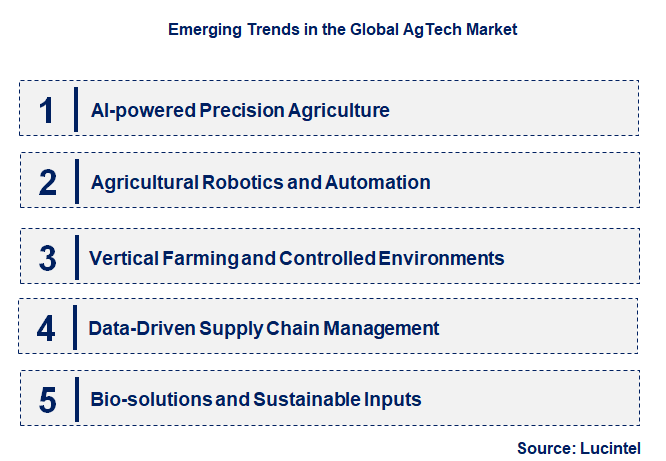
• Integration of AI and Machine Learning: A key development is the deep integration of AI and machine learning into AgTech solutions. AI models are now used for predictive analytics to forecast crop yields, manage pests, and optimize resource allocation. The impact is enhanced decision-making on the farm, which reduces waste, increases productivity, and helps farmers adapt to unpredictable weather patterns and other climate-related challenges.
• Expansion of Agritech Startups: A major development is the proliferation of agritech startups that are bringing innovative solutions to the market. These companies are often focused on niche areas like precision beekeeping, vertical farming, and food waste management. The impact is a more diverse and dynamic market, with new players introducing cutting-edge technologies that challenge traditional farming models and drive rapid innovation.
• Increased Funding for Sustainable Solutions: There has been a notable development in the flow of venture capital towards AgTech companies that are focused on sustainability. Investors are prioritizing solutions that address climate change, improve soil health, and reduce resource consumption. The impact is an acceleration of research and development in areas like regenerative agriculture and bio-based inputs, which is critical for creating a more resilient food system.
• Partnerships Between Tech Giants and Agriculture: Tech giants like Microsoft and Amazon are increasingly partnering with established agricultural companies to bring their cloud computing and data analytics expertise to the farm. This helps to scale AgTech solutions and make them more accessible. The impact is a fusion of technology and agriculture, which is creating a new ecosystem where data is at the heart of farming operations.
• Advancements in IoT and Sensor Technology: A recent development is the improvement of Internet of Things (IoT) sensors, which are now more durable, cost-effective, and have longer battery life. These sensors collect real-time data on soil moisture, nutrient levels, and plant health. The impact is a continuous stream of data that enables farmers to make precise, real-time adjustments, leading to optimized growing conditions and higher yields.
These recent developments are collectively impacting the AgTech market by making it more technologically advanced, efficient, and responsive to consumer needs. The focus on AI, data, and sustainability is ensuring its continued growth and relevance. These advancements are solidifying AgTech’s position as a crucial and versatile sector that can meet the complex demands of modern food production.• Precision Farming Solutions: The precision farming sector is a major growth opportunity. Technologies like GPS-guided machinery, variable rate applicators, and drone-based analytics allow farmers to apply inputs with pinpoint accuracy. The impact is a high-growth, high-value market segment driven by the global push for resource efficiency and sustainability, positioning precision farming as a key solution for modern agriculture.
• Livestock Management Technologies: The livestock management sector offers a significant growth opportunity. Technologies like wearable sensors for animals, automated feeding systems, and data analytics for health monitoring are improving animal welfare and productivity. The impact is a growing demand from the livestock industry for a sustainable and data-driven approach, which improves animal health, reduces waste, and enhances overall farm management.
• Supply Chain and Food Traceability: The supply chain and food traceability market represents a compelling growth opportunity. Technologies like blockchain and advanced data analytics provide end-to-end transparency, allowing consumers to trace their food from the farm to the table. The impact is a new market segment driven by rising consumer demand for transparency and food safety, which builds trust and reduces the risk of food fraud.
• Controlled-Environment Agriculture: The CEA market, including vertical farms and smart greenhouses, is a new and emerging growth opportunity. These systems use technology to control light, temperature, and nutrients to grow crops in non-traditional environments. The impact is the diversification of the AgTech market into urban and controlled-environment food production, which addresses land scarcity and provides a stable food supply.
• Farm Management Software and Data Platforms: The market for farm management software and data platforms offers a key growth opportunity. These platforms collect and analyze data from various sources to provide farmers with actionable insights. The impact is the creation of a centralized data hub that empowers farmers to make informed decisions, optimize operations, and improve profitability.
These strategic growth opportunities are reshaping the AgTech market by expanding its presence into high-growth, high-value sectors beyond traditional farming. By focusing on applications like precision farming, supply chain management, and controlled-environment agriculture, manufacturers can capitalize on the global demand for efficient and sustainable solutions. These opportunities highlight the versatility of AgTech and its crucial role in enabling innovation across a diverse range of industries.• Sakata Seed Corporation
• Ceres Ag Corp
• Bayer
• AGRIInject
• Valagro
• Syngenta
• Monsanto
• Nutrien
• Helena AgriEnterprises
• BASF
• Precision Agriculture
• Biotechnology
• Automation & Robotics
• Farm Management Software
• Crop Management
• Soil Management
• Livestock Management
• Greenhouse Management
• Farms
• Agricultural Cooperatives
• Research Institutions
• North America
• Europe
• Asia Pacific
• The Rest of the World
• United States: The U.S. AgTech market is defined by a strong focus on precision agriculture and robotics. Recent developments include increased investment in autonomous tractors and AI-driven solutions for planting, weeding, and harvesting. While facing an overall funding downturn, the market is seeing a shift of investment toward late-stage startups that address food security and climate change.
• China: China’s market is rapidly modernizing, with recent developments centered on government-led initiatives to promote digital agriculture and smart farming. The country is a leader in the adoption of agricultural drones for crop spraying and monitoring. There’s also a significant focus on developing domestic capabilities in biotechnology and genetically modified crops to reduce reliance on imports.
• Germany: Germany’s AgTech market is characterized by a strong emphasis on automation and sustainable practices. Recent developments include the integration of smart, connected implements and standardized communication protocols (ISOBUS) to enhance precision farming. The market is also seeing a growing adoption of AI-driven solutions for livestock management and crop monitoring, supported by government investment.
• India: India’s market is a high-growth sector, with recent developments focusing on addressing the needs of smallholder farmers. The market is seeing a surge in startups using digital technologies like online marketplaces and data analytics to connect farmers directly with buyers and provide data-driven insights. These innovations are improving efficiency and transparency in the agricultural supply chain.
• Japan: Japan’s AgTech market is a high-tech niche, driven by the need to counter an aging and shrinking agricultural population. Recent developments include the widespread adoption of robotic harvesters and AI-driven farm management systems. The government is also promoting smart agriculture through new laws and financial incentives to ensure sustainable food production and a stable food supply.


• Sakata Seed Corporation
• Ceres Ag Corp
• Bayer
• AGRIInject
• Valagro
• Syngenta
• Monsanto
• Nutrien
• Helena AgriEnterprises
• BASF
Q5. Which AgTech market segment will be the largest in future?

Choose a license that fits your team. Instant PDF delivery.
Prices exclude taxes. Instant delivery. Custom licensing available on request.
Market Report · July 29, 2026
Market Report · July 20, 2026
Market Report · July 20, 2026
Trusted partner for strategic intelligence and business growth


Receive a complimentary market analysis tailored to your industry. Our analysts will identify key growth opportunities and competitive dynamics specific to your business.

Market size, growth rate, and key trend analysis for your specific sector.

Top competitor positioning and market share analysis.

Strategic recommendations backed by data-driven insights.
Get curated market intelligence and competitive moves straight to your inbox.
By subscribing, you agree to receive our monthly insights. Unsubscribe anytime.
Receive a complimentary market analysis tailored to your industry. Our analysts will identify key growth opportunities and competitive dynamics specific to your business.
Market size, growth rate, and key trend analysis for your specific sector.
Top competitor positioning and market share analysis.
Strategic recommendations backed by data-driven insights.
Get curated market intelligence, emerging trends, and competitive moves straight to your inbox each month.
By subscribing, you agree to receive our monthly insights. Unsubscribe anytime.
We'll send your sample report shortly.