
Aerospace And Defense Optical Fiber Cable Market Report: Trends, Forecast and Competitive Analysis to 2035

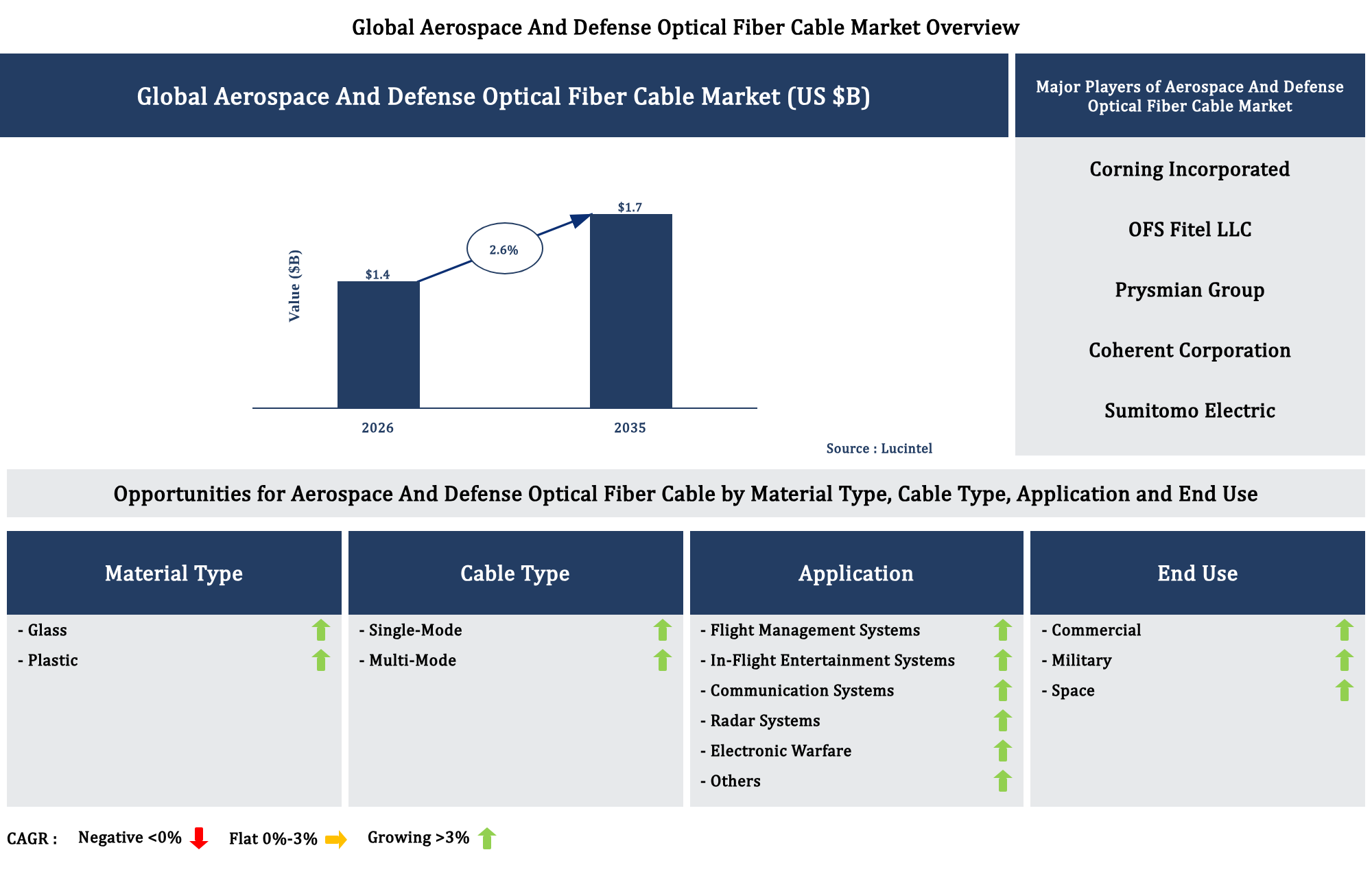
Key data points: The market size in 2035 = $1.7 billion, growth forecast = 2.6% annually for the next 8 years. Scroll below to get more insights. This market report covers trends, opportunities and forecasts in aerospace and defense optical fiber cable market to 2035 by material type (glass and plastic), cable type (single-mode and multi-mode), application (flight management systems, in-flight entertainment systems, communication systems, radar systems, electronic warfare, and others), end use (commercial, military, and space), and region (North America, Europe, Asia Pacific, and the Rest of the World)

Publisher: Lucintel Last Updated: July 2026
See Pricing

Download Sample Report

| ✨ New Download Sample report — Get instant insights! | ✨ New Download Sample report — Get instant insights!

Aerospace And Defense Optical Fiber Cable Market Report: Trends, Forecast and Competitive Analysis to 2035

Aerospace And Defense Optical Fiber Cable Market

The future of the global aerospace and defense optical fiber cable market looks promising with opportunities in the commercial, military, and space markets. The global aerospace and defense optical fiber cable market is expected to reach an estimated $1.7 billion by 2035 with a CAGR of 2.6% from 2026 to 2035. The major drivers for this market are the increasing demand for high-speed data transmission, the rising adoption of lightweight communication systems, and the growing defense modernization driving fiber cable deployment.

  • Lucintel forecasts that, within the material type category, glass is expected to witness higher growth over the forecast period due to the high durability, low signal loss, and cost-effective performance.
  • Within the application category, military is expected to witness the highest growth due to the increasing deployment of secure, high-speed military communication networks.
  • In terms of regions, North America is expected to witness the highest growth over the forecast period due to the rising defense communication investments and ongoing aerospace technology advancements.

Gain valuable insights for your business decisions with our comprehensive 150+ page report. Sample figures with some insights are shown below.
Aerospace And Defense Optical Fiber Cable Market

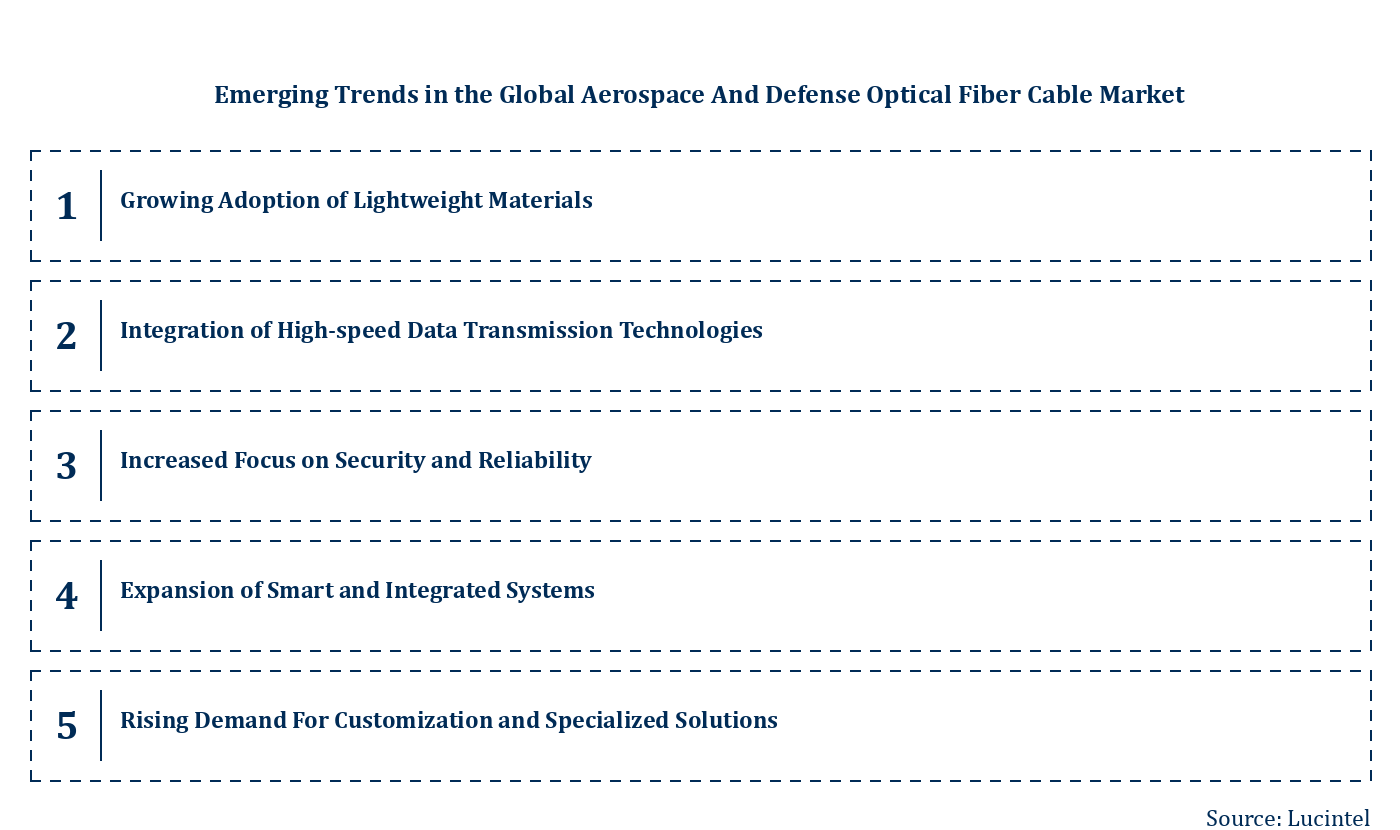
Emerging Trends in the Aerospace And Defense Optical Fiber Cable Market

The aerospace and defense optical fiber cable market is experiencing rapid evolution driven by technological advancements, increasing security needs, and the demand for high-performance communication systems. As aircraft, spacecraft, and defense systems become more sophisticated, the integration of optical fiber cables offers enhanced data transmission, reduced weight, and improved durability. These developments are reshaping the industry landscape, prompting manufacturers to innovate and adapt to new standards. The following key trends highlight the major shifts influencing this market, reflecting its trajectory toward greater efficiency, security, and technological integration.

  • Growing Adoption of Lightweight Materials: The demand for lightweight optical fiber cables is increasing to reduce overall system weight in aerospace and defense applications. These cables contribute to fuel efficiency and payload capacity in aircraft and spacecraft. Advanced materials such as flexible polymers and composite coatings are being developed to withstand extreme conditions while maintaining minimal weight. This trend enhances operational efficiency and supports the push for more sustainable and cost-effective aerospace solutions.
  • Integration of High-Speed Data Transmission Technologies: The need for faster, more reliable communication systems in defense and aerospace sectors is driving the adoption of high-speed optical fiber cables. Innovations like multi-core fibers and advanced connectors enable higher bandwidth and lower latency. These technologies support real-time data sharing, enhanced surveillance, and improved navigation systems, which are critical for modern military operations and space missions. The trend ensures that communication infrastructure keeps pace with evolving technological demands.
  • Increased Focus on Security and Reliability: As defense systems and aerospace applications handle sensitive information, the market is emphasizing secure and reliable optical fiber solutions. Features such as encryption capabilities, tamper-proof designs, and robust shielding are becoming standard. These cables are designed to withstand harsh environments, electromagnetic interference, and physical damage, ensuring uninterrupted data flow. This focus on security and reliability is vital for mission-critical operations and national security.
  • Expansion of Smart and Integrated Systems: The integration of optical fiber cables with smart sensors and embedded systems is a significant trend. These systems enable real-time monitoring of structural health, environmental conditions, and system performance. In aerospace, this facilitates predictive maintenance and enhances safety. In defense, it improves situational awareness. The development of intelligent optical fiber networks is transforming traditional systems into interconnected, self-monitoring platforms, leading to increased operational efficiency and reduced downtime.
  • Rising Demand for Customization and Specialized Solutions: The market is witnessing a shift toward tailored optical fiber cable solutions designed to meet specific aerospace and defense requirements. Customization includes specialized coatings, connectors, and configurations to withstand unique environmental conditions such as extreme temperatures, vibrations, and chemical exposure. This trend allows manufacturers to address niche applications, improve system integration, and ensure compliance with stringent industry standards, thereby expanding market opportunities and fostering innovation.

These emerging trends are fundamentally reshaping the aerospace and defense optical fiber cable market by promoting lightweight, high-speed, secure, integrated, and customized solutions. These developments are enabling more efficient, reliable, and advanced aerospace and defense systems, positioning the industry for sustained growth and technological leadership.
Aerospace And Defense Optical Fiber Cable Market by country

Recent Developments in the Aerospace And Defense Optical Fiber Cable Market

The aerospace and defense optical fiber cable market is experiencing rapid growth driven by technological advancements and increasing demand for reliable communication systems in aircraft and military applications. Innovations in fiber optic technology are enhancing data transmission speed, security, and durability. Governments and private sectors are investing heavily in upgrading existing infrastructure and developing new solutions. This evolving landscape presents significant opportunities for manufacturers and service providers to expand their market share and develop cutting-edge products tailored to specific aerospace and defense needs.

  • Growing Demand for High-Speed Data Transmission: The need for faster, more reliable communication systems in aircraft and defense equipment is fueling the adoption of optical fiber cables, which offer superior bandwidth and low latency, improving operational efficiency and safety.
  • Advancements in Fiber Optic Technology: Innovations such as bend-insensitive fibers and enhanced durability are expanding application possibilities, enabling deployment in harsh environments and reducing maintenance costs, thus boosting market growth.
  • Increasing Military and Aerospace Investments: Governments worldwide are increasing defense budgets and investing in modernizing military communication infrastructure, which directly drives demand for advanced optical fiber cables in military aircraft, ships, and ground systems.
  • Development of Lightweight and Compact Cables: The focus on reducing weight in aerospace applications has led to the development of lightweight, space-saving fiber optic cables, improving fuel efficiency and payload capacity, thereby expanding market opportunities.
  • Rising Adoption of Fiber Optic Cables in Commercial Aircraft: Airlines are integrating fiber optic systems for in-flight entertainment, connectivity, and communication, which enhances passenger experience and operational efficiency, contributing to market expansion.

The overall impact of these developments is a robust growth trajectory for the aerospace and defense optical fiber cable market, driven by technological innovation, increased defense spending, and the demand for high-performance communication solutions, positioning it as a critical component in future aerospace and defense infrastructure.

Strategic Growth Opportunities in the Aerospace And Defense Optical Fiber Cable Market

The aerospace and defense optical fiber cable market is experiencing rapid growth driven by technological advancements, increasing defense budgets, and the need for reliable, high-speed communication systems in aircraft, spacecraft, and military applications. The demand for lightweight, durable, and high-capacity cables is expanding across various sectors, including commercial aviation, military communications, and space exploration. Strategic investments and innovations are creating new opportunities for market players to enhance connectivity, security, and operational efficiency in this highly specialized industry.

  • Increasing Adoption of Optical Fiber Cables in Military Communications: The military sector is increasingly adopting optical fiber cables for secure, high-speed data transmission in battlefield communications, surveillance, and command centers. These cables offer enhanced security, resistance to electromagnetic interference, and lightweight design, making them ideal for rugged environments. Growing defense budgets and modernization initiatives are further accelerating demand, with applications expanding into naval, land, and airborne systems, creating significant growth opportunities for manufacturers.
  • Expansion of Optical Fiber Use in Commercial Aircraft and Spacecraft: The aviation industry is integrating optical fiber cables to improve in-flight connectivity, data transfer, and aircraft control systems. Spacecraft applications benefit from optical fibers due to their lightweight and high-bandwidth capabilities, essential for satellite and space station communications. As commercial airlines and space agencies invest in advanced communication systems, the demand for specialized aerospace-grade optical fiber cables is expected to rise, opening avenues for innovation and market expansion.
  • Development of Rugged and High-Performance Optical Fiber Cables for Harsh Environments: The need for durable cables capable of withstanding extreme temperatures, vibrations, and mechanical stresses in aerospace and defense applications is driving innovation. Manufacturers are developing ruggedized optical fiber cables with enhanced protective coatings, fire resistance, and flexibility. These cables are crucial for military vehicles, aircraft, and space missions, where reliability and safety are paramount, thus presenting substantial growth prospects in niche, high-performance segments.
  • Integration of Smart Optical Fiber Cables with Monitoring Capabilities: The emergence of smart optical fiber cables embedded with sensors enables real-time monitoring of structural health, temperature, and strain in aerospace and defense assets. This technology enhances predictive maintenance, safety, and operational efficiency. The increasing adoption of IoT and sensor integration in aerospace systems is fueling demand for intelligent cables, creating opportunities for companies to develop innovative solutions that improve asset longevity and reduce downtime.
  • Growing Demand for Miniaturized and Lightweight Optical Fiber Cables: The drive to reduce weight and size in aerospace and defense systems is boosting the development of miniaturized optical fiber cables. These cables contribute to overall weight reduction, fuel efficiency, and payload capacity in aircraft, drones, and satellites. Advances in fiber technology and materials are enabling the production of ultra-thin, flexible cables suitable for space-constrained environments, opening new markets and applications in next-generation aerospace platforms.

These strategic growth opportunities are poised to significantly influence the aerospace and defense optical fiber cable market by fostering innovation, enhancing performance, and expanding application scope. As technological demands evolve, market players that capitalize on these opportunities will be better positioned to lead in this competitive landscape, ultimately driving industry growth and supporting the increasing need for reliable, high-capacity communication solutions in aerospace and defense sectors.

Aerospace And Defense Optical Fiber Cable Market Drivers and Challenges

The aerospace and defense optical fiber cable market is influenced by a range of technological, economic, and regulatory factors. Rapid advancements in fiber optic technology, increasing defense budgets worldwide, and the need for high-speed, reliable communication systems are key drivers. Additionally, stringent safety and security regulations, along with the growing adoption of fiber optics in aerospace applications, shape market dynamics. However, the market also faces challenges such as high manufacturing costs, technological complexities, and regulatory hurdles that can impede growth. Understanding these drivers and challenges is essential for stakeholders aiming to capitalize on emerging opportunities and navigate potential risks effectively.

The factors responsible for driving the aerospace and defense optical fiber cable market include:

  • Technological Advancements: Rapid innovations in fiber optic technology enhance data transmission speed, security, and reliability, which are critical for aerospace and defense applications. These advancements enable the development of lightweight, durable, and high-performance cables suitable for aircraft, satellites, and military systems. As technology continues to evolve, demand for cutting-edge fiber optic solutions increases, fostering market growth. The integration of smart fiber optics with sensors and IoT devices further expands application scope, making technological progress a primary growth driver.
  • Increasing Defense Budgets: Governments worldwide are allocating more funds toward modernizing their defense infrastructure, including communication systems. Enhanced defense budgets facilitate procurement of advanced fiber optic cables for secure and high-speed data transfer in military operations, aircraft, and naval vessels. This financial commitment directly boosts market demand, especially in regions like North America, Europe, and Asia-Pacific, where defense modernization is a priority. The sustained increase in defense spending ensures a steady growth trajectory for the market.
  • Growing Adoption in Aerospace Applications: The aerospace industry is increasingly adopting fiber optic cables for aircraft communication, navigation, and sensing systems due to their lightweight and high-bandwidth capabilities. These cables improve overall aircraft performance, safety, and reliability. The rising demand for next-generation aircraft, including commercial and military planes, drives the need for advanced fiber optic solutions. This trend is further supported by the push for more fuel-efficient and environmentally friendly aircraft, making fiber optics a crucial component in aerospace innovation.
  • Regulatory and Safety Standards: Stringent safety, security, and quality regulations in the aerospace and defense sectors influence market growth. Compliance with standards such as MIL-STD and RTCA DO-160 ensures the reliability and durability of fiber optic cables in harsh environments. These regulations encourage manufacturers to develop high-quality, certified products, which can increase R&D costs but ultimately lead to safer and more reliable systems. Regulatory compliance acts as both a driver for innovation and a barrier to entry for new players.

The challenges in the aerospace and defense optical fiber cable market are:

  • High Manufacturing Costs: Producing specialized fiber optic cables for aerospace and defense applications involves complex manufacturing processes, high-quality materials, and rigorous testing. These factors contribute to elevated costs, which can limit market penetration, especially in cost-sensitive regions. Additionally, maintaining quality standards and certifications adds to production expenses. High costs may restrict adoption among smaller defense agencies or commercial aerospace companies, potentially slowing overall market growth.
  • Technological Complexities: Developing fiber optic cables that can withstand extreme conditions such as high radiation, temperature fluctuations, and mechanical stress is technically challenging. Ensuring durability and performance in harsh aerospace environments requires advanced materials and innovative design solutions, which can prolong development cycles and increase costs. These complexities may hinder rapid deployment and limit the integration of fiber optics in certain aerospace and defense systems.
  • Regulatory Hurdles: Strict regulatory frameworks and lengthy certification processes can delay product development and deployment. Compliance with international standards and security clearances often involve extensive testing and documentation, increasing time-to-market. Navigating these regulatory landscapes requires significant resources and expertise, which can be a barrier for new entrants and may slow down innovation and market expansion.

The aerospace and defense optical fiber cable market is driven by technological progress, increased defense spending, and the adoption of fiber optics in aerospace applications. However, high manufacturing costs, technological challenges, and regulatory hurdles pose significant obstacles. These factors collectively shape a dynamic market landscape, requiring stakeholders to innovate continuously and adapt to evolving standards. While growth prospects remain promising, addressing these challenges is crucial for sustained expansion and competitive advantage in this specialized sector.

List of Aerospace And Defense Optical Fiber Cable Market Companies

Companies in the market compete on the basis of product quality offered. Major players in this market focus on expanding their manufacturing facilities, R&D investments, infrastructural development, and leverage integration opportunities across the value chain. Through these strategies aerospace and defense optical fiber cable market companies cater increasing demand, ensure competitive effectiveness, develop innovative products & technologies, reduce production costs, and expand their customer base. Some of the aerospace and defense optical fiber cable market companies profiled in this report include-

  • Corning Incorporated
  • OFS Fitel LLC
  • Prysmian Group
  • Coherent Corporation
  • Sumitomo Electric
  • Amphenol Corporation
  • W.L. Gore & Associates
  • Radiall Corporation
  • Collins Aerospace
  • Optical Cable Corporation

Aerospace And Defense Optical Fiber Cable Market by Segment

The study includes a forecast for the global aerospace and defense optical fiber cable market by material type, cable type, application, end use, and region.

  • Aerospace and Defense Optical Fiber Cable Market by Material Type [Value from 2019 to 2035]:
    • Glass
    • Plastic
  • Aerospace and Defense Optical Fiber Cable Market by Cable Type [Value from 2019 to 2035]:
    • Single-Mode
    • Multi-Mode
  • Aerospace and Defense Optical Fiber Cable Market by Application [Value from 2019 to 2035]:
    • Flight Management Systems
    • In-Flight Entertainment Systems
    • Communication Systems
    • Radar Systems
    • Electronic Warfare
    • Others
  • Aerospace and Defense Optical Fiber Cable Market by End Use [Value from 2019 to 2035]:
    • Commercial
    • Military
    • Space
  • Aerospace and Defense Optical Fiber Cable Market by Region [Value from 2019 to 2035]:
    • North America
    • Europe
    • Asia Pacific
    • The Rest of the World

Country Wise Outlook for the Aerospace And Defense Optical Fiber Cable Market

The aerospace and defense optical fiber cable market is experiencing rapid growth driven by technological advancements, increasing demand for high-speed data transmission, and the need for enhanced security in defense applications. Countries are investing heavily in research and development to improve fiber optic technology, expand infrastructure, and meet the evolving needs of aerospace and defense sectors. The market's expansion is also fueled by the integration of fiber optics in aircraft, satellites, and military communication systems. As global defense budgets increase, countries are prioritizing innovative solutions to maintain strategic advantages, leading to significant developments across key markets.

  • United States: The U.S. market is witnessing significant advancements with increased adoption of fiber optic cables in military aircraft, naval vessels, and satellite systems. Major defense contractors are investing in R&D to develop lightweight, high-capacity cables that support high-speed data transfer and secure communications. The U.S. government is also funding initiatives to upgrade existing infrastructure and develop next-generation aerospace communication systems, boosting market growth.
  • China: China is rapidly expanding its aerospace and defense capabilities, with substantial investments in fiber optic technology for military and civilian applications. The country is focusing on indigenous development of fiber optic cables to reduce reliance on imports, enhancing its satellite communication and aircraft systems. Government initiatives aim to integrate fiber optics into military communication networks, supporting China’s strategic modernization efforts.
  • Germany: Germany's aerospace and defense sector is emphasizing the integration of advanced optical fiber cables in aircraft and defense systems. The country is known for its high-quality manufacturing standards and innovation in fiber optic technology. German companies are collaborating with international partners to develop robust, reliable cables for military applications, including secure communication networks and avionics systems.
  • India: India is witnessing rapid growth in its aerospace and defense sector, with increasing adoption of fiber optic cables for military communication, radar, and aircraft systems. The government’s "Make in India" initiative encourages domestic manufacturing and innovation in fiber optic technology. Investments are also being made to upgrade existing defense infrastructure and develop indigenous solutions to meet strategic needs.
  • Japan: Japan is focusing on enhancing its aerospace and defense capabilities through advanced fiber optic solutions. The country is investing in research to develop high-performance, durable cables suitable for harsh environments encountered in defense applications. Japan’s emphasis on technological innovation aims to strengthen its security infrastructure and support its aerospace industry’s modernization efforts.

Features of the Aerospace And Defense Optical Fiber Cable Market

  • Market Size Estimates: Aerospace and defense optical fiber cable market size estimation in terms of value ($B).
  • Trend and Forecast Analysis: Market trends (2019 to 2025) and forecast (2026 to 2035) by various segments and regions.
  • Segmentation Analysis: Aerospace and defense optical fiber cable market size by various segments, such as by material type, cable type, application, end use, and region in terms of value ($B).
  • Regional Analysis: Aerospace and defense optical fiber cable market breakdown by North America, Europe, Asia Pacific, and Rest of the World.
  • Growth Opportunities: Analysis of growth opportunities in different material types, cable types, applications, end uses, and regions for the aerospace and defense optical fiber cable market.
  • Strategic Analysis: This includes M&A, new product development, and competitive landscape of the aerospace and defense optical fiber cable market.
  • Analysis of competitive intensity of the industry based on Porter’s Five Forces model.

Top 5 Companies

  • Corning Incorporated
  • OFS Fitel LLC
  • Prysmian Group
  • Coherent Corporation
  • Sumitomo Electric

Table of Contents

1. Executive Summary
15.1 Competitive Analysis Overview

List of Figures

List of Tables

Table 6.1: Attractiveness Analysis for the Global Aerospace and Defense Optical Fiber Cable Market by Application Table 6.2: Market Size and CAGR of Various Application in the Global Aerospace and Defense Optical Fiber Cable Market (2019-2025) Table 6.3: Market Size and CAGR of Various Application in the Global Aerospace and Defense Optical Fiber Cable Market (2026-2035) Table 6.4: Trends of Flight Management Systems in the Global Aerospace and Defense Optical Fiber Cable Market (2019-2025) Table 6.5: Forecast for Flight Management Systems in the Global Aerospace and Defense Optical Fiber Cable Market (2026-2035) Table 6.6: Trends of In-Flight Entertainment Systems in the Global Aerospace and Defense Optical Fiber Cable Market (2019-2025) Table 6.7: Forecast for In-Flight Entertainment Systems in the Global Aerospace and Defense Optical Fiber Cable Market (2026-2035) Table 6.8: Trends of Communication Systems in the Global Aerospace and Defense Optical Fiber Cable Market (2019-2025) Table 6.9: Forecast for Communication Systems in the Global Aerospace and Defense Optical Fiber Cable Market (2026-2035) Table 6.10: Trends of Radar Systems in the Global Aerospace and Defense Optical Fiber Cable Market (2019-2025) Table 6.11: Forecast for Radar Systems in the Global Aerospace and Defense Optical Fiber Cable Market (2026-2035) Table 6.12: Trends of Electronic Warfare in the Global Aerospace and Defense Optical Fiber Cable Market (2019-2025) Table 6.13: Forecast for Electronic Warfare in the Global Aerospace and Defense Optical Fiber Cable Market (2026-2035) Table 6.14: Trends of Others in the Global Aerospace and Defense Optical Fiber Cable Market (2019-2025) Table 6.15: Forecast for Others in the Global Aerospace and Defense Optical Fiber Cable Market (2026-2035)

Methodology

Lucintel has been in the business of market research and management consulting since 2000 and has published over 1000 market intelligence reports in various markets / applications and served over 1,000 clients worldwide. This study is a culmination of four months of full-time effort performed by Lucintel's analyst team. The analysts used the following sources for the creation and completion of this valuable report:

  • In-depth interviews of the major players in this market
  • Detailed secondary research from competitors' financial statements and published data
  • Extensive searches of published works, market, and database information pertaining to industry news, company press releases, and customer intentions
  • A compilation of the experiences, judgments, and insights of Lucintel's professionals, who have analyzed and tracked this market over the years.

Extensive research and interviews are conducted across the supply chain of this market to estimate market share, market size, trends, drivers, challenges, and forecasts. Below is a brief summary of the primary interviews that were conducted by job function for this report.

Lucintel's methodology for market research

Thus, Lucintel compiles vast amounts of data from numerous sources, validates the integrity of that data, and performs a comprehensive analysis. Lucintel then organizes the data, its findings, and insights into a concise report designed to support the strategic decision-making process. The figure below is a graphical representation of Lucintel's research process.

Primary interviews by job function

Buy Now

Choose a license that fits your team. Instant PDF delivery.

Market Report

1 User PDF

$4,850
Buy Now

Market Report

2-5 Users PDF

$6,700
Buy Now

Market Report

Corporate PDF

$8,850
Buy Now

Market Report

Global PDF

$10,000
Buy Now

Prices exclude taxes. Instant delivery. Custom licensing available on request.

Frequently Asked Questions

What is the aerospace and defense optical fiber cable market size?
The global aerospace and defense optical fiber cable market is expected to reach an estimated $1.7 billion by 2035.
What is the growth forecast for aerospace and defense optical fiber cable market?
The global aerospace and defense optical fiber cable market is expected to grow with a CAGR of 2.6% from 2026 to 2035.
What are the major drivers influencing the growth of the aerospace and defense optical fiber cable market?
The major drivers for this market are the increasing demand for high-speed data transmission, the rising adoption of lightweight communication systems, and the growing defense modernization driving fiber cable deployment.
What are the major segments for aerospace and defense optical fiber cable market?
The future of the aerospace and defense optical fiber cable market looks promising with opportunities in the commercial, military, and space markets.
Who are the key aerospace and defense optical fiber cable market companies?

Some of the key aerospace and defense optical fiber cable companies are as follows:

  • Corning Incorporated
  • OFS Fitel LLC
  • Prysmian Group
  • Coherent Corporation
  • Sumitomo Electric
  • Amphenol Corporation
  • W.L. Gore & Associates
  • Radiall Corporation
  • Collins Aerospace
  • Optical Cable Corporation
Which aerospace and defense optical fiber cable market segment will be the largest in future?
Lucintel forecasts that, within the material type category, glass is expected to witness higher growth over the forecast period.
In aerospace and defense optical fiber cable market, which region is expected to be the largest in next 8 years?
In terms of region, North America is expected to witness the highest growth over the forecast period.
Do we receive customization in this report?
Yes, Lucintel provides 10% customization without any additional cost.

Key Questions

  • What are some of the most promising, high-growth opportunities for the aerospace and defense optical fiber cable market by material type (glass and plastic), cable type (single-mode and multi-mode), application (flight management systems, in-flight entertainment systems, communication systems, radar systems, electronic warfare, and others), end use (commercial, military, and space), and region (North America, Europe, Asia Pacific, and the Rest of the World)?
  • Which segments will grow at a faster pace and why?
  • Which region will grow at a faster pace and why?
  • What are the key factors affecting market dynamics? What are the key challenges and business risks in this market?
  • What are the business risks and competitive threats in this market?
  • What are the emerging trends in this market and the reasons behind them?
  • What are some of the changing demands of customers in the market?
  • What are the new developments in the market? Which companies are leading these developments?
  • Who are the major players in this market? What strategic initiatives are key players pursuing for business growth?
  • What are some of the competing products in this market and how big of a threat do they pose for loss of market share by material or product substitution?
  • What M&A activity has occurred in the last 5 years and what has its impact been on the industry?
Why Choose Us

The Lucintel Advantage

Trusted partner for strategic intelligence and business growth

25+ Years Excellence

25+ Years Excellence

Quarter century of proven expertise in management consulting and market research across global markets.
Game-Changer Ideas

Game-Changer Ideas

Innovative strategies and actionable insights that help clients become the smartest in their industry.
Global Reach

Global Reach

Extensive coverage across 50+ industries and markets worldwide with localized expertise.
Start Your Growth Journey

Get Your Free
Market Intelligence
Briefing

Receive a complimentary market analysis tailored to your industry. Our analysts will identify key growth opportunities and competitive dynamics specific to your business.

Custom Market Snapshot

Market size, growth rate, and key trend analysis for your specific sector.

Competitive Landscape Overview

Top competitor positioning and market share analysis.

Growth Opportunity Identification

Strategic recommendations backed by data-driven insights.

Subscribe

Subscribe to our Newsletter

Get curated market intelligence and competitive moves straight to your inbox.

By subscribing, you agree to receive our monthly insights. Unsubscribe anytime.

Industry Trends Market Signals Opportunities Competitor Moves
