
Market Report · July 16, 2026

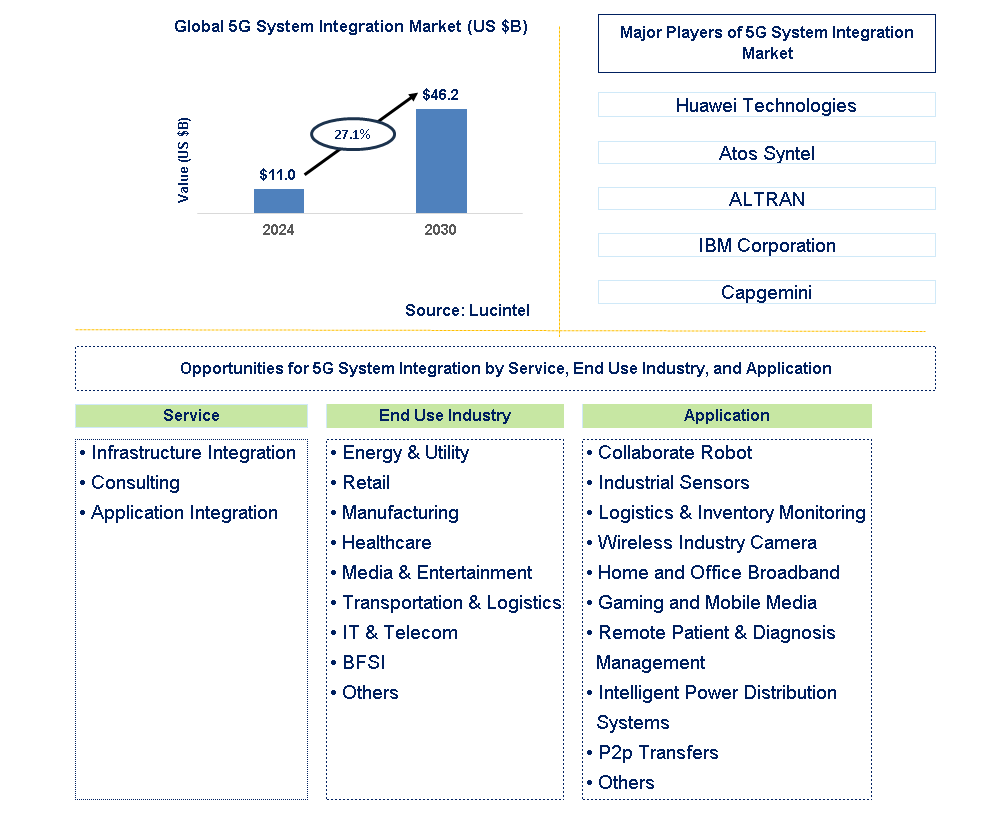
Key data points: The market size in 2030 = $46.2 billion, growth forecast = 27.1% annually for the next 6 years. Scroll below to get more insights. This market report covers trends, opportunities, and forecasts in the global 5G system integration market to 2030 by service (infrastructure integration, consulting, and application integration), end use industry (energy & utility, retail, manufacturing, healthcare, media & entertainment, transportation & logistics, IT & Telecom, BFSI, and others), application (collaborate robot, industrial sensors, logistics & inventory monitoring, wireless industry camera, home and office broadband, gaming and mobile media, remote patient & diagnosis management, intelligent power distribution systems, P2P transfers, and others), and region (North America, Europe, Asia Pacific, and the Rest of the World)
We'll send your sample report shortly.
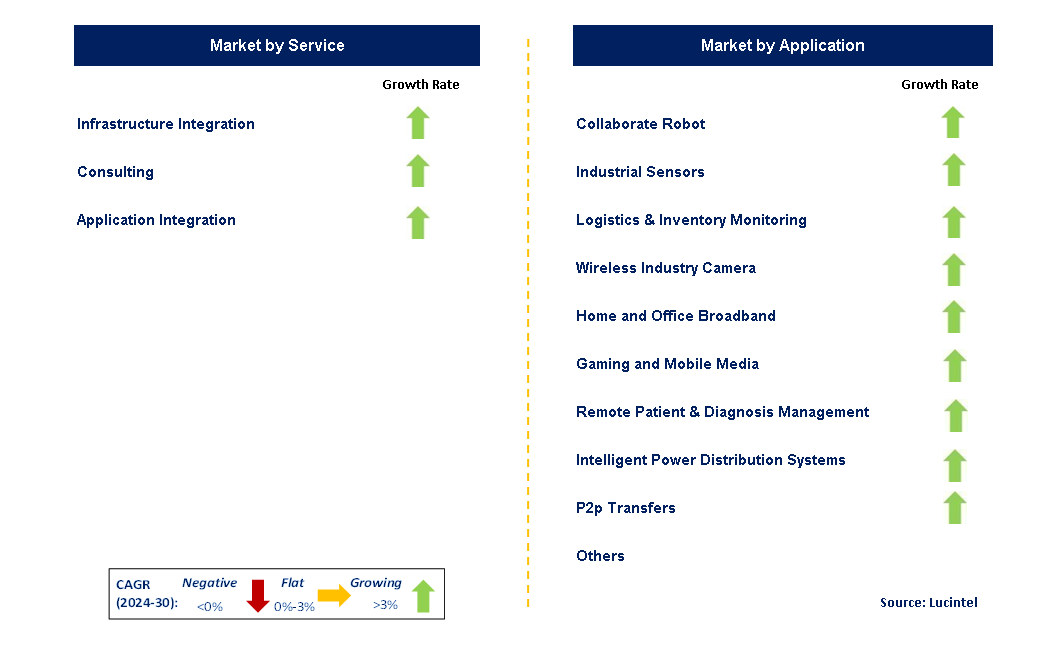
• Lucintel forecasts that, within the service category, infrastructure integration will remain the largest segment over the forecast period because of greater requirement to combine state-of-the-art 5G network design with older or conventional network infrastructure, as well as, the services for building management, data center infrastructure management, and network integration are also included in infrastructure system integration packages.
• In terms of regions, APAC will remain the largest region over the forecast period due to growing telecom infrastructure investments and the increasing use of advanced technology in countries such as China, Japan, and south Korea. Gain valuable insights for your business decisions with our comprehensive 150+ page report.
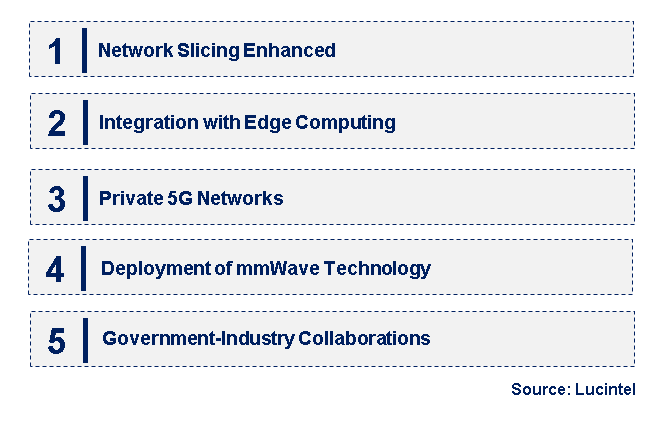
• Network Slicing Enhanced: The principle of network slicing in 5G provides the ability to create multiple logical networks within one physical 5G network. This trend allows operators to optimize network performance for diverse use cases, including IoT, high-speed broadband, and low-latency applications. Enhanced network slicing lays a stronger foundation for resource utilization and serves varied applications, from autonomous vehicles to industrial automation.
• Integration with Edge Computing: The integration of 5G with edge computing will become more prevalent, offering better performance with lower latency for data-intensive applications. Edge computing processes information closer to its origin to minimize latency and bandwidth requirements. This will facilitate a number of applications, including real-time analytics, autonomous systems, and smart cities, all aimed at ensuring network efficiency.
• Private 5G Networks: The development and increasing presence of private 5G networks have become popular among enterprises, guaranteeing highly performant and secure connectivity. These networks are tailor-made for specific organizational needs, powering smart manufacturing, logistics, and remote operations. This trend reflects a move toward more customizable and secure network solutions for businesses.
• Deployment of mmWave Technology: There is an increasing deployment of millimeter-wave (mmWave) technology, which will significantly advance the speed and capacity of 5G wireless networks. mmWave frequencies offer much higher bandwidth and faster data rates, making them ideal for high-density urban areas and advanced applications. This trend is crucial for supporting applications such as high-definition video streaming and augmented reality.
• Government-Industry Collaborations: One of the key factors enabling the fast-track deployment of 5G systems has been collaboration between governments and industry players. Public-private partnerships will continue to drive infrastructure investments, especially in regulatory support and innovation. This collaboration ensures that 5G rollout happens in a harmonized way, overcoming deployment and regulatory challenges. These trends are shaping the 5G system integration market by enhancing the network's capabilities, supporting a wide range of applications, and promoting collaborative efforts. Focus on network slicing, edge computing, private networks, mmWave technology, and collaborative efforts is driving innovation and expanding the boundaries of 5G technology, opening its adoption across sectors and applications.
• Improved Network Infrastructure Investments: Significant investments are being made to build better 5G network infrastructure, including additional base station deployments and upgrades to higher frequencies. Such developments support broader coverage and improved network performance, enabling the provision of more robust and reliable 5G services.
• Diversification of 5G Use Cases: The applications of 5G are increasingly expanding beyond mobile connectivity to include smart cities, autonomous driving, and industrial automation. This evolution reflects growing awareness of the transformative potential of 5G technology across various verticals.
• Improvement in the Virtualization of Networks: New network virtualization technologies, such as NFV and SDN, are being integrated with 5G systems. These enhancements make network management more flexible and efficient, guaranteeing better scalability and reducing operational costs.
• More Emphasis on the Improvement of Network Security: As 5G is integrated into an expanding range of applications, more emphasis is being placed on improving network security. Evolving security protocols and solutions are being developed to protect against potential vulnerabilities, maintaining the integrity of 5G systems and safeguarding user data.
• Industry Collaborative Initiatives: Industry collaborations and consortia are driving system integration for 5G in tangible ways. Collaboration among telecom operators, technology providers, and regulatory bodies is enabling the development of standardized solutions and overcoming challenges related to deployment and interoperability. The growing use of 5G will drive the system integration market by upgrading network infrastructure, increasing use cases, and focusing on security. Efforts in network virtualization and collaborative innovation are successfully driving the deployment and integration of 5G systems across various applications and regions.
• Development of Smart Cities: The development of smart cities becomes more feasible as 5G system integration supports advanced connectivity for urban infrastructure. Applications include intelligent traffic management, smart lighting, and environmental monitoring. This growth opportunity facilitates urban planning and enhances quality of life through cutting-edge technological solutions.
• Industrial Automation: 5G systems open new possibilities for industrial automation, improving operational efficiency and productivity. Applications include remote monitoring, predictive maintenance, and automated manufacturing processes. Low latency and high bandwidth in 5G extend the capabilities of industrial operations.
• Healthcare and Telemedicine: Integrated 5G systems enhance telemedicine and healthcare services, offering high-speed and reliable connectivity. Remote diagnostics, teleconsultation, and real-time health monitoring will be more accessible. Advanced connectivity through 5G technology will improve access to healthcare services and result in better outcomes.
• Autonomous Vehicles: The deployment of 5G systems is essential for the development and deployment of autonomous vehicles. Real-time communication between vehicles, infrastructure, and central systems is enabled by 5G. Its low latency and high-speed data transfer support the safety and efficiency of autonomous driving technologies.
• Smarter Entertainment: The integration of 5G systems will enable the creation of new and enhanced entertainment services, such as HD streaming, VR, and AR. Higher bandwidth and negligible latency in 5G permit immersive and interactive entertainment applications, driving innovation in the media and entertainment vertical. These strategic growth opportunities showcase the transformative effect of 5G system integration across various applications. 5G technology is supporting smart cities, industrial automation, healthcare, autonomous vehicles, and entertainment, driving innovation and new value creation in multiple fields and shaping the future of connectivity and technology.
• Technology Innovation: Developments in areas like 5G speed, latency, and other factors contribute to the growth of this market. These advancements provide enhanced connectivity, support new applications, and improve overall network performance. Continuous evolution in these areas promotes further investment and development in system integration.
• Growing Demand for High-Speed Connectivity: As different sectors demand faster and more reliable internet connectivity, 5G systems have become a favorable adaptation. Consumers and businesses need better network performance for applications such as multimedia streaming, gaming, and remote work. This demand requires significant investment in 5G infrastructure and its integration.
• Supportive Government Policies: Government policies and regulatory support are crucial drivers for 5G system integration. Initiatives related to spectrum allocation, infrastructure funding, and regulatory support are needed for the deployment and expansion of 5G networks. Government support accelerates 5G system integration and propels market growth. Challenges in the 5G system integration market are:
• High Deployment Costs: The cost of deploying infrastructure for 5G and integrating systems is high. Expenses related to network equipment, spectrum acquisition, and installation costs pose challenges to affordability and the speed of deployment. These costs are a key obstacle for stakeholders in the 5G market.
• Issues with Regulation and Spectrum Allocation: Regulatory complexities and spectrum allocation can delay deployment. Each country has its own regulatory requirements for 5G spectrum usage, affecting timelines and operational efficiency. Effectively addressing these regulatory challenges is critical to successful system integration.
• Security and Privacy: As the connectivity offered by 5G systems increases, security and privacy concerns arise. Protecting against cyber threats and safeguarding user data are key challenges. Any concerns regarding security may undermine consumer confidence and raise questions about the safety of 5G networks. The drivers include continuous technology improvements, increasing demand for high-speed connectivity, supportive government policies, new use cases, and infrastructure investments. On the other hand, high deployment costs, regulatory issues, and security concerns pose challenges. A balance between these drivers and challenges is necessary for the successful integration and expansion of 5G systems, which will define the future of connectivity and technological innovation.
• Huawei Technologies
• Atos Syntel
• ALTRAN
• IBM Corporation
• Capgemini
• CA Technologies
• Cisco Systems
• Tech Mahindra
• Cognizant
• Keysight Technologies
• Infrastructure Integration
• Consulting
• Application Integration
• Energy & Utility
• Retail
• Manufacturing
• Healthcare
• Media & Entertainment
• Transportation & Logistics
• IT & Telecom
• BFSI
• Others
• Collaborate Robot
• Industrial Sensors
• Logistics & Inventory Monitoring
• Wireless Industry Camera
• Home and Office Broadband
• Gaming and Mobile Media
• Remote Patient & Diagnosis Management
• Intelligent Power Distribution Systems
• P2p Transfer
• North America
• Europe
• Asia Pacific
• The Rest of the World
• United States: Major U.S. telecommunications companies like Verizon, AT&T, and T-Mobile are aggressively expanding their 5G networks. Recent developments include the use of millimeter-wave technology to increase network speed. The focus is also on integrating 5G with edge computing and AI to improve network efficiency and support new applications such as smart cities and autonomous vehicles. Infrastructure investments are accelerating through public-private partnerships to cover more geographic areas and urban centers.
• China: China is a leader in system integration, driven by companies like Huawei and ZTE. The government aims to develop a unified 5G network that integrates seamlessly with smart city projects and IoT applications. Recent deployments across metropolitan and rural areas are backed by government policies encouraging technological innovation and infrastructure development. China aims to achieve comprehensive 5G coverage and enhanced data speeds and connectivity.
• Germany: Germany is advancing 5G system integration through collaborations between telecom operators like Deutsche Telekom and technology providers. Developments focus on building 5G networks in dense city centers and industrial campuses, with a strong emphasis on integrating 5G with Industry 4.0 applications. The strategy involves deploying private 5G networks for operational efficiency in industries like automotive and manufacturing.
• India: India is a growing market for 5G system integration, with leading players like Reliance Jio and Bharti Airtel making significant strides. Recent developments include spectrum auctions and pilot projects for 5G technology. India is pushing for affordable 5G solutions to cater to its large population, while focusing on digital inclusion, smart city initiatives, and improved connectivity in underserved areas.
• Japan: Japan is actively developing 5G system integration in cooperation with major telecom operators such as NTT Docomo and SoftBank. Recent initiatives include expanding 5G networks in metropolitan and rural areas and integrating emerging technologies such as AR/VR and smart cities. Japan's policy includes fostering collaboration among telecom operators and technology providers to drive network development and innovation in areas like robotics and advanced manufacturing.


• Huawei Technologies
• Atos Syntel
• ALTRAN
• IBM Corporation
• Capgemini
• CA Technologies
• Cisco Systems
• Tech Mahindra
• Cognizant
• Keysight Technologies Q6. Which 5G system integration market segment will be the largest in future? Answer: Lucintel forecasts that infrastructure integration will remain the largest segment over the forecast period because of greater requirement to combine state-of-the-art 5G network design with older or conventional network infrastructure, as well as, the services for building management, data center infrastructure management, and network integration are also included in infrastructure system integration packages. Q7. In 5G system integration market, which region is expected to be the largest in next 5 years? Answer: APAC will remain the largest region over the forecast period due to growing telecom infrastructure investments and the increasing use of advanced technology in countries such as China, Japan, and south Korea. Q.8 Do we receive customization in this report? Answer: Yes, Lucintel provides 10% customization without any additional cost.


Choose a license that fits your team. Instant PDF delivery.
Prices exclude taxes. Instant delivery. Custom licensing available on request.
Market Report · July 16, 2026
Market Report · May 18, 2026
Market Report · May 18, 2026
Trusted partner for strategic intelligence and business growth


Receive a complimentary market analysis tailored to your industry. Our analysts will identify key growth opportunities and competitive dynamics specific to your business.

Market size, growth rate, and key trend analysis for your specific sector.

Top competitor positioning and market share analysis.

Strategic recommendations backed by data-driven insights.
Get curated market intelligence and competitive moves straight to your inbox.
By subscribing, you agree to receive our monthly insights. Unsubscribe anytime.
Receive a complimentary market analysis tailored to your industry. Our analysts will identify key growth opportunities and competitive dynamics specific to your business.
Market size, growth rate, and key trend analysis for your specific sector.
Top competitor positioning and market share analysis.
Strategic recommendations backed by data-driven insights.
Get curated market intelligence, emerging trends, and competitive moves straight to your inbox each month.
By subscribing, you agree to receive our monthly insights. Unsubscribe anytime.
We'll send your sample report shortly.