
Market Report · July 22, 2026

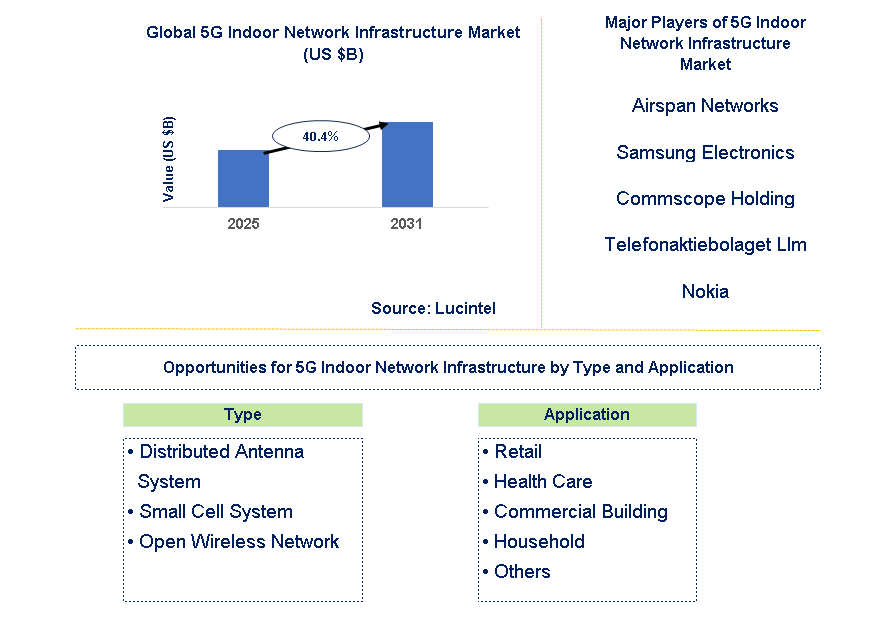
Key data points: The growth forecast = 40.4% annually for the next 7 years. Scroll below to get more insights. This market report covers Trends, opportunity and forecast in 5G indoor network infrastructure market to 2031 by type (distributed antenna system, small cell system, and open wireless network), application (retail, health care, commercial building, household, and others), and region (North America, Europe, Asia Pacific, and the Rest of the World)
We'll send your sample report shortly.
• Small Cells and Distributed Antenna Systems (DAS): Small cells and DAS are becoming the backbone of 5G indoor network infrastructure. These solutions provide high-speed, low-latency connectivity, particularly in high-density areas. Small cells are being used to fill coverage gaps and boost signal strength inside buildings, while DAS is deployed in large venues like airports, stadiums, and shopping centers. These technologies, by enhancing the utilization of spectrum and ensuring smoother connectivity, address the rising needs of indoor 5G users.
• Private 5G Networks for Businesses: Many businesses are adopting private 5G networks because of their growing demands for indoor connectivity. Businesses want more secure, reliable, and faster connections to cater to ever-improving manufacturing, logistics, and healthcare sectors. With private 5G networks, businesses can efficiently optimize their activities with low-latency applications that include real-time asset tracking, smart factories, and augmented reality tools. In this regard, the shift encourages telecom providers to offer tailored solutions for enterprise clients, expanding the potential of indoor 5G infrastructures.
• IOT and Smart Building: The proliferation of IoT devices as well as smart buildings is the most significant driving force behind indoor 5G infrastructure development. 5G brings the speed and connectivity needed for the large IoT devices being pushed into indoor premises. From lighting and HVAC solutions to security cameras and connected home appliances, this is making a way for even faster data transport and better interaction between these and other devices as well. Here, businesses may be looking into ways to operationalize efficiency improvement, and their IoT-driven smart building ecosystems heavily rely on having 5G indoor infrastructure.
• Edge Computing for better performance: There is growing usage of edge computing along with the 5G indoor network. Edge computing helps in processing data near to the point of origin that reduces the latency and increases the performance of the network. This trend is more beneficial for environments where instant data processing is required, such as healthcare, manufacturing plants, and retail stores. With edge computing, businesses will be able to leverage 5G for applications such as real-time analytics, machine learning, and augmented reality to transform the experience in indoor spaces and improve operational efficiency.
• Better Network Security: As 5G networks in interiors become the new normal, securing these networks is a growing issue. Advanced security features like encryption, multi-factor authentication, and intrusion detection systems are becoming a top priority for the implementation of the enterprises and telecom providers. In 5G, there are more entry points for cyberattacks, and hence, protecting the networks from such threats is of utmost importance for maintaining service reliability and safeguarding user data. Companies are investing in next-gen security protocols to ensure the protection of sensitive information and mitigate the risks posed by increasing digitalization.
These emerging trends are reshaping the 5G indoor network infrastructure market by driving innovation and providing businesses with the tools they need to stay connected and competitive in a digital-first world.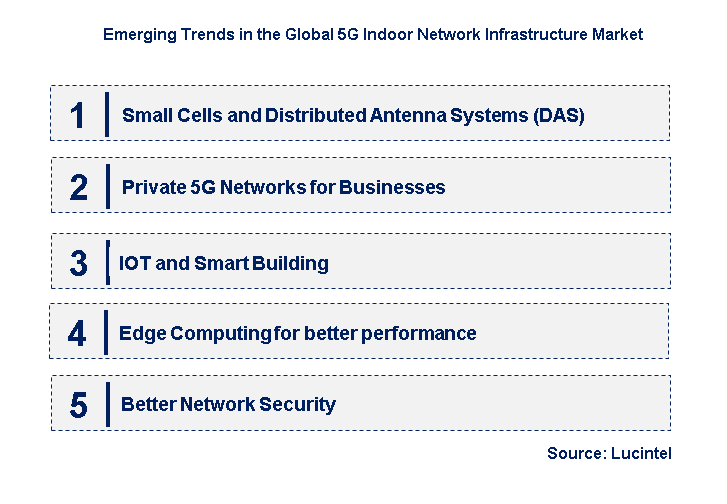
• Small Cell Deployments: The deployment of small cells has grown at a rapid pace. Telecom operators have been looking to improve indoor 5G coverage in dense urban areas and commercial properties. Small cells are compact and energy-efficient, which gives better coverage and faster speeds inside buildings. Growing demand for reliable mobile data in urban environments is pushing for greater small cell deployment, which in turn drives growth in the indoor network infrastructure market.
• Investment by the Telecom Industry in DAS: Distributed antenna systems are installed in venues such as stadiums, airports, and office buildings to enhance 5G coverage. This technology helps telecom providers to expand their indoor reach and capacity where macro cell towers cannot do much. With the growing demand for data-intensive applications, DAS solutions have become an integral part of the indoor 5G infrastructure to ensure that high-traffic areas remain continuously connected.
• Private 5G Networks for Businesses: Enterprises are investing in private 5G networks to address their specific indoor connectivity needs. Dedicated 5G infrastructure on premises provides enterprises with greater control, security, and low-latency connections. This trend is strong in sectors such as manufacturing, logistics, and healthcare, where real-time data processing and IoT connectivity are critical. Telecom providers are responding by offering tailored private network solutions to support these needs.
• Government Incentives for 5G Rollout: Governments in countries such as the United States, China, and India are making investments to speed up the deployment of 5G infrastructure. Such initiatives include providing funds, regulatory support, and spectrum allocation to intensify the rollout of 5G networks, including indoor solutions. Government policies are driving investments in 5G technology and are creating an environment in which the indoor network infrastructure market can grow.
• Partnering with enterprises by Telecom Service Providers: Now, the need for a bespoke 5G solution that supports specific indoor environment is what leading telecom service providers are engaging enterprises for. Partnerships for a customized network at the enterprise are being established and focused on such high-speed reliable connectivity of applications that require constant real-time data. As these enterprise-specific needs for 5G increase in demand, they will continue opening up opportunities to telecom providers in terms of further growth.
These developments highlight the increasing importance of 5G indoor network infrastructure and its role in shaping the future of connectivity. As demand for high-speed, low-latency networks continues to rise, these advancements are helping ensure that both businesses and consumers can stay connected.• Smart Buildings and IoT Integration: The demand for smart buildings and IoT devices is growing rapidly, creating a huge opportunity for 5G indoor network infrastructure. High-speed 5G networks supporting large-scale IoT deployments will enable more efficient building management systems, energy monitoring, security, and other services, making it a key growth area as the world increasingly embraces smart cities and connected infrastructure.
• Enterprise Networking Solutions: Private 5G networks for enterprises offer strategic opportunities for telecommunications operators. Telecom operators can capture a high-value market by offering customized 5G solutions to enterprises in manufacturing, logistics, or healthcare. To facilitate secure and reliable connectivity, enterprises will demand specific network foundations that can lead to growth in the indoor infrastructure market.
• Industrial Automation: Industrial automation creates an immense requirement for 5G indoor infrastructure in terms of low-latency, high-speed connectivity. From machine-to-machine communication to robotics and real-time analytics, industries require a very robust 5G network for optimization of processes. Telecom companies can help address this demand by offering customized solutions for industries interested in embracing 5G to optimize operations.
• Smart Retail Solutions: There are now various efforts on the part of retailers to create an optimal experience for their customers. Smart indoor networks enabled by 5G support such applications as augmented reality, location-based services, and personalized marketing. Therefore, the adoption of 5G will help increase telecom's take in the retail industry as operators assist them with better connectivity-high-speed, low-latency.
• Public Venues and Large-scale Events: Increased adoption of 5G through data-intensive use cases like content streaming and rich immersive experiences places the indoor network infrastructure in need for sports arenas and concert venues. Small cell and DAS can provide comprehensive, high-bandwidth coverage on which attendees' demand depends to continue enjoying and accessing services such as streaming smoothly. These end-user venues can be considered key growth opportunities within the indoor network infrastructure market.
These strategic opportunities explain how businesses can align their goals with the growing demand for 5G solutions. The continued drive towards innovation and expansion of the 5G indoor network infrastructure market is recommended in these opportunities.• Airspan Networks
• Samsung Electronics
• Commscope Holding Company
• Telefonaktiebolaget Llm Ericsson
• Nokia
• Huawei Technologies
• Corning Incorporated
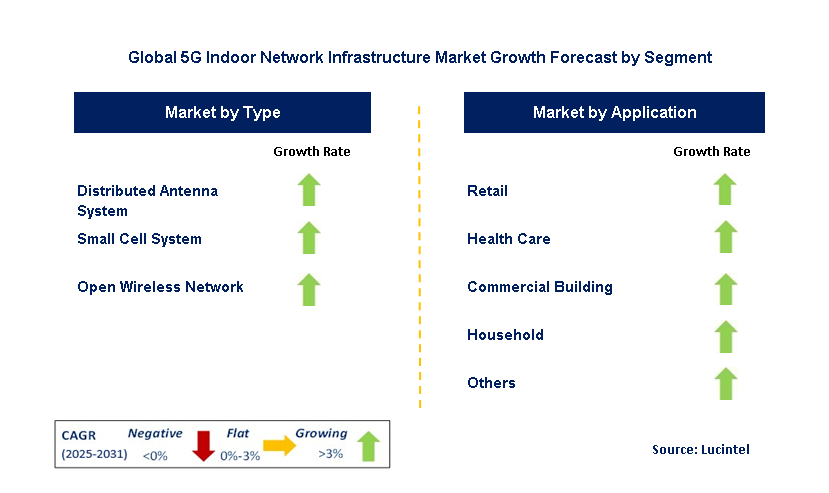
• Distributed Antenna System
• Small Cell System
• Open Wireless Network
• Retail
• Health Care
• Commercial Building
• Household
• Others
• North America
• Europe
• Asia Pacific
• The Rest of the World
• United States: Deployments of 5G indoor network infrastructure are picking up pace in the United States. Both private enterprises and telecom providers are investing heavily in enhancing connectivity. Companies are working on solutions like small cells and distributed antenna systems (DAS) to ensure seamless 5G coverage in high-density urban areas, office buildings, and commercial complexes. The U.S. government has, in recent years, focused much of its effort on encouraging the development of infrastructure, along with private-public collaborations, which have increased the spread of 5G technologies. Moreover, investments in indoor solutions that can manage the increasing demand for high-speed mobile data driven by IoT and smart devices are also on the rise.
• China: China is taking the lead in the development of 5G indoor network infrastructure. The proactive policies and investment of the government in expanding the 5G network are expected to take this forward. Its telecom giants, such as China Mobile, China Telecom, and China Unicom, are strongly focusing on indoor 5G connectivity, particularly in commercial buildings, airports, and shopping malls. There is a significant coverage and deployment of small cells and other indoor 5G solutions that help in meeting the demand for high-speed mobile data. China's aggressive push for the wide adoption of 5G is supported by massive manufacturing capabilities that help develop affordable network hardware for widespread adoption.
• Germany: Germany steps up significantly in improving its 5G indoor infrastructure while focusing on smart cities and industrial applications. The country is using its good technology and engineering sectors to make sure that connectivity indoors can accommodate the demands of Industry 4.0, autonomous vehicles, and other such advanced technologies. The government has a 5G Action Plan and funding programs to speed up the deployment of infrastructure, emphasizing the integration of 5G in both urban and rural environments. German telecom operators are investing in small cells, DAS, and other indoor solutions to ensure reliable, high-speed mobile access in key locations like office buildings, malls, and public spaces.
• India: India is experiencing significant growth in the 5G indoor network infrastructure market, fueled by the government’s push to roll out 5G connectivity across urban centers. The Telecom operators of India are actively deploying indoor 5G solutions, such as small cells and DAS, in high-traffic areas like malls, stadiums, and office buildings. Also, the rapidly growing Internet of Things, along with a spectacular demand for mobile data, has only worked to increase the pressure toward creating robust indoor infrastructure. India's telecom sector is also targeting the provision of affordable, scalable 5G network solutions that improve both commercial and residential connectivity to ensure wide accessibility of high-speed mobile networks.
• Japan: Japan is heavily investing in 5G indoor network infrastructure to enhance connectivity in both urban and industrial environments. The country's telecom operators such as NTT Docomo are deploying advance 5G solutions like small cells and DAS to strengthen coverage in buildings, train stations, and public spaces. Moreover, Japan aims to integrate 5G within its smart city initiatives and industrial automation systems and improve connectivity between businesses and the citizens. As Japan enters a new leadership role in the development of new 5G applications, especially related to the automotive and manufacturing sector, indoor infrastructure will be highly essential to ensure continuity in connectivity across the country.


• Airspan Networks
• Samsung Electronics
• Commscope Holding Company
• Telefonaktiebolaget Llm Ericsson
• Nokia
• Huawei Technologies
• Corning Incorporated
Q5. Which 5G indoor network infrastructure market segment will be the largest in future?

Choose a license that fits your team. Instant PDF delivery.
Prices exclude taxes. Instant delivery. Custom licensing available on request.
Market Report · July 22, 2026
Market Report · July 17, 2026
Market Report · July 17, 2026
Trusted partner for strategic intelligence and business growth


Receive a complimentary market analysis tailored to your industry. Our analysts will identify key growth opportunities and competitive dynamics specific to your business.

Market size, growth rate, and key trend analysis for your specific sector.

Top competitor positioning and market share analysis.

Strategic recommendations backed by data-driven insights.
Get curated market intelligence and competitive moves straight to your inbox.
By subscribing, you agree to receive our monthly insights. Unsubscribe anytime.
Receive a complimentary market analysis tailored to your industry. Our analysts will identify key growth opportunities and competitive dynamics specific to your business.
Market size, growth rate, and key trend analysis for your specific sector.
Top competitor positioning and market share analysis.
Strategic recommendations backed by data-driven insights.
Get curated market intelligence, emerging trends, and competitive moves straight to your inbox each month.
By subscribing, you agree to receive our monthly insights. Unsubscribe anytime.
We'll send your sample report shortly.