
Market Report · July 22, 2026

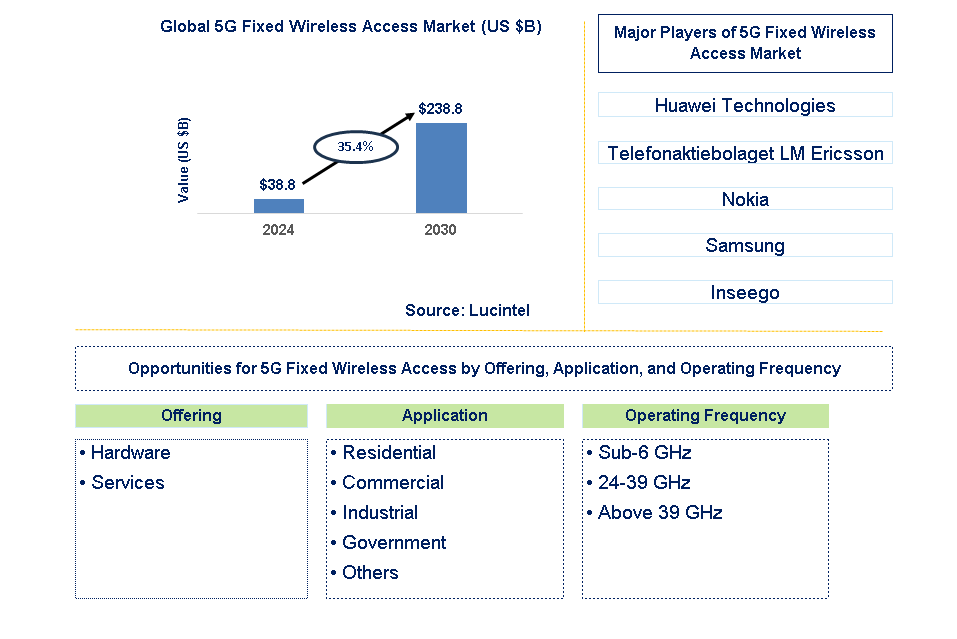
Key data points: The market size in 2031 = $323.4 billion, growth forecast = 35.4% annually for the next 7 years. Scroll below to get more insights. This market report covers trends, opportunities, and forecasts in the global 5G fixed wireless access market to 2031 by offering (hardware and services), application (residential, commercial, industrial, government, and others), operating frequency (sub-6 ghz, 24-39 ghz, and above 39 ghz), and region (North America, Europe, Asia Pacific, and the Rest of the World)
We'll send your sample report shortly.
• Lucintel forecasts that within the offering category, services is expected to witness higher growth over the forecast period due to modernization of cellular networks worldwide to meet the growing demand for the internet, as well as, the growth of the internet of things (IoT) and the increasing proliferation of data-intensive applications, companies and consumers are expecting quicker and more dependable connectivity.
• Within the application category, residential will remain the largest segment due to increasing demand for high-speed broadband, the growing popularity of smart home technology, and the growth in telecommuting and remote work.
• In terms of regions, North America is expected to witness the highest growth over the forecast period due to rising use of smart home gadgets, rising demand for high-speed internet connection, and the arrival of 5G infrastructure in the region. Gain valuable insights for your business decisions with our 150+ page report.
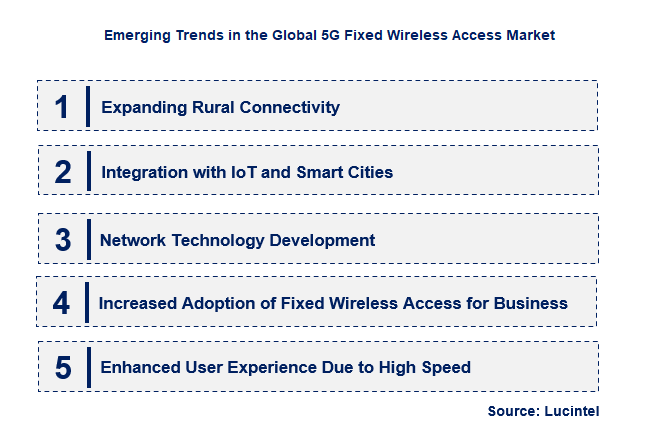
• Expanding Rural Connectivity: The primary trend of 5G fixed wireless access is the extension of connectivity in rural and underserved areas. This will be one of the necessities in bridging the gap in digital divide issues, ultimately providing high-speed internet access in areas that traditionally lack reliable broadband options. Furthermore, the use of 5G fixed wireless access is believed to be cost-effective for reaching these areas, thereby increasing access and fostering digital inclusion.
• Integration with IoT and Smart Cities: 5G fixed wireless access is increasingly being applied in IoT applications and projects for smart cities. This enables the deployment of sensor-connected devices, thus creating smart urban infrastructure and services. The high-speed and reliable connectivity provided by 5G fixed wireless access allows for timely data transmission, with the hope that advanced applications such as smart traffic management and environmental monitoring will be supported.
• Network Technology Development: Technological advancements in 5G networks include improved beamforming and MIMO technologies, both of which significantly enhance the performance of fixed wireless access solutions. These new technologies further increase data speeds, enhance capacity, and improve signal quality—all positive features of the latest 5G fixed wireless access desired by residential and business customers alike.
• Increased Adoption of Fixed Wireless Access for Business: With applications becoming more varied, including remote offices and enterprise backup, 5G fixed wireless access remains vital for business adoption. The flexibility and high speeds enabled by 5G fixed wireless access create a potent combination for any enterprise that relies on reliable internet access but does not need—and therefore does not want to invest in—wired infrastructure.
• Enhanced User Experience Due to High Speed: As technology in 5G fixed wireless access improves, users can experience much faster speeds and better performance over the internet. This has been driven by advancements in network technologies and increased spectrum availability, enabling higher download and upload speeds, low latency, and an improved online experience. Trends such as increasing rural connectivity, integration with IoT and smart cities, advancements in network technology, adoption for business solutions, and improvements in user experience are the ongoing reshaping forces of the 5G fixed wireless access market. These trends are leading to increased adoption and growth of 5G fixed wireless access, improving connectivity and performance across applications and geographies. They are expected to continue evolving in the future and will thus shape the future landscape of the 5G fixed wireless access market.
• Major Telecom Operators Expand Networks: Major telcos, such as Verizon, AT&T, and Deutsche Telekom, have expanded their 5G fixed wireless access networks significantly. Verizon and AT&T are enhancing their coverage across both urban and rural segments of the U.S., while Deutsche Telekom is improving connectivity in Germany. This effort aims to bridge the gaps in the provisioning of high-speed internet services.
• Government Support and Funding Initiatives: Various governments around the world are encouraging 5G fixed wireless access deployments through funding and policy support. The FCC of the U.S. has developed the Rural Digital Opportunity Fund to extend broadband coverage to all areas that remain unserved or underserved. Recently, the German government decided to invest in digital infrastructure to boost 5G fixed wireless access. Such support tends to accelerate network rollouts and increase connectivity.
• Technology Advancements Improving Performance: Advancements in beamforming and higher spectrum utilization are further enhancing 5G performance, making fixed wireless access solutions faster and more reliable, with the capability to handle greater capacity. Therefore, most telecom operators take advantage of these advancements to offer superior internet experiences to their subscribers.
• Deployment in Rural and Remote Areas: There is an escalating priority to deploy 5G fixed wireless access in rural and remote areas to bridge the digital divide. Thus, telecom operators in countries like India and China are targeting the expansion of coverage in underserved regions. This approach addresses the need for high-speed internet access in areas lacking traditional broadband infrastructure.
• Emergence of New Market Players: New entrants in the 5G fixed wireless access market are adding creativity to the solutions offered, making it highly competitive. Firms specializing in fixed wireless access technology and network infrastructure are emerging, providing a variety of options for customers. This influx will spur further innovation and expand the portfolio of available solutions. These recent developments include network expansions by major telecom operators, government support, technological advancements, deployments in rural areas, and the entry of new players into the 5G fixed wireless access market. These elements ensure better connectivity, increase competition, and bridge the gaps to further improve broadband access and performance across more geographies.
• Expanding Rural Connectivity: This creates a significant opportunity to enhance internet access for rural and underserved communities using 5G fixed wireless access. In doing so, it ensures that telcos bridge gaps in connectivity and guarantee high-speed internet in areas with limited or no traditional broadband options. Such expansion is critical for raising digital inclusion and responding to the needs of remote communities.
• Improved Smart City Initiatives: 5G fixed wireless access will strongly contribute to various smart city projects by offering reliable, high-speed connectivity for applications such as smart traffic management, public safety, and environmental monitoring. This integration of fixed wireless access in smart city architecture will also support advanced urban solutions for improved overall city management.
• Supporting Remote Work and Education: Remote work and online education have increased the demand for home internet solutions. 5G fixed wireless access offers high-speed, stable connectivity unmatched by any other technology solution in meeting the demands of remote work and e-learning applications. Thus, it stands out as a preferred alternative for households and educational institutions that require enhanced internet performance.
• Providing Business Backup Connectivity: Companies use 5G fixed wireless access as a backup strategy for primary point-to-point internet connections. fixed wireless access provides an alternative that ensures continuity in case of outages or disruptions in the network. The value of this use case is particularly important for enterprises that need constant and reliable connectivity to keep operational processes running.
• Leveraging IoT and Connected Devices: fixed wireless access combined with IoT will open new avenues for better management of connectivity and data. With high-speed and reliable access to the Internet, fixed wireless access is poised to support the ever-increasing number of connected devices used in diverse applications such as smart homes, industrial automation, and healthcare. Accordingly, the strategic growth opportunities within the 5G fixed wireless access market relate to expanding rural connectivity, enhancing smart city initiatives, enabling remote work and education, offering backup connectivity for businesses, and providing IoT applications. These potential opportunities demonstrate how 5G fixed wireless access can address various connectivity needs and create new areas within industries that shape the future of broadband access and technology integration.
• Technological Advancement: Advancing 5G technology features, such as enhanced beamforming and higher spectrum usage, drive the demand for fixed wireless access solutions. This, in turn, enhances network performance, assures higher speeds with more capacity, and increases reliability. As 5G technology evolves, it enables better fixed wireless access services, making high-speed internet more accessible.
• Increasing Demand for High-Speed Internet: Due to remote work, streaming services, and smart devices, the demand for high-speed internet is accelerating the adoption of 5G fixed wireless access. Indeed, consumer and business customers alike are seeking quicker and more reliable ways to access internet services. fixed wireless access thus presents an excellent choice for fulfilling these needs in areas where conventional broadband access is sparse.
• Network Infrastructure Expansion: Telecom operators are investing in the extension of 5G network infrastructure for broader fixed wireless access coverage. More base stations are being added, along with enhanced network equipment. Better infrastructure supports higher network capacity and coverage and, therefore, allows for wider and more practical deployments of 5G fixed wireless access.
• Government Support and Funding: Government deployment initiatives and funding, particularly in unserved areas, facilitate the rollout of 5G fixed wireless access. In addition, digital inclusion and infrastructure development programs promote financial and policy incentives that encourage operators to expand their fixed wireless access offerings. This will reduce the time needed for the network rollout process and further improve connectivity.
• Increased Competition and Innovation: New entrants and increasing competition in the fixed wireless access market drive innovation and improvement in service offerings. Companies within this highly competitive market develop new technologies and solutions that differentiate them and help secure market share. Heavy competition positively affects consumers by offering a wider range of options and performance. Challenges in the 5G fixed wireless access market are:
• High Deployment Costs: The cost of 5G fixed wireless access deployment, including infrastructure, equipment, and operational expenses, is relatively high. These costs can make it more difficult for some operators to scale their services or invest in new technologies. One of the biggest issues faced by market participants is managing such deployment costs.
• Issues Regarding Regulations and Compliance: Spectrum assignment, data protection, and infrastructure development regulations are the main obstacles to 5G fixed wireless access regulatory compliance and obtaining necessary permissions. Various regulations related to spectrum allocation, data privacy, and infrastructure installation affect 5G fixed wireless access. This requires proper planning and coordination with regulatory authorities.
• Integration with Existing Infrastructure: Integrating 5G fixed wireless access into existing network infrastructure and systems can be daunting. Achieving compatibility with a transition from legacy technologies to new solutions involves technical and operational challenges. Integration will be a key component of seamless and reliable delivery of fixed wireless access services. In conclusion, with increased technological development, demand for high-speed internet, extended network infrastructure, government support, and rising competition, the 5G fixed wireless access market is promising. However, challenges persist, including high deployment costs, regulatory issues, and integration complexities. These drivers and challenges must be considered by stakeholders to leverage opportunities effectively and advance in the evolving 5G fixed wireless access landscape.
• Huawei Technologies
• Telefonaktiebolaget LM Ericsson
• Nokia
• Samsung
• Inseego
• Qualcomm Technologies
• Intel Corporation
• MediaTek
• COMMSCOPE
• Verizon Communications
• Hardware
• Services
• Residential
• Commercial
• Industrial
• Government
• Others
• Sub-6 GHz
• 24-39 GHz
• Above 39 GHz
• North America
• Europe
• Asia Pacific
• The Rest of the World
• United States: In the US, major telecom operators, from Verizon to AT&T, have significantly expanded their 5G fixed wireless access offerings, targeting both urban and remote areas. Verizon has launched 5G Home Internet in multiple cities, offering fast and efficient competitive speeds along with high bandwidth. AT&T continues to improve the infrastructure of its 5G network to provide ever-wider coverage for fixed wireless access, especially targeting rural areas that remain underserved. Investments in infrastructure and technology aim to close the digital divide and bring high-speed internet closer to more people.
• China: The rapid development of 5G fixed wireless access deployment is driven by several major players, including China Mobile and China Unicom. Coverage is emphasized across extensive urban and suburban areas. Consequently, significant investments are occurring in 5G base stations and network infrastructure. China Unicom has launched 5G fixed wireless access services in select cities, leveraging its large-scale 5G network to offer high-speed internet access to residential and business customers. Support from the Chinese government and related investments have accelerated the adoption of fixed wireless access solutions.
• Germany: The German 5G fixed wireless access market is growing, with a focus on rural and suburban areas, particularly regarding connectivity. Deutsche Telekom and Vodafone are leading the deployment of 5G networks, enabling better broadband services. In fact, Deutsche Telekom has already introduced 5G fixed wireless access services in most states, replacing conventional DSL connections with faster and more viable options. The government has also financially supported Germany and regulated the faster development of digital infrastructure and connectivity.
• India: Due to the national broadband connectivity gap, 5G fixed wireless access is gaining traction in the country. Reliance Jio and Bharti Airtel are investing in their 5G infrastructure to expand their fixed wireless access offerings. Jio has been testing 5G fixed wireless access solutions in select cities to bring high-speed internet to both urban and rural areas. The Indian government's emphasis on digital inclusion and smart cities encourages 5G fixed wireless access growth in the region.
• Japan: The Japanese 5G fixed wireless access market is gaining momentum, supported by the contributions of major telcos, including NTT Docomo and SoftBank. NTT Docomo has launched its 5G fixed wireless access service in major cities to offer a faster internet connection. SoftBank is also expanding its 5G fixed wireless access network, targeting applications for both residential and enterprise use cases. The Japanese government's support for 5G deployment and digital transformation is accelerating advancements in the fixed wireless access sector.


• Huawei Technologies
• Telefonaktiebolaget LM Ericsson
• Nokia
• Samsung
• Inseego
• Qualcomm Technologies
• Intel Corporation
• MediaTek
• COMMSCOPE
• Verizon Communications Q6. Which 5G fixed wireless access market segment will be the largest in future? Answer:Lucintel forecasts that within the offering category, services is expected to witness the higher growth over the forecast period due to modernization of cellular networks worldwide to meet the growing demand for the internet, as well as, growth of the internet of things (IoT) and the increasing proliferation of data-intensive applications, companies and consumers are expecting quicker and more dependable connectivity. Q7. In 5G fixed wireless access market, which region is expected to be the largest in next 5 years? Answer: In terms of regions, North America is expected to witness highest growth over the forecast period due to rising use of smart home gadgets, rising demand for high-speed internet connection, and the arrival of 5G infrastructure in the region. Q.8 Do we receive customization in this report? Answer: Yes, Lucintel provides 10% customization without any additional cost.


Choose a license that fits your team. Instant PDF delivery.
Prices exclude taxes. Instant delivery. Custom licensing available on request.
Market Report · July 22, 2026
Market Report · July 17, 2026
Market Report · July 17, 2026
Trusted partner for strategic intelligence and business growth


Receive a complimentary market analysis tailored to your industry. Our analysts will identify key growth opportunities and competitive dynamics specific to your business.

Market size, growth rate, and key trend analysis for your specific sector.

Top competitor positioning and market share analysis.

Strategic recommendations backed by data-driven insights.
Get curated market intelligence and competitive moves straight to your inbox.
By subscribing, you agree to receive our monthly insights. Unsubscribe anytime.
Receive a complimentary market analysis tailored to your industry. Our analysts will identify key growth opportunities and competitive dynamics specific to your business.
Market size, growth rate, and key trend analysis for your specific sector.
Top competitor positioning and market share analysis.
Strategic recommendations backed by data-driven insights.
Get curated market intelligence, emerging trends, and competitive moves straight to your inbox each month.
By subscribing, you agree to receive our monthly insights. Unsubscribe anytime.
We'll send your sample report shortly.