
Market Report · July 22, 2026

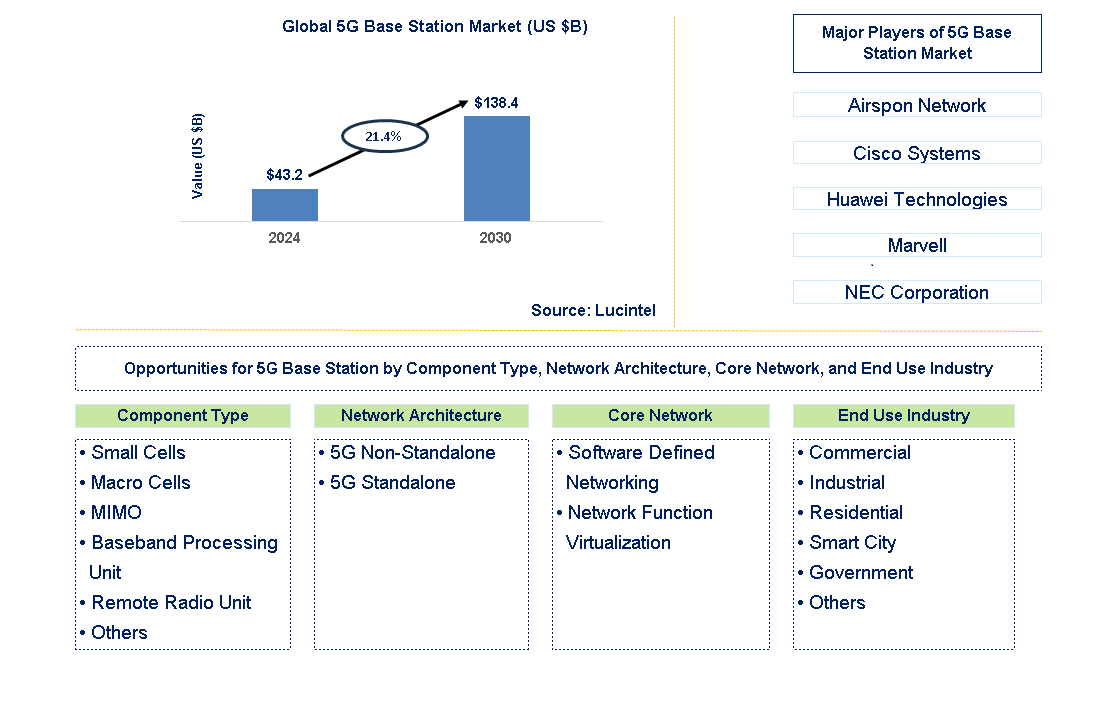
Key data points: The market size in 2030 = $138.4 billion, growth forecast = 21.4% annually for the next 6 years. Scroll below to get more insights. This market report covers trends, opportunities, and forecasts in the global 5G base station market to 2030 by component type (small cells, macro cells, mimo, baseband processing unit (BPU), remote radio unit (RRU), and others), network architecture (5G non-standalone and 5G standalone), core network (software defined networking and network function virtualization), end use industry (commercial, industrial, residential, smart city, government, and others), and region (North America, Europe, Asia Pacific, and the Rest of the World)
We'll send your sample report shortly.
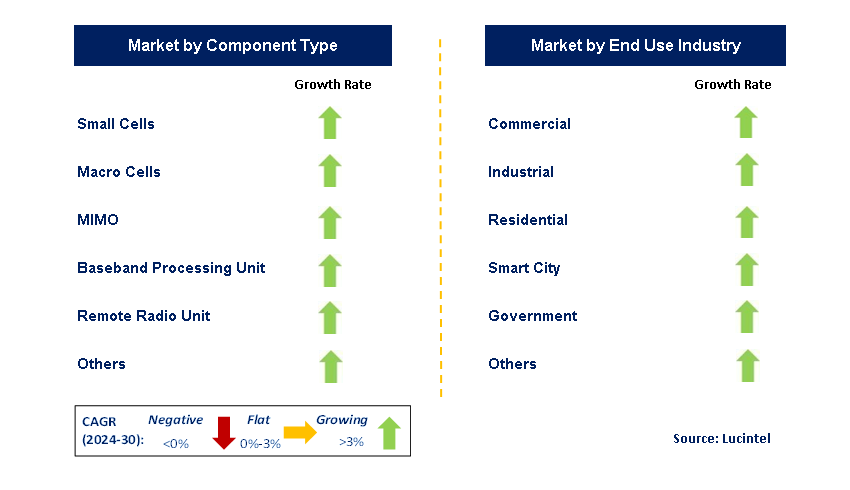
• Lucintel forecasts that, within the component type category, small cells is expected to witness the highest growth over the forecast period due to numerous noteworthy characteristics, including affordability, simplicity of installation and greater capacity.
• Within the end use category, commercial will remain the largest segment due to growing need across a range of businesses for dependable and fast wireless communication services, as well as, businesses, corporations, and public areas are served by commercial 5G base station deployments, which offer improved connection that stimulates creativity and productivity.
• In terms of regions, APAC is expected to witness highest growth over the forecast period due to rapid growth and adoption of 5G technology, increasing penetration of smartphones and other connected devices, as well as, rapid economic development in the region. Gain valuable insights for your business decisions with our comprehensive 150+ page report.
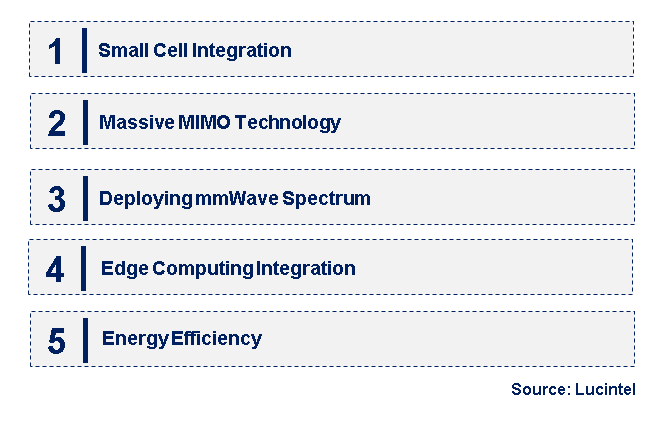
• Small Cell Integration: Small cells are increasingly being integrated with 5G, offering improvements in coverage and capacity, especially in high-density towns and cities. Complementing macro cells, they bring greater signal strength while offering reduced latency. This trend is crucial in meeting the growing demand for high-speed connectivity, ensuring a seamless user experience in the most densely populated regions.
• Massive MIMO Technology: Massive MIMO technology is evolving, enabling base stations to support more concurrent connections and higher data rates. It serves several users simultaneously by using a large number of antennas to enhance network efficiency and capacity. Adoption of this technology is vital for 5G networks due to high traffic demand.
• Deploying mmWave Spectrum: The use of mmWave, or millimeter-wave spectrum, is becoming more prevalent. Higher spectrum is required for faster data speeds, essential for providing the high speeds promised by 5G. As multiple operators deploy their base stations with mmWave, it will increase network capacity and support advanced applications requiring high data rates.
• Edge Computing Integration: Data processing through integrated edge computing with 5G base stations is now closer to the end-user, reducing latency and improving performance for applications such as autonomous vehicles and augmented reality. Edge computing allows real-time processing and supports 5G network efficiency by offloading traffic from central servers.
• Energy Efficiency: Energy efficiency is becoming increasingly vital in the 5G base station market, as operators strive to reduce operational costs and carbon footprints. Energy-efficient hardware and network management practices are being embraced to reduce power consumption and operational costs, ensuring the sustainable development of networks while meeting global energy-saving policies. The 5G base station market is evolving with priorities such as small cell integration, advancements in Massive MIMO, mmWave spectrum deployment, edge computing integration, and energy efficiency. These trends drive improvements in network performance, capacity, and sustainability. These developments will be crucial in enabling the full potential of 5G technology as the market continues to expand and find support in various applications and industries.
• Increasing mmWave Spectrum Adoption: Adoption of the mmWave spectrum is growing, offering higher data rates and more bandwidth. This is a key enhancement contributing to the acceleration of the 5G network, providing the speeds necessary for demanding applications such as streaming and real-time communication. Base stations supporting mmWave help operators enhance network performance and capacity to meet growing data consumption.
• Massive MIMO Technology Advancement: Massive MIMO, or Multiple Input Multiple Output technology, has significantly improved. It supports more simultaneous connections with higher efficiency by using a large number of antennas that serve several independent users, increasing network capacity and reducing latency. This technology is critical to meeting the high data rate demands of 5G networks.
• Small Cell Integration: Integration of small cells into the 5G network is increasingly deployed, especially in urban areas. Small cells complement macro cells by providing spot-like coverage, helping to overcome network congestion. This development improves signal strength and reduces latency, enhancing user experience in high-density areas and supporting overall performance in the 5G network.
• Advanced Network Slicing: Network slicing allows operators to carve out virtual networks for specific use cases, enabling dynamic and efficient resource allocation. This enhances network performance for applications like IoT and industrial automation. Network slicing technology will provide more flexible and efficient use of 5G infrastructure to meet diverse service needs.
• Energy Efficiency: Energy efficiency is a major focus in the 5G base station market. Innovations related to energy-efficient hardware and operational best practices are being adopted to reduce consumption and operational costs. This trend will support sustainable network expansion and align with global energy conservation goals, reducing the ecological footprint of 5G deployments. Recent developments in the 5G base station market include the expansion of the mmWave spectrum, advancements in Massive MIMO technology, integration with small cells, deployment of network slicing, and energy efficiency concerns. These advancements improve network performance, capacity, and sustainability, leading to the increasing adoption and deployment of 5G technology.
• Smart Cities: The growth of smart cities presents a major opportunity for 5G base stations. Advanced connectivity in these cities is necessary for applications such as traffic management, surveillance, and environmental monitoring. High speed and low latency, enabled by 5G, will be crucial to facilitating real-time data exchange, ensuring effective smart city infrastructure.
• Industrial Automation: 5G base stations enable industrial automation through high-speed, low-latency connectivity, allowing real-time control and monitoring of machines. Industries are looking to leverage 5G to increase operational efficiency, reduce downtimes, and enable remote equipment management. This application is vital in advancing manufacturing processes and driving Industry 4.0.
• Medical Innovations in Healthcare: The healthcare sector offers significant growth potential for 5G base stations. 5G capabilities support telemedicine, remote surgeries, and real-time health monitoring, improving patient outcomes and increasing access to medical care in underserved areas.
• Improved Consumer Experience: 5G base stations play an important role in enhancing consumer experiences in AR and VR applications. Both technologies rely on high-speed data transmission and low latency. The growing demand for AR and VR applications is a major driver for the increased demand for advanced 5G infrastructure.
• Autonomous Vehicles: The development and operation of autonomous vehicles depend on the deployment of 5G base stations. 5G enables V2X communication, where vehicles connect with other vehicles, pedestrians, and infrastructure, facilitating real-time data exchange between moving objects. This is crucial for the safety and efficiency of autonomous driving. Smart cities, industrial automation, healthcare innovations, enhanced consumer experiences, and autonomous vehicles represent strategic growth opportunities in the 5G base station market. Each of these applications increases the demand for more advanced 5G infrastructure, creating innovation and transformation across various industries. The ability to capitalize on these opportunities will be critical in maximizing the benefits of 5G technology.
• Increased demand for high-speed connectivity: The growing demand for data consumption and high-speed connectivity has led to the need for advanced 5G base stations. With streaming services, IoT devices, and smart applications becoming more prevalent, operators must deploy more base stations to meet these requirements and provide seamless connectivity at high speeds.
• Technological Advancements: Advancements in technologies such as Massive MIMO, mmWave spectrum, and small cells enhance the potential of 5G base stations. These innovations improve networking performance, capacity, and efficiency, helping meet the ever-increasing demands of 5G applications and services.
• Government Support and Investment: Various governments are providing support for 5G infrastructure construction and regulatory policies, speeding up deployment. These policies and funding initiatives help increase the reach of 5G and reduce the cost of deployment. Challenges in the 5G base station market include:
• High Costs of Deployment: Deploying 5G base stations is expensive due to the costs of equipment, installation, and maintenance. This makes it difficult for operators to deploy in areas with low financial resources or low returns on investment.
• Regulatory and Licensing Issues: Deployment of 5G base stations may be delayed due to regulatory barriers and licensing. Complex regulatory environments and the need for permits make the process cumbersome and costly, slowing down 5G rollout.
• Infrastructure and Integration Challenges: Incorporating new 5G base stations and other infrastructure is challenging. Issues like site acquisition, network compatibility, and technical integration must be addressed for the seamless deployment and operation of 5G networks. The 5G base station market is driven by increased demand for high-speed connectivity, technological advancements, government support, industrial adoption, and emerging use cases. However, it faces challenges such as high deployment costs, regulatory issues, and difficulties with infrastructure integration. Overcoming these challenges while leveraging growth drivers will be key to the successful expansion and deployment of 5G networks.
• Airspon Network
• Cisco Systems
• Huawei Technologies
• Marvell
• NEC Corporation
• Nokia
• Qualcomm Incorporated
• Small Cells
• Macro Cells
• MIMO
• Baseband Processing Unit (BPU)
• Remote Radio Unit (RRU)
• Others
• 5G Non-Standalone
• 5G Standalone
• Software Defined Networking
• Network Function Virtualization
• Commercial
• Industrial
• Residential
• Smart City
• Government
• Others
• North America
• Europe
• Asia Pacific
• The Rest of the World
• United States: Recently, major U.S. telecom operators such as Verizon and AT&T have accelerated their 5G base station deployments to enhance coverage and boost the capacity of urban cores. Recent developments include expanding mmWave spectrum use, adding small cells, and adopting Massive MIMO. The FCC has also accelerated regulatory procedures to foster competition in the 5G development sector.
• China: Under the leadership of major firms like Huawei and ZTE, China has made significant progress in deploying base stations. The country is aggressively expanding 5G infrastructure to ensure nationwide coverage and support industrial applications. Recent large-scale installations and integration with IoT and smart cities are advancing rapidly. The Chinese government is also providing significant investments to maintain leadership in 5G deployment.
• Germany: Germany continues to progress in its 5G base station rollout, with major telecom companies like Deutsche Telekom, Vodafone, and Telefonica making significant strides. Recent developments include further investment in 5G infrastructure and base stations deployed across major cities and rural areas. The focus is on high speeds, low latency, and using 5G for industrial applications and smart cities.
• India: The Indian 5G base station market is growing, driven by major telecom players like Reliance Jio and Bharti Airtel. The focus is on expanding trials and pilot projects, particularly in high-density urban areas and key commercial hubs. The government of India has released spectrum and introduced policies to support 5G development, addressing challenges related to infrastructure costs and regulatory hurdles for broader adoption.
• Japan: Japan has experienced rapid growth in its 5G base station market, with operators such as NTT Docomo, SoftBank, and KDDI leading the charge. Recent developments include the installation of 5G base stations in megacities, the deployment of beamforming, network slicing, and more. The Japanese government is implementing plans for 5G use in smart cities and IoT, backed by a favorable regulatory environment and technological innovation to accelerate 5G deployment.


• Airspon Network
• Cisco Systems
• Huawei Technologies
• Marvell
• NEC Corporation
• Nokia
• Qualcomm Incorporated Q6. Which 5G base station market segment will be the largest in future? Answer: Lucintel forecasts that small cells is expected to witness the highest growth over the forecast period due to numerous noteworthy characteristics, including affordability, simplicity of installation and greater capacity. Q7. In 5G base station market, which region is expected to be the largest in next 5 years? Answer: APAC is expected to witness highest growth over the forecast period due to rapid growth and adoption of 5G technology, increasing penetration of smartphones and other connected devices, as well as, rapid economic development in the region. Q.8 Do we receive customization in this report? Answer: Yes, Lucintel provides 10% customization without any additional cost.


Choose a license that fits your team. Instant PDF delivery.
Prices exclude taxes. Instant delivery. Custom licensing available on request.
Market Report · July 22, 2026
Market Report · July 17, 2026
Market Report · July 17, 2026
Trusted partner for strategic intelligence and business growth


Receive a complimentary market analysis tailored to your industry. Our analysts will identify key growth opportunities and competitive dynamics specific to your business.

Market size, growth rate, and key trend analysis for your specific sector.

Top competitor positioning and market share analysis.

Strategic recommendations backed by data-driven insights.
Get curated market intelligence and competitive moves straight to your inbox.
By subscribing, you agree to receive our monthly insights. Unsubscribe anytime.
Receive a complimentary market analysis tailored to your industry. Our analysts will identify key growth opportunities and competitive dynamics specific to your business.
Market size, growth rate, and key trend analysis for your specific sector.
Top competitor positioning and market share analysis.
Strategic recommendations backed by data-driven insights.
Get curated market intelligence, emerging trends, and competitive moves straight to your inbox each month.
By subscribing, you agree to receive our monthly insights. Unsubscribe anytime.
We'll send your sample report shortly.