
Market Report · July 22, 2026

Key data points: The growth forecast = 15.5% annually for the next 7 years. Scroll below to get more insights. This market report covers Trends, opportunity and forecast in 5.5G infrastructure market to 2031 by type (femtocell, pico cell, micro cell, and macro cell), application (autonomous driving, industrial iot, smart home, smart cities, healthcare, smart farming, and others), and region (North America, Europe, Asia Pacific, and the Rest of the World)
We'll send your sample report shortly.
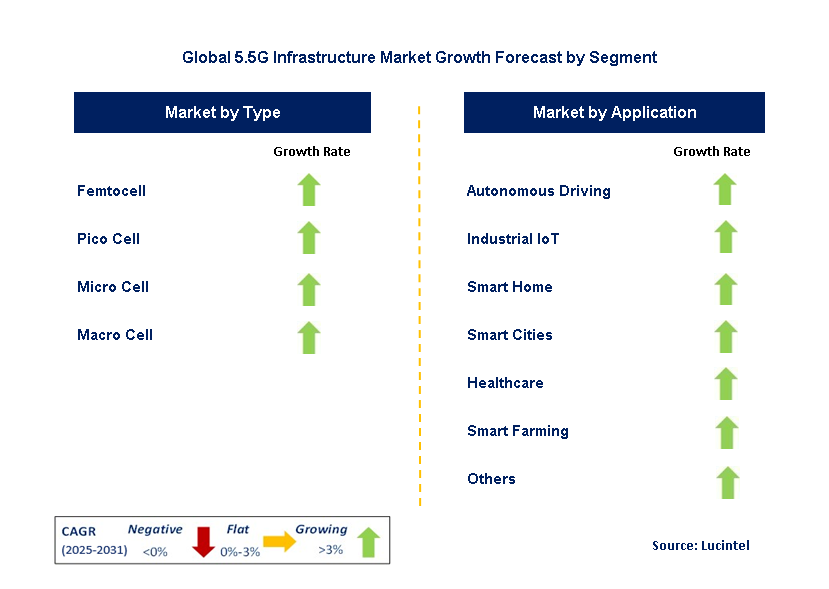
• Lucintel forecasts that, within the type category, femtocell is expected to witness the highest growth over the forecast period.
• Within the application category, smart city is expected to witness the highest growth.
• In terms of region, APAC is expected to witness the highest growth over the forecast period.
Gain valuable insights for your business decisions with our comprehensive 150+ page report. Sample figures with some insights are shown below.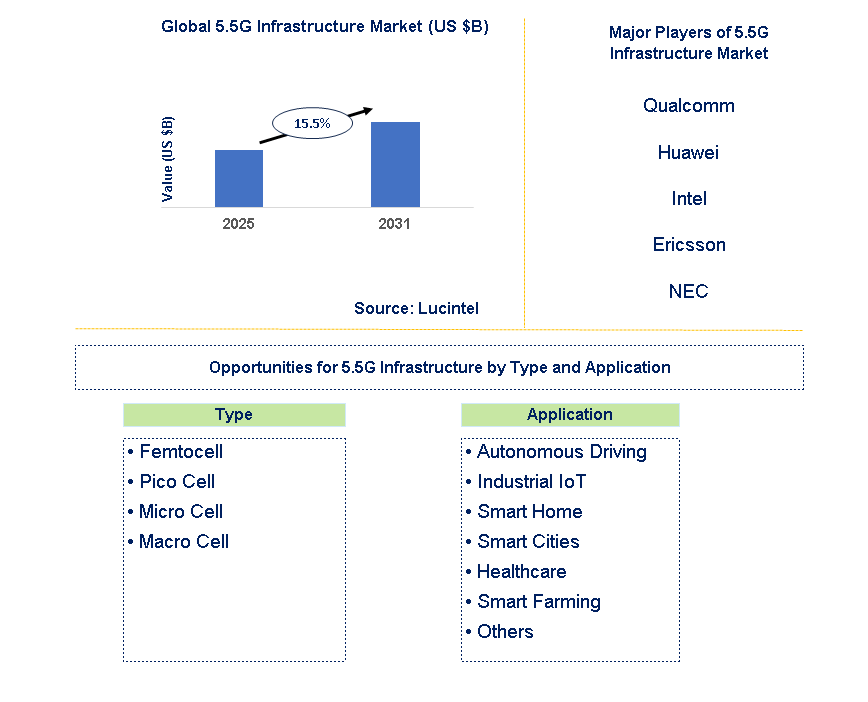
• Increased Focus on Low Latency and High Bandwidth: As applications requiring ultra-low latency and high bandwidth, such as augmented reality (AR) and virtual reality (VR), become more mainstream, the demand for 5.5G networks capable of supporting these technologies grows. With advancements in edge computing and network slicing, 5.5G is designed to provide the necessary infrastructure for these high-performance applications, enabling seamless experiences for consumers and industries alike.
• Integration of AI and Machine Learning: AI and machine learning are being integrated into 5.5G networks to enhance operational efficiency, optimize network management, and predict system failures. By using AI-powered algorithms for real-time network analysis, service providers can improve network performance and reliability. This trend is particularly valuable in large-scale deployments, where managing traffic and preventing congestion will be key challenges as 5.5G adoption increases.
• Private 5G Networks for Enterprises: Private 5G networks are becoming an attractive option for industries requiring high-performance and secure communication solutions. Enterprises in sectors like manufacturing, logistics, and healthcare are deploying their own 5G infrastructure to meet their unique connectivity needs. 5.5G enables private networks with higher speeds and reliability, providing greater control over data privacy and security.
• Enhanced IoT Connectivity: 5.5G will support a new wave of Internet of Things (IoT) devices, offering significantly improved capacity and connectivity. With the increase in IoT applications, especially in smart cities, agriculture, and industrial automation, the need for robust, scalable networks is critical. 5.5G will enhance machine-to-machine communication, enabling smarter operations and real-time decision-making across various industries.
• Sustainability and Green Networks: Sustainability is becoming a major priority in the development of 5.5G networks. Telecom operators are focusing on reducing energy consumption and carbon emissions associated with network infrastructure. Innovations such as energy-efficient hardware, renewable energy sources, and advanced cooling techniques are being incorporated into 5.5G systems. This trend is helping operators align with global sustainability goals while maintaining efficient network performance.
These emerging trends are reshaping the 5.5G infrastructure market, creating new opportunities for innovation and growth. As telecom companies and enterprises leverage the potential of 5.5G, the market will continue to evolve with a greater emphasis on speed, efficiency, and sustainability.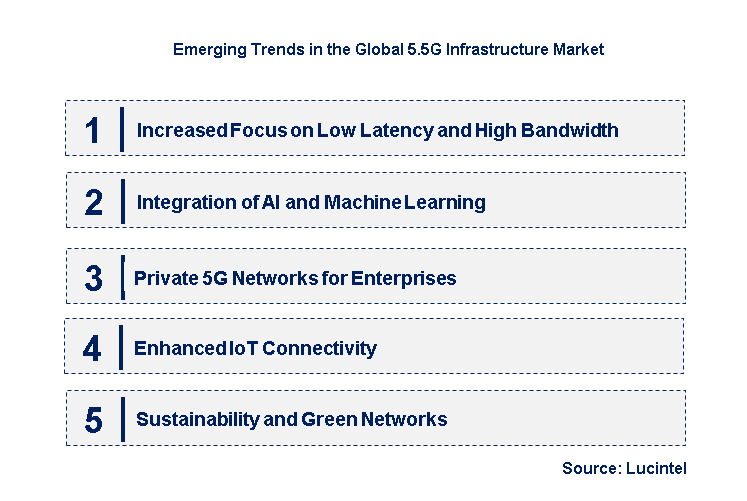
• Expansion of Private 5G Networks: Private 5G networks are being adopted at an increasing rate, particularly in sectors like healthcare, manufacturing, and logistics. Companies are seeing the value of custom-built, secure networks that offer dedicated bandwidth and improved reliability. With the rise of Industry 4.0 and the need for low-latency communication, private 5G networks are becoming a cornerstone of 5.5G deployment strategies.
• Network Slicing for Efficient Resource Allocation: Network slicing, a key feature of 5.5G, allows telecom providers to create multiple virtual networks within the same physical infrastructure. This enables more efficient resource allocation and customization of services for different user needs. As demand for differentiated services grows, the ability to slice networks to meet specific requirements will become essential in supporting various industries’ connectivity needs.
• Acceleration of Edge Computing Integration: Edge computing is becoming increasingly integrated with 5.5G infrastructure, enabling faster data processing closer to the end user. This development enhances the performance of applications that require real-time processing, such as autonomous vehicles, industrial automation, and augmented reality. By reducing latency and bandwidth use, edge computing supports the seamless experience promised by 5.5G networks.
• Global Spectrum Allocation: Governments worldwide are working to allocate more spectrum to accommodate the growing demand for high-speed mobile networks. Spectrum auctions in countries like the U.S., India, and Japan are critical to ensuring that the necessary bandwidth is available for 5.5G networks. This development ensures that telecom operators can meet future demand for faster, more reliable services.
• Collaborations and Partnerships: Strategic partnerships between telecom companies, technology providers, and equipment manufacturers are accelerating the development and deployment of 5.5G infrastructure. Collaborations like those between Ericsson, Nokia, and major telecom providers are driving the roll-out of 5.5G, facilitating the creation of standardized infrastructure that will allow for widespread adoption.
These recent developments are positioning the 5.5G infrastructure market for exponential growth. As more industries adopt 5.5G technologies, the market will see continued advancements in the capabilities of telecommunication networks.• Smart Manufacturing and Industry 4.0: The manufacturing sector is one of the key growth areas for 5.5G, driven by Industry 4.0 technologies. 5.5G’s low-latency, high-bandwidth capabilities are ideal for supporting automation, real-time monitoring, and predictive maintenance. As industries seek to increase operational efficiency, the demand for 5.5G solutions will continue to rise.
• Autonomous Vehicles and Smart Transportation: Autonomous vehicles and smart transportation systems require ultra-reliable, low-latency networks to operate safely and efficiently. 5.5G infrastructure will play a crucial role in enabling communication between vehicles and their environment, helping optimize traffic management and safety systems.
• Healthcare and Telemedicine: Telemedicine and healthcare applications are increasingly relying on high-speed, low-latency networks to provide remote care and real-time data transmission. 5.5G will enable better patient monitoring, remote surgeries, and faster diagnostics, providing significant growth opportunities in the healthcare sector.
• Smart Cities and IoT Applications: Smart cities, powered by IoT devices and sensors, require robust, scalable networks to manage the vast amounts of data generated. 5.5G will provide the infrastructure needed for real-time data processing and communication, driving growth in urban development and public services like traffic management and waste collection.
• Entertainment and Media: The demand for high-quality streaming, virtual reality, and gaming experiences is rapidly increasing. 5.5G will enhance content delivery, enabling seamless streaming and immersive experiences. Entertainment and media companies will benefit from the enhanced bandwidth and low latency provided by 5.5G networks.
The 5.5G infrastructure market is poised for significant growth, with key applications driving innovation across various sectors. As demand for high-speed, low-latency connectivity continues to rise, companies across industries are increasingly turning to 5.5G to unlock new opportunities and improve operational efficiency.• Qualcomm
• Huawei
• Intel
• Ericsson
• NEC
• Qorvo
• ZTE
• Femtocell
• Pico Cell
• Micro Cell
• Macro Cell
• Autonomous Driving
• Industrial IoT
• Smart Home
• Smart Cities
• Healthcare
• Smart Farming
• Others
• North America
• Europe
• Asia Pacific
• The Rest of the World
• United States: The U.S. is making notable strides in 5.5G infrastructure, with major investments from top telecom providers. The focus is on enhancing low-latency, high-bandwidth services. Companies like Verizon and AT&T have ramped up trials and rollouts of advanced 5G technologies, pushing the limits of the existing 5G infrastructure. The U.S. government is supporting the rollout of broadband expansion and increasing the adoption of IoT applications, thus further propelling the 5.5G transition, and the country would remain ahead of the curve in terms of innovation in telecommunications.
• China: The country continues to be at the forefront of the development of 5.5 G. Infrastructural investment and research into the technology are on the high side. The government has taken a front-row seat in its digitalization plan and expansion of 5G networks in urban and rural settings. The Chinese telecom giants, Huawei and ZTE, are the drivers for the 5.5G transition, centered on next-generation mobile networks and innovative use cases such as smart cities and autonomous vehicles. The rapid deployment of 5G has laid the foundation for 5.5G in China, and this country will be part of the next milestone development of global 5G infrastructure.
• Germany: Germany has been proactive in advancing 5.5G infrastructure, especially in its industrial sectors. Deutsche Telekom, along with other providers, is making significant strides toward improving network capabilities to meet growing demands for automation and IoT. The government’s support for digital infrastructure and the focus on private 5G networks for industries like manufacturing and automotive are accelerating the deployment of 5.5G technologies. Germany's emphasis on cybersecurity and regulatory alignment will ensure that 5.5G infrastructure remains robust and secure as it rolls out.
• India: India's 5.5G infrastructure market is beginning to gain momentum, with an increased focus on affordable connectivity and reaching rural areas. Telecom providers like Reliance Jio and Bharti Airtel are testing 5G networks to gradually upgrade them to 5.5 G. The Indian government’s push for “Digital India” and its recent spectrum auctions will accelerate 5.5G deployment. With the country’s large population and rising smartphone penetration, 5.5G will offer significant potential for digital transformation in sectors like healthcare, education, and finance.
• Japan: Japan has been a pioneer in 5G deployment and is now shifting focus toward 5.5 G. Japanese telecom companies such as NTT DoCoMo and SoftBank are making strides in enhancing network capacity and reliability. The country is leveraging 5.5G technologies for use cases in robotics, smart manufacturing, and autonomous driving. Japan’s commitment to next-gen infrastructure, coupled with its strong technological ecosystem, is positioning it as a key player in the 5.5G infrastructure market.


• Qualcomm
• Huawei
• Intel
• Ericsson
• NEC
• Qorvo
• ZTE
Q5. Which 5.5G infrastructure market segment will be the largest in future?

Choose a license that fits your team. Instant PDF delivery.
Prices exclude taxes. Instant delivery. Custom licensing available on request.
Market Report · July 22, 2026
Market Report · July 17, 2026
Market Report · July 17, 2026
Trusted partner for strategic intelligence and business growth


Receive a complimentary market analysis tailored to your industry. Our analysts will identify key growth opportunities and competitive dynamics specific to your business.

Market size, growth rate, and key trend analysis for your specific sector.

Top competitor positioning and market share analysis.

Strategic recommendations backed by data-driven insights.
Get curated market intelligence and competitive moves straight to your inbox.
By subscribing, you agree to receive our monthly insights. Unsubscribe anytime.
Receive a complimentary market analysis tailored to your industry. Our analysts will identify key growth opportunities and competitive dynamics specific to your business.
Market size, growth rate, and key trend analysis for your specific sector.
Top competitor positioning and market share analysis.
Strategic recommendations backed by data-driven insights.
Get curated market intelligence, emerging trends, and competitive moves straight to your inbox each month.
By subscribing, you agree to receive our monthly insights. Unsubscribe anytime.
We'll send your sample report shortly.