
Market Report · July 15, 2026

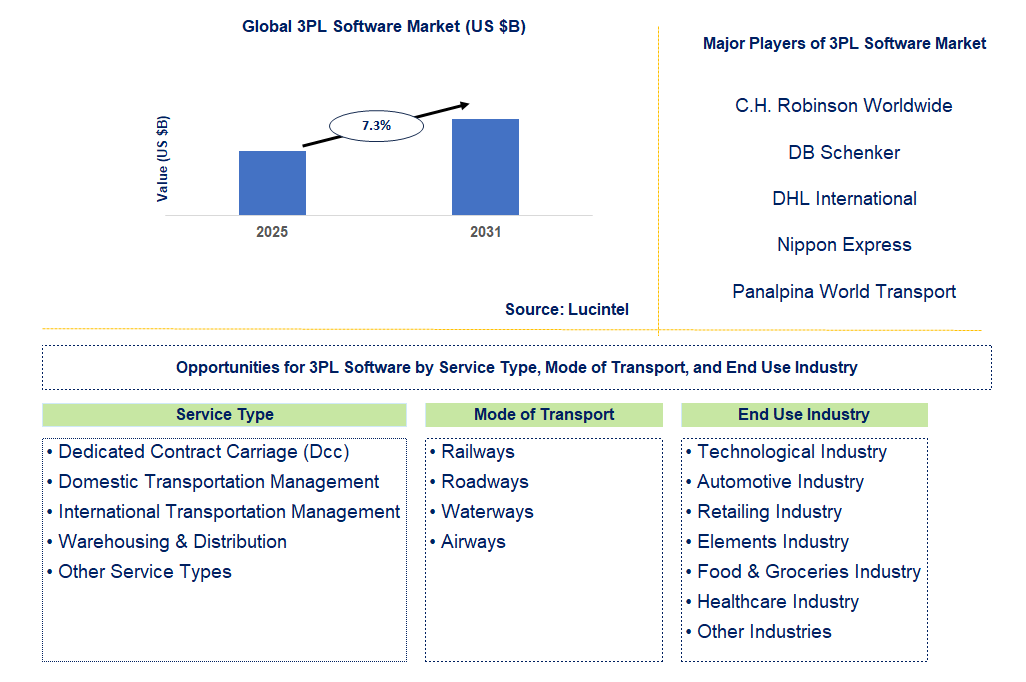
Key data points: The growth forecast = 7.3% annually for the next 7 years. Scroll below to get more insights. This market report covers Trends, opportunities and forecasts in 3PL software market to 2031 by service type (dedicated contract carriage (DCC), domestic transportation management, international transportation management, warehousing & distribution, and other service types), mode of transport (railways, roadways, waterways, and airways), end use industry (technological industry, automotive industry, retailing industry, elements industry, food & groceries industry, healthcare industry, and other industries), and region (North America, Europe, Asia Pacific, and the Rest of the World)
We'll send your sample report shortly.
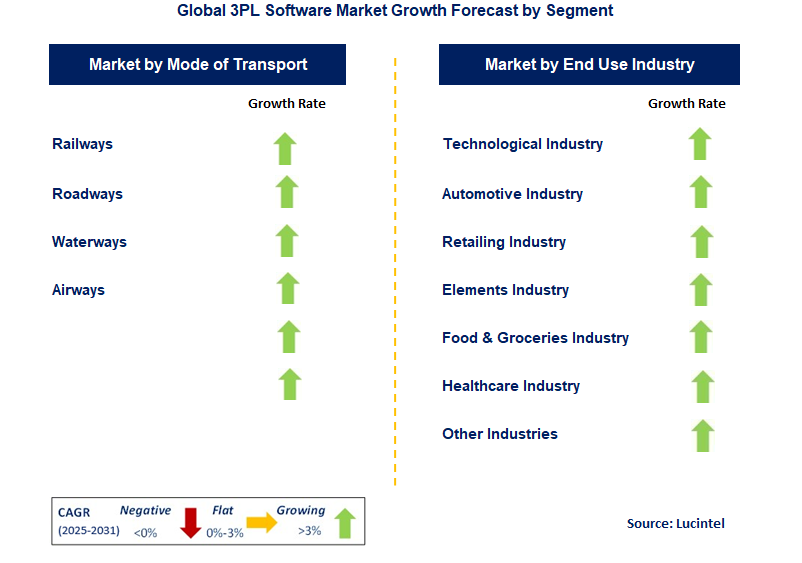
• Lucintel forecasts that, within the mode of transport category, roadways will remain the largest segment over the forecast period.
• Within the end-use industry category, the healthcare industry is expected to witness the highest growth.
• In terms of region, APAC is expected to witness the highest growth over the forecast period.
• AI and Machine Learning Integration: AI and machine learning are being used to improve demand forecasting, route optimization, and predictive analytics in 3PL software. These tools enable dynamic responses to supply chain disruptions and customer needs. Predictive functions help companies make faster, smarter decisions, enhancing service and reducing costs. AI-driven automation also cuts labor needs and errors, boosting efficiency.
• Visibility and Shipment Tracking: Improved GPS and IoT capabilities provide real-time tracking of shipments at every stage. This visibility enhances logistics planning and customer satisfaction by offering accurate ETAs. Tracking also enables quick issue resolution, reducing delays and improving resource use.
• Deployment via Cloud and SaaS: Cloud-based 3PL software improves accessibility, scalability, and automatic updates, making it ideal for businesses of all sizes. SaaS models offer fast implementation and adaptability, ensuring continuity across global supply chains. They are also cost-effective by eliminating the need for major infrastructure investment.
• Green Logistics and Sustainability Features: Sustainability targets and regulatory pressures are leading to 3PL software with eco-routing, carbon tracking, and energy-efficient warehouse tools. These features lower utility costs while supporting ESG compliance, aligning cost savings with environmental responsibility.
• Using Blockchain for Greater Security and Transparency: Blockchain is being explored for secure, tamper-proof records that boost trust in multi-party logistics. Smart contracts streamline workflows and cut administrative costs. Distributed ledgers also improve data accuracy across supply chains, enhancing operational efficiency.
Emerging technologies are transforming the 3PL software landscape. AI, cloud, and blockchain are helping logistics firms tackle digital marketplace challenges while meeting consumer and regulatory expectations. These innovations strengthen operational performance and build supply chain resilience for future growth.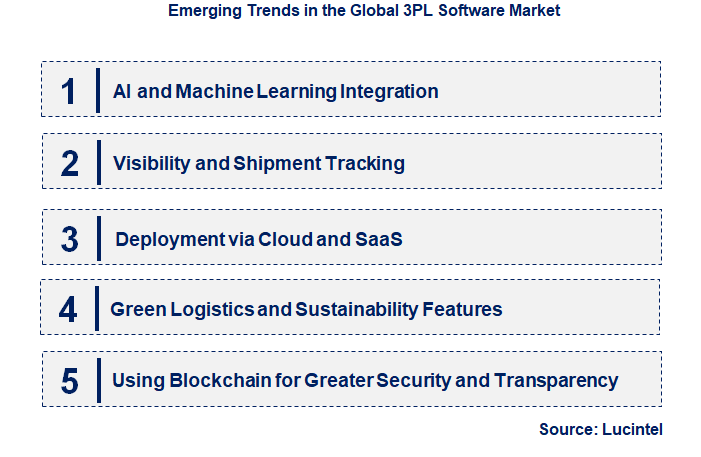
• Fundamentals of Modular Software Architectures: Modular designs reduce costs, speed deployment, and improve system compatibility for future scaling.
• AI-Enhanced Decision Support Software: AI-driven insights optimize labor, transport, and storage, increasing speed and reducing planning errors.
• Enhanced API Connectivity for Ecosystem Integration: APIs enable smooth data flow across partners, eliminating silos and improving efficiency.
• Mobile-First Features and Remote Accessibility: Mobile interfaces support real-time scanning and task updates, boosting field accuracy.
• Cybersecurity Enhancements and Compliance Tools: Modern 3PL tools offer strong data security, access control, and global regulation support.
New developments such as AI, modular designs, and mobile-friendly interfaces are enabling smarter, faster, and more secure logistics operations, enhancing agility and compliance globally.• 3PL E-Commerce and Omni-Channel Fulfillment: Software supports fast shipping, return workflows, and inventory syncing across retail channels.
• Cold Chain and Pharmaceutical Logistics: Tools ensure cold storage compliance, real-time monitoring, and biologics traceability.
• Automotive and Industrial Manufacturing: 3PL platforms support just-in-time delivery and integration with manufacturing planning systems.
• Retail and Consumer Goods: Software improves seasonal planning, demand-led restocking, and flexible warehouse management.
• Cross-Border and International Logistics: Global trade features automate documentation, customs clearance, and regulatory alignment.
Application-focused innovation in 3PL software is unlocking industry-specific efficiencies, enabling automation, better service, and stronger vendor-client collaboration in a dynamic logistics market.• C.H. Robinson Worldwide
• DB Schenker
• DHL International
• Nippon Express
• Panalpina World Transport
• Union Pacific Railroad
• United Parcel Service
• Dedicated Contract Carriage (DCC)
• Domestic Transportation Management
• International Transportation Management
• Warehousing & Distribution
• Other Service Types
• Railways
• Roadways
• Waterways
• Airways
• North America
• Europe
• Asia Pacific
• The Rest of the World
• United States: In the US 3PL software market, there is a growing emphasis on more sophisticated digital solutions that facilitate full transparency in logistics processes. There has been a surge in the adoption of cloud-based solutions as they are cost-effective and can be adopted by both small and large businesses. There is greater adoption of AI and machine learning to automate routing, demand forecasting, and inventory management. Oracle, SAP, and Manhattan Associates are the leading players, but there is also growing competition from agile, small companies that specialize in unique offerings.
• China: With the advancements in automation within logistical services in China, the 3PL Chinese software industry is growing at a fast pace. There are increasing efforts to implement IoT and big data technologies for better fleet and warehouse management systems. Government support for “smart logistics” through policies like “Internet Plus” has propelled the usage and integration of complex software systems. Also, the growing urbanization in conjunction with the large geographical area of China continues to increase the demand for advanced AI-powered last-mile delivery and route planning optimization software.
• Germany: Strong infrastructure and manufacturing base positively impact the 3PL software market as investment in automated supply chains has increased, creating a market for digital services. The country now implements more advanced systems for tracking goods within the country, which include real-time tracking, as well as AI-supported demand forecasting through predictive analytics. There is also a strong push toward environmentally friendly logistics solutions, such as software provided to track and manage carbon emissions generated within logistics activities. German logistics companies are willing to invest more in operational efficiency, and the need for stronger data protection fuels progress on secure GDPR-compliant systems.
• India: Due to the ongoing digitization of logistics and e-commerce in India, the 3PL software market is growing at a very high pace. There is considerable spending in both warehouse and fleet management systems as rhe aetail and automotive industries avail more services from third-party logistics providers. Indian 3PL operators are now selling software that provides better visibility to the clients’ supply chains, customer care, and AI- and automation-predictive analytics for rapidly evolving e-commerce businesses. Japan: Similar to other nations, Japan has seen consistent growth in the 3PL software market because its logistics firms are further automating their operations and incorporating more data analytics. The country boasts one of the premier transportation networks globally, and the application of intelligent technologies like IoT, robotics, tnd extensive data analytics,along with extensive data analytics, is improving supply chain management systems. There is a growing interest in remote-assisted systems of commute, thanks to the aging population increasing automation to fill up the labor gap, forcing companies to use more intelligent process-optimizing tools. Simultaneously, Japan is developing tools to assist with transportation sustainability in a bid to decrease carbon emissions, making it also eco-friendly.


• C.H. Robinson Worldwide
• DB Schenker
• DHL International
• Nippon Express
• Panalpina World Transport
• Union Pacific Railroad
• United Parcel Service
Q5. Which 3PL software market segment will be the largest in future?

Choose a license that fits your team. Instant PDF delivery.
Prices exclude taxes. Instant delivery. Custom licensing available on request.
Market Report · July 15, 2026
Market Report · June 26, 2026
Market Report · June 24, 2026
Trusted partner for strategic intelligence and business growth


Receive a complimentary market analysis tailored to your industry. Our analysts will identify key growth opportunities and competitive dynamics specific to your business.

Market size, growth rate, and key trend analysis for your specific sector.

Top competitor positioning and market share analysis.

Strategic recommendations backed by data-driven insights.
Get curated market intelligence and competitive moves straight to your inbox.
By subscribing, you agree to receive our monthly insights. Unsubscribe anytime.
Receive a complimentary market analysis tailored to your industry. Our analysts will identify key growth opportunities and competitive dynamics specific to your business.
Market size, growth rate, and key trend analysis for your specific sector.
Top competitor positioning and market share analysis.
Strategic recommendations backed by data-driven insights.
Get curated market intelligence, emerging trends, and competitive moves straight to your inbox each month.
By subscribing, you agree to receive our monthly insights. Unsubscribe anytime.
We'll send your sample report shortly.