
Market Report · July 15, 2026

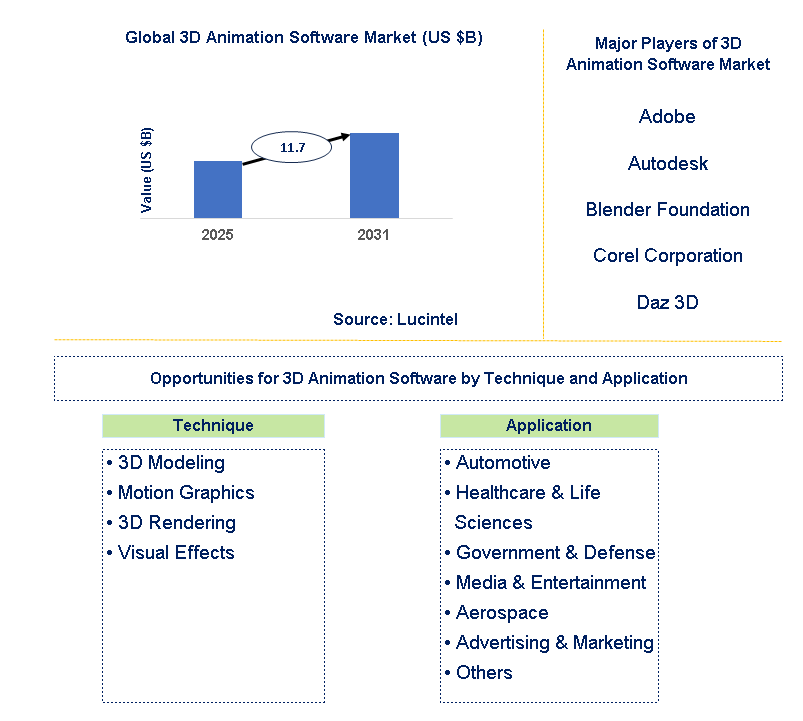
Key data points: The growth forecast = 11.7% annually for the next 7 years. Scroll below to get more insights. This market report covers trends, opportunities and forecasts in 3D animation software market to 2031 by technique (3D modeling, motion graphics, 3D rendering, and visual effects), application (automotive, healthcare & life sciences, government & defense, media & entertainment, aerospace, advertising & marketing, and others), and region (North America, Europe, Asia Pacific, and the Rest of the World)
We'll send your sample report shortly.
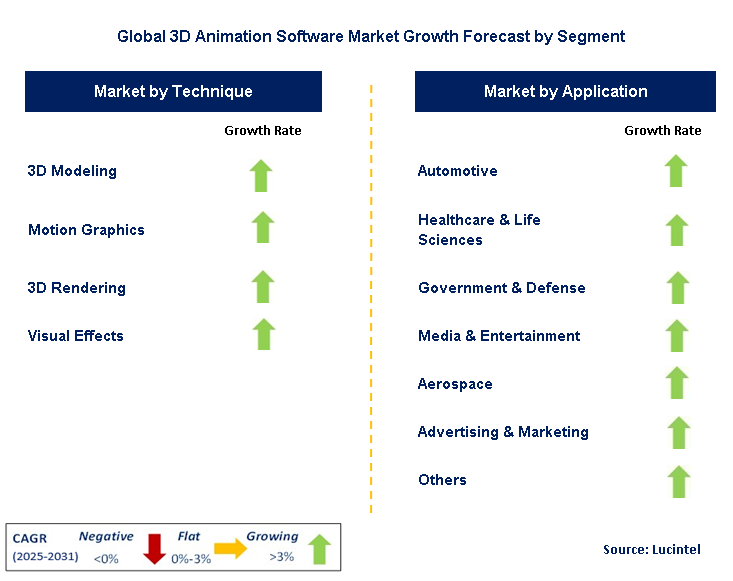
• Lucintel forecasts that, within the technique category, 3D modeling is expected to witness the highest growth over the forecast period.
• Within the application category, advertising & marketing is expected to witness the highest growth.
• In terms of region, North America is expected to witness the highest growth over the forecast period. Gain valuable insights for your business decisions with our comprehensive 150+ page report. Sample figures with some insights are shown below.
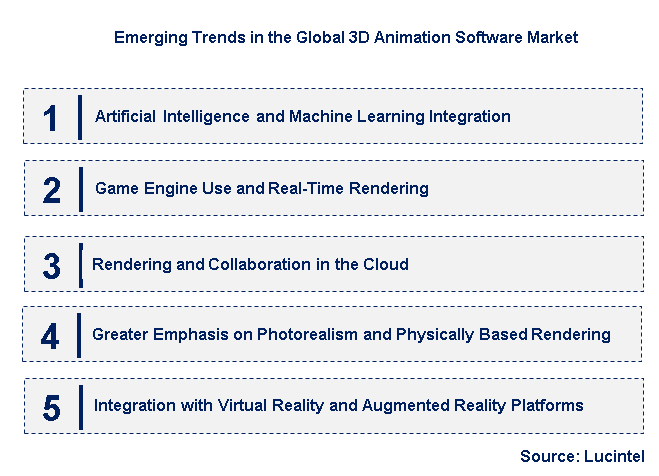
• Artificial Intelligence and Machine Learning Integration: AI and machine learning are being increasingly integrated into 3D animation software to make complex and time-consuming activities like motion capture clean-up, character rigging, facial animation, and even creating realistic textures automated. It simplifies workflows, saves production time, and enables animators to concentrate on creative work. The effect is a huge increase in efficiency and the capacity to attain greater realism with less human labor, making complex animation methods accessible to everyone.
• Game Engine Use and Real-Time Rendering: Usage of real-time rendering technologies and game engines such as Unreal Engine and Unity is picking up pace in the animation sector. These tools enable artists to receive instant feedback on their work without long rendering times, significantly reducing iteration cycles. The effect is quicker production pipelines, which allow virtual production workflows and interactive experiences. This trend allows for faster content creation for film, TV, games, and even architectural visualization, expanding creative possibilities.
• Rendering and Collaboration in the Cloud: Cloud computing is revolutionizing 3D animation workflows by allowing geographically separated teams to work together on projects and shifting computationally intensive rendering tasks to strong cloud servers. This minimizes the expenses of costly in-house equipment and maximizes scalability. The effect is improved productivity on the part of teams, minimized infrastructure costs, and accelerated rendering. This trend is friendly to remote work models and enables studios of every size to tap into high-end rendering prowess without committing massive capital upfront.
• Greater Emphasis on Photorealism and Physically Based Rendering: Rapid progress in rendering algorithms, including ray tracing and global illumination, combined with physically based rendering (PBR) workflows, is stretching the envelope of photorealism in 3D animation. This produces images that are nearly impossible to differentiate from live-action sequences. The effect is the need for software that will be able to effectively mimic lighting, shadows, and material properties, generating more immersive and realistic animated output for film, gaming, and architecture visualization.
• Integration with Virtual Reality and Augmented Reality Platforms: 3D animation tools are becoming increasingly integrated with VR and AR platforms, allowing creators to construct immersive spaces and interactive experiences directly within these platforms. This encompasses software for producing 3D content geared for extended reality (XR) uses and virtual production studios. The effect is a new frontier for virtual worlds such as the metaverse, interactive storytelling, and training simulations, making content creation software for these new immersive environments in high demand. These new trends are inherently redefining the 3D animation software industry by making animation more accessible, efficient, and competent to create increasingly realistic and interactive content. The marrying of AI, real-time pipelines, and cloud technologies is democratizing quality animation while speeding up production. This revolution is not merely extending creative possibilities but also broadening the use of 3D animation into new markets, guaranteeing its sustained growth and innovation in the digital content space.
• AI-driven automation in workflows: One of the biggest developments is the deeper embedding of artificial intelligence and machine learning algorithms into 3D animation software. This streamlines time-consuming processes such as character rigging, motion capture data cleaning, facial animation, and even procedural content creation. The effect is a dramatic decrease in production time and expenses, enabling animators to spend less time on technical drudgery and more time on creative fine-tuning. This brings difficult animation workflows to more users.
• Real-time rendering performance: The trend towards real-time rendering is having a deeply affecting influence on the market, enabling animators to witness instantaneous visual feedback for their changes without delayed rendering times. This is largely because of the improvements in game engines such as Unreal Engine and Unity, which today are extensively utilized in film and TV production. The effect is radically faster iteration cycles and greater creative freedom, facilitating virtual production environments and faster content delivery for different applications.
• Cloud collaboration and rendering solutions: Cloud computing adoption in 3D animation workflows is the major breakthrough. Cloud-based project management, asset libraries, and high-performance cloud rendering solutions with no on-premises render farms needed come into play. The effect is better collaboration between geographically separated teams and on-demand scalable rendering capability. This drops infrastructure costs, enhances workflow productivity, and brings high-end animation capability to small, medium, and large studios alike.
• More photorealism and physically based rendering (PBR): Software continues to improve to deliver greater photorealism through increasingly sophisticated rendering methods like ray tracing, global illumination, and complex physically based rendering pipelines. These developments mimic light and material behavior with microaccuracy. The result is the production of phenomenally real-looking images for movies, video games, and architectural visualizations, responding to the greater need for interactive and credible digital content from consumers and clients alike.
• Friendly interfaces and accessibility to newbies: Professional software continues to be sturdy, but there is increasing movement towards easier user interfaces and more intuitive tools for hobbyist animators, designers, and even everyday consumers. These involve drag-and-drop capabilities, pre-existing asset repositories, and AI-enabled creation tools. The effect is democratization of 3D animation, opening its usage beyond conventional studios and allowing the creation of content for social media, marketing, and education by a broad audience. These innovations are all converging to affect the 3D animation software market by speeding up production cycles, improving visual fidelity, and expanding accessibility. The convergence of AI and cloud technologies is revolutionizing workflows, while user-friendly interfaces and real-time rendering are empowering more creatives. All this is turning 3D animation into an ever-more versatile and powerful tool in many industries and fueling market growth and ongoing innovation in content creation.
• Construction and architectural visualization: 3D animation has a vast scope for producing realistic architectural walkthroughs, urban planning simulations, and rich building information modeling (BIM) visualizations. This enables architects, developers, and clients to visualize a project prior to construction. The potential is to offer special features for rendering materials, lighting, and environmental effects so that virtual tours provide greater client presentation, efficient design processes, and reduced expensive revisions during real-world construction.
• Medical and health training: 3D animation is transforming medical education, surgical planning, and patient comprehension with highly accurate anatomical models, simulations of intricate procedures, and visualizations of biological systems. The opportunity is creating software tools to accurately create interactive medical animations for training surgeons, teaching medical students, and educating patients, improving learning outcomes and communications in the healthcare industry.
• Product design, prototyping, and manufacturing: Product development industries are increasingly leveraging 3D animation software for conceptual design, virtual prototyping, and process simulation of manufacturing. This enables companies to virtually visualize, test, and iterate on products before actual production. The opportunity is to provide high-performance modeling, rendering, and simulation features that speed up product development workflows, lower the cost of prototyping, and support faster time to market for new products by streamlining design and manufacturing workflows.
• E-learning and educational content development: 3D animation enriches online learning by converting intricate ideas into appealing, interactive, and simple-to-grasp visual content. It applies to all levels of education, from K-12 to college and corporate training. The opportunity lies in creating software that’s easy for teachers to develop animated tutorial lessons, science simulations, and history reconstruction, resulting in greater student engagement, improved information retention, and more effective training programs.
• Advertising, marketing, and e-commerce: 3D animation is emerging as a force to be reckoned with in creating engaging advertisements, product demonstrations, and interactive marketing campaigns that cut through a noisy digital environment. It allows brands to display products in interactive and variable formats. The prospect is to offer software that facilitates high-quality rendering for TV commercials, interactive 3D product configurators on websites, and augmented reality experiences for virtual try-ons, making consumers more engaged and boosting sales. These strategic growth prospects are deeply affecting the 3D animation software market by broadening its revenue streams and user base beyond conventional entertainment. By customizing software features to address the unique demands of these diverse applications, developers are opening new markets and proving the irreplaceable significance of 3D animation in communication, education, and innovation throughout global industries. This expands the market’s reach and guarantees its ongoing rapid expansion.
• Adobe
• Autodesk
• Blender Foundation
• Corel Corporation
• Daz 3D
• Foundry Visionmongers
• MAXON Computer
• NewTek
• NVIDIA Corporation
• Pixar Animation Studios
• 3D Modeling
• Motion Graphics
• 3D Rendering
• Visual Effects
• Automotive
• Healthcare & Life Sciences
• Government & Defense
• Media & Entertainment
• Aerospace
• Advertising & Marketing
• Others
• North America
• Europe
• Asia Pacific
• The Rest of the World
• United States: The 3D animation market in the United States is witnessing high growth, led by the strong entertainment and gaming sectors. Large corporations such as Disney and Warner Bros are investing aggressively in cutting-edge 3D animation technologies. There is an emphasis on embedding artificial intelligence and machine learning capabilities into automated tools such as motion capture and rigging, making workflows more efficient. The growth of virtual reality and augmented reality technologies also plays a major role in the demand for advanced 3D animation tools, creating constant innovation from software firms such as Autodesk and Adobe.
• China: China’s 3D animation industry is expanding fast, fueled by significant growth in its growing film, TV, and gaming industries. The nation is investing in domestic animation companies and riding the wave of technological breakthroughs in artificial intelligence and virtual reality to bolster visual effects and post-production capabilities. Video streaming services such as Tencent Video and iQiyi are driving demand for premium animation content, and this translates into growing use of advanced 3D animation software and emphasis on the uniqueness of content and intellectual property rights.
• Germany: The market for 3D animation in Germany is dominated by a very high priority for architectural visualization, engineering and manufacturing, and media and entertainment. These industries are demanding increasing amounts of high-quality visual content. Software suppliers are concentrating on tools that provide greater realism, streamlined workflows, and integration with other design applications. German firms are also looking into how 3D animation can be applied to marketing to produce compelling and engaging experiences that appeal to an advanced consumer base.
• India: India’s 3D animation industry is witnessing a huge growth on account of its growing media and entertainment industry, coupled with rising demand from architectural, manufacturing, and educational markets. The nation is also witnessing growth in the use of 3D modeling and visual effects for movies, television, and video games. There is an emphasis on nurturing local expertise and using cost-efficient solutions. Educational projects such as the Maya Academy of Advanced Cinematics are also helping to fuel the development and availability of 3D animation technology.
• Japan: Japan’s market for 3D animation is strong, especially in anime, video games, and visual effects. There is always a need for powerful software to support complex character animation and rich environments. Advances have included a focus on improving rendering capabilities and incorporating new technologies to make production pipelines for high-quality content more efficient. Japanese studios are interested in using advanced tools to continue leading the world in visually rich animated content, such as for virtual reality experiences.


• Adobe
• Autodesk
• Blender Foundation
• Corel Corporation
• Daz 3D
• Foundry Visionmongers
• MAXON Computer
• NewTek
• NVIDIA Corporation
• Pixar Animation Studios Q5. Which 3D animation software market segment will be the largest in future? Answer: Lucintel forecasts that, within the technique category, 3D modeling is expected to witness the highest growth over the forecast period. Q6. In 3D animation software market, which region is expected to be the largest in next 5 years? Answer: In terms of region, North America is expected to witness the highest growth over the forecast period. Q7. Do we receive customization in this report? Answer: Yes, Lucintel provides 10% customization without any additional cost.


Choose a license that fits your team. Instant PDF delivery.
Prices exclude taxes. Instant delivery. Custom licensing available on request.
Market Report · July 15, 2026
Market Report · June 26, 2026
Market Report · June 24, 2026
Trusted partner for strategic intelligence and business growth


Receive a complimentary market analysis tailored to your industry. Our analysts will identify key growth opportunities and competitive dynamics specific to your business.

Market size, growth rate, and key trend analysis for your specific sector.

Top competitor positioning and market share analysis.

Strategic recommendations backed by data-driven insights.
Get curated market intelligence and competitive moves straight to your inbox.
By subscribing, you agree to receive our monthly insights. Unsubscribe anytime.
Receive a complimentary market analysis tailored to your industry. Our analysts will identify key growth opportunities and competitive dynamics specific to your business.
Market size, growth rate, and key trend analysis for your specific sector.
Top competitor positioning and market share analysis.
Strategic recommendations backed by data-driven insights.
Get curated market intelligence, emerging trends, and competitive moves straight to your inbox each month.
By subscribing, you agree to receive our monthly insights. Unsubscribe anytime.
We'll send your sample report shortly.