
Market Report · July 24, 2026

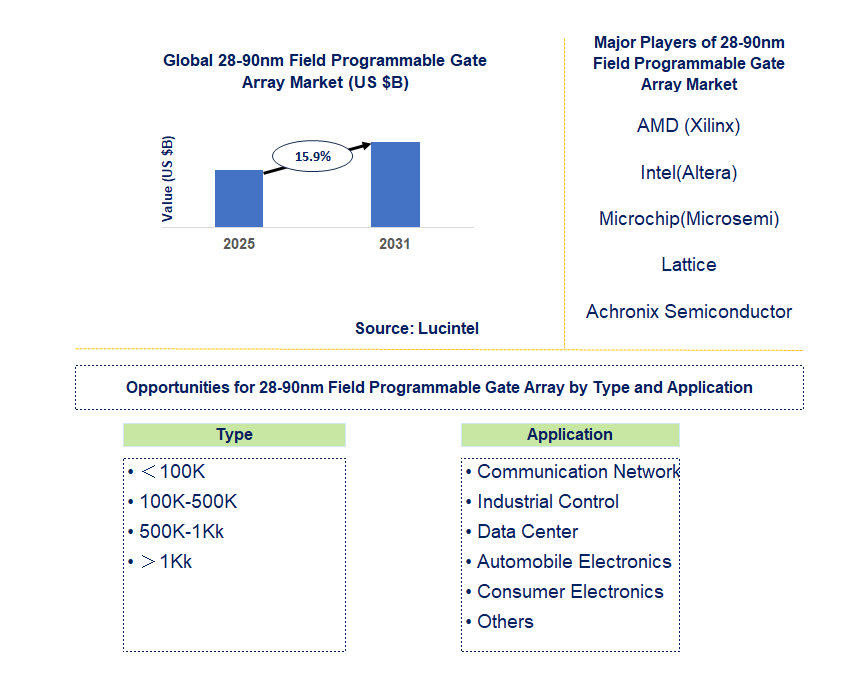
Key data points: The growth forecast = 15.9% annually for the next 7 years. Scroll below to get more insights. This market report covers Trends, opportunities and forecasts in 28-90nm field programmable gate array market to 2031 by type (<100k, 100k-500k, 500k-1kk, and >1kk), application (communication network, industrial control, data center, automobile electronics, consumer electronics, and others), and region (North America, Europe, Asia Pacific, and the Rest of the World)
We'll send your sample report shortly.
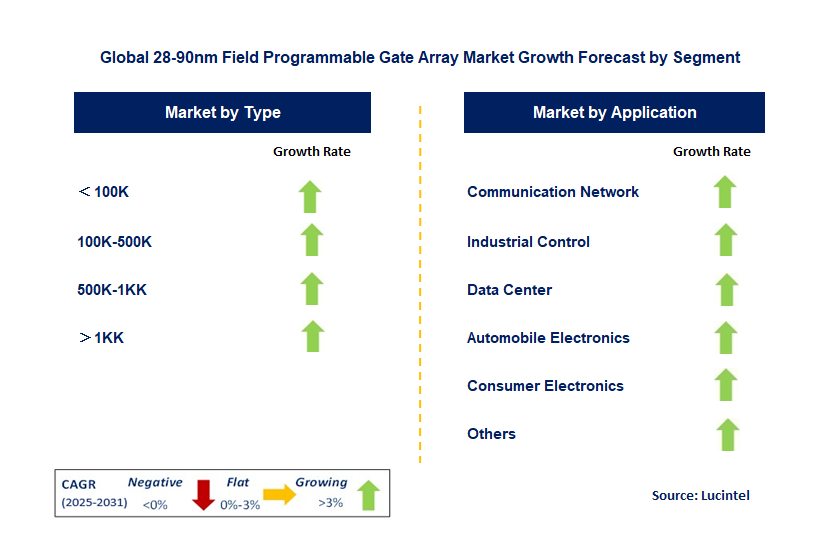
• Lucintel forecasts that, within the type category, 500k-1kk is expected to witness higher growth over the forecast period.
• Within the application category, automobile electronics is expected to witness the highest growth.
• In terms of region, APAC is expected to witness the highest growth over the forecast period due to increasing demand in electronics and automotive sector.
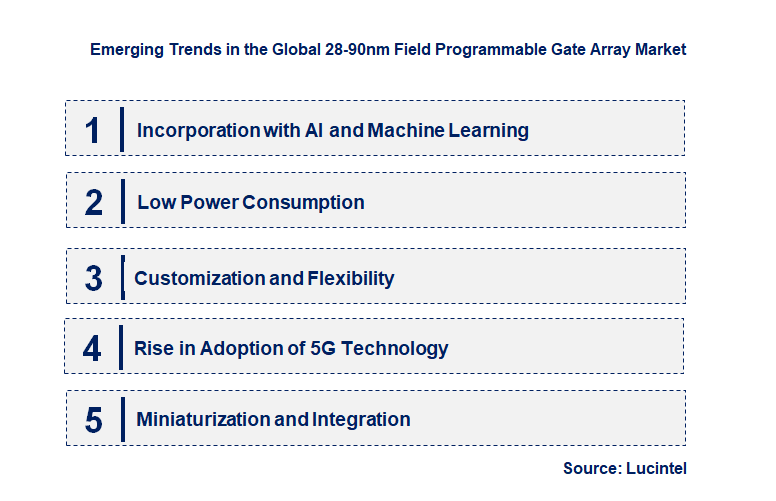
• Incorporation with AI and Machine Learning: 28-90nm FPGAs are being more incorporated with AI and machine learning solutions. They provide high-speed data processing, which is essential for AI-based applications in sectors like telecommunications, healthcare, and automotive. Their parallel processing capabilities are enhancing real-time predictions and decision-making of AI models.
• Low Power Consumption: Power efficiency is gaining prominence as FPGAs are being used in energy-conscious applications. Companies are concentrating on developing 28-90nm FPGAs with low power consumption and high performance. This trend is particularly significant for the automotive and telecommunications sectors, where energy efficiency is essential for long-term viability.
• Customization and Flexibility: There is an increasing need for customized solutions, with 28-90nm FPGAs providing more flexibility. FPGAs can be designed to suit the requirements of particular applications, including high data throughput or improved signal processing. Customized FPGAs are used more and more in applications such as IoT, communications, and consumer electronics.
• Rise in Adoption of 5G Technology: With the worldwide deployment of 5G technology, the demand for 28-90nm FPGAs to handle the higher data rates and low latency needed for 5G applications is increasing. FPGAs are employed in base stations, routers, and edge devices and are essential to improve communication performance.
• Miniaturization and Integration: As companies need devices to be more powerful but smaller, 28-90nm FPGAs are being progressively miniaturized. Integration continues to advance in enabling greater functionality with smaller chip sizes, and thus applications within small systems such as wearables, automotive electronics, and IoT. The trends are remodeling the market in a way that presents more adaptable, efficient, and specialized solutions to the escalating need in markets that need custom and powerful computing.
• Increased Power Efficiency: One of the key advancements in the market is increased power efficiency. Companies are concentrating on creating FPGAs that can work with less power consumption without losing speed. This ensures 28-90nm FPGAs are the best for battery-operated products, increasing their applications in mobile devices.
• Improvement in FPGA Manufacturing: The introduction of sophisticated FPGA manufacturing methods has enabled the production of more efficient 28-90nm chips. These FPGAs can now handle increased logic functions, speed, and more high-bandwidth application capability. This is making it possible to have more advanced designs in consumer electronics and industrial automation.
• AI-Optimized FPGAs: An important trend is the creation of AI-optimized and machine learning-optimized FPGAs that are able to handle AI algorithms more efficiently with support for evolution in automated systems, robotics, and real-time analytics. These FPGAs are particularly good at handling data processing at very large scales thanks to their capabilities in parallel processing.
• Expansion into Edge Computing: 28-90nm FPGAs are increasingly deployed in edge computing systems. This trend supports processing data at or near the source, thereby decreasing latency and bandwidth needs. Applications of edge computing in verticals such as IoT, autonomous systems, and healthcare are all leveraging these high-performance FPGA chips.
• 5G Solution Integration: The installation of 5G networks has created demand for the custom 28-90nm FPGAs. The chips are being deployed in routers and base stations to support the 5G‘s high data rate and low latency needs. The flexibility to accommodate new communication protocols is rendering the 28-90nm FPGAs a requirement for the telecom sector. These trends point to the fact that 28-90nm FPGAs are gaining in power, efficiency, and programmability with huge ramifications across telecommunication, automotive, and industrial automation sectors.
• Telecommunications: Telecommunication is one of the most significant growth prospects for 28-90nm FPGAs. FPGAs play a significant role in facilitating high-speed data transmission and low latency in 5G networks. With the growing demand for 5G technology in the world, specialized FPGAs in telecom infrastructure will see a dramatic increase in demand.
• Automotive: The automotive sector is another key use for 28-90nm FPGAs, particularly with the growth of advanced driver-assistance systems (ADAS) and autonomous cars. FPGAs provide the flexibility and capability to handle high amounts of sensor data in real-time, enabling the creation of safer and more efficient vehicles.
• Consumer Electronics: With the increasing popularity of wearable devices, smart TVs, and other consumer electronics, 28-90nm FPGAs are highly placed to fuel innovation in this area. Their small size and power efficiency are critical to address the size and energy needs of contemporary consumer products.
• Industrial Automation: Industrial automation is increasingly depending on FPGA-based systems in robotics, factory automation, and real-time monitoring. 28-90nm FPGAs provide fast data processing and control system flexibility, which are most suitable for increasing manufacturing efficiency and accuracy.
• Medical and Healthcare: Medical devices provide an opportunity for 28-90nm FPGAs to grow, especially within medical devices requiring high-performance compute for imaging, diagnostics, and monitoring. Its capability to deal with complex data in an efficient and power-free manner is inspiring the use of FPGAs in medical procedures. These opportunity areas highlight the widening scope for applications of 28-90nm FPGAs, leading them to play a key part in the industry‘s future for many industries.
• AMD (Xilinx)
• Intel(Altera)
• Microchip(Microsemi)
• Lattice
• Achronix Semiconductor
• <100k
• 100k-500k
• 500k-1kk
• >1kk
• Communication Network
• Industrial Control
• Data Center
• Automobile Electronics
• Consumer Electronics
• Others
• North America
• Europe
• Asia Pacific
• The Rest of the World
• United States: America is experiencing phenomenal growth in the 28-90nm FPGA market, driven by greater applications in telecommunications, automotive, and defense. Key players in the U.S. are heavily investing in enhancing the performance of FPGA and minimizing power consumption, facilitating greater integration with AI and machine learning technologies. The market continues to expand with these FPGAs offering configurable solutions for varying applications.
• China: The growth in demand for 28-90nm FPGAs is picking up speed in China as the nation prioritizes innovation in the telecommunication and electronics industries. Chinese vendors are enhancing FPGA design, improving speed, and endorsing new standards in mobile communication and IoT use cases. With continuous government efforts to increase high-tech production, the nation is emerging as a central player in the FPGA market.
• Germany: Germany‘s industrial and automotive industries are spearheading the need for 28-90nm FPGAs. Focusing on high-performance computing applications like advanced driver-assistance systems (ADAS) and automation, German manufacturers are embedding FPGAs into leading-edge technology. Power efficiency and reliability improvements are also key to the increasing market in these industries.
• India: Demand for 28-90nm FPGAs in India is being boosted by increasing interest in smart cities, telecommunication, and industrial automation. Local companies are shifting focus toward building cost-effective but effective FPGA solutions for domestic uses. Such improvements in FPGA technology are backing India‘s thrust into technological advancement and digital transformation.
• Japan: Japan is at the forefront of 28-90nm FPGAs development for automotive and consumer electronics. With growing demand for high-performance computing and low-power applications, Japan‘s companies are emphasizing delivering FPGAs that enable sophisticated design and integration. Additionally, Japanese firms are developing the technology to enable automotive autonomous systems and IoT infrastructure.


• AMD (Xilinx)
• Intel(Altera)
• Microchip(Microsemi)
• Lattice
• Achronix Semiconductor Q5. Which 28-90nm field programmable gate array market segment will be the largest in future? Answer: Lucintel forecasts that, within the type category, 500k-1kk is expected to witness higher growth over the forecast period. Q6. In 28-90nm field programmable gate array market, which region is expected to be the largest in next 5 years? Answer: In terms of region, APAC is expected to witness the highest growth over the forecast period due to increasing demand in electronics and automotive sector. Q7. Do we receive customization in this report? Answer: Yes, Lucintel provides 10% customization without any additional cost.


Choose a license that fits your team. Instant PDF delivery.
Prices exclude taxes. Instant delivery. Custom licensing available on request.
Market Report · July 24, 2026
Market Report · July 20, 2026
Market Report · July 20, 2026
Trusted partner for strategic intelligence and business growth


Receive a complimentary market analysis tailored to your industry. Our analysts will identify key growth opportunities and competitive dynamics specific to your business.

Market size, growth rate, and key trend analysis for your specific sector.

Top competitor positioning and market share analysis.

Strategic recommendations backed by data-driven insights.
Get curated market intelligence and competitive moves straight to your inbox.
By subscribing, you agree to receive our monthly insights. Unsubscribe anytime.
Receive a complimentary market analysis tailored to your industry. Our analysts will identify key growth opportunities and competitive dynamics specific to your business.
Market size, growth rate, and key trend analysis for your specific sector.
Top competitor positioning and market share analysis.
Strategic recommendations backed by data-driven insights.
Get curated market intelligence, emerging trends, and competitive moves straight to your inbox each month.
By subscribing, you agree to receive our monthly insights. Unsubscribe anytime.
We'll send your sample report shortly.