
Market Report · July 29, 2026

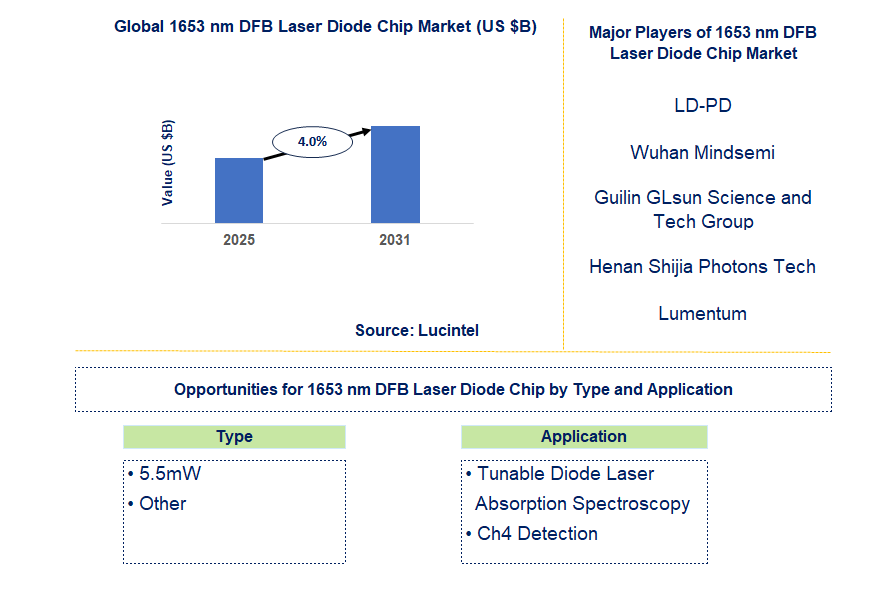
Key data points: The growth forecast = 4.0% annually for the next 7 years. Scroll below to get more insights. This market report covers Trends, opportunity and forecast in 1653 nm DFB laser diode chip market to 2031 by type (5.5mw and other), application (tunable diode laser absorption spectroscopy and ch4 detection), and region (North America, Europe, Asia Pacific, and the Rest of the World)
We'll send your sample report shortly.
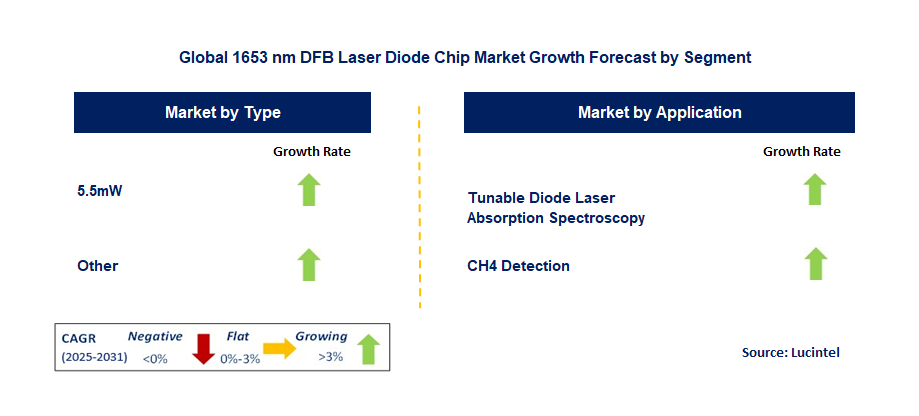
• Lucintel forecasts that, within the type category, 5.5mw is expected to witness higher growth over the forecast period due to it is a specific power value.
• Within the application category, tunable diode laser absorption spectroscopy is expected to witness the highest growth due to it is a broader analytical technique, while ch4 detection is a specific application of that technique.
• In terms of region, APAC is expected to witness the highest growth over the forecast period due to its strong manufacturing base, advanced telecom infrastructure, and high demand for optical communication components. Gain valuable insights for your business decisions with our comprehensive 150+ page report. Sample figures with some insights are shown below.
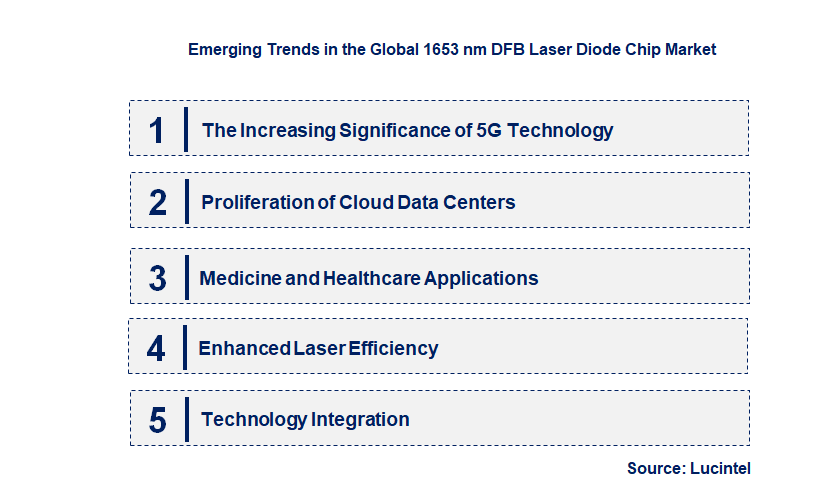
• The Increasing Significance of 5G Technology: The demand and fiber based networks increase the need for new laser technologies that would include components such as 1653 nm DFB laser diodes. This is required for building new long distance optical communication devices that will help greatly in optimizing the networks and speeding up the transfer rates. Global investments in the rollout of 5G networks will likely be among the largest market drivers in the near future, requiring more efficient and lower-cost laser diode options.
• Proliferation of Cloud Data Centers: In all sectors, cloud services and digital businesses are transforming the conventional structure, and as a result, there is an accelerating pace for the economy and global interconnectedness. This goes along with the rapid growth of cloud-based services that are also fueling the growth of cyber infrastructures, which will be in great demand for communications technologies that will need to be low latency, fast and meet the increased demands. 1653 nm DFB laser diode chips have played a key role as part of high-speed data-transmitting optical transceivers. This has been driving markets that require tremendous amounts of data to be transmitted efficiently.
• Medicine and Healthcare Applications: The 1653 nm DFB laser diodes are used in medical imaging endoscopy and Optical Coherence Tomography OCT in the medical field because of their efficiency and accuracy. There is a tremendous growth in the demand for high performance lasers in medicine because of their increased precision and reliability. With growing worldwide need for advanced healthcare technology, such regions are anticipated to invest major resources in military technology which would drive a huge demand for high-performance lasers.
• Enhanced Laser Efficiency: New innovations and advanced research are focusing on both the performance as well as energy efficiency of the 1653 nm DFB laser diodes. Manufacturers are employing new material, containers, and construction methods for microelectronics to increase the life span of devices as well as reduce energy use. In addition, these developments result in higher performance and low cost, hence making the chips more price competitive in different markets.
• Technology Integration: The increased integration of autonomous vehicles and industrial automation with the laser diode chips has been observed, which has opened new avenues for the 1653 nm DFB laser diode chip markets. The demand for laser diodes is increasing due to the increased reliance on automation in industries that use sensors and fast communication networks, and there is a need for precise and energy-efficient laser diodes. There is sufficient room for broadening the base of applications of the market for the 1653 nm DFB laser diode chip, owing to its integration. The trends discussed above have shown that industries such as telecommunications, medical services, and autonomous technologies have an increased need for 1653 nm DFB laser diode chips. In any case, corporations investing in next-gen technologies will also result in the increase in demand and growth of this market.
• Advances in Integration of 5G Technology: The recent advances in 5G technology have revolutionized the 1653 nm DFB laser diode chip market. Telecom companies are racing to complete their 5G rollouts at a breakneck pace, thus increasing demand for high-speed and low-latency communication solutions. 1653 nm DFB laser diodes hold a significant role in optical fibre networks, aiding in efficient transfer of data along long distances. These diodes are crucial as they help ensure the high-bandwidth requirements within 5G infrastructure, thus guaranteeing faster, more reliable forms of communication systems. The heavy investment in the 5G infrastructure has in turn increased the requirement for advanced diodes, contributing to the advancement of the 1653 nm DFB laser diode market.
• Enhanced Medical Imaging Systems with Laser Diodes: Advances have been witnessed in the medical field in the health sector, wherein 1653 nm DFB laser diodes are used to enhance medical imaging technologies. High precision and clear imaging in the non-invasive diagnostic procedures has been provided with the integration of these diodes into Optical Coherence Tomography and endoscopy systems. They enable high-speed detailed imaging, and hence they have a potential in improving the diagnosis of ophthalmological and cardiological diseases. The increasing demand for minimally invasive procedures and advanced imaging technologies is accelerating the adoption of 1653 nm DFB lasers, thereby expanding their market presence in healthcare applications.
• Improvement in Data Center and Cloud Computing Applications: The increased reliance on cloud computing and digital services has led to major developments in the use of 1653 nm DFB laser diodes in data centers. These laser diodes are very crucial in high-speed optical communication systems that facilitate faster and more efficient data transmission. In a bid to cater to the increased demand for faster data processing and storage, data centers are heavily investing in 1653 nm DFB laser diode technology to meet the high-bandwidth needs of modern cloud infrastructure. The market for laser diode chips is growing due to the adoption of 1653 nm DFB lasers in these applications.
• Technology Advancements in Manufacturing Process: Manufacturers have always been innovating to make the production process of 1653 nm DFB laser diodes more efficient and cost-effective. The advancements in manufacturing processes, such as the use of new materials and advanced fabrication techniques, have improved the performance and durability of these diodes. With the advancements in manufacturing, the production costs have also reduced. As a result, 1653 nm DFB lasers become relatively cheaper and available for use by a wide array of industries. These improvements not only make the market more competitive but also enhance the use of laser diodes in applications requiring precision and reliability.
• Increasing Application in Automotive and Autonomous Vehicles: The automotive industry has emerged as a new business leader in the 1653 nm DFB laser diode chip market, with growing demand for autonomous vehicles. LiDAR systems, which depend on laser diodes, are essential in enabling vehicles to detect and navigate their surrounding environment. With this direction by the automotive industry toward autonomous driving technologies, the need for precise, reliable laser diodes increases. The development of 1653 nm DFB laser diodes for automotive applications is paving the way for safer and more efficient self-driving systems, further driving the expansion of the market in this sector. Recent developments in the global 1653 nm DFB laser diode chip market reflect the increasing demand for high-performance, cost-effective solutions across multiple sectors. Some key influences on growth are advancements in 5G technology, applications in medical imaging, data centers, manufacturing, and automotive technology. These areas of development create scope for ever-expanding 1653 nm DFB laser diode application space while challenging industries to move further ahead of each other and into new spaces of innovation. As these trends continue, the 1653 nm DFB laser diode market is expected to expand further, opening new avenues for growth and technological development in different sectors.
• Telecommunications and 5G Networks: The proliferation of 5G networks presents new possibilities for the 1653 nm DFB laser diode chip market. Laser diodes are essential as they facilitate increased volumes of data transfer and enhanced network performance which are requirements for 5G systems. There is potential for companies in optical communication technologies and its components to exploit this market growth opportunity.
• Healthcare and Medical Imaging: The laser diodes find their applications in the medical imaging system such as OCT and endoscopy. Due to the need for better diagnostic tools in the globe, these have a good opportunity for growth. Again, the competition in the market for medical devices is so high that only devices with good precision and reliability survive.
• Industrial Automation and Sensors: Technologies of automation are taking roots which includes robotics, smart factories, and more. The deployment of 1653 nm DFB laser diodes in sensors, measurement systems, and communication technologies is a boom to growth opportunities in these environments. And with the transition to automated systems across industries, the performance requirements for laser diode chips will also rise.
• Data Centers and Cloud Computing: The growth in data centers and cloud computing is leading to an increased demand for 1653 nm DFB laser diode chips. Their high-speed data transmission and ability to minimize lag in cloud services have led to an increased demand for these chips, making them an essential component of the expanding data center industry.
• Automotive: The development inside the automotive towards autonomous vehicles is giving way to a new opportunity in 1653 nm DFB laser diodes. This upsurges the demand for laser diodes in the automotive sector due to the chips used in LiDAR sensors and other technologies used in the self-driving industry. If it keeps at this pace, the impact of laser diodes is likely to become very high for the entire automotive market. The main sectors that are at the forefront of the expansion of the 1653 nm DFB laser diode chip market are the telecommunications, healthcare, industrial automation, data centers, and automotive industries. There is prima facie growth potential across a variety of application areas including laser diodes across all these sectors. Because of the ambition of these industry players to provide more up-to-date and trustworthy laser solutions, the market for these laser diodes is expected to grow rapidly.
• LD-PD
• Wuhan Mindsemi
• Guilin GLsun Science and Tech Group
• Henan Shijia Photons Tech
• Lumentum
• 5.5mW
• Other
• Tunable Diode Laser Absorption Spectroscopy
• Ch4 Detection
• North America
• Europe
• Asia Pacific
• The Rest of the World
• United States: The market for 1653 nm DFB laser diode chips in the United States has begun to grow as sectors such as telecommunication and optical communication systems initiate progression with the help of aeronautical technologies. In addition, the 1653 nm DFB laser diode is also seeing a surge in usage within the healthcare sector, specifically medical imaging systems. Major players in the industry are keen on improving chip efficiency and cutting down on the manufacturing costs which in turn would allow for more widespread integration of this technology into common everyday products. Such innovations will be boosted by private and public sector research and development investment as well as by initiatives searching for accelerations on the advances of laser technologies, all which will contribute toward the USA being one of the major driving forces of the growth of the 1653 nm DFB laser diode market.
• China: China is expanding the manufacturing of its 1653 nm DFB laser diode chip due to its ability to produce it in large quantity and also as it is very keenly searching for Next Generation Communication Systems. The nation is heavily developing high-speed internet networks which itself states the necessity for long distance data transfer through laser diode chips.". China also looks for bringing technology relating to lasers that would accompany electronics and the industrial sector. Local vendors focus on enhancing chip performance and integration inside data centers, communication networks, and autonomous technologies that, in turn, would trigger demand for high-power 1653 nm lasers."
• Germany: Germany has emerged as a centre of excellence for the research and development activities in the 1653 nm DFB laser diode chip market especially in the automotive and the industrial automation fields. German manufacturers are currently developing new ideas that will improve the efficiency and precision of laser diodes which are currently used in sensors, systems for a variety of manufacturing processes and high technology diagnostics. In this particular segment- Germany’s engineering and manufacturing foundation is consolidated with the high demand in the industrial and medical sectors for lasers enabling further expansion. Moreover, Germany is focusing on quantum technologies that involve laser diodes substantially.
• India: With an increased need to enhance the telecom infrastructure and an introduction of the concept of Digital India, India is becoming an important competitor in the international market for 1653 nm DFB laser diode chip. Increased investments in data centres and cloud services are raising demand for high-performing laser diode chips. The Indian government has encouraged local companies hence lowering the production cost and increasing the supply by encouraging the local manufacturers. Moreover, the expansion in healthcare, electronics and other industries are opening new market opportunities for laser diodes in medical and consumer products.
• Japan: The constantly expanding mobile fabrication market in Japan and focus on high-quality laser diodes in advanced telecommunications equipment drives growth for the 1653nm DFB laser diode chips. Japan’s businesses are focusing on maximizing laser diode applications, improving chip quality, and reducing energy costs. The high-performance laser diodes are in demand for advanced sensors and communication systems which is critical for the high tech industries prevalent in the country including the automotive and robotics industries. Huge investments are being made in the F5 market and 1653 nm diodes are incorporated into the modem and act to enhance networks by transmitting and receiving data.


• LD-PD
• Wuhan Mindsemi
• Guilin GLsun Science and Tech Group
• Henan Shijia Photons Tech
• Lumentum Q5. Which 1653 nm DFB laser diode chip market segment will be the largest in future? Answer: Lucintel forecasts that 5.5mw is expected to witness higher growth over the forecast period due to it is a specific power value. Q6. In 1653 nm DFB laser diode chip market, which region is expected to be the largest in next 5 years? Answer: APAC is expected to witness the highest growth over the forecast period due to its strong manufacturing base, advanced telecom infrastructure, and high demand for optical communication components. Q7. Do we receive customization in this report? Answer: Yes, Lucintel provides 10% customization without any additional cost.


Choose a license that fits your team. Instant PDF delivery.
Prices exclude taxes. Instant delivery. Custom licensing available on request.
Market Report · July 29, 2026
Market Report · July 20, 2026
Market Report · July 20, 2026
Trusted partner for strategic intelligence and business growth


Receive a complimentary market analysis tailored to your industry. Our analysts will identify key growth opportunities and competitive dynamics specific to your business.

Market size, growth rate, and key trend analysis for your specific sector.

Top competitor positioning and market share analysis.

Strategic recommendations backed by data-driven insights.
Get curated market intelligence and competitive moves straight to your inbox.
By subscribing, you agree to receive our monthly insights. Unsubscribe anytime.
Receive a complimentary market analysis tailored to your industry. Our analysts will identify key growth opportunities and competitive dynamics specific to your business.
Market size, growth rate, and key trend analysis for your specific sector.
Top competitor positioning and market share analysis.
Strategic recommendations backed by data-driven insights.
Get curated market intelligence, emerging trends, and competitive moves straight to your inbox each month.
By subscribing, you agree to receive our monthly insights. Unsubscribe anytime.
We'll send your sample report shortly.